
This post may contain affiliate links. If you buy through links on this page, we may earn a commission at no extra cost to you.
As an Amazon Associate I earn from qualifying purchases.
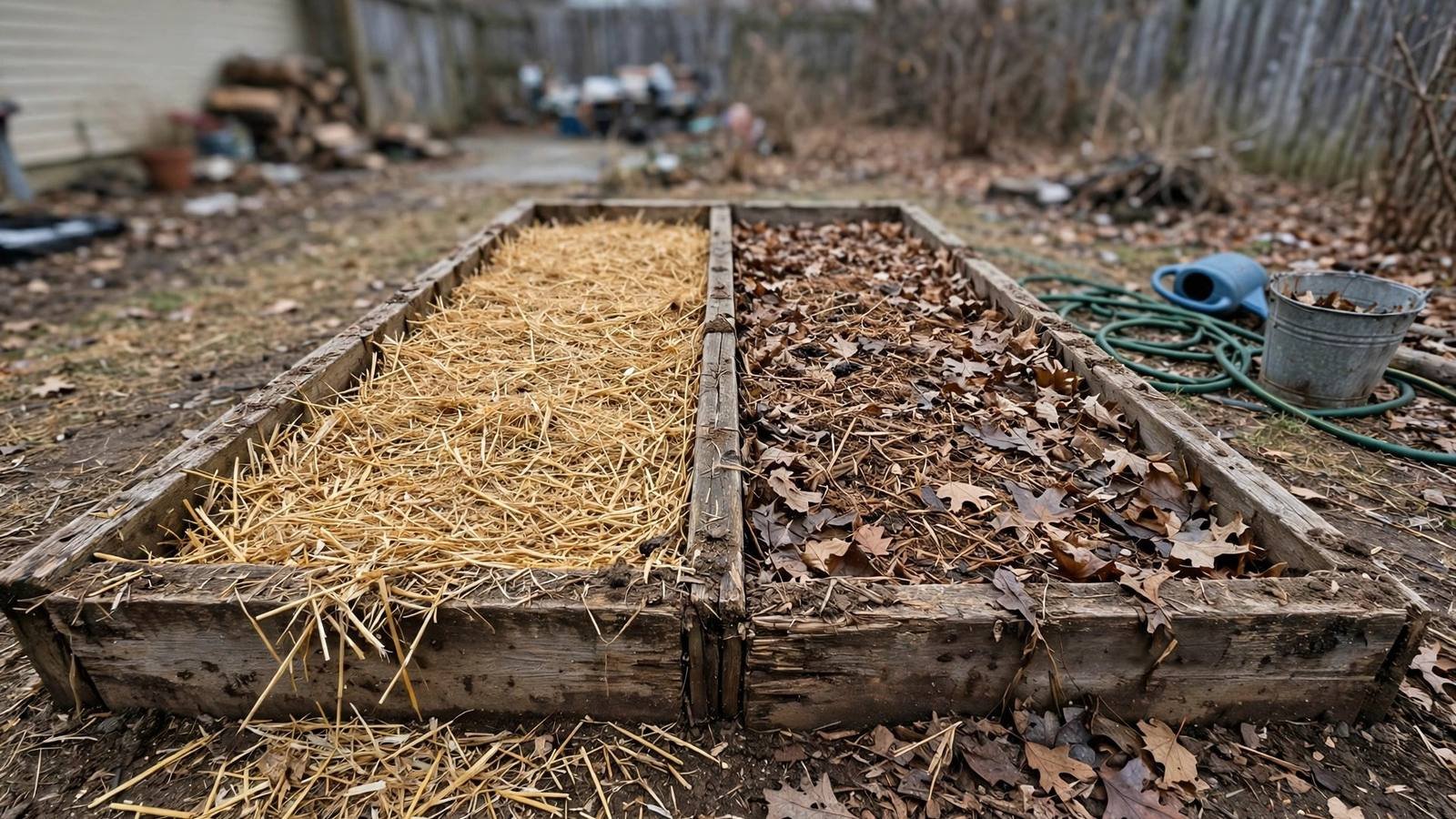
A winter mulch does three jobs at once. It holds soil moisture through dry spells, keeps soil temperature steady through freeze and thaw, and blocks weeds from sprouting in the first warm weeks of spring. Straw and shredded leaves both do those jobs, but they do them in different ways.
Straw is the dry stalks left after grain is harvested, sold in bales at garden centers and farm stands. Shredded leaves are the autumn leaves from your own yard, run through a mower or a shredder so they sit flat instead of matting into a wet sheet. This guide compares the two side by side, works out what each one costs for a single 4-by-8 bed, and looks at how each one behaves from the first frost to the spring cleanup. For the steps of putting winter mulch on perennial beds, see our guide on how to mulch perennials for winter.
Straw vs leaves as winter mulch at a glance
The table below gives the short version. The sections after it fill in the application steps, the cost math, and the timing.
| Trait | Straw | Shredded leaves |
|---|---|---|
| What it is | Dry grain stalks, sold in bales | Autumn leaves from your yard, shredded first |
| Cash cost for one 4-by-8 bed | About $8 to $12 for one small bale | $0 for the material itself |
| Time to apply | About 30 minutes | About 1.5 hours with shredding and hauling |
| Depth to apply | 4 to 6 inches | 3 to 4 inches shredded |
| Insulation | Good, holds its loft all winter | Good when shredded, poor when matted |
| Weed suppression | Strong if the straw is weed-free | Strong while the layer stays in place |
| Breakdown by spring | Slow, much of it is still there | Fast, much of it has rotted into the soil |
| Slug and pest shelter | Low when the straw stays dry | Higher, damp leaves shelter slugs |
| Availability | Buy it in fall, stock can run out | On hand every fall if you have trees |
| Spring cleanup | Pull it aside or compost it | Mostly gone, rake the rest aside |
Straw mulch: what it is and how to use it
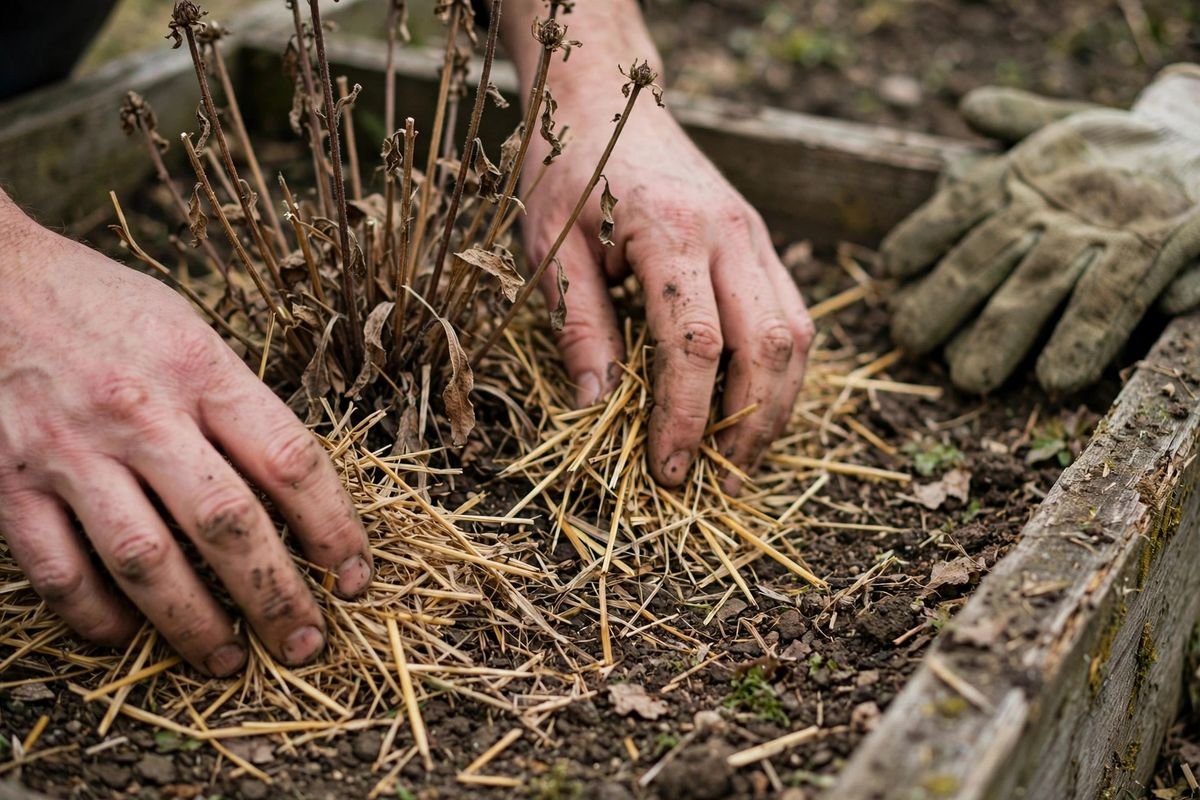
Straw is the stem of wheat, oats, barley, or a similar grain crop, cut and baled after the grain heads are harvested. It is light, hollow, and springy, which is why it traps air and insulates soil so well. A bale breaks apart into loose flakes that spread fast over a bed, and a single bale goes a long way. Buy straw that is sold as weed-free, and do not buy hay by mistake. Hay is cut grass with seed heads still in it, and a bale of hay can sow a whole crop of weeds into your beds.
Spread straw 4 to 6 inches deep over beds once the soil has started to freeze, and keep it a few inches away from plant crowns and stems so moisture does not sit against them. On windy sites, wet the straw lightly after spreading, or lay a few branches over it, so the top flakes do not blow into the paths. For the full perennial routine, see our guide on how to mulch perennials for winter.
If you need a bale and no farm stand is near, you can browse weed-free straw mulch on Amazon. We have not tested the products linked here, and we give no current store prices. Check each listing for current details before you buy.
Pros of straw mulch
- Holds its loft all winter, so insulation stays even after rain and snow.
- Light and fast to spread, about 30 minutes for a 4-by-8 bed.
- Breaks down slowly, so one application lasts the whole cold season.
- Stays dry on top, which gives slugs little damp shelter.
- Clean to handle, with no mud and no smell.
Cons of straw mulch
- Costs money, and the price climbs fast when you mulch many beds.
- Can blow around on windy sites until it settles and gets wet.
- Cheap straw can carry grain seed or weed seed, so buy weed-free.
- Adds little food for soil life compared with leaves, since it is mostly carbon.
- You have to fetch it, haul it, and store any bale you do not use.
Shredded leaves: what they are and how to use them
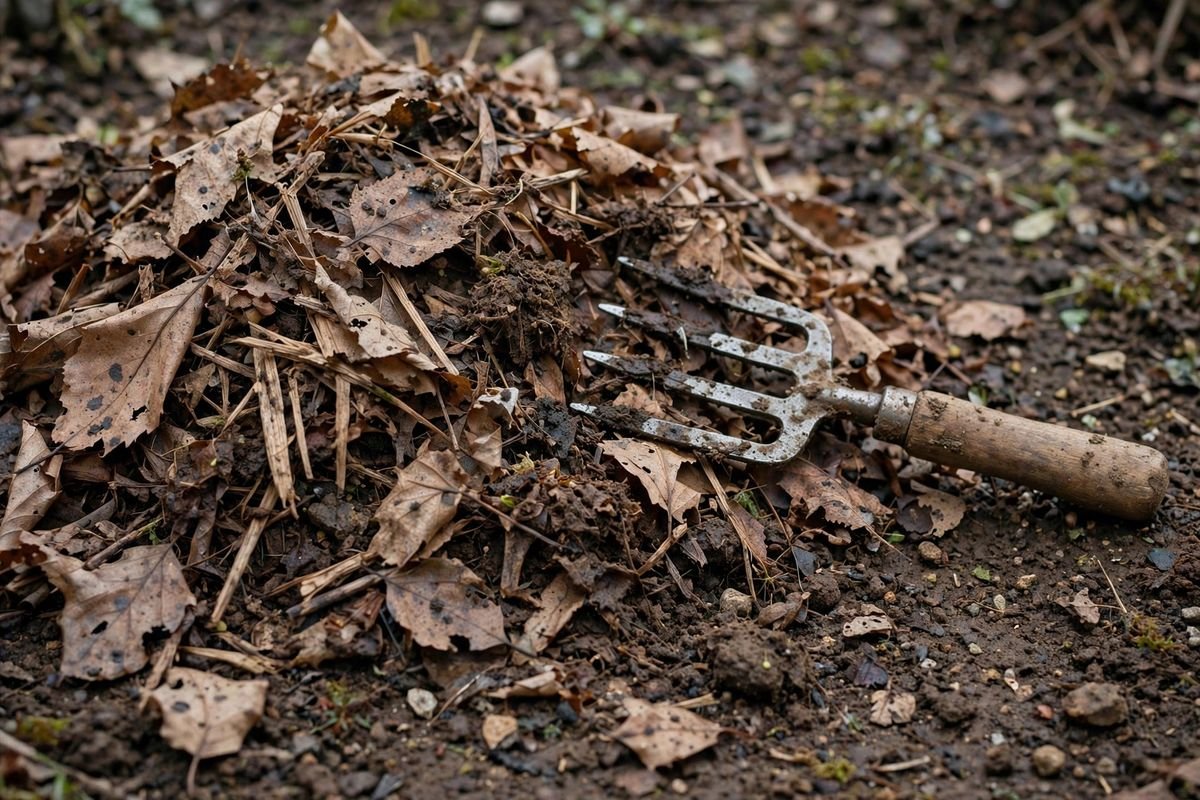
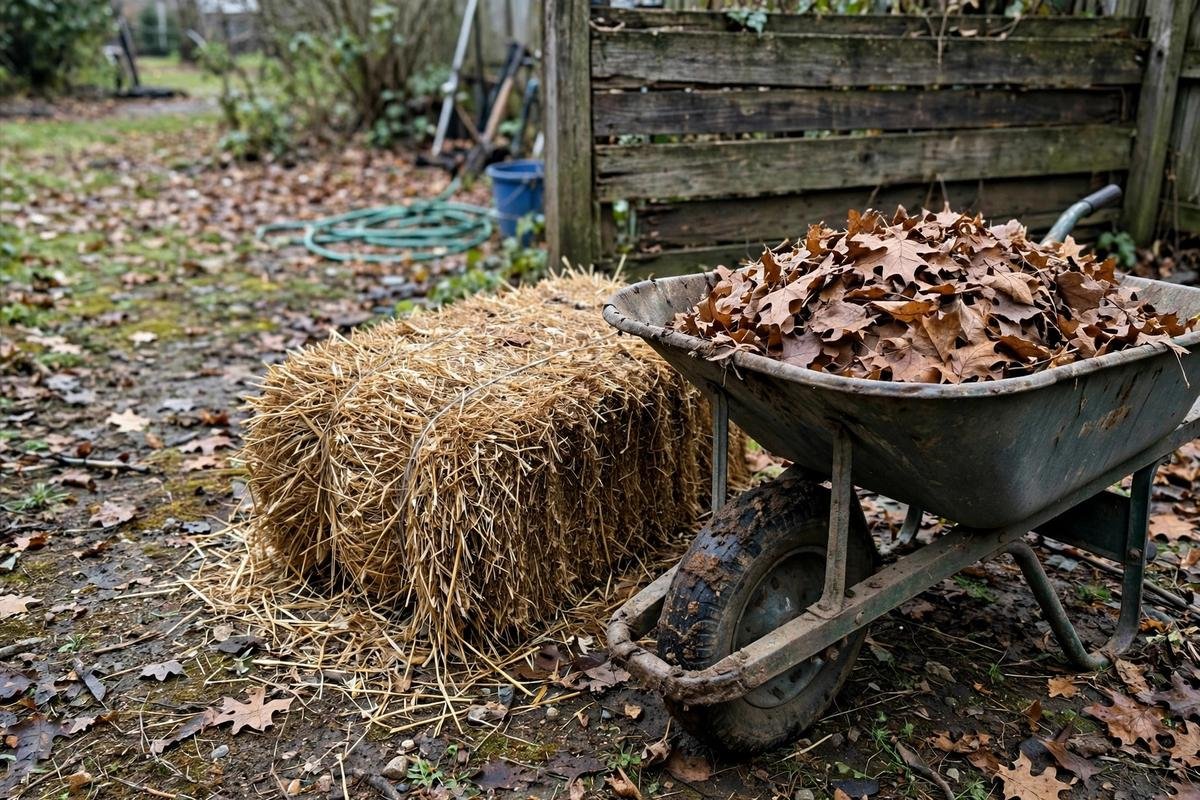
Shredded leaves are autumn leaves chopped into small pieces, usually by running a mower over a pile a few times or feeding them through a leaf shredder. Shredding is the step that makes leaves work as mulch. Whole leaves lie flat, lock together when wet, and form a soggy mat that blocks air and water from the soil. Shredded leaves stay loose, let rain through, and rot down into dark, crumbly matter by spring.
Spread shredded leaves 3 to 4 inches deep over empty beds and around perennials, again after the soil has started to freeze, and keep the layer a few inches back from stems and crowns. Leaves from most trees work, including oak and maple, though oak leaves break down more slowly than soft maple or birch leaves. Do not use leaves from trees that showed heavy disease this year, or leaves from a lawn treated with weed killer. For more ways to put autumn leaves to work, see our guide on what to do with fallen leaves, and for the slow-rotted version, see our guide on how to make leaf mold.
A mower with a bag does the shredding for most gardeners, but if you want a dedicated tool, you can browse leaf shredders on Amazon. We have not tested the products linked here, and we give no current store prices. Check each listing for current details before you buy.
Pros of shredded leaves
- Free, if you have trees, and always on hand in fall.
- Break down into humus that feeds soil life and improves soil structure.
- Hold moisture well once they settle, which helps soil stay damp under the layer.
- Suppress weeds well while the layer stays in place.
- Most of the layer is gone by spring, so cleanup is light.
Cons of shredded leaves
- Take real time to rake, shred, haul, and spread, about 1.5 hours per bed.
- Damp leaves shelter slugs and pill bugs close to plant crowns.
- Whole leaves mat into a wet sheet, so shredding is not optional.
- Light, dry leaves blow away before the first rain settles them.
- Some leaves, like oak, break down slowly and can sit in a thick layer into spring.
Our worked example: the cost of mulching one 4-by-8 bed
The two mulches look close until you put numbers on them. Here is the math for one 4-by-8 raised bed, 32 square feet, with the assumptions stated in the table. These are our own computed numbers, not a trial, and the prices are an approximate range seen at garden centers in fall. Check local prices before you plan a big mulching day.
| Item | Straw | Shredded leaves |
|---|---|---|
| Bed size | 4 by 8 feet, 32 square feet | 4 by 8 feet, 32 square feet |
| Depth applied | 4 inches | 3 inches |
| Volume needed | 32 times 4 divided by 12, about 10.7 cubic feet | 32 times 3 divided by 12, about 8 cubic feet |
| Material | One small two-string bale, about 10 cubic feet loose once broken apart | About two 30-gallon bags of shredded leaves, about 4 cubic feet each |
| Cash cost | $8 to $12 per bale, so $8 to $12 for the bed | $0 |
| Time | About 30 minutes to carry, break apart, and spread | About 1.5 hours to rake, shred, haul, and spread |
| Cost per square foot | About $0.25 to $0.38 | $0 |
Two things stand out from the table. First, leaves win on cash by a wide margin: a gardener with trees pays nothing for the material, while straw costs $8 to $12 per bed. Across ten beds, that is $80 to $120 for straw and $0 for leaves. Second, straw wins on time: spreading a bale takes about a third of the time that raking, shredding, hauling, and spreading leaves takes. Across ten beds, leaves take about 15 hours of work against about 5 hours for straw.
Depth changes the straw bill fast. University of Minnesota Extension suggests 5 to 6 inches of mulch on perennial and bulb beds once the soil begins to freeze. At 6 inches, the same 4-by-8 bed needs 32 times 6 divided by 12, or 16 cubic feet, which is about two small bales, or $16 to $24. Leaves at that depth need 16 cubic feet too, or about four bags, but the cash cost stays $0 and only the time grows. A gardener with a big yard and a free afternoon saves real money with leaves. A gardener buying mulch for many beds pays more for straw and finishes the job in a single morning.
There is also a second-year effect worth counting. Straw breaks down slowly, so much of a November layer is still on the bed in March, and it can be pulled aside and composted or used again as a spring mulch. Leaves break down fast, so most of a November layer has rotted into the top of the soil by March, which means the bed gains organic matter but needs a fresh layer sooner.
When to mulch and how to time it
Timing matters more than the material. Mulch goes on after the soil has started to freeze, not during a warm spell in early fall. Mulch laid down too early holds warmth in the soil, which can keep perennials growing soft late growth that a hard freeze then damages. Wait until the ground has had its first few frosts and the top of the soil is firm in the morning, then lay the mulch on. The mulch then holds the cold in, which sounds backwards, but it is the freeze-and-thaw cycle that heaves plants out of the ground, and a steady cold layer stops that cycle.
Use your local frost dates and regional planting guidance — not your USDA hardiness zone alone — to choose planting dates. A zone number tells you how cold the winter gets, not when your first frost arrives, and two gardens in the same zone can sit weeks apart on frost dates. Your local extension planting calendar is the better guide for the exact dates in your town. For frost protection on the beds themselves, see our guide on how to protect raised beds from frost.
In spring, pull the mulch back from plant crowns as soon as growth starts, and leave it on the paths or in the compost pile. Straw pulled aside can be reused around summer crops, and leaves pulled aside are usually half rotted and can go straight into the compost; see our guide on how to make compost at home.
Which mulch should you choose?
Choose straw if you want a mulch that goes down fast, holds its shape all winter, and stays dry on top. Straw fits a gardener with many beds, little free time in fall, and no big trees dropping leaves. It also fits beds of perennials and bulbs that need a thick, steady layer through the cold months, and beds where slugs have been a problem in past years.
Choose shredded leaves if you want a mulch that costs nothing, feeds the soil as it rots, and disappears mostly by spring. Leaves fit a gardener with trees, a mower, and a free afternoon in fall, and beds that will be planted early in spring, where a fast-rotting mulch is a help rather than a chore. Leaves also fit gardeners who want to keep yard waste on site instead of bagging it for pickup.
Many gardeners use both. Straw goes on the perennial and bulb beds, where a long-lasting layer pays off, and shredded leaves go on the empty vegetable beds, where they rot into the soil over winter and leave the bed ready to plant. If you compare the two materials head to head for a different use, see our guide on mulch vs compost. Either material beats bare soil through winter.
Troubleshooting
The straw blew into the paths after one windy night
Straw is light until it gets wet, and a dry layer on a windy site will move. Wet the layer lightly after spreading, lay a few branches across it, or spread it just before rain is forecast. Once the top flakes are damp and settled, wind moves it far less.
The leaves matted into a wet sheet
Whole leaves were used, or the shredding was too coarse. Pull the mat up, run it through a mower again, and spread it back in a thinner layer, no more than 3 to 4 inches deep. A matted layer blocks air and water, so do not leave it sitting on a planted bed through winter.
Slugs are thick under the leaf mulch in spring
Damp leaves shelter slugs, and a thick layer near plant crowns gives them a damp home all winter. In spring, pull the leaf layer back from crowns early, let the soil surface dry for a few days, and check under the mulch at dusk. On beds where slugs were heavy last year, use straw next winter, or keep the leaf layer thinner and farther from stems.
Frequently asked questions
Can I use hay instead of straw?
It is a poor swap. Hay is cut grass with seed heads, and a bale can sow grass seed and weeds across a bed. Straw is grain stalks after the grain is harvested, with far less seed in it. If the only bale on sale is hay, skip it and use leaves.
Can I mulch with whole leaves?
You can, but only in a loose, fluffy layer on an empty bed, and you should expect it to mat when wet. Shredded leaves are the safer choice on planted beds, since they let air and water through and rot down faster. If you have no shredder, run a mower over the pile a few times.
Do I remove the mulch in spring?
Pull it back from plant crowns when growth starts, but you do not have to haul it away. Straw can be reused around summer crops or composted, and half-rotted leaves can go into the compost pile or be dug lightly into an empty bed.
Sources and further reading
- University of Minnesota Extension, Mulching for soil and garden health
- University of Minnesota Extension, Mulch perennials and bulbs after the soil freezes
- University of Minnesota Extension, Mulching 101: the secret to a healthy and happy garden
- Clemson Cooperative Extension, Soil conditioning: establishing a successful gardening foundation
Related reading: How to Mulch Perennials for Winter, What to Do with Fallen Leaves, How to Make Leaf Mold, Mulch vs Compost
By the Pot and Plot Team