
This post may contain affiliate links. If you buy through links on this page, we may earn a commission at no extra cost to you.
As an Amazon Associate I earn from qualifying purchases.
Buying potting mix for containers often ends in one of two mistakes: a bag too small, with pots half filled, or three extra bags sitting in the garage through winter. The fix is simple math done before you shop. Measure each pot, work out its volume in cubic feet, add a little for settling, and then compare the total with the bag sizes at the store.
We have not tested the products linked here, and we give no current store prices. The links below go to search pages for potting mix types, so you can compare current options, bag sizes, and prices at the time you shop. This guide gives the formulas for round pots, square pots, and rectangular planters, plus two worked examples with every step shown.
Measure first, in inches
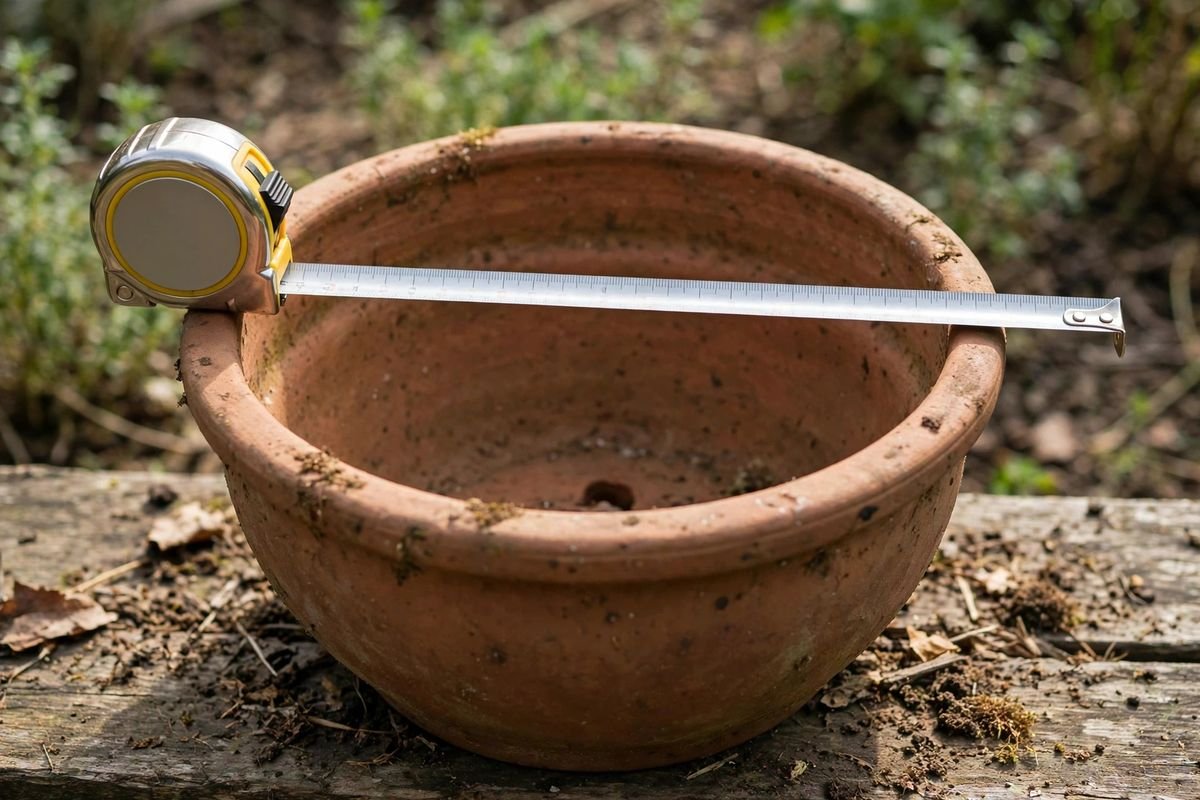
For a round pot, measure the inside diameter across the top and the inside depth from the rim to the bottom. Pots taper, so the bottom is narrower than the top. For a close estimate, also measure the inside diameter across the bottom, then average the top and bottom diameters. Use that average diameter in the formula below.
For a square or rectangular planter, measure the inside length, width, and depth in inches. Measure inside the walls, not outside, since thick pot walls can take an inch or more off each side. Write the numbers down pot by pot. Guessing from memory at the store is how the extra-bag mistake happens.
One conversion runs through all the math in this guide: 1 cubic foot equals 1,728 cubic inches. That number comes from 12 inches times 12 inches times 12 inches. Every formula below ends by dividing cubic inches by 1,728 to get cubic feet, which is how potting mix bags are labeled.
Round pots: the cylinder formula
For a round pot, use the cylinder volume formula: volume equals 3.14 times radius squared times depth. The radius is half the diameter. Work in inches throughout, then divide by 1,728 for cubic feet.
Worked example one uses a round pot with an average inside diameter of 14 inches and a depth of 12 inches. The radius is 7 inches. Square the radius: 7 times 7 equals 49. Multiply by 3.14: 49 times 3.14 equals 153.86. Multiply by the depth: 153.86 times 12 equals 1,846.32 cubic inches. Divide by 1,728: 1,846.32 divided by 1,728 equals about 1.07 cubic feet.
That 1.07 cubic feet is the full volume of the pot. Soil settles after watering, so add about 10 percent for settling and for the space you leave below the rim: 1.07 times 1.10 equals about 1.18 cubic feet to buy for this pot. A single 2-cubic-foot bag fills this pot with about 0.82 cubic feet left over, enough for a small herb pot beside it. Two of these pots need about 2.36 cubic feet, so buy two 2-cubic-foot bags or one larger bag of at least 2.5 cubic feet, if the store stocks that size.
The assumption here is stated plainly: the pot is filled with potting mix alone, with no large drainage layer taking up space at the bottom. If you add a thick layer of anything else at the bottom, subtract that layer volume from the total before you shop.

Rectangular planters and window boxes
For a rectangular planter, multiply inside length times inside width times inside depth, all in inches, then divide by 1,728. Worked example two uses a planter that measures 24 inches long, 12 inches wide, and 10 inches deep inside. Multiply: 24 times 12 equals 288, and 288 times 10 equals 2,880 cubic inches. Divide by 1,728: 2,880 divided by 1,728 equals about 1.67 cubic feet.
Add 10 percent for settling: 1.67 times 1.10 equals about 1.83 cubic feet to buy. A single 2-cubic-foot bag covers this planter with a little left over for topping up after the first few waterings. Three planters of this size need about 5.49 cubic feet, so three 2-cubic-foot bags cover the job with about 0.51 cubic feet to spare.
Window boxes follow the same formula, but depth is often the surprise. A long box that is only 6 inches deep holds far less mix than its length suggests, and it dries out fast in sun. Check depth before you trust a length-based guess. For box depth and plant pairings, see best window boxes for herbs and flowers, and for pot basics, see container gardening for beginners.
Bag counts for a whole patio
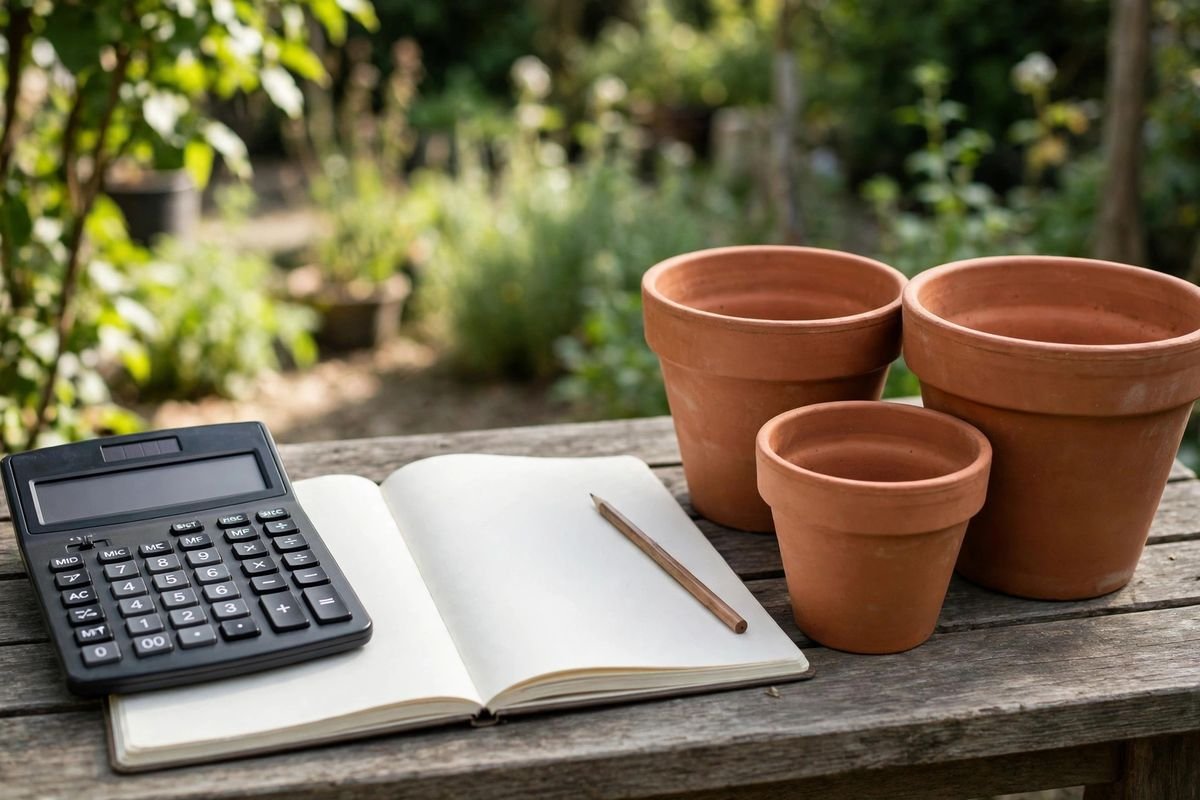
Most shoppers fill more than one pot, so add the pots up before you buy. List each pot with its cubic feet from the formulas above, add the list, then add 10 percent once to the total for settling. Do not add 10 percent pot by pot and then again to the total, or you will overbuy.
A sample patio list shows how this works: two round pots at 1.07 cubic feet each, one rectangular planter at 1.67 cubic feet, and two herb pots at 0.35 cubic feet each. Add them: 1.07 plus 1.07 plus 1.67 plus 0.35 plus 0.35 equals 4.51 cubic feet. Add 10 percent: 4.51 times 1.10 equals about 4.96 cubic feet, so round up to 5 cubic feet to buy. That is three 2-cubic-foot bags, with about 1 cubic foot left over for topping up through the season.
Keep the leftover mix dry in a sealed bin or a tied bag. Wet mix stored open grows mold and loses structure, and a bag left in rain gains weight without gaining usable volume. Top up pots after the first month, since watering and settling lower the soil line by an inch or more in most pots.
Soil type, reuse, and common mistakes
Use potting mix for containers, not garden soil dug from a bed. Garden soil compacts in a pot, drains poorly, and can carry weed seeds and pests. Potting mix is made to stay open and drain in a small volume. For the differences in detail, see potting soil vs garden soil and best potting mixes for container vegetables.
Old mix can be reused with care. Shake out old roots, mix in fresh compost at about one part compost to three parts old mix, and check drainage before replanting. Mix that smells sour, stays soggy, or held a diseased plant last season should go in the compost bin instead. Full reuse steps are in can you reuse potting soil.
Three mistakes cause most miscalculations. First, measuring outside dimensions instead of inside ones overstates volume. Second, forgetting the taper of a round pot overstates volume, since the bottom is narrower than the top. Third, filling pots to the very rim leaves no room for watering, so water runs off instead of soaking in. Leave one inch of space below the rim on every pot, and include that gap in your planning by using the settling allowance above.
Questions
Bag labels can confuse the math, because some bags list quarts or liters instead of cubic feet. One cubic foot equals about 28.3 liters, and one cubic foot equals about 29.9 dry quarts. If a bag lists 2 cubic feet, use 2 in the formulas above. If a bag lists only quarts, divide quarts by 29.9 to get cubic feet before you compare.
Another point of confusion is pot size labels. A pot sold as 14 inches usually means its top diameter, not its volume and not its depth. Always measure depth yourself, since two pots with the same top diameter can differ by several inches in depth and hold very different amounts of mix.
To compare current options, search for potting mix in 2-cubic-foot bags and container potting mix. Compare the cubic feet on the label first, then the mix type, then the price per cubic foot. That last check stops a small bag with a low price from looking cheaper than a large bag that costs less per cubic foot.