
This post may contain affiliate links. If you buy through links on this page, we may earn a commission at no extra cost to you.
As an Amazon Associate I earn from qualifying purchases.
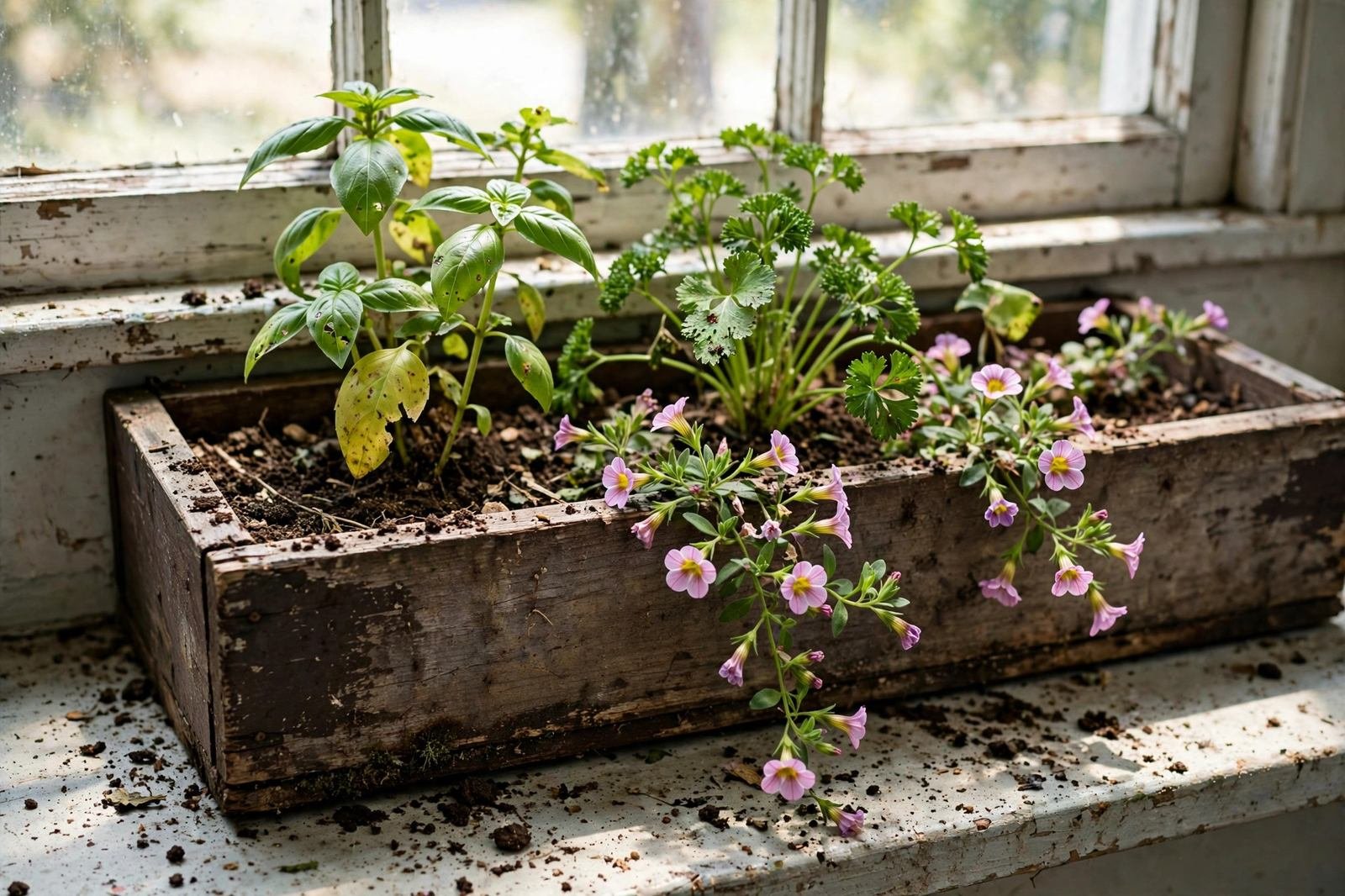
A window box sits where people see it every day, from the kitchen sink and from the sidewalk. That close view changes what matters. Plants in a window box need steady water, roots need room, and the box itself must stay put in wind and rain. Herbs and flowers can share a box well, but only when the box is deep enough and the planting mix matches both kinds of plants.
We have not tested the products linked here, and we give no current store prices. The links below go to search pages for box types, so you can compare current options, sizes, and prices at the time you shop. This guide covers box size, soil volume, plant pairings, watering, and mounting, with numbers you can check against your own window.
How much soil a window box really holds
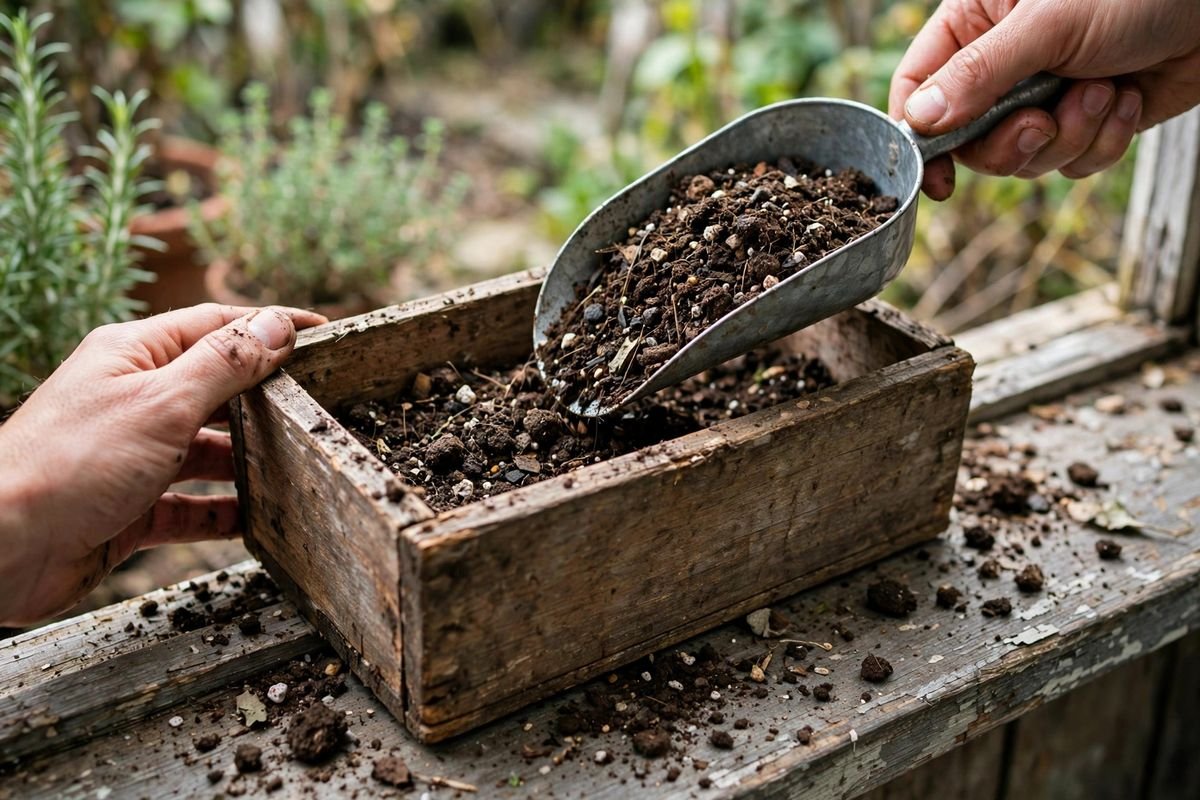
Window boxes look larger than they are. A common box measures 24 inches long, 8 inches wide, and 8 inches deep. Multiply those numbers and you get 1,536 cubic inches. Divide by 1,728 cubic inches per cubic foot and the result is about 0.89 cubic feet, before you allow for the space plants and drainage material take up. In practice, plan on about 0.75 cubic feet of potting mix for that box.
That volume sets the plant count. For a 24-inch box, we suggest three herb plants or four small flower plants, not both at full density. Basil, parsley, and chives fill a box of that size by midsummer. Add two trailing flowers and the herbs still have room, but add six plants and the roots crowd each other by July.
Depth matters more than length. A box only 6 inches deep dries out fast and gives parsley roots little room. A box 8 to 10 inches deep holds water longer and suits most herbs. Flower roots vary, but the same depth range covers petunias, marigolds, and trailing lobelia.
Herbs and flowers that share a box well
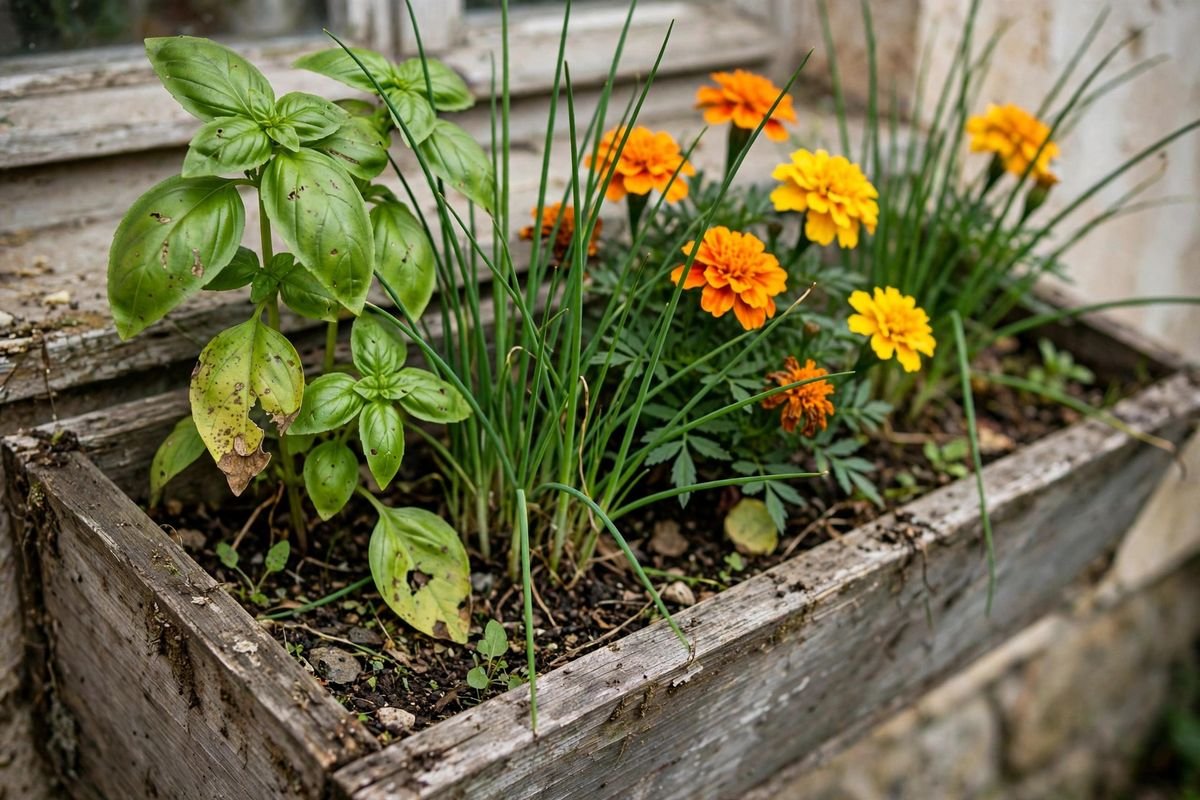
Pair plants with similar water needs. Basil, parsley, and chives all like soil that stays lightly moist. Marigolds and petunias accept the same watering rhythm. Rosemary and lavender prefer drier soil, so they sit poorly beside basil in one box. Keep rosemary in its own pot and let the window box hold the moisture-loving group.
Put trailing plants at the front edge and upright plants at the back. Trailing lobelia or trailing petunias spill over the front and shade the box wall, which slows drying. Basil and parsley stand behind them and still get sun over the top. Chives work at either end, since their narrow leaves take little space.
For a kitchen window, a workable planting is basil at one end, parsley in the middle, chives at the other end, and one trailing flower at the front center. That is four plants in a 24-inch box. For a street-facing window where flowers matter more, use two marigolds, two petunias, and one parsley plant for green filler between the flowers.
Watering and drainage in a shallow box
A window box dries faster than a ground bed and faster than a deep pot. Sun hits the front wall, wind moves across the box, and the soil volume is small. In warm weather, check the soil each morning by pushing a finger one inch into the mix. Water when that top inch feels dry. A 24-inch box in full sun often needs water daily in summer, and sometimes twice a day during a heat spell.
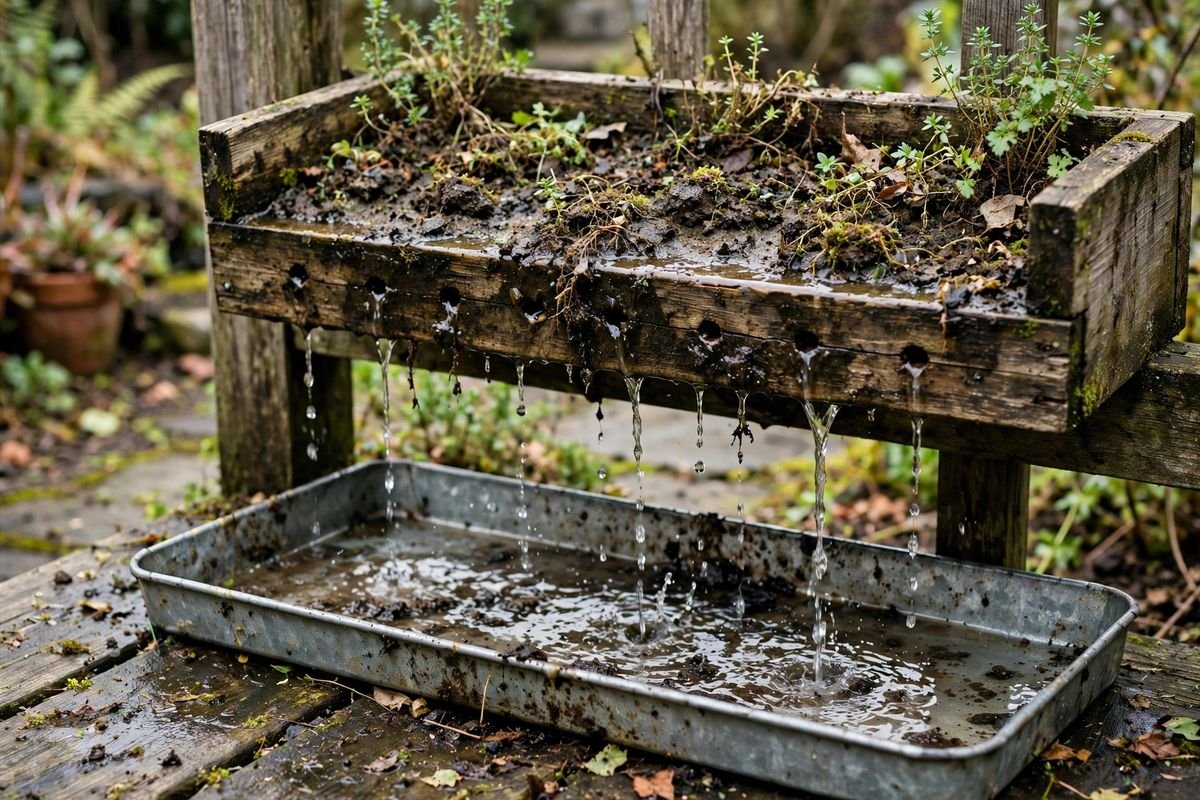
Drainage holes are not optional. A box without holes stays wet after rain, and herb roots rot in standing water. If your box has no holes, drill three or four holes of about one-half inch across the bottom. Set the box on brackets that leave a gap under it, so water can leave freely instead of pooling under the box.
Catchment trays help on a balcony, but a tray that stays full defeats drainage. Empty the tray after watering and after rain. If the tray holds water for more than a day, the box sits in water and the same rot problem returns.
Mounting and weight
Wet soil is heavy. Our 24-inch box holds about 0.75 cubic feet of mix. Wet potting mix weighs roughly 40 pounds per cubic foot, so the soil alone weighs about 30 pounds. Add the box, plants, and water in a tray, and the full box weighs 35 to 40 pounds. A 36-inch box holds about 1.1 cubic feet of mix and weighs 50 to 55 pounds when wet. Use those numbers when you pick brackets and screws.
Mount brackets into studs or solid masonry, not into siding alone. Two brackets suit a 24-inch box, and three brackets suit a 36-inch box. Screws should reach at least one and one-half inches into solid material. After mounting, press down on the front edge with both hands. If the box moves, add a bracket or use longer screws before you plant anything.
For renters, a railing-mounted box avoids drilling into walls. Check the railing rules for your building first, and use a box with hooks sized for your rail width. A railing box still needs the same weight check, since a full box can bend a thin rail or slip if the hooks fit loosely.

Box types compared
| Box type | Strengths | Limits | Best fit |
|---|---|---|---|
| Wood | Insulates roots, easy to drill, natural look | Weathers, needs sealing, heavier | Herb boxes at a kitchen window |
| Resin or plastic | Light, holds moisture, low upkeep | Heats in sun, can look plain | Rental windows, long boxes |
| Metal | Neat, strong, slim profile | Heats fast, can rust at joints | Shaded windows, flower boxes |
| Ceramic | Steady in wind, holds moisture | Heavy, breaks if dropped | Ground-floor windows, one show box |
To compare current options, search for wooden window boxes, resin window boxes, and metal window boxes. Compare depth first, then length, then bracket style. A box that is 8 inches deep beats a longer box that is only 6 inches deep for most herbs.
Questions
Herbs in a window box need the same soil check as flowers. Push a finger into the mix each morning and water when the top inch feels dry. Harvest herbs often, since regular picking keeps basil and parsley bushy instead of tall and thin.
Window boxes also suit readers who already grow in pots. Our guide to container gardening for beginners covers soil mixes and drainage in more depth, and how to keep container soil from drying out too fast gives watering methods for shallow pots. For a balcony setup, how to start a balcony garden covers railings, weight, and wind.