

This post may contain affiliate links. If you buy through links on this page, we may earn a commission at no extra cost to you.
As an Amazon Associate I earn from qualifying purchases.
Garden supplies spread fast in a small apartment. A bag of potting mix leans against the balcony door, pots stack up in the closet, a trowel lives in a kitchen drawer, and a half-used bag of fertilizer ends up on top of the fridge. Nothing is lost, exactly, but nothing is easy to find either, and every planting session starts with 20 minutes of digging through piles. A small apartment does not need a shed. It needs a fixed home for each type of supply, sized to what you actually keep, and a rule that nothing new comes in until something old goes out.
The plan below starts with measuring what you have, then matches it to bins and closet space that fit a real apartment. The numbers use a typical stash for a container gardener with a balcony or a few windowsills, and the worked example shows how the volume adds up. Adjust the bin sizes to your own stash, but keep the order: measure first, buy bins second, and put labels on everything third.
Start by measuring the stash
Empty every hiding place onto the floor at once: the closet shelf, the balcony corner, the drawer with the twine, the bag under the sink. Sort the pile into five groups: pots and trays, potting mix and amendments, tools, watering gear, and seed and label supplies. Throw out cracked pots, dried-out mix, and rusted tools that no longer hold an edge, because broken supplies take up the same space as good ones and slow every job down.
Then measure the three numbers that decide the storage plan: how many pots you keep, how much mix you keep on hand, and how much closet or balcony space you can give up. Count the pots by size, and note the largest pot, because one 14 inch pot needs as much room as four 6 inch pots stacked. Weigh or estimate the mix in cubic feet, not in bags, because bag sizes vary and a cubic foot is the unit that matches bin labels. Measure the closet shelf or balcony corner in inches, including the height, because a bin that is 2 inches too tall for a shelf is useless.
A worked example: bin and closet volume for a real stash
Here is a stash that fits a gardener with about 20 containers on a balcony and a windowsill herb garden. Inputs: 12 small pots from 4 to 6 inches, 6 medium pots from 8 to 10 inches, 2 large pots at 14 inches, one 2 cubic foot bag of potting mix, one 1 cubic foot bag of compost, a small bag of perlite, hand tools (trowel, fork, snips, gloves), a 2 gallon watering can, a coil of twine, plant labels, and a seed box.
Stack the small pots in nests of 4, which turns 12 small pots into 3 stacks about 10 inches tall each. The 6 medium pots nest into 2 stacks about 14 inches tall. The 2 large pots nest into a single stack about 18 inches tall. Nested like this, all 20 pots fit in a single 18 gallon tote, which measures about 24 inches long, 16 inches wide, and 15 inches tall, or about 2.4 cubic feet inside. Without nesting, the same pots would need roughly twice the volume, so nesting is the step that makes the plan work.
Mix and amendments need their own sealed bin. Two cubic feet of potting mix plus 1 cubic foot of compost plus a half cubic foot of perlite comes to 3.5 cubic feet, and a 27 gallon tote holds about 3.6 cubic feet, so it fits with a little room to spare. A tote this size measures about 30 inches long, 20 inches wide, and 15 inches tall, and it weighs about 35 to 40 pounds when full of damp mix, so it should live on the floor or on a low shelf, never on a high closet shelf. Scoop mix out with a yogurt container or a small scoop kept in the bin, and keep the lid snapped shut so the mix stays damp and the apartment stays clean.
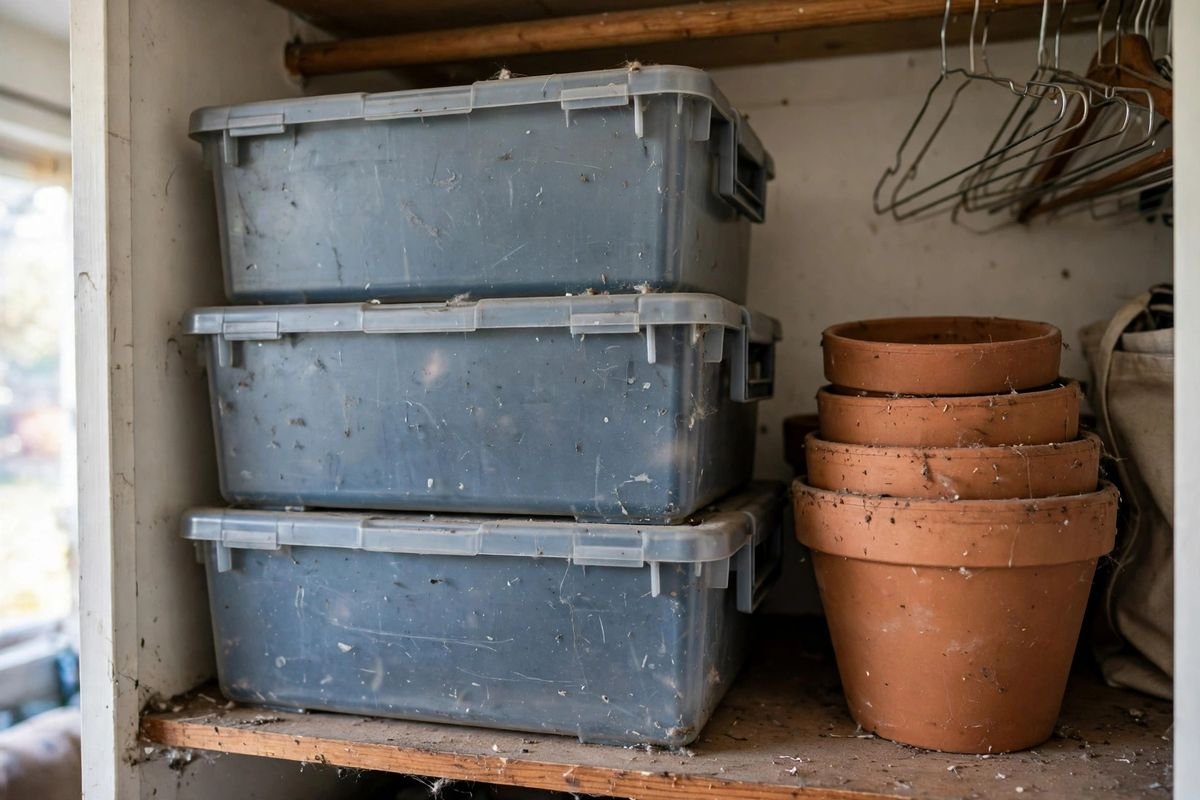
Tools and small supplies fit in a 10 gallon tote, about 1.3 cubic feet, with a small caddy inside for hand tools so they do not end up buried under a coil of twine. The watering can and the seed box sit outside the bins: the can hangs on a hook by the balcony door, and the seed box lives on a closet shelf where it stays cool and dry. Add the three totes together and the whole stash takes about 7.3 cubic feet, which fits on two closet shelves each 24 inches deep and 36 inches wide, with the mix tote on the floor underneath and the pot tote on the lower shelf.
Run the same arithmetic on your own stash before buying bins. Add up the cubic feet of mix, count the pots after nesting, and measure the shelf. If the total is more than the shelf holds, the answer is to keep fewer pots or less mix on hand, not to buy a bigger bin that does not fit. A good target for a small apartment is one bag of mix open at a time, plus one sealed spare, and no more pots than the tote holds.
The closet setup
A hall closet or a bedroom closet with two shelves is usually enough. Put the mix tote on the floor, where its weight is safe and where you can scoop from it without lifting. Put the pot tote on the lower shelf, and the tool tote on the upper shelf, where lighter items belong. Keep a small dustpan and a hand brush on the shelf edge, because a little spilled mix is normal, and cleaning it right away keeps the closet from smelling like damp soil.
Label each tote on the front and on the top with a strip of tape and a marker: pots, mix, tools. The label sounds obvious, but in a shared closet the labels are what keep other people in the household from stacking coats or shoes on top of the garden bins. Clear totes help too, because you can see at a glance whether the pot tote is full or whether the mix tote is running low, without opening every lid.
Keep seeds in a small box with a lid, on the coolest shelf, away from the mix tote, because damp air shortens seed life. Paper packets go in the box as they are, and a silica gel packet from a shoe box or a vitamin bottle helps in a humid apartment. For the mix itself, our guide to the best potting mixes for container vegetables covers what to keep on hand, and for soil you already have, see whether you can reuse potting soil.
The balcony corner
Some supplies are better kept outside, near where they are used, as long as they stay dry. A narrow deck box or a small bench with storage inside holds the watering can, a bag of mix in a sealed bin, and the pots you reach for most often. Keep the deck box against the wall, out of the rain line from the balcony above, and check the lid seal before the rainy season. Fertilizer and seed packets stay inside the apartment, because heat and damp on a balcony shorten their life.
A balcony corner also needs a rule about clutter. Limit the outside stash to one deck box and one stack of pots, and move anything else back to the closet. A balcony full of loose pots and bags looks messy, blocks the door, and draws complaints from neighbors and landlords. One tidy box and one neat stack read as a garden; a dozen loose pots read as storage, and storage on a balcony is what gets a note from the building manager.
Tools: keep few, keep them clean
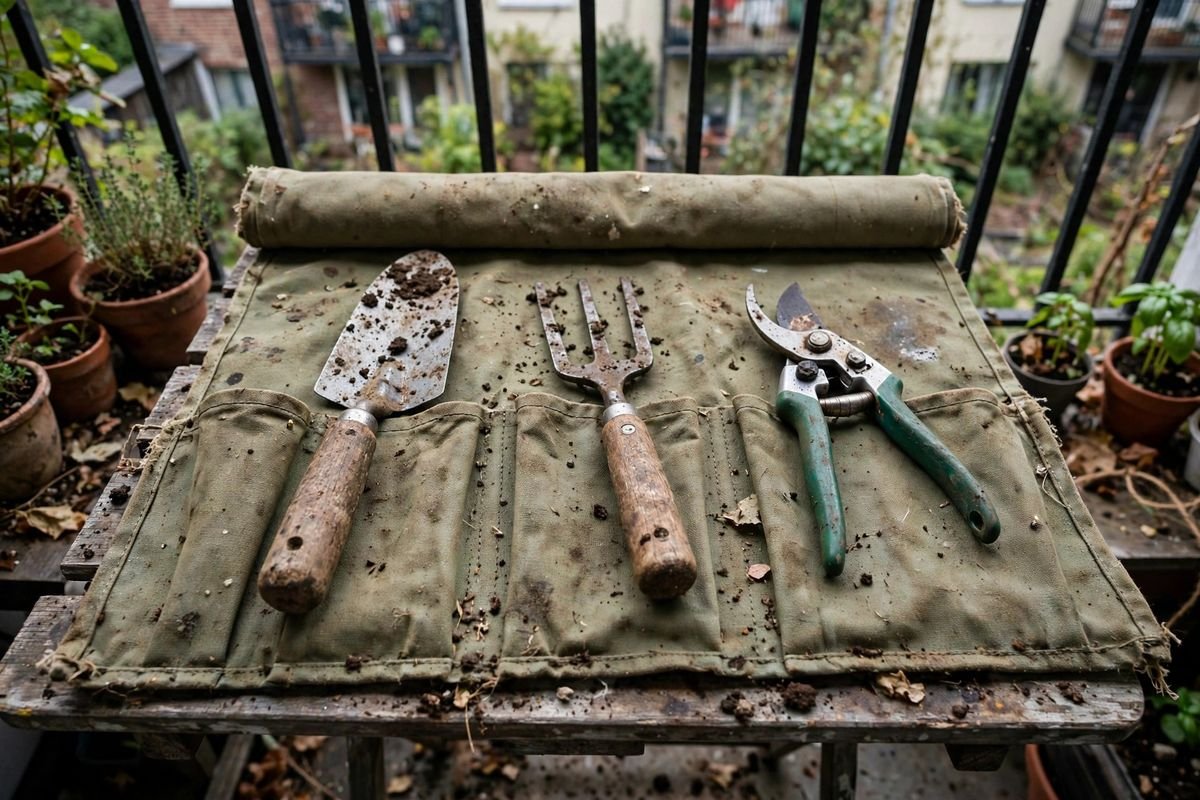
A small apartment gardener needs about five tools: a trowel, a hand fork, snips, gloves, and a watering can. Everything else is a nice extra, not a need, and each extra tool is one more thing to store. Buy the five in a size that fits your hand, clean them after use, and keep them in the tool tote in a small caddy or a canvas roll so they do not rattle around and dull each other.
Clean tools last longer and store better. Knock the soil off after each use, wipe the blades dry, and oil the snips once a season with a drop of household oil on a rag. Rusty tools take up the same space as sharp ones and cut worse, so a tool that has gone fully to rust should be replaced, not stored. For rust removal on tools worth saving, see our guide to how to remove rust from garden tools, and for choosing between cutting tools, see garden scissors versus pruning shears.
Mix, fertilizer, and the damp problem
Potting mix is the bulkiest supply and the one most likely to make a mess. Buy it in the smallest bag that fits your planting plans, usually 1 to 2 cubic feet for a balcony gardener, and transfer it to the sealed tote the day you bring it home. A torn bag on a closet floor spills mix every time someone brushes past it, and a sealed tote keeps the mix at a steady dampness so it is ready to use.
Fertilizer needs a dry, sealed home of its own. Keep it in its original container inside a small lidded box, on a high shelf away from food and away from children and pets. Liquid fertilizer bottles go in a tray or a zip bag in case they leak, because a leak inside a closet ruins a shelf and everything on it. Write the purchase date on the container with a marker, and replace anything that has clumped into a solid brick or that smells strongly off.
Compost in a small apartment is a smaller question. A sealed bag of finished compost stores the same way as mix, in the mix tote or its own small bin. Do not try to keep an open compost pile on a balcony, because the smell and the insects will end the experiment fast. If you want to compost in an apartment, a small sealed bokashi or worm bin is the realistic route, and it lives in the kitchen, not in the garden closet.
Seasonal rotation: what stays out, what goes away
Twice a year, in spring and in fall, pull the bins out and do a quick reset. In spring, move the seed starting trays and the extra pots to the front of the closet, and put the frost covers and the cold-weather gear at the back. In fall, swap them: frost covers and any cold frame parts come forward, and the seed trays go to the back. The reset takes about 20 minutes and keeps the supplies you need now within reach, instead of buried behind the supplies you needed three months ago.
Use the reset to count again. If the pot tote no longer closes, give away or recycle the extras. If the mix tote still holds last spring’s mix, use it up in a repotting round before buying more. Our guide to container gardening for beginners covers how many pots a first balcony garden needs, which is a useful check on whether the stash has grown past what the garden can use.

A shopping list that fits the plan
Start with three totes: one 18 gallon tote for pots, one 27 gallon tote for mix, and one 10 gallon tote for tools, plus a small lidded box for seeds and a hook for the watering can. Buy the totes after measuring the shelf, not before, and bring a tape measure to the store. Clear totes with snap lids are the practical pick, because they stack, they show what is inside, and they keep mix dust out of the closet.
Add a roll of tape and a marker for labels, a small scoop for mix, and a hand brush and dustpan for the shelf. That is the whole list. Anything beyond it should earn its place by solving a problem you have actually hit, such as a second mix tote when you start growing tomatoes in 10 gallon grow bags, or a taller deck box when the balcony garden doubles in size. Storage grows with the garden, and it should grow one bin at a time, not one shopping trip at a time.
Sources & Further Reading
University of California Agriculture and Natural Resources
Cornell Cooperative Extension
National Gardening Association