
This post may contain affiliate links. If you buy through links on this page, we may earn a commission at no extra cost to you.
As an Amazon Associate I earn from qualifying purchases.
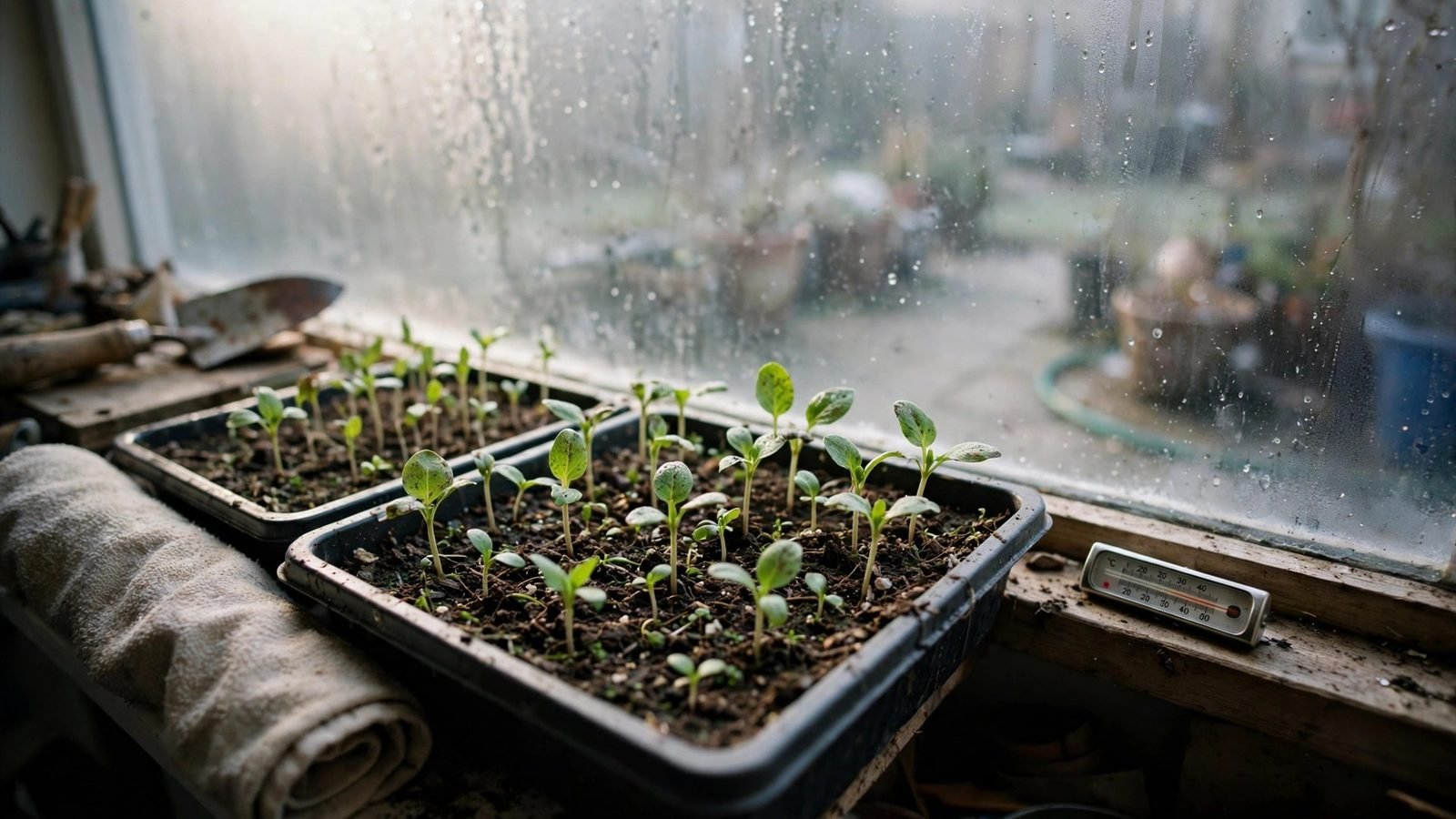
A tray of seedlings on a windowsill looks fine at noon and can be in trouble by morning. The air in the room may feel comfortable, but the soil in a small cell cools fast once the sun goes down, and a cold windowsill can sit several degrees below room temperature all night. Seeds that would sprout in five warm days may take two weeks in cold soil, and seedlings that do sprout often grow slowly, with pale leaves and thin stems.
The fix is not a warmer house. It is a warmer tray, a drier windowsill, and a few habits that keep night cold away from young roots. This guide covers how cold is too cold, how to measure soil temperature, and what to do when the tray sits next to a drafty window.
Start with the tray, not the room. Seedlings care about the temperature of the soil their roots sit in, and that number can be very different from the number on the wall thermostat. A tray on a cold sill, a stone countertop, or a basement shelf loses heat to the surface under it, even in a room that feels fine to you.
How cold is too cold for seedlings
Most seeds germinate best when the soil sits between about 65 and 75 degrees Fahrenheit. Warm-season crops want the top of that range or a little above it: tomatoes and peppers sprout fastest with soil near 75 to 85 degrees, while eggplant is slow below 70. Cool-season crops are more forgiving: lettuce, peas, and spinach germinate well with soil in the low 60s, and some will sprout in the 50s, just more slowly.
Below about 50 degrees, most seeds stall. They do not die right away, but they sit in damp soil for days, and damp, cold soil is where damping-off fungi do their damage. A seed that rots before it sprouts looks like a seed that never germinated, and the cause is usually temperature, not a bad packet.
Seedlings that have already sprouted handle cold a little better than seeds, but not by much. Most young vegetable seedlings grow slowly below 55 degrees, and warm-season seedlings such as tomatoes, peppers, and basil can show chilling damage below 50 degrees: leaves curl, growth stops, and purple tints show on the stems. One cold night rarely kills a tray, but a week of cold nights leaves seedlings stunted, and stunted seedlings rarely catch up after transplanting.
Our guide to whether seedlings need a heat mat covers which crops gain the most from bottom heat and which do fine without it.
Measure the soil, not the air
Guessing the temperature is the most common mistake in indoor seed starting. A room thermometer on the wall tells you about the air at chest height. The soil in a tray on a windowsill can be 5 to 10 degrees colder, especially at night, when the glass cools and the sill radiates cold into the tray.
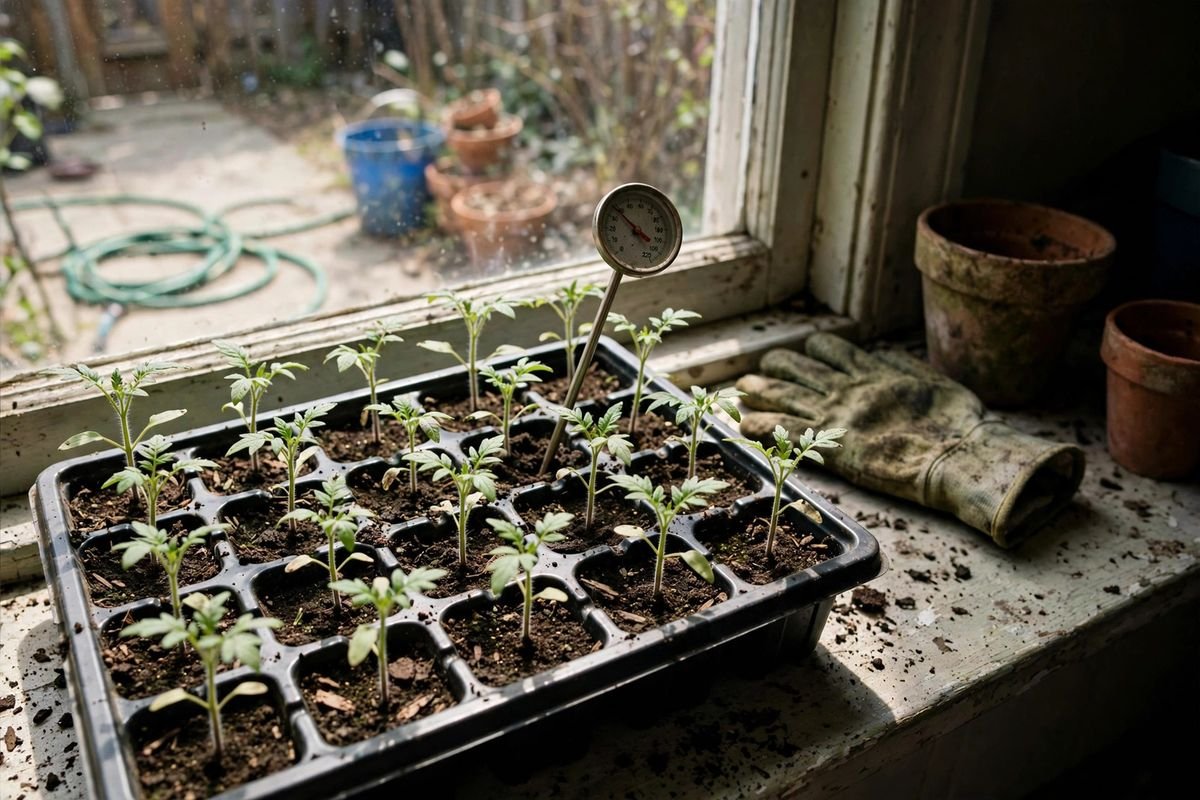
Push a soil thermometer into the mix at the depth of the seeds and read it in the morning, before the sun warms the sill. Take the reading at the same time for a few days to see the pattern. A tray that reads 72 degrees at noon and 55 degrees at 6 a.m. has a night problem, not a day problem, and the fix is night warmth, not more light.
Look for a soil thermometer for seed starting with a probe long enough to reach the middle of the cell, past the surface. A kitchen thermometer works in a pinch, but a soil probe reads faster and does not pack the mix down the way a wide probe does.
Write the morning readings on a scrap of paper taped to the shelf. Three or four mornings of numbers show whether the tray needs help or whether one cold night was a fluke. If the morning soil stays below 60 degrees for warm-season crops, the tray needs bottom heat or a warmer spot.
Move the tray off the cold sill at night
The cheapest fix is also the simplest: move the tray. A windowsill is the coldest spot in most rooms at night, because the glass loses heat to the outside and the sill sits in that cold layer of air. Moving the tray a few feet into the room, onto a table or a shelf, can raise the soil temperature several degrees by morning.
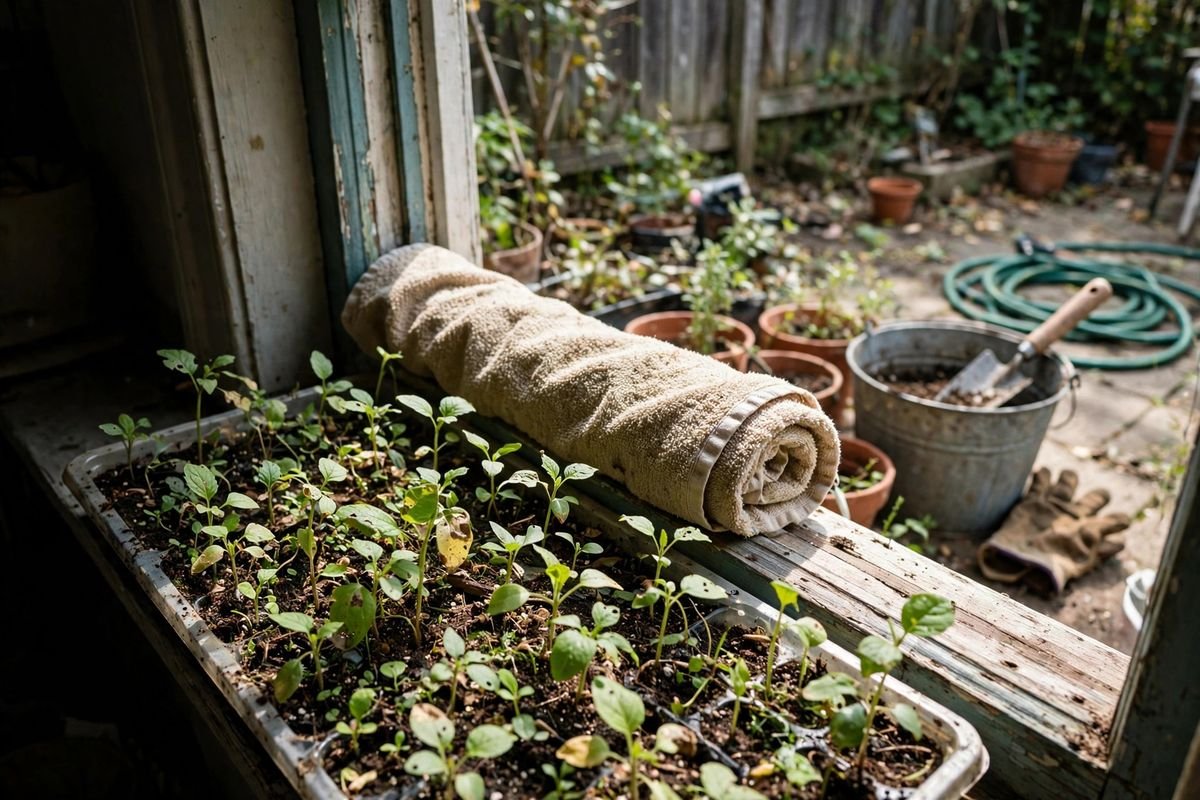
If the tray has to stay on the sill for light, slide a folded towel, a piece of foam board, or a cork mat under it. The layer breaks the contact between the cold sill and the bottom of the tray, and it costs nothing. A tray sitting directly on stone, tile, or a metal shelf loses heat the same way, so the same trick works there too.
Our guide to setting up a seed starting station shows how to arrange shelves, lights, and trays so the setup stays warm without crowding the window.
Use a heat mat the right way
A heat mat under the tray is the most reliable way to hold soil temperature steady through the night. The mat warms the mix from below, which is where the roots are, and it keeps the temperature steady even when the room cools after dark.
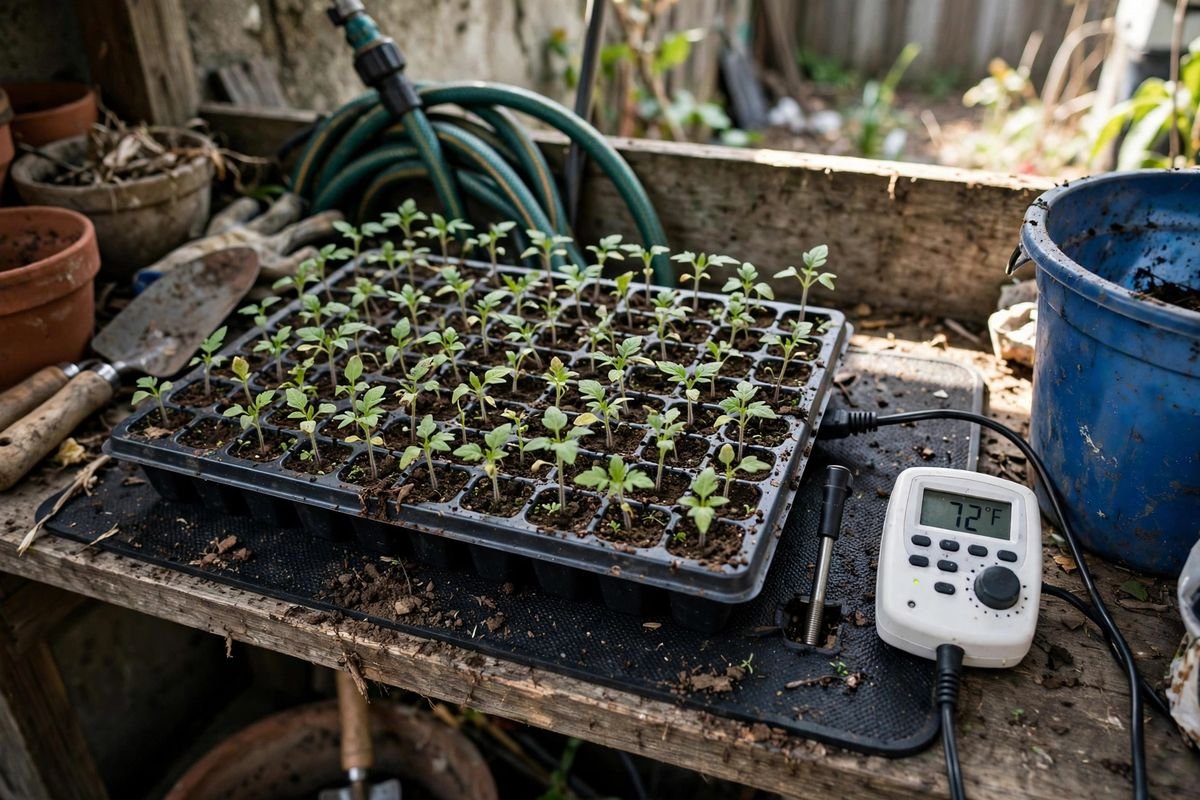
Set the mat on a flat surface, put the tray on top, and use a thermostat if the mat has one. Without a thermostat, a mat can push the soil above 85 degrees on a warm day, which dries the mix out and can cook young roots. With a thermostat, set the target to the range your crop wants: about 70 to 75 degrees for tomatoes and peppers, about 65 for lettuce and most flowers. The probe goes into the soil of one cell, not on top of the mat, so the thermostat reads what the roots feel.
Turn the mat off once the seeds have sprouted and the seedlings have their first true leaves, unless the room stays cold. Seedlings grow sturdier with a small day-night temperature drop, and a mat left on all season keeps the mix drying out faster than a young plant can drink.
Look for a seedling heat mat with a thermostat sized to your tray. A standard 10-by-20-inch mat fits one full tray, and a thermostat controller lets you set the soil temperature instead of guessing.
Worked example: what a heat mat costs to run
Growers often skip a heat mat because they assume it will add to the power bill. The numbers are small, and they are easy to work out from the wattage printed on the mat. This example uses a common 20-watt mat and a stated electricity price, so you can repeat the same steps with your own rate.
A 20-watt mat running 24 hours a day uses 20 times 24, which is 480 watt-hours, or 0.48 kilowatt-hours per day. At a stated rate of 17 cents per kilowatt-hour, close to the US average residential price, the mat costs 0.48 times 17, which is about 8 cents per day. Over a 30-day month, that comes to about $2.45.
A thermostat cuts that further. Once the soil reaches the set temperature, the mat cycles off and on, and in a room that holds near 65 degrees at night, the mat may run about half the time. Half of 8 cents is 4 cents per day, or about $1.20 for the month. That is less than the cost of one packet of seeds, and it buys steady germination instead of a tray that stalls for two weeks.
The same math works for any mat. Multiply the wattage by 24 hours, divide by 1,000 to get kilowatt-hours per day, then multiply by your own rate per kilowatt-hour. A 45-watt mat for a larger shelf costs a little more than twice as much to run as a 20-watt mat, and a mat on a thermostat costs less than either figure suggests.
Block the drafts
A draft is a stream of cold air, and it finds seedlings the way it finds people: through gaps around the window. Old windows leak at the edges, and the cold air pools on the sill right where the tray sits. A seedling in a draft can be 10 degrees colder than a seedling two feet away on the same shelf.
Hold a lit candle or a strip of tissue near the window edges on a windy night and watch for movement. If the flame flickers or the tissue moves, air is coming through. A rolled towel along the sill, a strip of foam weatherstripping on the window frame, or a sheet of clear plastic film over the window all cut the draft, and any of them is cheaper than replacing the tray.
Keep trays away from exterior doors as well. Every time the door opens, a wave of cold air crosses the floor and climbs the nearest shelf. A tray on a shelf by the back door can lose several degrees in a minute, and repeated cold shocks slow growth more than one steady cool night.
Water with room-temperature water
Cold water from the tap can drop the soil temperature several degrees in one watering. In winter, tap water can arrive near 45 degrees, and a tray of small cells holds so little mix that the cold water cools the whole cell at once. The seedlings then sit in cold, wet mix until the room warms them again.
Fill the watering can the night before and leave it in the same room as the trays. By morning, the water has reached room temperature, and it will not shock the roots. Bottom watering helps too: set the tray in a shallow pan of room-temperature water for 10 to 15 minutes, then let it drain. The mix takes up water from below, and the surface stays drier, which also cuts damping-off.
Our guide to how often to water seedlings covers how to tell when the mix is dry enough to water and when to leave it alone.
What to do when seedlings already look cold
Cold damage shows up slowly. The first sign is a tray that stops growing: the seedlings look the same size for days, the leaves turn a dull green or purple, and new leaves come in small. The stems may feel limp in the morning and firm up by noon, which points to cold nights rather than a watering problem.
Move the tray to a warmer spot, add bottom heat if you have it, and hold off on fertilizer until growth restarts. Fertilizer on cold, stalled roots does nothing except build up salts in the mix. Wait until the seedlings put out a new leaf, then feed at half strength.
Some seedlings will not recover. A tomato seedling that sat below 45 degrees for several nights may grow again, but it often stays behind the rest of the tray for the season. It is better to sow a fresh tray and keep it warm than to nurse a stunted tray for weeks. Seed is cheap, and a warm start is worth more than a head start that froze.
Leggy seedlings are a different problem, usually caused by weak light rather than cold. Our guide to why seedlings go leggy under grow lights covers the light side of the setup.
Frequently asked questions
Can I put the tray in a warmer room at night and move it back in the morning?
Yes, and it works well for a small number of trays. Move the tray to an interior room or a shelf away from the window at night, then back to the light in the morning. Keep the routine steady, since a tray that moves every day can dry out faster than one that stays put.
Will a heat mat dry out the soil?
A mat warms the mix and speeds evaporation, so trays on mats need checking more often. A humidity dome or a sheet of plastic over the tray holds moisture in until the seeds sprout. Once the seedlings are up, take the cover off and water from below so the surface stays dry.
Is it safe to leave a heat mat on overnight?
Heat mats made for seed starting are built to run for days at a time, and a thermostat adds a shutoff when the soil reaches the set temperature. Keep the mat on a flat, dry surface, keep water off the electrical parts, and check the cord and plug for wear before each season.
Do I need a heat mat for every crop?
No. Cool-season crops such as lettuce, peas, spinach, and most brassicas germinate well in a cool room. Save the mat for warm-season crops such as tomatoes, peppers, eggplant, and basil, where cold soil is the main reason seeds sit and wait.
Sources and further reading
- University of Minnesota Extension: Starting Seeds Indoors
- Penn State Extension Master Gardener: Starting Seeds
- Royal Horticultural Society: How to Sow Seeds Indoors
Related reading: Do Seedlings Need a Heat Mat?, Best Heat Mats for Seed Starting, How to Set Up a Seed Starting Station, How to Water Indoor Plants in Winter
By the Pot and Plot Team