
This post may contain affiliate links. If you buy through links on this page, we may earn a commission at no extra cost to you.
As an Amazon Associate I earn from qualifying purchases.
A fruit tree outgrows hand pruners fast. Pruning shears handle twigs up to about three quarters of an inch, and loppers reach to about one and a half inches, but a dead limb, a crossing branch, or a low scaffold limb on an apple or peach tree is often two to four inches thick. That wood needs a saw, and the wrong saw turns a short job into a tiring one with a ragged cut.
This guide compares the three saws a home orchard needs: folding saws, fixed-blade saws, and pole saws. It gives cut-size and reach guidance, a worked cost-per-season example for one backyard orchard, and the cleaning routine that keeps a blade cutting cleanly. We have not tested the saws linked here, and this guide compares types rather than naming tested winners. Pruning timing in this guide follows local frost dates and regional guidance rather than a USDA zone number alone, since two gardens in the same zone can sit weeks apart on frost.
The three types at a glance
All three types cut on the pull stroke, with teeth shaped to clear sawdust from the cut. They differ in carry, reach, and control. The table below gives the short version, and the sections after it fill in the tradeoffs.
| Type | Blade and reach | Cut size it handles | Best for | Main drawback |
|---|---|---|---|---|
| Folding saw | Blade folds into the handle, carried in a pocket | Branches up to about 4 inches | General orchard work and carrying on a walk | Must open and close the blade for each use |
| Fixed-blade saw | Straight or curved blade fixed to a handle, carried in a sheath | Branches up to about 4 inches | Steady cutting at ground level and on a ladder | Bulky to carry and needs a sheath for safety |
| Pole saw | Blade on a long pole, reach of 8 to 14 feet from the ground | Branches up to about 4 inches at height | High branches without a ladder | Less control over the cut and harder to place well |
Cut size is the first filter: a saw that cannot finish a four-inch limb is the wrong tool for a mature fruit tree.
Folding pruning saws
A folding saw carries its blade inside the handle until it is needed. Flip the blade open, lock it, and the saw is ready. Fold it shut and it rides in a pocket or a tool belt without an exposed edge. That safe carry is the reason folding saws are the most common saw in a home orchard.
The blade on a folding saw is usually six to ten inches long, with coarse teeth that cut fast on the pull stroke. A curved blade follows the shape of a branch and helps the teeth stay in the cut, while a straight blade cuts a flat kerf and suits a gardener who wants a precise line. Either shape cuts branches up to about four inches, which covers most routine fruit tree work.
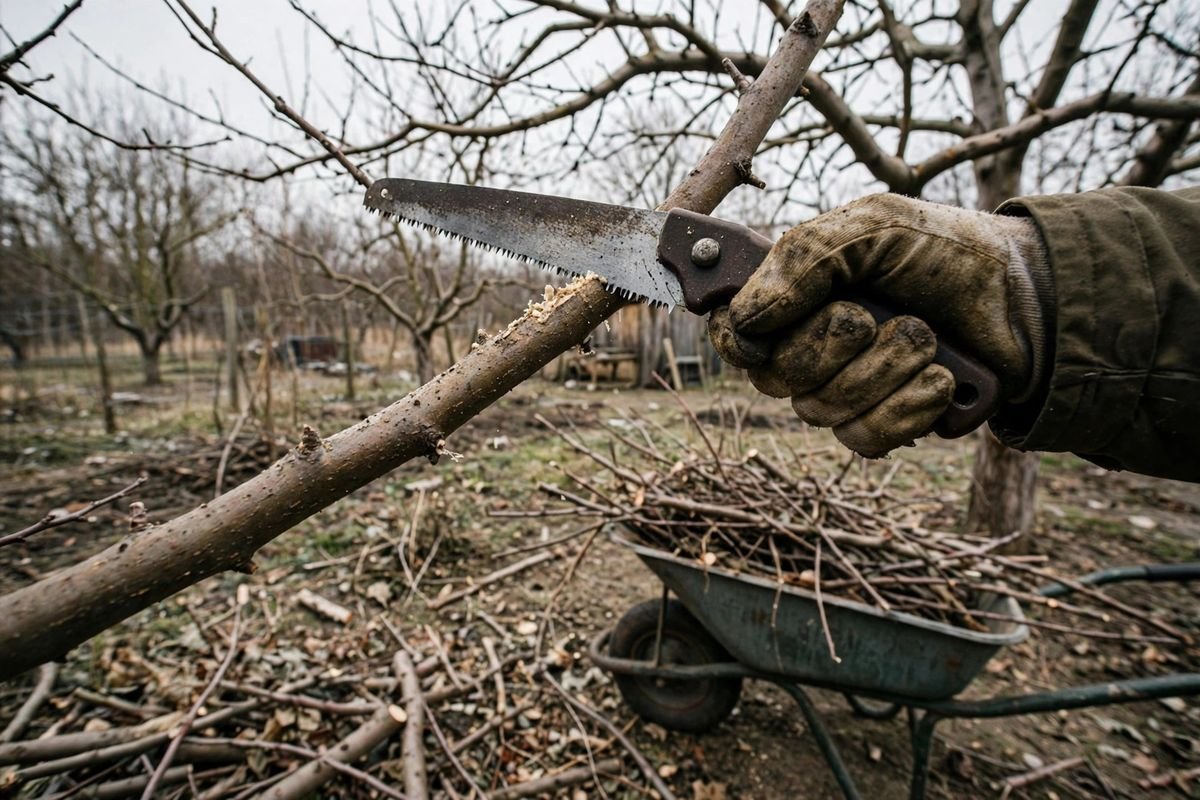
The folding joint is the weak point. It can loosen over years of use, and a blade that wobbles in the handle cuts a wider kerf and tires the arm faster. Check the lock before each cut, and tighten or replace the saw when the blade no longer locks solidly. If you need a folding saw, you can browse folding pruning saws on Amazon. We have not tested the products linked here, and we give no current store prices. Check each listing for current details before you buy.
Fixed-blade pruning saws
A fixed-blade saw has no joint. The blade runs straight from the handle, which makes the tool stiffer and the cut more direct. That stiffness shows up on thick limbs, where a fixed blade tracks a straight line and wastes less effort than a blade that flexes at a hinge.
The price of that stiffness is carry. A fixed blade needs a sheath or a scabbard, and the sheath needs to stay on whenever the saw is not cutting. A bare fixed blade in a tool bucket is a cut waiting to happen, and a blade banging against other tools dulls faster. Gardeners who work from a ladder often prefer a fixed blade, since there is no lock to fumble with one-handed.
Fixed-blade saws suit a gardener with a set pruning routine and thick limbs on mature trees, where the stiff blade earns its keep. If you need a fixed-blade saw, you can browse fixed-blade pruning saws on Amazon.
Pole saws
A pole saw puts a pruning blade on the end of a long pole, so branches eight to fourteen feet up can be cut with both feet on the ground.
Reach costs control. A blade at the end of a twelve-foot pole is hard to place exactly, and the cut often lands a little off the branch collar or leaves a longer stub than a hand saw would. The pole also flexes, which slows the cut and makes it harder to keep the teeth in the kerf.
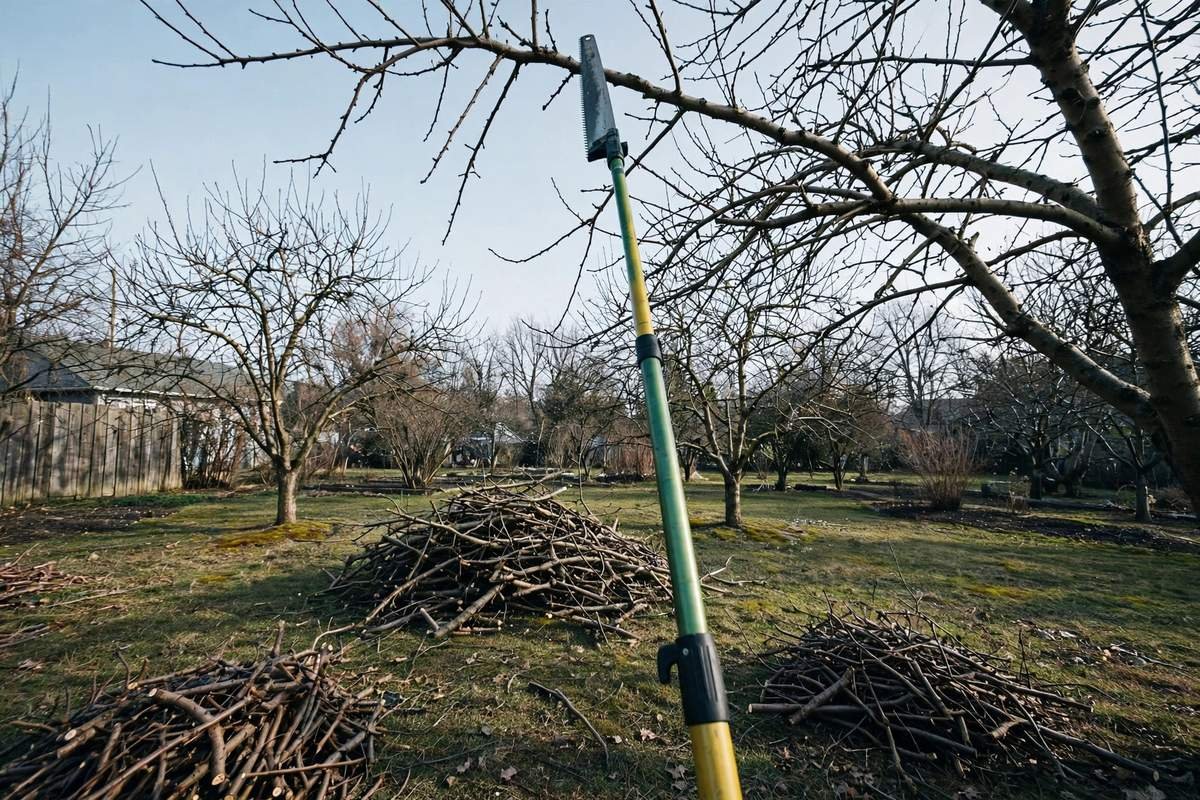
Safety rules matter more with a pole saw than with any hand saw. Never use a pole saw near power lines, and never cut a branch that could fall toward you or toward a fence, a roof, or a person. If you need a pole saw, you can browse manual pole saws on Amazon.
How to match the saw to the branch
Match the tool to the branch diameter before reaching for it. Hand pruners cover stems up to about three quarters of an inch. Loppers cover branches up to about one and a half inches. A hand saw covers branches from about one inch up to about four inches. Leave anything thicker than four inches, or any job needing a ladder plus a saw plus a rope, to a certified arborist.
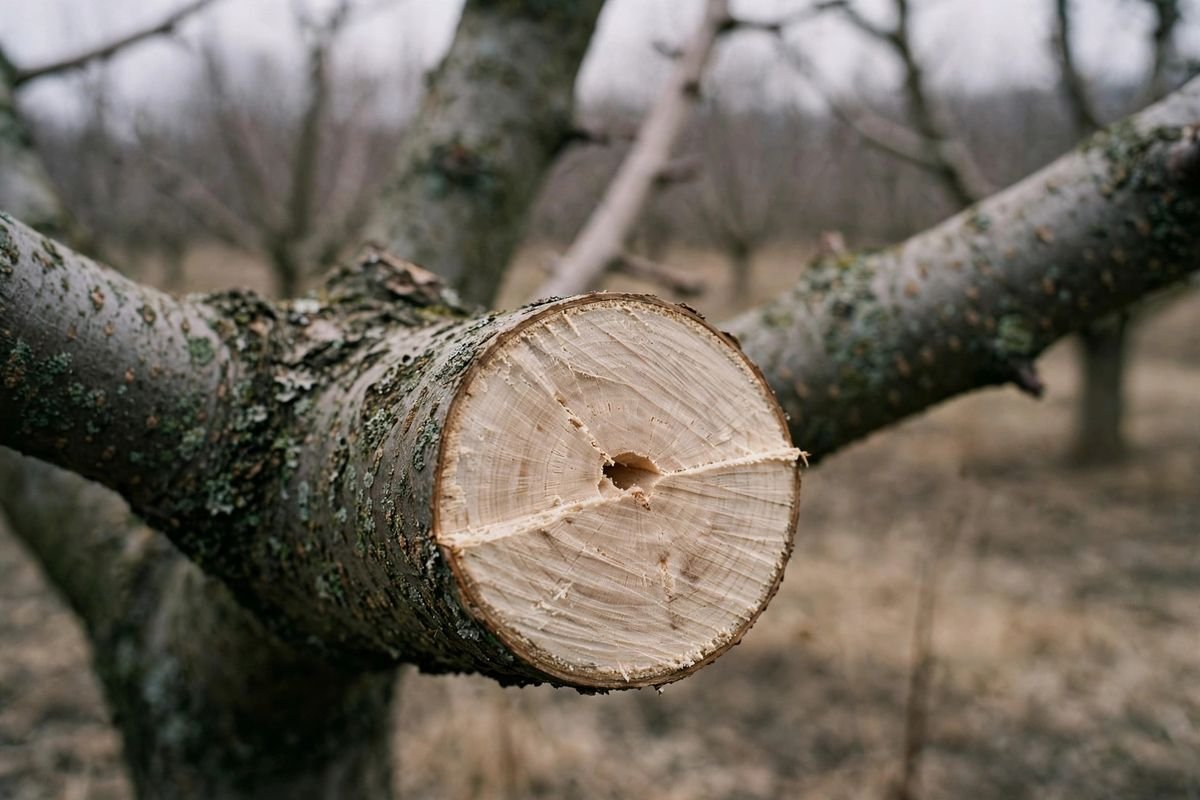
Cut size also decides the cutting method. A branch under two inches can come off in one cut, made just outside the branch collar, the slightly swollen ring where the branch meets the trunk or a larger limb. A branch over two inches needs the three-cut method: an undercut a foot out from the trunk, a top cut just past the undercut to drop the limb, and a final cut just outside the collar to remove the stub. For the full winter routine, see our guide on how to prune fruit trees in winter.
Reach decides between a hand saw and a pole saw. If the branch can be reached with both feet on the ground or from a stable ladder, a hand saw gives the cleaner cut. If the branch is high and the ladder cannot reach it safely, a pole saw is the right call. For the small cuts that come before the saw work, see our guide on the best pruning shears for home gardeners.
Which saw fits your orchard
Choose a folding saw if you walk between trees with tools in your pockets. Choose a fixed-blade saw if you prune from a ladder and cut thick limbs. Choose a pole saw if your trees are tall and you want to cut high branches without climbing.
Our worked example: cost per season for one backyard orchard
Here is the cost-per-season math for one backyard orchard with six fruit trees, pruned once a year in late winter. Every price and lifespan below is a stated example figure for the math, not a store price. Change any figure and the result changes with it.
Assumptions: the orchard has six fruit trees, a mix of apple, pear, and plum; each tree is pruned once a year; example purchase prices are 30 dollars for a folding saw, 35 dollars for a fixed-blade saw, and 60 dollars for a pole saw; example blade lives are five seasons for a folding saw, eight seasons for a fixed-blade saw, and six seasons for a pole saw; example replacement blades cost 15 dollars for a folding saw, 18 dollars for a fixed-blade saw, and 25 dollars for a pole saw.
| Type | Example price | Example blade life | Example replacement blade | Cost over 10 seasons | Cost per season |
|---|---|---|---|---|---|
| Folding saw | $30 | 5 seasons | $15 | $45 | $4.50 |
| Fixed-blade saw | $35 | 8 seasons | $18 | $53 | $5.30 |
| Pole saw | $60 | 6 seasons | $25 | $85 | $8.50 |
The math is simple. Add the purchase price to the replacement blades needed over ten seasons, then divide by ten. For the folding saw, 30 dollars plus one 15-dollar blade is 45 dollars over ten seasons, or 4.50 dollars per season. For the pole saw, 60 dollars plus one 25-dollar blade is 85 dollars over ten seasons, or 8.50 dollars per season. The folding saw is the cheapest per season in this example, and the pole saw is the dearest.
Time is the other half of the cost. Assume each tree needs about 15 saw cuts in a yearly pruning, which is 90 cuts for six trees, and assume each two-inch cut takes about 30 seconds of sawing. That works out to about 45 minutes of sawing for the whole orchard, before counting the time spent moving between trees and hauling brush.
Keeping a pruning saw sharp and clean
A dull saw tears wood instead of cutting it, and torn cuts heal slowly and invite disease. Most pruning saw blades cannot be sharpened with an ordinary file, because the teeth are hardened. When the blade stops cutting cleanly, replace it rather than grinding at it. For the tools that can be sharpened at home, see our guide on how to sharpen pruning shears.
Clean the blade between trees as well as at the end of the day. Wipe it with a cloth dampened with 70 percent alcohol or a one-to-nine mix of household bleach and water, and let it dry before the next cut. Our guide on how to clean and disinfect garden tools covers the full routine.
Store the saw dry, with the blade sheathed or folded shut, and a light wipe of oil on the blade before it goes on the shelf. A saw left damp in a shed rusts over winter, and rust shortens the blade life the cost table assumes.
Troubleshooting
The saw binds halfway through a cut
A binding saw usually means the blade is pinching in the kerf, which happens when the branch sags as it is cut. Support the branch before cutting, and use the three-cut method on limbs over two inches. A blade with packed sawdust in the teeth also binds, so brush the teeth clean.
The cut leaves a ragged, torn surface
A ragged cut comes from a dull blade, a blade pushed instead of pulled, or a cut made too far from the branch collar. Pruning saws cut on the pull stroke, so let the teeth do the work on the pull and ease off on the push. Replace a blade that tears even with good technique.
The blade wanders off the cut line
A wandering blade usually means the gardener is forcing the cut or the blade is loose in a folding handle. Slow down, check that a folding blade locks solidly, and start the cut with short gentle strokes to set the kerf before lengthening the stroke. A pole saw wanders more than a hand saw by nature, so save fine cuts for a hand saw.
Sap gums up the blade
Fresh sap sticks to teeth and slows the cut, most often on pine relatives and on stone fruit in spring. Wipe the blade with a damp cloth during the job, and wash it with warm soapy water at the end of the day. Pruning in late winter, while the tree is dormant, keeps gumming to a minimum.
Frequently asked questions
What size saw do I need for fruit trees?
A blade six to ten inches long covers most home orchard work, cutting branches up to about four inches thick. A pole saw adds reach rather than cut size, and it handles the same four-inch branches at height.
Can I use a regular carpenter saw on a fruit tree?
A carpenter saw will cut the wood, but it is built for dry lumber and its teeth clog fast in green wood. A pruning saw has teeth shaped to clear wet sawdust and cuts on the pull stroke, which gives a cleaner cut in living wood.
When should I prune fruit trees?
Most fruit trees are pruned in late winter, while the tree is dormant and before buds break. Dead and broken branches can come off at any time of year. Check your local frost dates and regional extension guidance for the exact window.
Do I need a pole saw if I own a ladder?
Not always. A ladder plus a hand saw gives a cleaner cut than a pole saw, and it suits trees that stay under about twelve feet. A pole saw earns its place when the trees are taller than a safe ladder reach.
Sources and further reading
- University of Minnesota Extension, Pruning Trees and Shrubs
- University of Maryland Extension, Pruning Tools
- North Carolina State University Extension, Training and Pruning Fruit Trees in North Carolina
Related reading: How to Prune Fruit Trees in Winter, How to Sharpen Pruning Shears, Best Pruning Shears for Home Gardeners, How to Clean and Disinfect Garden Tools
By the Pot and Plot Team