
This post may contain affiliate links. If you buy through links on this page, we may earn a commission at no extra cost to you.
As an Amazon Associate I earn from qualifying purchases.
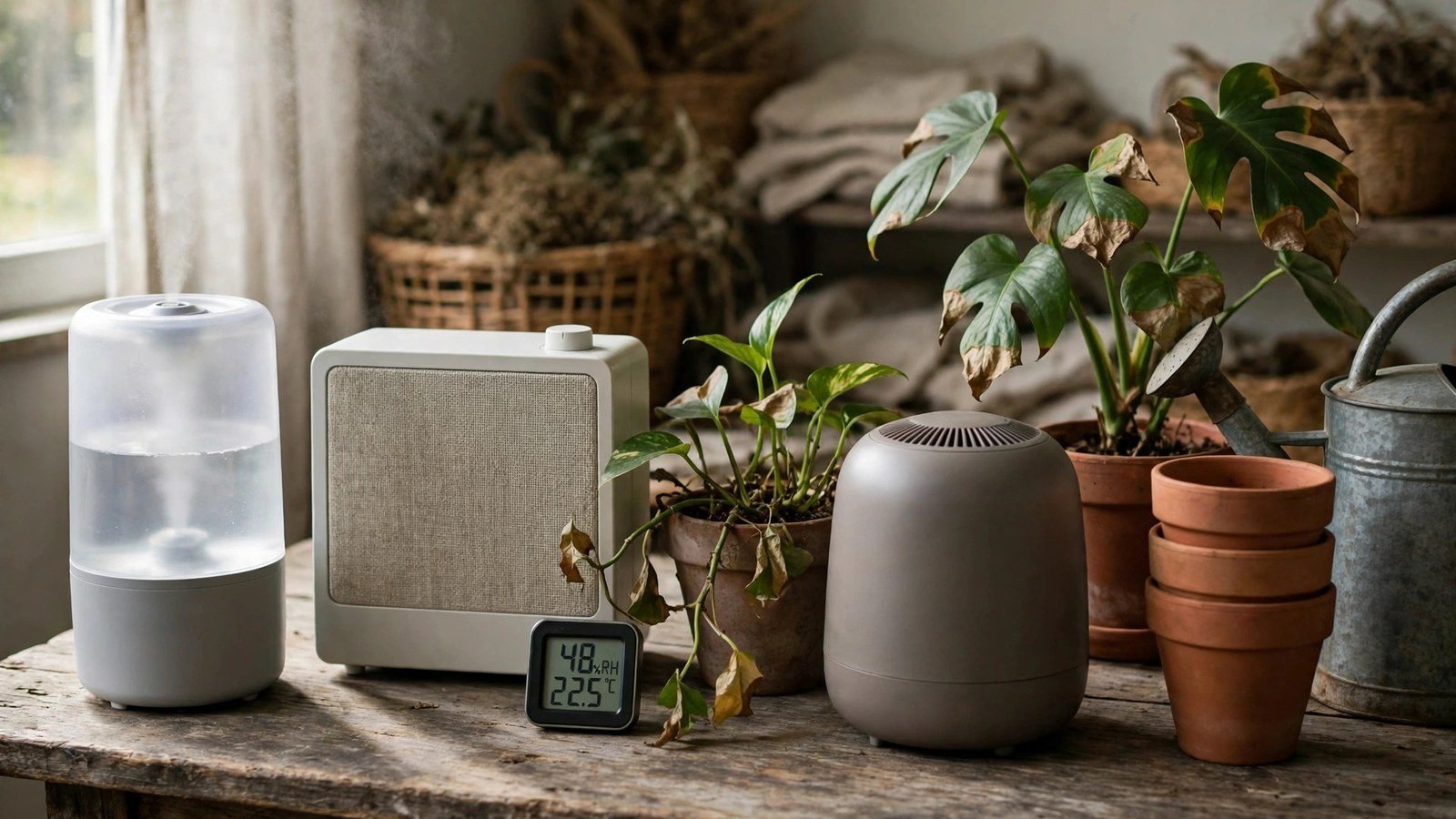
Winter heating dries indoor air fast. A heated living room in January often sits at 20 to 30 percent relative humidity, while most tropical houseplants come from places where the air holds 50 percent humidity or more. The gap shows up as brown leaf tips, crispy leaf edges, and plants that stall even when the watering routine is right. A humidifier closes that gap, but the three common types differ in noise, running costs, and cleaning chores.
This guide compares evaporative, ultrasonic, and warm-mist humidifiers side by side, with a comparison table, a worked running-cost example for a 150-square-foot room, and the cleaning routine that keeps any of them safe to run near plants. We have not tested the models linked here, and this guide compares types rather than naming tested winners. Winter timing in this guide follows local frost dates rather than a USDA zone number alone, since two gardens in the same zone can sit weeks apart on frost.
The three types at a glance
Every room humidifier adds water vapor to the air, but each type gets there by a different route. An evaporative unit blows air through a wet wick. An ultrasonic unit shakes water into a fine cool mist with a vibrating plate. A warm-mist unit boils water and releases steam. The table below gives the short version, and the sections after it fill in the tradeoffs for each type.
| Type | How it adds moisture | Noise | Running cost | Main drawback |
|---|---|---|---|---|
| Evaporative | Fan blows room air through a wet wick | Low fan hum | Low | Wick needs regular cleaning and replacement |
| Ultrasonic | Vibrating plate turns water into fine cool mist | Near silent | Low | Tap water minerals can leave white dust |
| Warm mist | Heating element boils water into steam | Low hum | High | Uses far more power and the steam is hot |
Evaporative humidifiers
An evaporative humidifier holds a wick, usually a paper or fabric pad, that sits partly in a water tank. A fan pulls dry room air through the wet wick, and the water evaporates into the air stream. The output rises when the air is dry and falls as the room gets more humid, which gives this type a natural self-limiting habit.
The fan makes a steady low hum, about the level of a small desk fan on its lowest setting. The wick is the part that needs care. It traps minerals from the water and grows slimy if it stays damp for weeks without cleaning, so rinse it often and replace it on the schedule in the manual. A wick left too long also cuts output, since a clogged wick passes less air.
Evaporative units suit larger rooms and plant collections, because they move a good volume of air and the output adjusts itself to the room. If you need an evaporative unit, you can browse evaporative humidifiers on Amazon. We have not tested the products linked here, and we give no current store prices. Check each listing for current details before you buy.
Ultrasonic humidifiers
An ultrasonic humidifier uses a small metal plate that vibrates at a very high frequency to break water into a fine cool mist. The mist drifts out of a nozzle and evaporates into the room air. There is no fan and no heating element, so the unit runs near silent and draws little power.
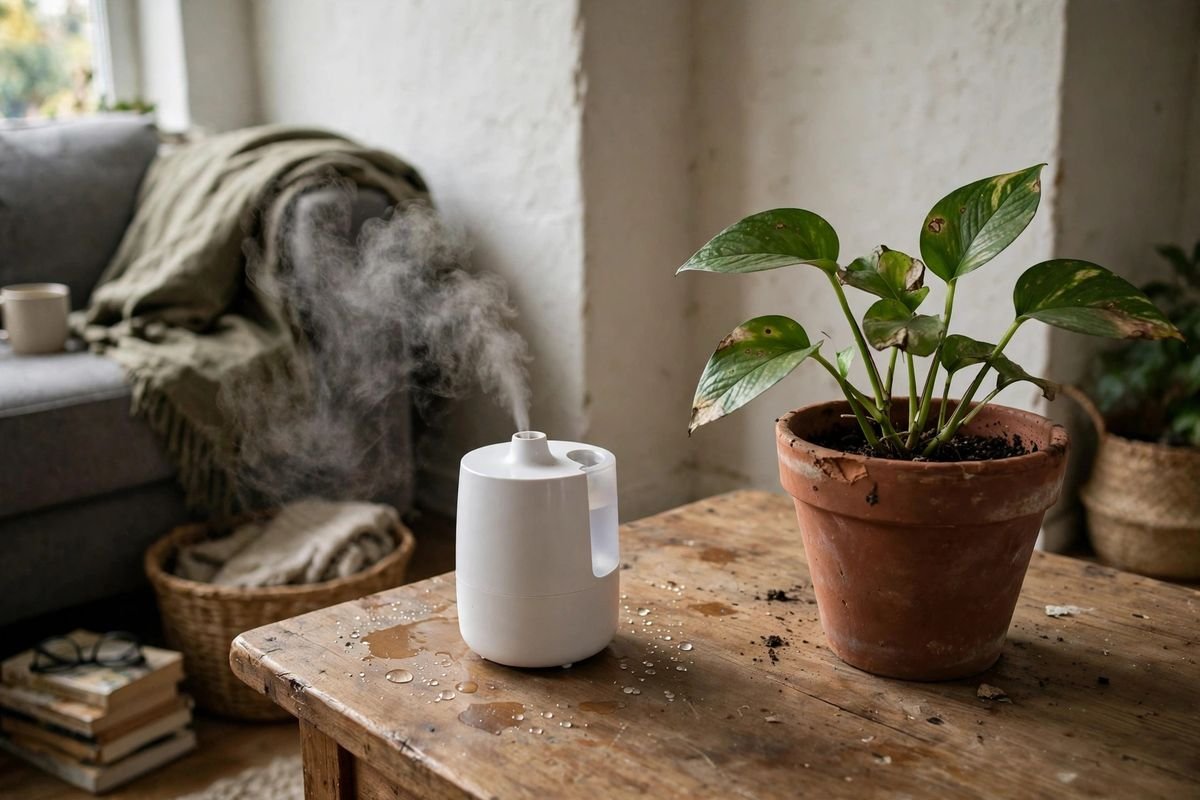
The fine mist is also the weak point. Tap water carries dissolved minerals, and an ultrasonic unit sends those minerals into the air with the mist. They settle as a fine white dust on leaves and shelves. The dust wipes off, but it can clog leaf pores if it builds up, so many owners run distilled or filtered water in these units, which adds a small ongoing cost.
Ultrasonic units suit small rooms and small plant groups, where a quiet unit beside the pots is enough. They suit a bedroom shelf of calatheas or ferns, where silence matters more than raw output. For a large open room, one small ultrasonic unit may not lift the humidity enough on its own. If you need an ultrasonic unit, you can browse ultrasonic cool mist humidifiers on Amazon.
Warm-mist humidifiers
A warm-mist humidifier boils water with a heating element and releases the steam into the room. The steam kills most germs in the water as it boils, which removes the white dust problem that ultrasonic units have with tap water.
The tradeoff is power. Boiling water takes far more electricity than shaking it into mist or blowing air through a wick, and the worked example below shows the gap in dollars. The steam is also hot, so keep the unit a few feet from the pots and out of reach of children and pets. Hot steam on a leaf can scald it.
Warm-mist units suit a gardener who wants to run plain tap water without white dust and who does not mind the higher power bill. They suit a cold room where the extra warmth is welcome. They are a poor fit for a small warm bedroom in summer, where the added heat works against comfort. If you need a warm-mist unit, you can browse warm mist humidifiers on Amazon.
How much humidity do houseplants need
Most common houseplants grow well at 40 to 60 percent relative humidity. Ferns, calatheas, and other tropical foliage plants prefer the upper end of that range, near 50 to 60 percent. Succulents and cacti are happy at the lower end and can suffer in air that stays too damp. A room that holds 45 percent humidity through winter suits most mixed collections.
Guesswork fails here, because a room can feel fine to people while sitting at 25 percent humidity. A small hygrometer gives a real number to work from. Place it at plant height, near the pots rather than on a far wall, and check it morning and evening for a week before deciding whether a humidifier is even needed. Some homes hold 40 percent humidity all winter without any device.
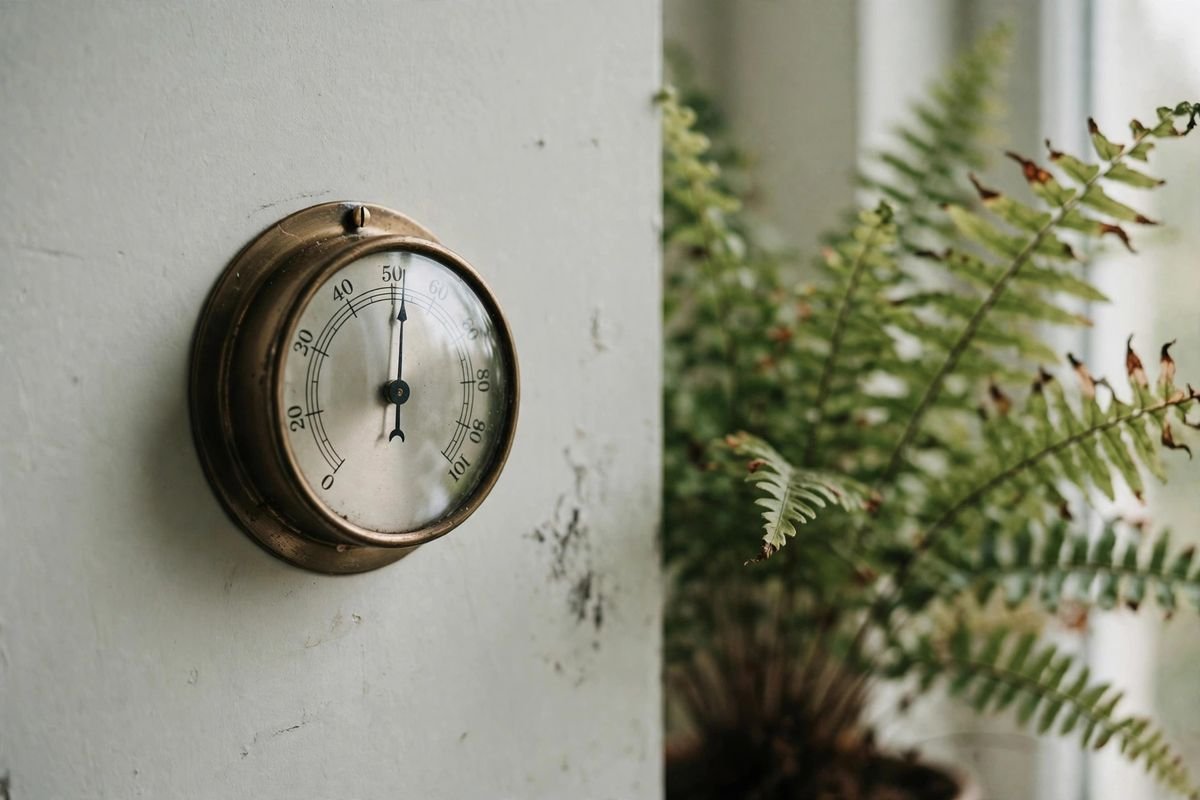
Humidity and watering work together. Dry air pulls water from leaves faster, so plants in dry rooms need more frequent watering, and the soil dries out sooner. Raising the humidity slows that loss, which can stretch the time between waterings by a day or two. For the watering side of the winter routine, see our guide on how to water indoor plants in winter. Herbs kept indoors through winter face the same dry air, and our guide on how to grow herbs indoors in winter covers their light and water needs. If you need a hygrometer, you can browse digital hygrometers on Amazon.
Which type fits your home
Choose evaporative if the room is large, the plant collection is big, and you want steady output that will not over-humidify the room. Choose ultrasonic if the room is small, quiet running matters, and you are willing to use distilled or filtered water to avoid white dust. Choose warm mist if you want to run plain tap water, you like the germ-killing boil, and the higher power use fits your budget.
Avoid choosing on mist looks alone. A thick visible plume from an ultrasonic unit looks strong, but much of that mist falls back to the surface before it evaporates, while an evaporative unit with no visible mist can be adding just as much water to the air.
Our worked example: running costs for a 150-square-foot room
Here is the running-cost math for a 150-square-foot room, about the size of a spare bedroom with a plant shelf along one wall. These are our own computed numbers, and every input below is a stated assumption for the math, not a rating of any product on sale. Change any input and the result changes with it, so rerun the same steps with your own unit and your own power rate.
Assumptions: the room is 150 square feet with the door closed most of the day; each type runs 8 hours a day; power costs 15 cents per kilowatt hour; the ultrasonic unit draws 25 watts; the evaporative unit draws 30 watts; the warm-mist unit draws 300 watts. The watt figures are assumed values for this example, chosen to show the size of the gap between types.
| Type | Watts (assumed) | Power per day, 8 hours | Cost per day | Cost per month, 30 days | Cost for a 4-month heating season |
|---|---|---|---|---|---|
| Ultrasonic | 25 | 0.20 kWh | $0.03 | $0.90 | $3.60 |
| Evaporative | 30 | 0.24 kWh | $0.04 | $1.08 | $4.32 |
| Warm mist | 300 | 2.40 kWh | $0.36 | $10.80 | $43.20 |
The math is simple. Multiply watts by hours, divide by 1,000 to get kilowatt hours, then multiply by the power rate. For the ultrasonic unit, 25 watts times 8 hours is 0.20 kilowatt hours, and 0.20 times 15 cents is 3 cents a day. For the warm-mist unit, 300 watts times 8 hours is 2.40 kilowatt hours, and 2.40 times 15 cents is 36 cents a day. Over a four-month heating season, the warm-mist unit costs about ten times as much to run as either cool type.
Power is only part of the running cost. An ultrasonic unit run on distilled water adds the price of that water, and an evaporative unit adds replacement wicks through the season. A warm-mist unit adds neither, but its power bill dwarfs those small extras.
Keeping a humidifier clean and safe
A humidifier tank is a warm, damp box, and that is exactly where mold and bacteria grow. Empty the tank every day, rinse it, and refill it with fresh water. Once a week, wash the tank and the wick housing with mild soap and water, rinse well, and let the parts dry fully before refilling. A unit that smells musty or shows pink or dark film inside needs a full wash before it runs again.

Never let water sit in a tank for days between uses, and never run a unit with a tank that has visible film inside. Keep the humidifier on a flat, stable surface, and keep the mist outlet a few feet from the nearest leaves. Aim for room humidity between 40 and 60 percent, and turn the unit off or down if condensation forms on the windows.
Troubleshooting
White dust settles on leaves and shelves
White dust comes from minerals in tap water, and it is most common with ultrasonic units. Switch to distilled water or filtered water, wipe the leaves with a damp cloth, and clean the tank before refilling. Evaporative and warm-mist units do not spread minerals this way.
The hygrometer reading barely moves
A reading that stays flat after a day of running points to a unit that is too small for the room, a door left open, or a tank that ran dry overnight. Close the door, refill the tank, and check again after 24 hours. If the room is large or drafty, group the plants closer together so the mist serves a smaller volume of air.
The humidifier smells musty
A musty smell means film or mold has grown inside the tank or on the wick. Empty the unit, wash every part that touches water with mild soap, rinse well, and let it dry fully before use. Replace a wick that still smells after washing, and empty and refill the tank daily.
Leaf tips still turn brown
Brown tips can come from dry air, but they can also come from salts in the soil, inconsistent watering, or cold drafts. Check the hygrometer first: if the room holds 40 to 50 percent humidity and the tips still brown, look at the watering routine and whether the pot sits near a heating vent. Fixing the air alone will not cure a watering problem.
Frequently asked questions
Do houseplants need a humidifier in winter?
Many do, because heated winter air often drops to 20 to 30 percent humidity while most tropical houseplants prefer 40 to 60 percent. Check with a hygrometer first. If the room already holds 40 percent humidity or more, the plants may not need a humidifier at all.
Is misting leaves a good substitute for a humidifier?
Misting raises humidity for a few minutes and then the water evaporates, so the effect is brief. It can also leave water sitting on leaves, which favors leaf disease. A room humidifier, or grouping plants together on a pebble tray, gives a steadier lift in humidity than misting.
Can a humidifier make a room too humid?
Yes, if it runs without limit in a small closed room. Watch for condensation on windows and a damp smell, and keep the room between 40 and 60 percent humidity. Evaporative units slow down on their own as the air gets damp, while ultrasonic and warm-mist units need the built-in humidistat or a manual shutoff.
Should I run a humidifier all night?
Running overnight is fine if the unit has an automatic shutoff when the tank empties, and if the room stays in the 40 to 60 percent range. Check the hygrometer in the morning for the first week. If the windows show condensation by morning, run the unit on a lower setting or for fewer hours.
Sources and further reading
- University of Minnesota Extension, When to Bring Houseplants Inside for the Winter
- North Carolina State University Extension, Plants Grown in Containers
- University of Minnesota Extension, When Houseplants Go Outside
Related reading: How to Water Indoor Plants in Winter, How to Grow Herbs Indoors in Winter, Best Light Meters for Indoor Gardeners, Best Indoor Herb Garden Kits
By the Pot and Plot Team