
This post may contain affiliate links. If you buy through links on this page, we may earn a commission at no extra cost to you.
As an Amazon Associate I earn from qualifying purchases.
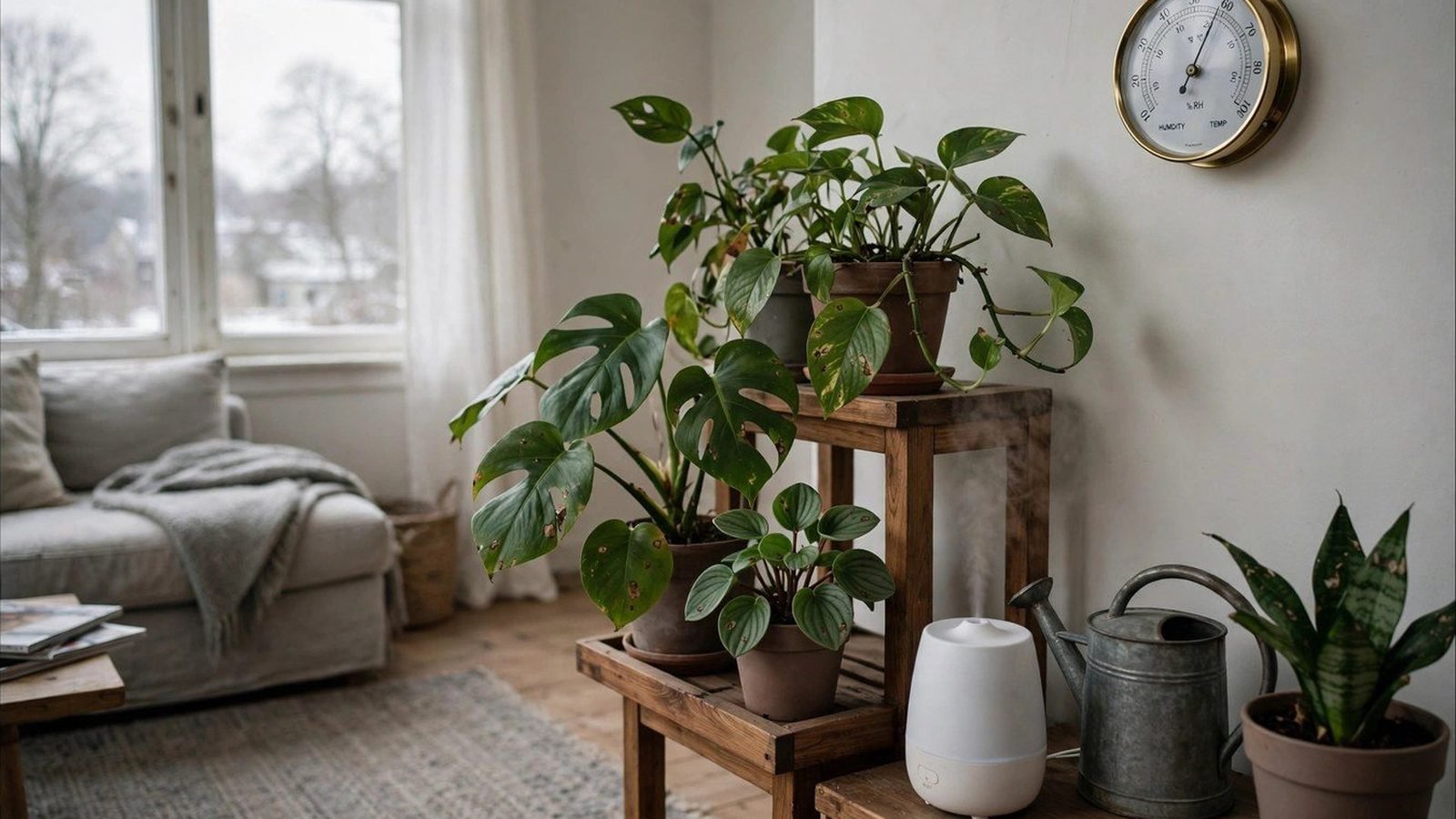
Winter is the hardest season for indoor plants, and the cause is usually not cold or darkness alone. It is dry air. Cold outdoor air holds very little moisture, and heating that air to room temperature dries it further, so a house that felt fine in October can drop to 10 or 20 percent relative humidity by January. Most houseplants come from warm, humid places and prefer 40 to 50 percent, so the gap between what the room offers and what the plant wants is wide all winter. The signs show up slowly: brown leaf tips, crisp edges, and growth that stalls until spring.
This guide explains how to measure the humidity in your rooms, which methods actually raise it, and which popular tips do almost nothing. The worked example below runs the numbers for one real room, with the assumptions stated. For the watering side of winter care, see our guide on how to water indoor plants in winter.
Why heated winter air is so dry
Relative humidity is the share of moisture the air holds compared with the most it could hold at that temperature. Cold air can hold only a little water, so winter air arriving from outside is nearly dry in absolute terms. When the furnace warms that air from 30 degrees to 70 degrees, its capacity to hold water grows several times over, but no new water is added, so the relative humidity falls. That is why a house can sit at 10 to 20 percent relative humidity in January while the same house holds 50 percent in July.
Iowa State University Extension puts the winter figure plainly: many houseplants prefer a relative humidity of 40 to 50 percent, while the air in many homes during the winter months may be only 10 to 20 percent. Penn State Extension adds that indoor relative humidity can easily fall below 30 percent during the heating season. The gap matters because leaves lose water to dry air all day through tiny pores, and a plant that cannot replace that water fast enough dries out at the edges first. Thin-leaved plants such as ferns, calatheas, and nerve plants show it first, while thick-leaved plants such as snake plants and ZZ plants cope far better. Move plants away from heat registers and cold glass.
How much humidity houseplants need
There is no single number for every plant, because different plants come from different climates. The table below gives the usual ranges cited by extension services. For people, the usual guidance is 30 to 50 percent indoors, which keeps the air comfortable and limits mold, and that range overlaps well with what most houseplants want. The plants that need more than that are better handled as a small group in one spot, rather than by pushing the whole house to a level that invites condensation on the windows. Keep the room below 60 percent to limit mold.
| Plant group | Relative humidity to aim for | Notes |
|---|---|---|
| Most common houseplants | 40 to 50 percent | Pothos, philodendron, spider plant, peace lily |
| Tropical plants | 50 to 60 percent | Calathea, fern, alocasia, nerve plant |
| Fussiest tropical plants | 60 percent or higher | Some calatheas and orchids; a closed case helps |
| Cacti and succulents | 30 to 40 percent | Low humidity suits them; extra moisture risks rot |
Measure first: use a hygrometer
Guessing the humidity wastes effort in both directions. A cheap digital hygrometer costs little, reads in seconds, and turns a vague worry into a number you can act on. Put one beside your plants at leaf height and leave it there for a few days, reading it morning and evening, because humidity shifts with the heating cycle and with cooking, showering, and the weather outside.
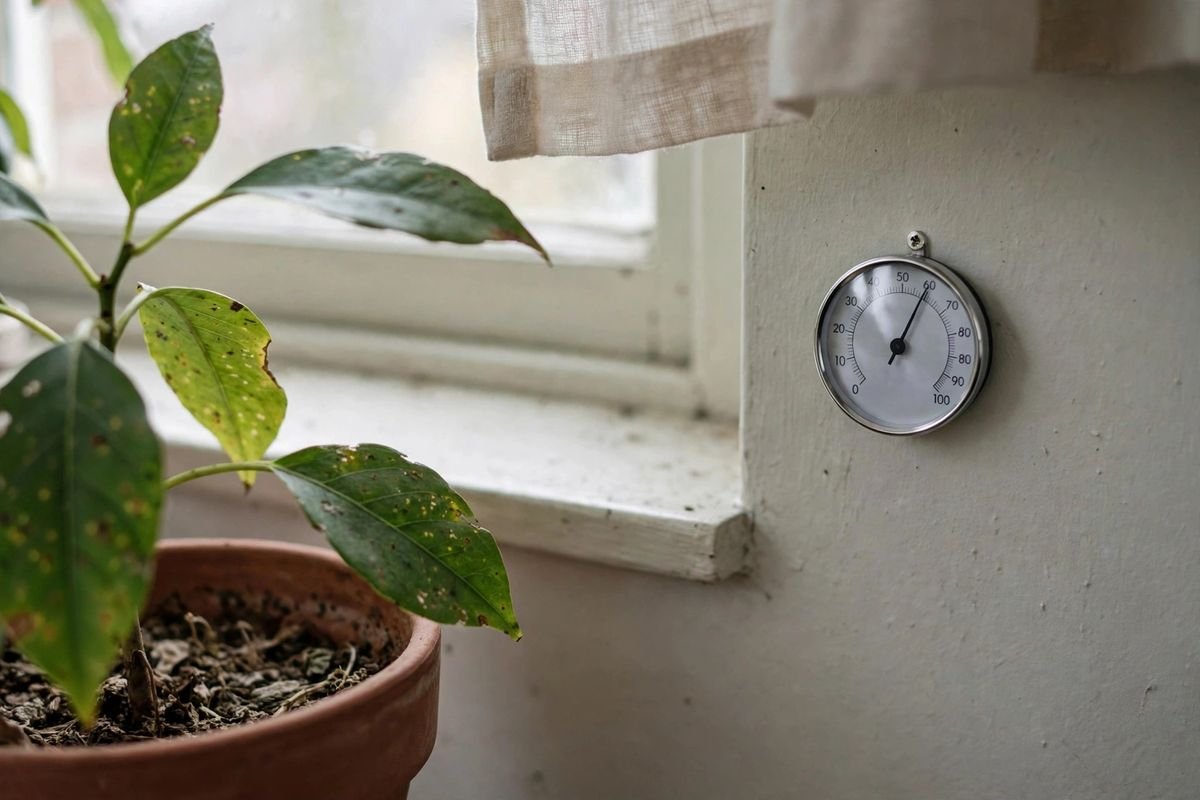
A reading of 40 percent or higher means most of your plants are fine and a humidifier can wait. A reading of 30 to 40 percent means the common plants will get through winter, but the tropical ones will show brown tips and may want a group setup or a pebble tray. A reading below 30 percent means the dry air is a real problem for anything tropical, and a humidifier is the honest fix. If you need a meter, you can browse digital hygrometers on Amazon. We have not tested the products linked here, and we give no current store prices. Check each listing for current details before you buy.
A humidifier does the heavy lifting
A humidifier is the most reliable way to raise humidity for houseplants. Iowa State calls humidifiers an excellent way to raise relative humidity in the home. A cool-mist or evaporative unit placed near the plants adds water to the air hour after hour, which is exactly what a dry room needs. A small unit rated at 1 to 2 pints per day suits one room of plants.
Place the humidifier close to the plants, within a few feet, raised off the floor so the mist drifts across the leaves instead of pooling on the floor. Run it on a timer or a humidistat if the unit has one, and aim to hold the room near 45 percent rather than running it flat out. Check the water tank daily in winter. Tap water leaves white mineral dust on leaves in hard-water areas, so distilled water is worth using if your water is hard. If you need a small unit for one room of plants, you can browse small room humidifiers on Amazon. We have not tested the products linked here, and we give no current store prices. Check each listing for current details before you buy.
Group plants together
Grouping plants is the simplest free method, and it works because plants release moisture from their leaves and from the soil surface. A cluster of plants shares that moisture, so the air inside the group stays a little more humid than the air in the rest of the room. Iowa State notes that the water evaporating from the potting soil, plus water lost through the foliage, raises the relative humidity near the grouped plants. The gain is modest, a few percentage points in most rooms, but it costs nothing.
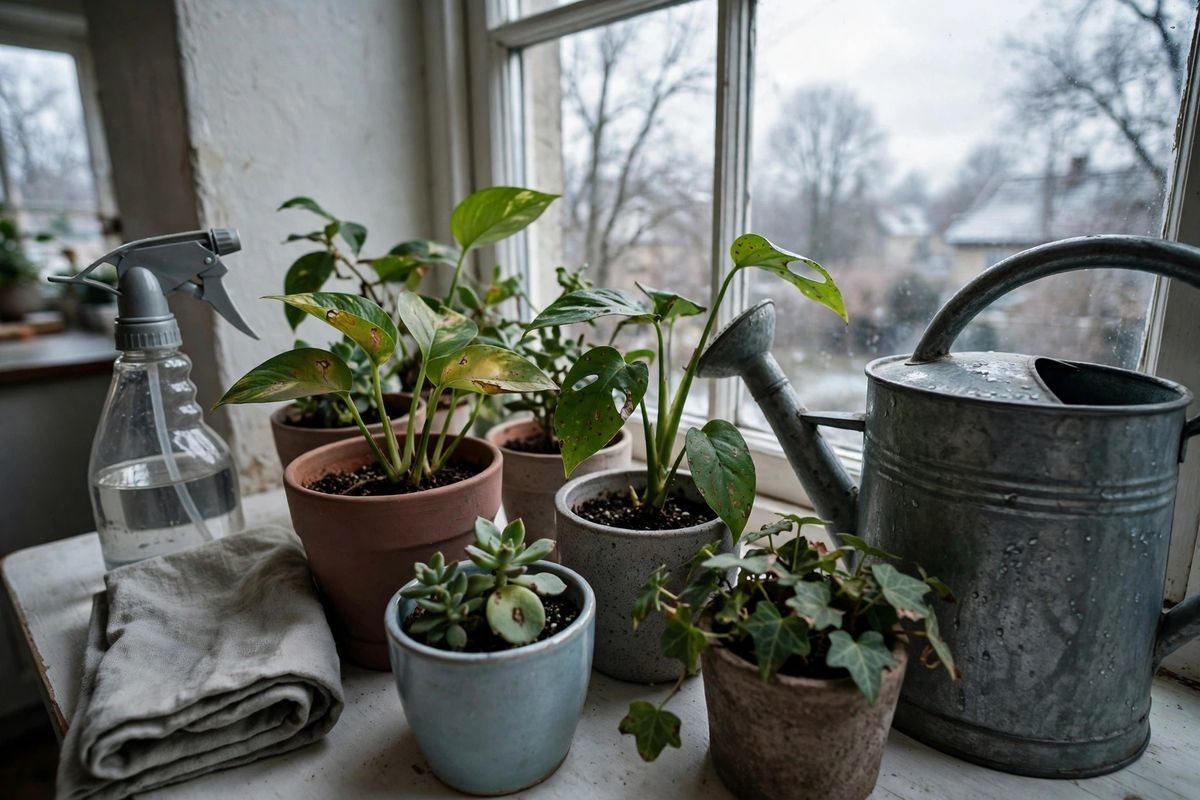
Put the plants that need humidity most in the center of the group and the tougher ones around the outside. A fern or a calathea in the middle, ringed by pothos and spider plants, gets more shelter than it would alone on a bare shelf. Grouping pairs well with a humidifier, since the humidifier raises the whole room and the group holds a pocket of moister air around the neediest plants. Grouping alone will not lift a room from 20 percent to 45 percent. Our guide to the best light meters for indoor gardeners covers placing the group where the light is enough without the cold glass.
Pebble trays
A pebble tray is a shallow tray filled with pebbles and water, with the pot standing on the pebbles above the water line. Water evaporates from the tray and moistens the air right around the plant. Iowa State lists pebble trays among the simple practices that raise humidity near houseplants, and the method suits a single prized plant or a small shelf of tropical plants. Keep the bottom of the pot above the water at all times, or the roots rot.
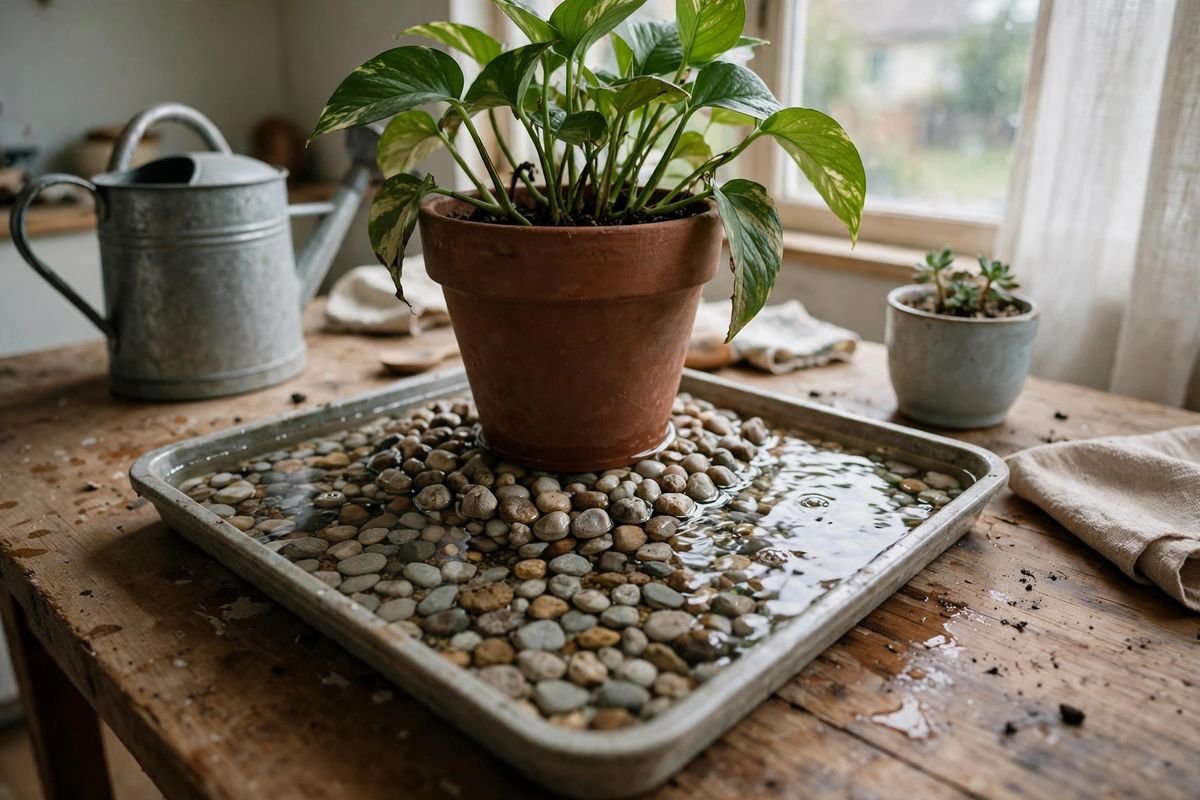
The effect of a pebble tray is local and small. It raises humidity in the few inches around the plant, not across the room, and the water needs topping up every few days as it evaporates. Penn State takes a skeptical view, noting that the evaporated water spreads through the room with almost no measurable effect, while other extension sources recommend the tray as a modest help. The tray helps the one plant sitting on it and does little for the room, so use it for that purpose, not as a substitute for a humidifier in a dry house. If you would rather buy a ready-made tray, you can browse plant humidity trays on Amazon. We have not tested the products linked here, and we give no current store prices. Check each listing for current details before you buy.
Our worked example: raising a 12 by 10 foot room from 20 to 45 percent
Here is a worked example with stated assumptions. The room is 12 feet by 10 feet with an 8-foot ceiling, which is 960 cubic feet of air. The room starts at 20 percent relative humidity and the goal is 45 percent, with the air at 70 degrees throughout. The humidifier is a small unit rated at 1.5 pints of water per day.
The math starts from how much water air holds at 70 degrees: a cubic foot of air holds about 0.52 grams of water when fully saturated. At 20 percent relative humidity it holds about 0.10 grams per cubic foot, and at 45 percent about 0.23 grams. The gap is about 0.13 grams per cubic foot, and over 960 cubic feet the room needs about 125 grams of water added to the air, or about 0.26 pints, since one pint of water weighs about 473 grams. These are our own computed figures.
| Step | Figure |
|---|---|
| Room volume, 12 by 10 by 8 feet | 960 cubic feet |
| Water in the air at 20 percent humidity | About 100 grams |
| Water in the air at 45 percent humidity | About 225 grams |
| Water to add, one-time fill | About 125 grams, or 0.26 pints |
| Humidifier output, 1.5 pints per day | About 30 grams per hour |
| Time to add 125 grams, sealed room | About 4 hours |
| Time with ordinary air leakage, half the moisture lost | About 8 hours |
The table shows two things. First, the one-time amount of water is small, about a quarter of a pint, which is why a pebble tray or a bowl of water can seem to help for an hour. Second, the room leaks: warm air escapes through gaps around doors and windows, and dry air comes in to replace it, so the humidifier has to keep working to hold the level. With half the added moisture lost to leakage, a 1.5-pint-per-day unit needs about 8 hours to lift this room from 20 to 45 percent. Run the same math for your own room by swapping in its length, width, and ceiling height, and check the result against your hygrometer after a day of running the unit.
What misting can and cannot do
Misting is the most repeated humidity tip and the least effective. Spraying the leaves wets them for a few minutes, and the humidity around the plant rises until the water evaporates, then falls straight back. Iowa State calls misting an ineffective way to raise relative humidity, because the leaves dry quickly and the effect lasts only minutes. Penn State puts it more bluntly: even daily misting does nothing to raise the humidity levels around a plant. Leaves that stay wet invite fungal spots, and water sitting in the crown of some plants can rot the growing point. For the average potted houseplant the spray bottle is a poor substitute for a humidifier. Herbs kept indoors through winter face the same dry air, and our guide on how to grow herbs indoors in winter covers their light and watering needs alongside the humidity question.
Troubleshooting
Leaf tips still turn brown after a week with a humidifier
Brown tips that appear after the humidity improves are often old damage finishing its course, because a leaf tip that dried out in December does not heal in January. Give it two or three weeks and watch the new growth instead: fresh leaves with clean tips mean the fix is working. If new leaves also brown at the tips, check the water. Fluoride and salts in tap water cause tip burn in sensitive plants, and switching to rainwater or distilled water can help.
The humidifier runs all day but the reading stays low
A reading that never moves points at the room, not the unit. Check for drafts around windows and doors, because a leaky room loses moisture as fast as a small unit adds it. Check the unit too: an empty tank, a clogged filter, or a mineral-caked wick can cut output to a trickle. Move the hygrometer closer to the plants, and consider a larger unit if the room is big or the winter is cold.
Frequently asked questions
Do all houseplants need a humidifier in winter?
No. Cacti, succulents, snake plants, and ZZ plants handle dry winter air well and often prefer it. Common plants such as pothos and spider plants cope with 30 to 40 percent and only show stress below that. The plants that truly need a humidifier are the thin-leaved tropical ones: ferns, calatheas, nerve plants, and some orchids. Check your hygrometer first, then buy a humidifier only for the plants that need it.
How often should I run the humidifier?
Run it as much as the hygrometer says you need. In a cold, dry week that may mean most of the day, with the unit set to hold about 45 percent. In a mild week it may mean a few hours in the morning. A unit with a built-in humidistat does this on its own, switching off when the room reaches the set level. Check the tank each morning and the hygrometer each evening, and adjust the setting when the weather changes.
Sources and further reading
- Iowa State University Extension and Outreach, How Can I Raise the Relative Humidity Indoors for My Houseplants?
- University of Minnesota Extension, Bringing Houseplants in for Winter
- University of Minnesota Extension, When to Bring Houseplants Inside for the Winter
Related reading: How to Grow Herbs Indoors in Winter, How to Water Indoor Plants in Winter, Best Light Meters for Indoor Gardeners
By the Pot and Plot Team