
This post may contain affiliate links. If you buy through links on this page, we may earn a commission at no extra cost to you.
As an Amazon Associate I earn from qualifying purchases.
Seedlings tell us when light falls short by growing tall and pale, but by then we have lost a week or more of compact growth. A light meter gives us a number at plant level before stems stretch, so we can move a light closer or shift a tray before the problem shows in the plants. The right meter depends on how much accuracy we need and how large our indoor setup has grown.
This guide compares three ways to measure light for indoor seed starting: phone-app light estimates, handheld lux meters, and PAR meters, also called quantum-style meters. We compare them by what each one measures, ease of use, and fit for a first shelf versus a larger indoor setup. We have not tested the products linked here, and we do not present any price below as a current store price. Where we give numbers, we state the assumptions so readers can judge the example on its own terms.
Three ways to measure light at a glance
| Option | What it measures | Ease of use | Fit |
|---|---|---|---|
| Phone-app estimate | An estimate of light level from the phone camera sensor | Open the app, hold the phone at plant level, read the screen | A first shelf, for rough comparisons between spots |
| Handheld lux meter | Light level in lux, read by a dedicated sensor | Hold the sensor flat at plant level, read the display | A first shelf or a few shelves, for repeatable readings |
| PAR meter | Photosynthetically active radiation, the light plants use for growth | Hold the sensor flat at plant level, read the display, and learn the unit it reports | A larger indoor setup, or a gardener who compares lights in plant terms |
Lux and PAR are not the same unit, and a lux number cannot convert to a PAR number with one simple factor that fits every light type. A lux meter tells us how bright light looks to a human eye, while a PAR meter tells us how much plant-usable light reaches the leaf. Use one unit for comparisons within one setup, and do not mix lux readings with PAR readings in the same set of notes.
Phone-app light estimates
A phone app estimates light level with the camera sensor that already sits in our phone, so it costs nothing extra and takes seconds to try. That low barrier is the main strength of the option. We can check a new shelf position and spot a dim corner without buying a device first. For a first shelf, an app gives a rough sense of which spots get more light, and that sense can guide tray placement.

The limits of a phone app are honest and plain. Phone apps estimate, and they are not a substitute for a dedicated meter where accuracy matters. Camera sensors differ between phone models, a phone case can shade the sensor, and readings may drift in dim light. An app reading can still guide a comparison within one phone on one day, but it cannot serve as a firm number to compare with a guide written for a dedicated meter. Treat app numbers as relative, note the phone model in our records, and move to a dedicated meter once decisions depend on the number. Search listings and app stores for a light meter app for plants only as a starting point before trusting any single reading.
Handheld lux meters
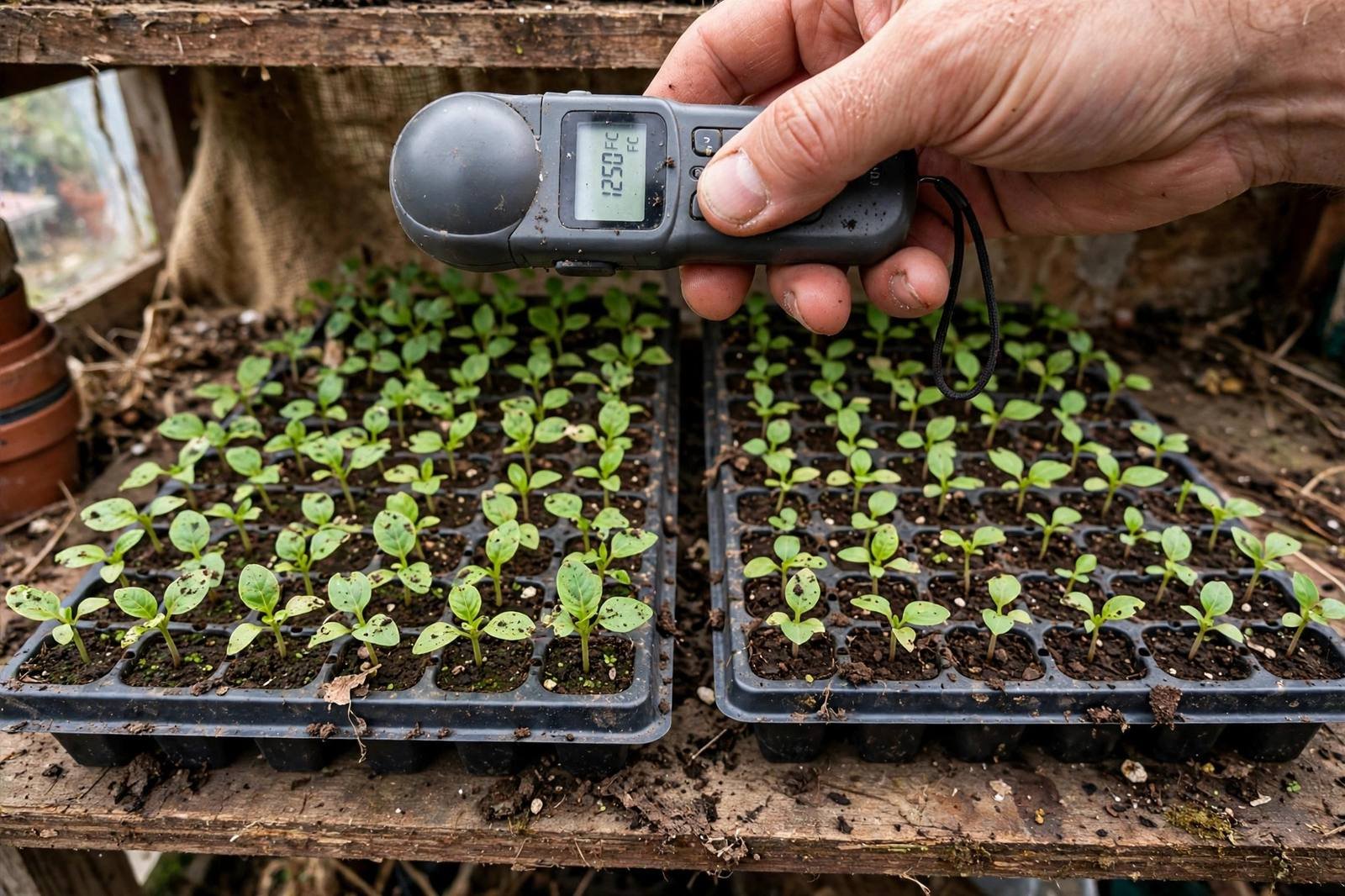
A handheld lux meter carries a dedicated sensor that reads light level in lux, and it suits a gardener who wants repeatable numbers without learning a new unit. We hold the sensor flat at plant level, read the display, and write the number down with the date. That routine gives us a repeatable record across weeks.

The limits of a lux meter come from the unit itself. Lux weights light by human vision, so a bulb that looks bright to us can read high in lux while giving plants less usable light than a bulb that reads lower. A lux meter cannot settle a close call between two grow lights with different color mixes. Use lux readings to compare spots under the same light and to find dim corners, but do not treat a lux number as a plant growth guarantee. Search listings for a handheld lux meter for plants and confirm the reading range and sensor type.
PAR meters
A PAR meter, also called a quantum-style meter, measures photosynthetically active radiation, the part of light that plants use for growth. That plant-based unit is the main strength of the option. When we compare two grow lights with different color mixes, a PAR reading speaks in plant terms, so the comparison rests on what leaves receive. A PAR meter also suits a larger setup, where several lights and shelves need a shared unit.
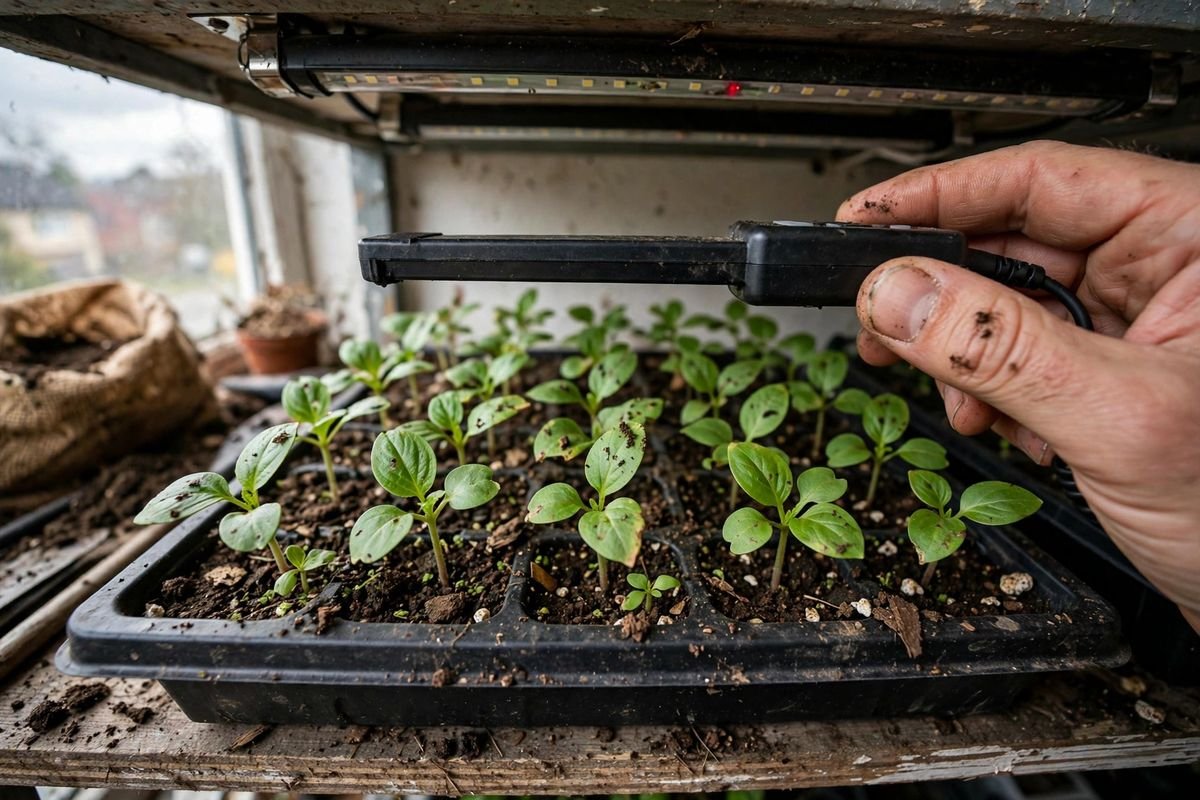
The limits of a PAR meter come from cost and from the learning curve of its unit. PAR meters tend to cost more than lux meters, and their readings need context before they guide a decision. A first shelf rarely needs that level of precision, since tray placement and light height solve most early problems. A PAR meter earns its place once we compare lights or run several shelves. Search listings for a PAR meter for indoor plants and confirm the unit it reports and the sensor shape.
Worked example: three readings on one shelf
Assume one shelf 2 feet by 1 foot under a single grow light, with seedlings at the same height across the tray. Hold the sensor flat at plant level and take three readings: one at the center, one at a long edge, and one at a corner. Write each reading down with the spot name and the light height, so the next set can repeat the same spots. In this example, the center reads 12,000 lux, the edge reads 9,000 lux, and the corner reads 6,000 lux, which is half the center reading. The example uses a lux meter, so all three numbers share one unit and one light type.

A corner at half the center calls for a tray move before it calls for a new light. Shift the tray toward the center so more plants sit in the brighter zone, and rotate it a quarter turn every few days. If the corner still reads near half after the shift, lower the light a small amount, or move the light so its center sits over the tray center. Our guide to how high grow lights should be above seedlings covers starting gaps and how to adjust them, and our guide to why seedlings grow leggy under grow lights covers the signs that light has fallen short.
If the corner still lags after tray moves and height moves, the shelf needs more light rather than a better meter. Add a second light over the dim end, or swap the single light for a longer fixture that covers the full shelf. Take the three readings again after any change, at the same spots and plant height. That pair shows whether the change worked, and it gives us a record for the next shelf. Our guide to best grow lights for seedlings compares fixture forms for a first indoor setup, and our guide to LED grow lights versus fluorescent lights for seedlings compares two common light types in plant terms.
How to choose
Choose a phone-app estimate if we run a first shelf, want a free first check, and only need rough comparisons between spots. Choose a phone app if we accept that its numbers are relative.
Choose a handheld lux meter if we want repeatable numbers and a shelf record across weeks. Choose a lux meter if we run one shelf or a few shelves and want a dedicated sensor.
Choose a PAR meter if we run a larger indoor setup and compare grow lights with different color mixes. Choose a PAR meter if we keep records across seasons and want each season to share one plant-based unit. Start with the shelf count and the decision at hand, then pick the option whose unit fits that decision. A rough check guides tray placement, while a meter record guides weekly adjustments.
Sources & Further Reading
University of Minnesota Extension, Starting seeds indoors: https://extension.umn.edu/planting-and-growing-guides/starting-seeds-indoors
North Carolina State Extension, Extension Gardener Handbook Chapter 13 Propagation: https://content.ces.ncsu.edu/extension-gardener-handbook/13-propagation