
This post may contain affiliate links. If you buy through links on this page, we may earn a commission at no extra cost to you.
As an Amazon Associate I earn from qualifying purchases.
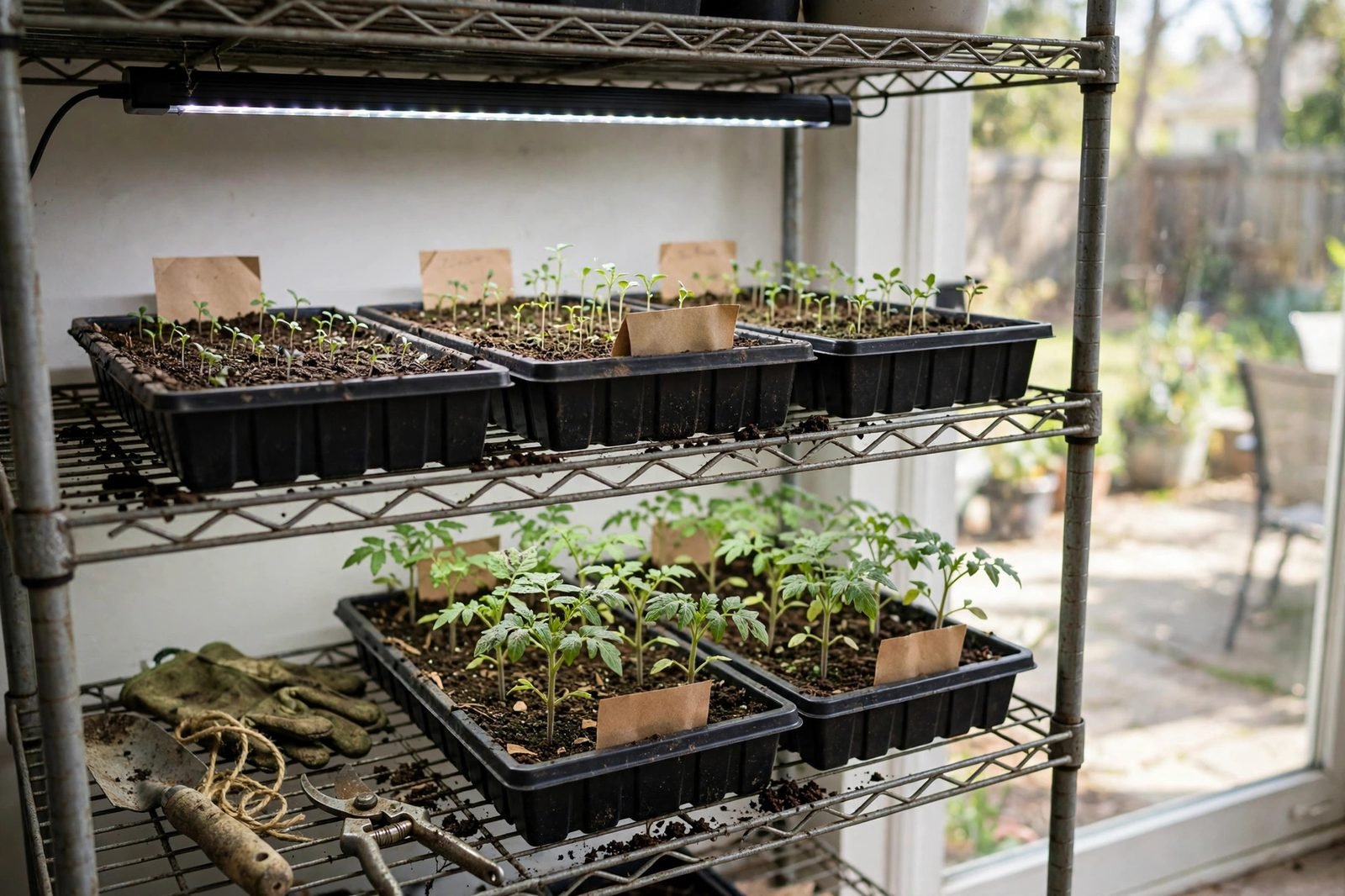
Strong seedlings come down to one thing more than any other: steady, close light for enough hours each day. A bright window helps, but in late winter the days are short and the light shifts across the sill, so stems stretch toward the glass and grow thin. A well-chosen grow light fixes that without much cost or fuss. The right fixture lights the whole tray evenly, stays cool near tender leaves, and runs on a timer so the routine holds even on busy days.
This is a research-based buying guide. We did not run hands-on product trials, and we will not pretend we did. We compared listed light types, common fixture sizes, and seller-stated wattage against standard seed-starting practice from university extension sources, then did the coverage and running-cost math ourselves so the numbers rest on stated assumptions you can check. The guide covers the four light types most home gardeners use, how to size light to tray count, and a clear pick for one tray, a full shelf, and a tight budget. For the head-to-head view, see our comparison of LED grow light versus a sunny window and our breakdown of grow light bars versus bulbs.
| Light Type | Coverage | Heat | Energy Use | Best Fit |
|---|---|---|---|---|
| LED bar | Even strip, 2 to 4 ft long; one bar lights one 10×20 tray well, two bars light two trays with overlap | Low; cool to the touch in most models | Low; about 20 to 40W per bar | Wire shelves and multi-tray setups |
| LED shop light | Wide 4 ft strip; covers two trays side by side or one wide flat | Low to moderate; housing warms slightly | Low; about 32 to 64W per fixture | Garage benches and wide shelves |
| Fluorescent tube fixture | Even strip, 2 to 4 ft; two-tube fixtures light one to two trays | Moderate; tubes warm the air just above trays | Higher than LED; about 32 to 80W per fixture | Gardeners who already own a fixture |
| Bulb (clamp or screw-in) | Bright circle, roughly 12 to 18 inches across; needs several bulbs per tray | Low for LED bulbs, higher for older CFL bulbs | Low per bulb; adds up with multiples | One small tray or a single potted herb |
No single type wins on every shelf. A bar fits the way most of us actually start seeds — in trays on a wire shelf — while a shop light suits a wide bench and a bulb suits a corner with one tray. The sections below walk through how to match the fixture to the space.
What Seedlings Need From Light
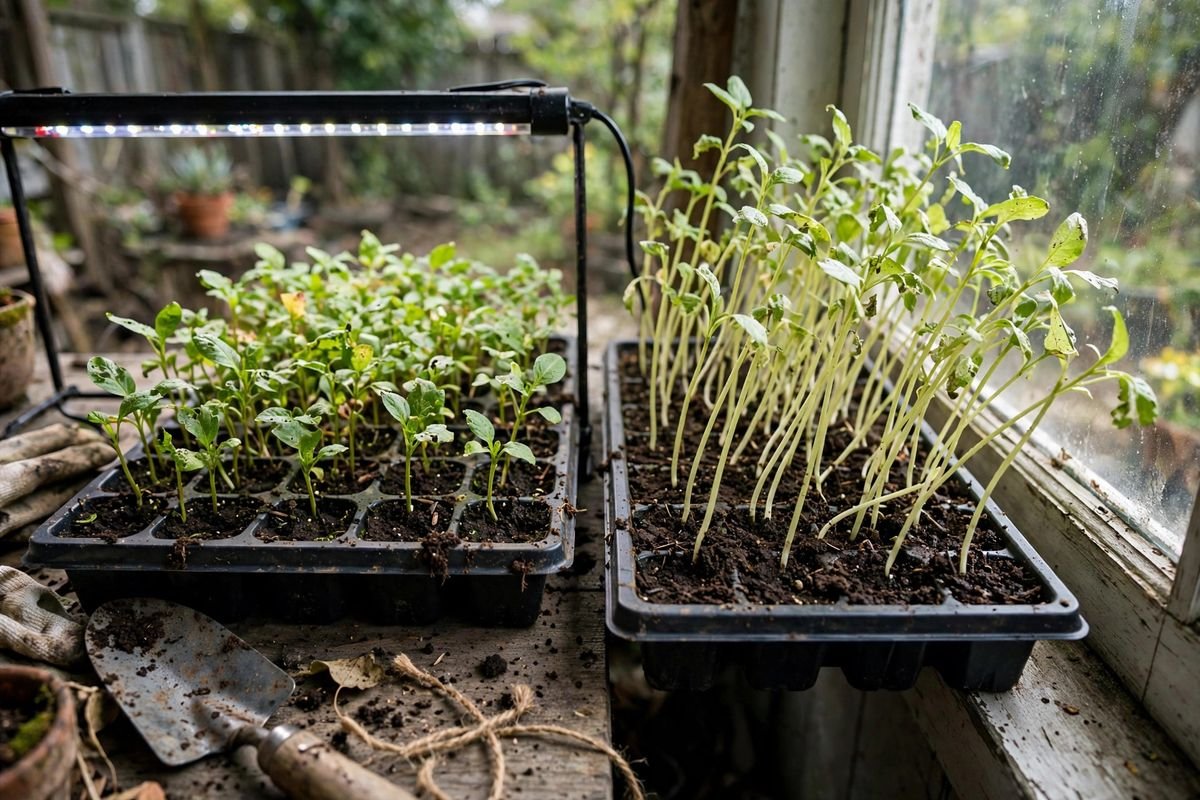
Seedlings need bright light for many hours, not a few hours of sun. Extension guidance for home seed starting commonly points to 14 to 16 hours of light per day, with the fixture kept just a few inches above the leaf tops and raised as the plants grow. When light sits too far away or runs too few hours, stems elongate, leaves stay pale and small, and transplants struggle outdoors. Short, stocky plants with deep green leaves and thick stems are the sign the setup is working.
Light color matters less at home scale than sellers suggest. A daylight or full-spectrum rating in the 5,000 to 6,500 Kelvin range is the common pick for leafy seedling growth, since it stays easy on the eyes and covers the blue light young plants use most. Red-heavy bloom lights can grow seedlings, but the pink-purple glow makes it hard to spot pale leaves or early problems, so we favor white light for a home shelf. Our guide to how to set up a seed starting station lays out shelf, trays, and airflow together once the light choice is settled.
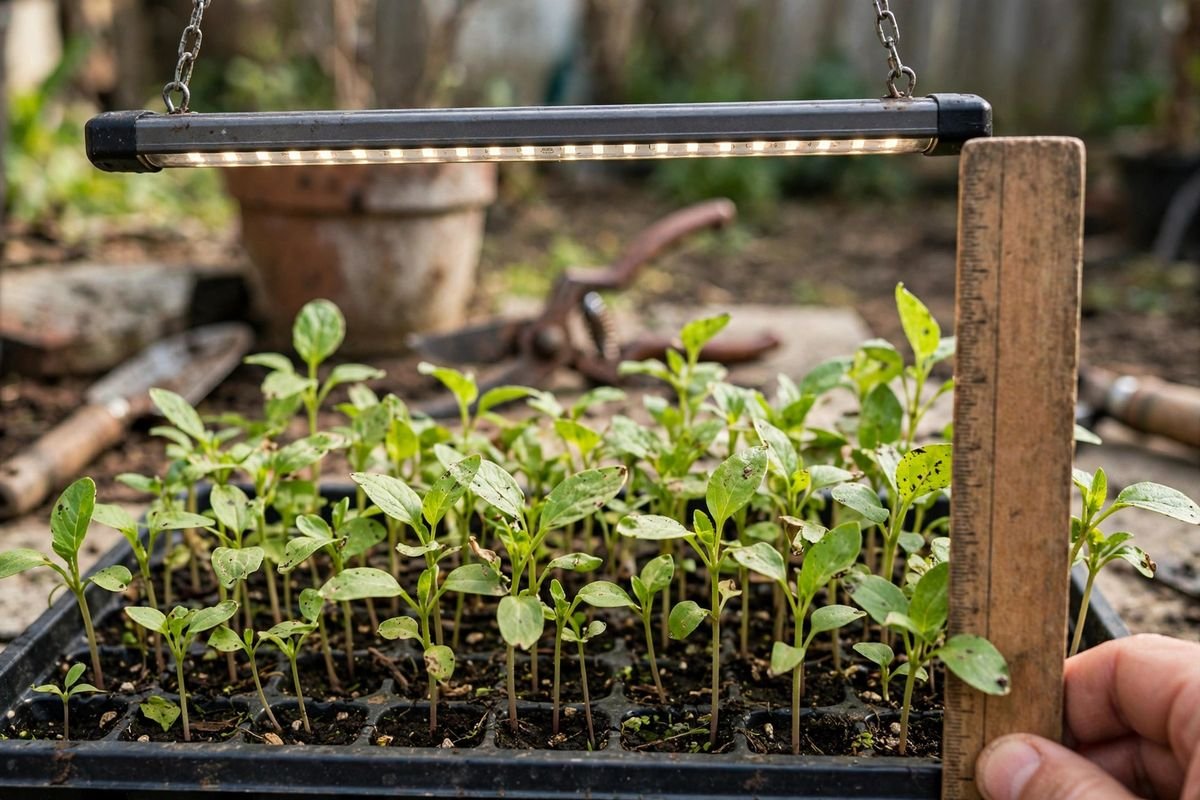
Distance does more work than raw wattage. A modest bar two inches above the tray often grows stockier plants than a stronger fixture hung a foot away, because light spreads and weakens with distance. We keep a simple rule: the light should sit close enough that you can slide a flat hand between the fixture and the leaves with room to spare, and it should move up as the seedlings rise.
Light Types Compared
The table above holds the short version. Here is how each type behaves across a season of daily use, with honest trade-offs on both sides. A dedicated side-by-side of tube types lives in our post on LED grow lights versus fluorescent lights for seedlings.
LED Bars
Long, slim fixtures, usually 2 or 4 feet, sold singly or in linkable multi-packs. Bars mount under a shelf tier or hang by wire and chains, and the light falls in an even strip that matches the shape of a standard tray.
Pros
- Even strip coverage that matches tray shape, with few dim corners
- Runs cool, so the fixture can stay close to leaves without scorching
- Low power draw and long rated life
- Linkable plugs keep a multi-shelf setup on one timer
Cons
- Needs hanging hardware or under-shelf mounting on most shelves
- Very cheap bars list inflated wattage; buy by length and coverage, not the number on the box
- Thin housings can flex if handled roughly
Browse LED grow light bars for seedlings on Amazon by bar length first — 2-foot bars for one tray, 4-foot bars for a full shelf tier.
LED Shop Lights
A 4-foot shop fixture with a built-in LED strip, sold as a hanging work light. Gardeners borrowed it for seed starting because it covers a wide bench in one fixture and costs little for its size.
Pros
- Wide coverage in a single fixture; good over two trays or a bench
- Sturdy metal housing that handles garage and basement use
- Simple chain hanging, no separate driver to mount
Cons
- 4-foot length overhangs a standard 24-inch shelf tier
- Light spreads wide, so some output lands past the tray edges
- Heavier than a bar; needs solid hooks in the shelf or ceiling
Listings for 4-foot LED shop lights on Amazon usually show cord length and hanging hardware in the photos — check both before ordering.
Fluorescent Tube Fixtures
The classic two- or four-tube shop fixture with T5 or T8 tubes. Many gardeners already own one, and it still grows fine seedlings when the tubes are fresh and hung close.
Pros
- Very even, diffuse light across the tray
- Fixture is cheap or already in the garage
- Tubes swap without replacing the whole fixture
Cons
- Uses more power than a comparable LED for similar coverage
- Tubes dim with age and need periodic replacement
- Bulkier and warmer than LED; ballast adds weight
- Older tubes contain mercury and need careful disposal
If your fixture still runs, replacement T5 tubes on Amazon keep it useful; if you are buying new today, an LED bar usually costs less to run.
Bulbs
Screw-in LED grow bulbs or shop bulbs in a clamp reflector. One bulb throws a bright circle and suits a single small tray, a potted herb, or a houseplant corner.
Pros
- Cheapest way to light one small tray or pot
- Clamp reflector aims light where you want it
- No shelf hardware needed
Cons
- Round throw leaves tray corners dim; seedlings at the edges lean in
- Covering a full tray evenly takes two or three bulbs and fixtures
- Clamp grips loosen; check them before the fixture slips
A pair of LED grow bulbs with clamp fixtures on Amazon covers a first tray well enough to learn on.
How Much Coverage One Light Really Gives
Sellers rate lights by wattage, but seedlings care about footprint. We worked the numbers for the tray nearly every home gardener uses, so you can size a shelf without guessing. Assumptions, stated plainly: a standard 10×20 tray measures 10 by 20 inches, about 200 square inches or 1.4 square feet of canopy. A typical 24-inch LED bar lists a useful throw of roughly 24 by 12 inches when hung 4 to 6 inches above the tray — a bright strip about the same shape as the tray itself.
One bar over one tray. The 24-by-12-inch throw covers the 10-by-20-inch tray end to end with about 2 inches of margin on each long side. Light lands where the plants are, corners stay lit, and the seedlings grow evenly across the flat. This is the sweet spot for a single-tray setup, and it is why bars outsell round bulbs for seed starting.
One bar over two trays. Set two 10×20 trays side by side and the pair spans 20 by 20 inches. That same bar still lights a 24-by-12-inch strip, so the trays share the bright zone: each tray gets full light across only about 60 percent of its width, with the outer rows sitting in the falloff. In practice, the seedlings in the middle rows stand straight while the edge rows lean toward the center. Two fixes solve it: add a second bar so each tray has its own, which is our pick for a keeper setup, or rotate the trays end-for-end every few days so every row takes a turn in the bright strip. Rotation works, but a second bar costs little and removes the chore.
Running cost, worked in full. Take one 24W LED bar run 16 hours a day for 8 weeks of seed starting. Eight weeks is 56 days. Hours of use: 16 times 56, or 896 hours. Energy: 24 watts times 896 hours is 21,504 watt-hours, or 21.5 kWh. At $0.17 per kWh — close to the recent U.S. residential average; use your own bill rate for exact local cost — the season runs 21.5 times $0.17, about $3.66. Doubling to two bars for two trays doubles the energy to about 43 kWh and roughly $7.31 for the whole season. Even a four-bar shelf across three tiers stays near $11 to $15 for eight weeks of daily light. A comparable fluorescent fixture at 64W would use 57.3 kWh over the same 896 hours, about $9.75 for one fixture, which is the quiet reason LED bars win on running cost even before tube replacement enters the picture.
What We Look For Before We Buy
Four checks sort a good seedling light from a box of inflated claims. Run every listing through them in order.
Coverage per tray, not headline wattage. Match fixture length to tray length. A 2-foot bar serves one 10×20 tray; a 4-foot bar or two 2-foot bars serve a full shelf tier. If a listing leads with a huge wattage number but never states the bar length or a hanging height, treat the number as decoration.
Wattage honesty. Many listings pair a large “equivalent” wattage with a small actual draw. The actual draw, listed in watts, is the figure that drives your power bill and roughly tracks light output within one technology. Our math above uses actual draw. When a listing hides the draw or states only an equivalent, the coverage claim deserves a second look.
Hanging hardware. A seedling light must move. Seedlings grow an inch or two a week at their fastest, and the fixture has to rise with them while staying level. Chains, wire hangers, or ratchet straps that adjust in small steps beat a fixed mount, and under-shelf bars need screws or strong clips that hold through a season of bumping trays in and out.
A timer you will actually use. Fourteen to sixteen hours a day, every day, is the routine that keeps seedlings stocky. An outlet timer holds that routine without daily plug duty and keeps weekends from slipping. Mechanical timers cost little and survive basement damp; the pick matters less than using one at all. Our shelf wiring notes in the seed starting station guide cover timer placement alongside cords.
Best Setup for a Single Tray
One 10×20 tray of tomatoes, peppers, or flowers on a spare table needs one 2-foot LED bar hung 4 to 6 inches above the tray, on a timer set for 16 hours. The bar covers the whole flat, runs cool enough to stay close, and plugs into a single outlet. Raise the bar on its chains as the seedlings gain height, keeping the gap steady. This is the setup we point first-timers to because it removes the two most common early failures at once: patchy coverage and forgotten light hours.
Choose this setup if you start a flat or two each spring and want the lowest-fuss result. Browse 2-foot LED grow light bars on Amazon and sort by bar length and included hanging hardware, not by the biggest wattage claim.
Best Setup for a Full Shelf
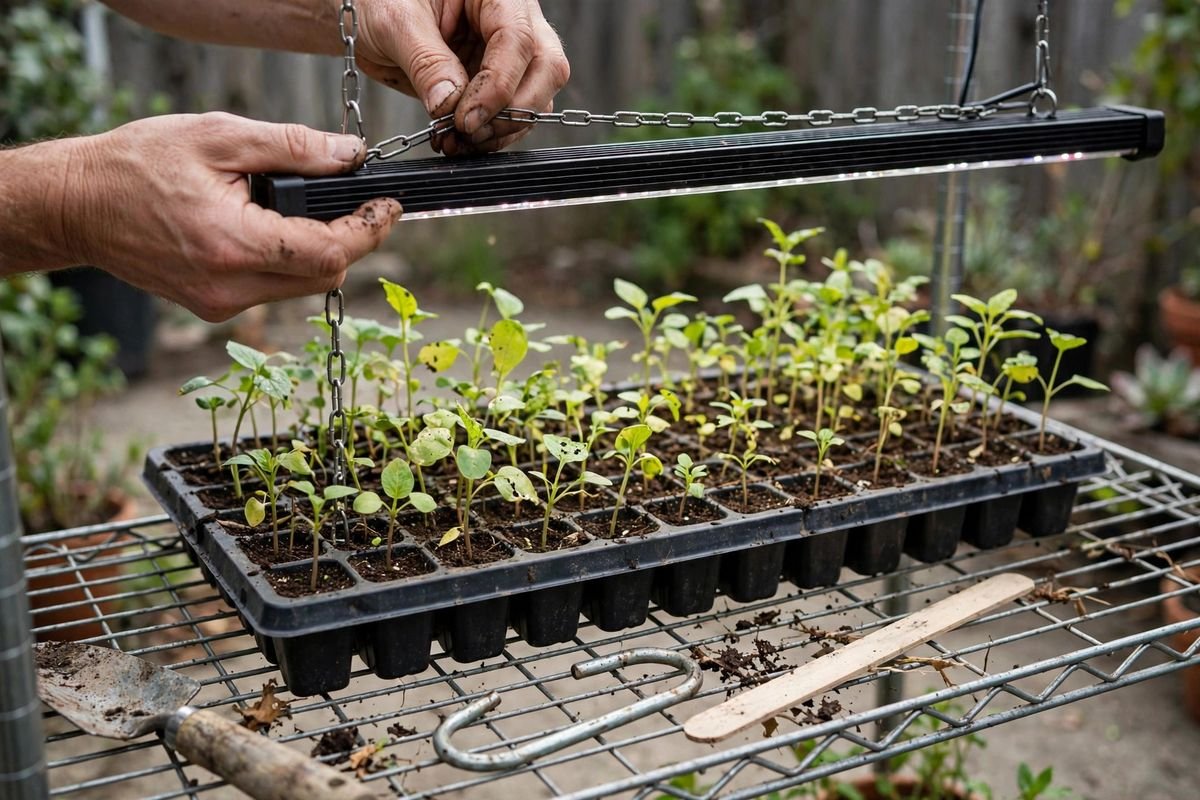
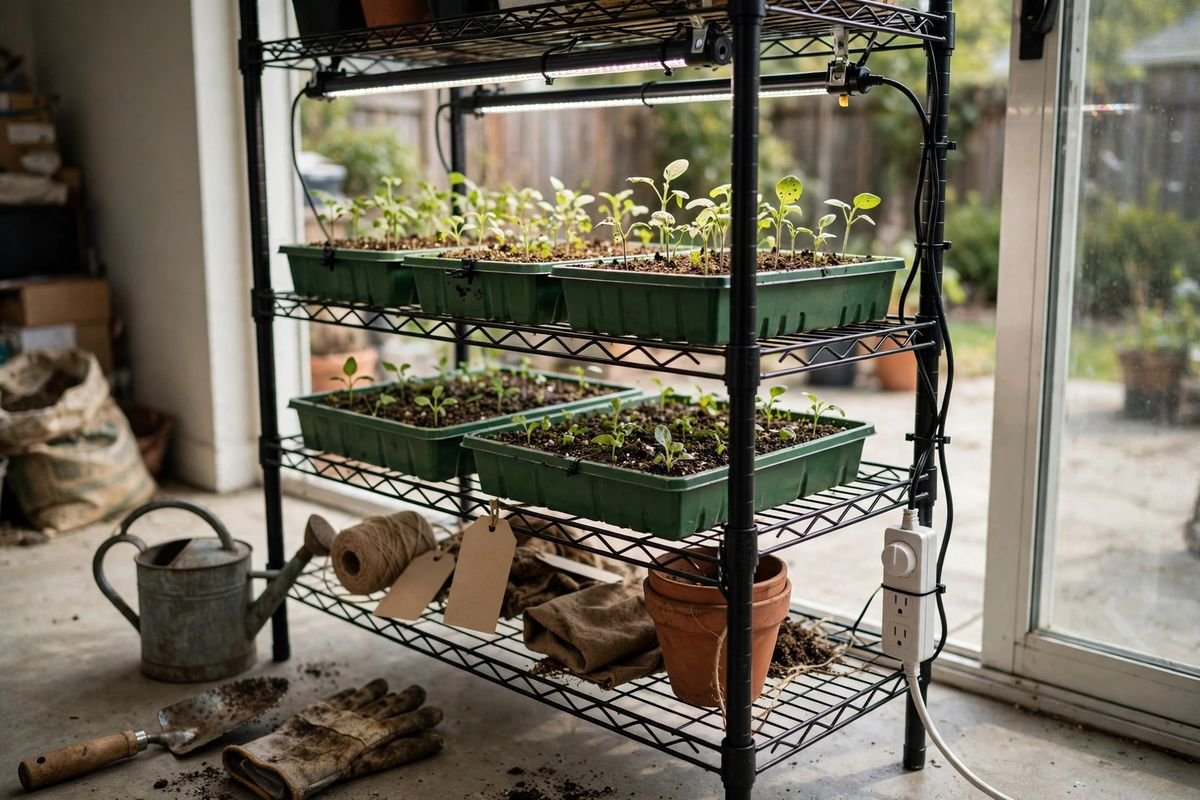
A standard 48-inch wire shelf tier holds two 10×20 trays side by side per tier, sometimes three with the flats turned lengthwise. Light each tier with two 2-foot bars or one 4-foot fixture so every tray sits under its own bright strip, and wire the tiers to one timer through a single power strip mounted on the shelf leg, away from watering. The even coverage pays off fast: a full tier of peppers and tomatoes grows at one pace, thinning and potting up happen on one schedule, and no edge row lags into the transplant window. For shelf dimensions, tier spacing, and cable routing, our walkthrough of how to set up a seed starting station covers the full build.
Choose this setup if you start six or more flats, run succession sowings, or grow on for plant sales and gifts. Linkable LED grow light bar packs on Amazon keep a multi-tier shelf on one timer without a nest of cords.
Best Budget Setup
The lowest-cost working setup pairs one clamp bulb over a single tray with a simple outlet timer. It grows a flat of seedlings well enough for a first season at a fraction of a bar setup, and the clamp moves to a houseplant when seed starting ends. Two limits come with the savings: the corners of the tray run dim, so rotate the flat every few days, and a second tray needs a second bulb. A 4-foot LED shop light is the other honest budget route when a bench, not a shelf, is the workspace — one fixture covers two trays at shelf-light cost.
Choose this setup if you are testing whether indoor starting suits you, or if a single tray of peppers is the whole spring plan. Start with LED grow bulbs with clamp fixtures on Amazon and add a timer if your outlet does not already run on one.
Wiring, Timers, and Daily Checks
Keep cords and water apart. Mount the power strip on the shelf leg above tray height, route cords down the leg instead of across the watering path, and let the timer sit where a glance confirms the schedule. A two-minute morning check covers the routine: lights on, trays moist but not soggy, gap between light and leaves still a hand-width. Seedlings under a steady light need little else — steady moisture, gentle air from a small fan on low for a few hours a day, and thinning once the first true leaves open so each plant keeps its share of the light.
Choose by Shelf, Not by Hype
The verdict compresses to shelf size and tray count, since every type in this guide grows seedlings when hung close and run long enough.
- Choose an LED bar if… you start seeds in standard 10×20 trays on a wire shelf and want even coverage, cool running, and the lowest season cost per tray.
- Choose an LED shop light if… your workspace is a wide bench or garage table and one sturdy 4-foot fixture covering two trays suits better than two slim bars.
- Choose a fluorescent fixture if… you already own a working two-tube fixture with fresh tubes, and you would rather spend on trays and mix this season than replace a light that still serves.
- Choose a bulb if… you start one small tray or keep a potted herb under light, and the lowest entry cost matters more than covering a full shelf evenly.
Whichever type you pick, the habits around it decide the result: hang it close, run it 14 to 16 hours on a timer, and raise it as the plants climb. The fixture is the tool; the routine grows the seedlings.
Common Mistakes
Light hung once and never raised
Seedlings that touch the fixture scorch at the tips, while a fixture left a foot above leggy plants never catches up. Raise the light in small steps as the canopy rises.
Enough hours, uneven coverage
A single bulb over a wide tray lights the center and starves the corners. Match fixture shape to tray shape, or rotate the flat on a schedule.
Buying by the biggest wattage number
Listing wattage often states an equivalent, not the actual draw. Buy by bar length, tray coverage, and the real watt figure instead.
FAQ
How many hours a day should grow lights run for seedlings?
Most home seed starting runs 14 to 16 hours a day. An outlet timer holds the schedule steady, and the plants get a true dark rest overnight.
How close should the light sit?
Keep the fixture a few inches above the leaf tops — close enough that a flat hand fits between light and leaves — and raise it as the seedlings grow.
Can one light cover two trays?
One 2-foot bar covers one 10×20 tray evenly. Two trays under one bar share the bright strip and lean at the edges; a second bar or regular rotation fixes it.
Is a shop light as good as a grow light for seedlings?
A daylight LED shop light at the same close distance grows seedlings on the same routine. The difference is shape and spread, not a special spectrum at home scale.
Sources & Further Reading
- University of Minnesota Extension — starting seeds indoors, light hours and fixture distance (extension.umn.edu)
- Iowa State University Extension and Outreach — starting seed indoors with fluorescent and LED lighting (extension.iastate.edu)
- Utah State University Extension — seed starting indoors, lighting and timing guidance (extension.usu.edu)
- USDA Agricultural Research Service and U.S. Energy Information Administration — residential electricity rate context for running-cost math (eia.gov)
Keep exploring:
- LED Grow Light vs Sunny Window for Seedlings for the window-versus-light choice.
- Grow Light Bars vs Bulbs for fixture shape and headroom.
- LED Grow Lights vs Fluorescent Lights for Seedlings for tube-by-tube costs.
- How to Set Up a Seed Starting Station for the full shelf build.
A shelf, a bar, and a timer turn a dim corner into the most reliable bed in the spring garden. How many trays will your first setup hold?