
This post may contain affiliate links. If you buy through links on this page, we may earn a commission at no extra cost to you.
As an Amazon Associate I earn from qualifying purchases.
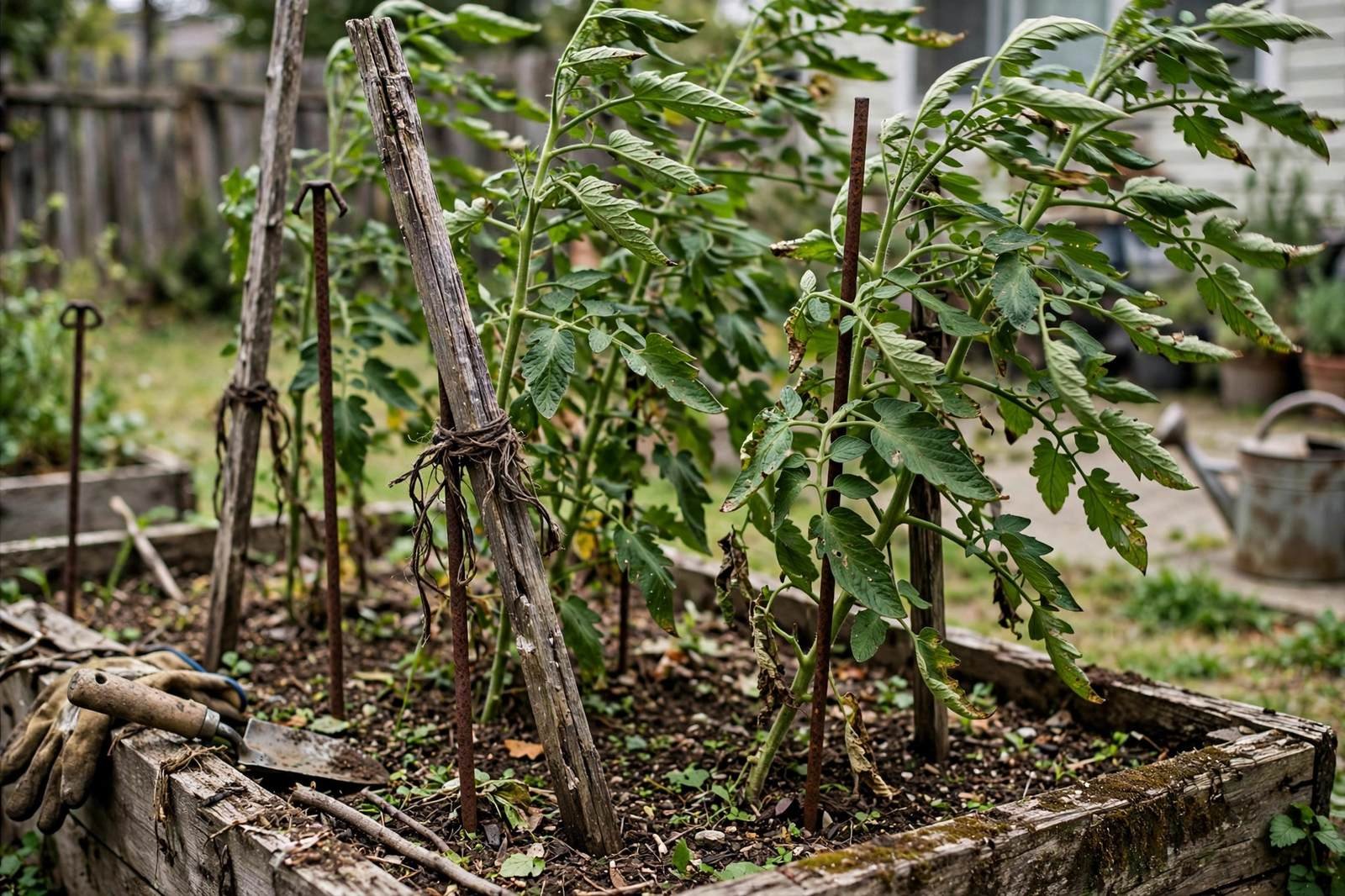
A calm week can hide a weak setup. Plants grow tall, leaf out, and catch more wind every day, and then one gusty afternoon leans a whole row of tomatoes into the path. The support did not fail because the plant got heavy. It failed because wind load climbs much faster than most of us expect, and a shallow stake or a thin cage leg has very little grip once the soil softens after rain.
We put this guide together for exposed beds, hilltop yards, coastal gardens, and balconies where pots and climbers take a beating. You will find a plain comparison of the five support styles we see most often, a worked wind example with the assumptions stated out in the open, and clear rules for depth and spacing. If your garden also needs help at the structure level, our guide to how to anchor garden structures in wind covers beds, hoops, and small tunnels, and container growers should also read how to protect balcony plants from strong wind.
Quick Reference: Supports at a Glance
| Support type | Best for | Wind strategy | Install effort |
|---|---|---|---|
| Spiral stake | Single-stem tomatoes, peppers | Stem follows the spiral, load stays close to the stake | Low, push and twist in |
| Heavy-duty cage | Bushy tomatoes, eggplant | Branches rest on rings, load spreads across 3-4 legs | Low to moderate |
| Single stake + ties | Almost any upright plant | One strong anchor point, ties do the work | Low, but ties need checking |
| Trellis panel | Beans, peas, cucumbers | Wide footprint, vines weave through and share the load | Moderate, posts at both ends |
| Grow-through grid | Peonies, peppers, bushy herbs | Stems grow through a low grid and hold each other up | Low, set early in the season |
Use this table to narrow the field, then read the head-to-head comparison below before you buy. The cheapest support is the one you do not have to replace mid-season with fruit already on the plant.
How Much Force Does Wind Actually Put on a Plant?
Here is the worked example we use when we plan a windy bed. The inputs are stated so you can swap in your own plant size and your own typical gust speed.
Assumptions. A tomato plant is 5 feet tall with a fairly full canopy. From the side, that canopy presents about 4 square feet of leaf area to the wind. We treat the leaves as a rough sail with a drag factor close to 1 for a simple planning number, and we put the center of that sail about 2.5 feet above the soil, which is near the middle of the plant. Wind pressure on a flat surface follows a standard engineering shortcut: pressure in pounds per square foot is roughly 0.00256 times wind speed in miles per hour, squared.
At 15 mph. Pressure is 0.00256 times 225, which is about 0.58 pounds per square foot. Across 4 square feet, that is roughly 2.3 pounds of sideways push. Acting at 2.5 feet up, it creates an overturning pull of about 6 foot-pounds at the base. Most stakes handle this without drama.
At 30 mph. Pressure is 0.00256 times 900, which is about 2.30 pounds per square foot. Across the same 4 square feet, that is roughly 9.2 pounds of push, and an overturning pull near 23 foot-pounds at the base. The wind only doubled, but the force went up four times, because pressure rises with the square of wind speed. A gusty 40 mph afternoon pushes the same plant at roughly 16 pounds per square foot of pressure terms, or about 16 pounds of total push on our example plant, before we count any flapping or rocking that loosens soil around a stake.
What this means in the bed. A stake buried only 6 inches deep has a short lever arm in the soil and can lever out once the top few inches get wet and soft. For tall plants in open ground, we plan on 18 to 24 inches of stake below ground for a 5 to 6 foot plant, and we keep tie points every 12 to 18 inches up the stem so no single tie carries the whole load. Two shorter supports set 18 to 24 inches apart and tied together often outlast one tall, shallow stake, because the pair resists rocking from more than one direction. This is also why our tomato growing guide pairs pruning with support: a plant pruned to one or two stems presents less sail area than an unpruned thicket, so the same cage or stake holds it with room to spare.
The Five Support Types, Compared Head to Head
All five styles below are widely sold for home gardens. We are comparing support geometry and typical construction you can see on a listing or in a store, not any single brand, and we have not run lab tests on specific models. Prices move around a lot by size and pack count, so the cost column describes the usual approach rather than a fixed dollar figure. Always check the current listing for dimensions and materials before you order.
| Support type | Wind resistance | Best plants | Cost approach | Main weaknesses |
|---|---|---|---|---|
| Spiral stake | Good for one stem; the spiral keeps the stem close to the anchor | Indeterminate tomatoes, peppers, eggplant | Sold singly or in small packs; reusable steel costs more upfront | Only supports one stem; undersized spirals bend at the base in soft soil |
| Heavy-duty cage | Very good when legs go 10-12 inches deep; load spreads across legs | Determinate and bushy indeterminate tomatoes, peppers | Galvanized or powder-coated cages cost more than thin wire cones | Bulky to store; cheap thin-wire versions fold at the welds |
| Single stake + soft ties | Good to very good; depends entirely on stake depth and tie upkeep | Tomatoes, peppers, young fruit trees, dahlias | Lowest entry cost; wood stakes are cheap, metal stakes last longer | Ties slip or cut stems if neglected; one stake can still rotate in loose soil |
| Trellis panel | Excellent when end posts are braced; the panel shares load across many vines | Pole beans, peas, cucumbers, small squash | Panel plus posts costs more upfront but covers a whole row | Acts like a sail before vines fill in; needs end bracing in open sites |
| Grow-through grid | Moderate; great against flopping, less help in a direct storm gust | Peonies, peppers, bush beans, floppy perennials | Mid-range; one grid per plant, reusable for years | Must go on early; hard to fit over a plant that is already leaning |
Two patterns stand out. First, depth beats thickness every time: a modest stake buried deep will out-hold a chunky stake pushed in a few inches. Second, anything that spreads the load across two or more ground contact points, like a cage or a braced panel, shrugs off shifting wind directions better than a single point of support.
Spiral Stakes: Tidy Support for Single Stems
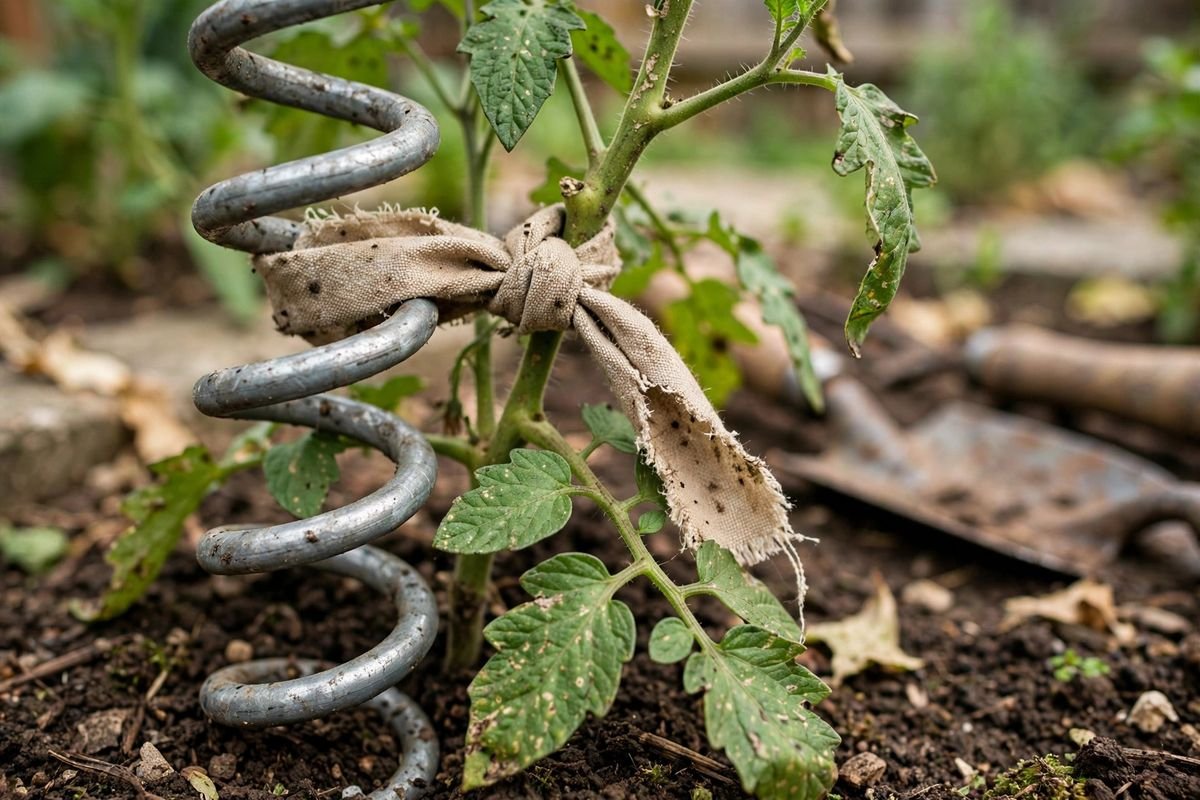
A spiral stake is a steel rod bent into an open corkscrew. You train the main stem up through the spiral as the plant grows, and the curves cradle the stem without a pocketful of ties. For pruned tomatoes and upright peppers, this keeps the plant close to the anchor, which shortens the lever arm the wind can grab. You can browse current styles under spiral tomato stakes and compare heights before choosing.
Pros
- Few ties needed, so there is less to check after a storm
- Stem stays centered on the stake instead of lashing out to one side
- Easy to pull, clean, and store flat-ish at the end of the season
Cons
- Supports one stem only; a multi-stem plant will outgrow it
- Short or thin spirals can tilt as a unit in sandy or freshly watered soil
- Hard to add after the plant is already tall and branching
Our take: pick a spiral that reaches at least two-thirds of the plant’s expected height and push it in 12 to 18 inches. If your soil is loose sand, pair the spiral with one extra soft tie to a second short stake set at an angle on the windward side.
Heavy-Duty Cages: The Set-and-Support Workhorse
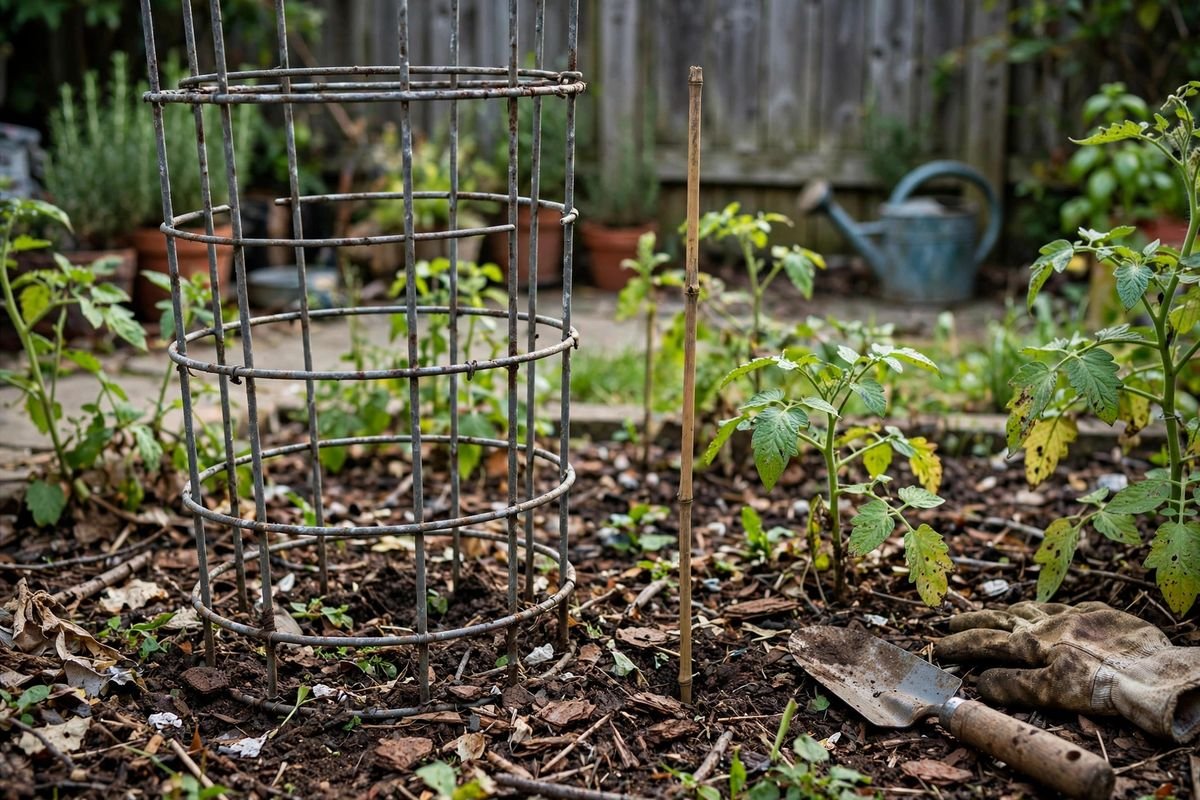
A real heavy-duty cage uses thick galvanized wire, three or four legs, and rings wide enough for a full tomato canopy. The thin, cone-shaped wire cages sold in big bundles are a different product entirely: they are fine for peppers in a sheltered yard and disappointing for a 5-foot tomato in an open one. When you shop, look at wire thickness, leg count, and overall height in listings such as heavy duty tomato cages, and favor cages you can push 10 to 12 inches into the ground while still keeping the lowest ring near the soil line.
Pros
- Branches rest on rings all the way up, so fruit weight and wind load are shared
- Three or four legs resist rocking from changing wind directions
- Little weekly upkeep once the cage is set early
Cons
- Takes real storage space in the off-season
- Cheap versions bend at welds and rust through in a few seasons
- A cage set late, over an already sprawling plant, never quite fits right
Our take: for most windy raised beds, a sturdy cage pushed deep is the lowest-effort path to a plant that is still upright in September. Add one tall stake woven through the cage on the windward side if your site funnels gusts down a fence line.
Single Stake and Soft Ties: Cheap, Strong, and Hands-On
The oldest method still works: one stout stake, buried deep, with the stem tied in a loose figure-eight every 12 to 18 inches. The tie matters as much as the stake. Bare twine and wire twist ties can saw into a stem that rocks in the wind, so we reach for soft fabric strips, old t-shirt yarn, or purpose-made soft plant ties that stretch a little. Metal or hardwood stakes outlast thin bamboo in wet soil; bamboo is fine for peppers and short-season crops.
Pros
- Lowest cost to start, and parts are easy to replace one at a time
- Works for almost any upright plant, in beds or large pots
- Easy to adjust tie height as the plant grows
Cons
- Needs a tie check every week or two, and always after a storm
- One stake can slowly rotate or lean in loose, wet soil
- Ties left tight will girdle a fast-thickening stem
Our take: this is the best budget system and a great backup for every other method. Drive the stake before or at planting so you do not spear roots later, and keep the below-ground portion near one-third of the total stake length for tall plants.
Trellis Panels: Row-Scale Support for Climbers
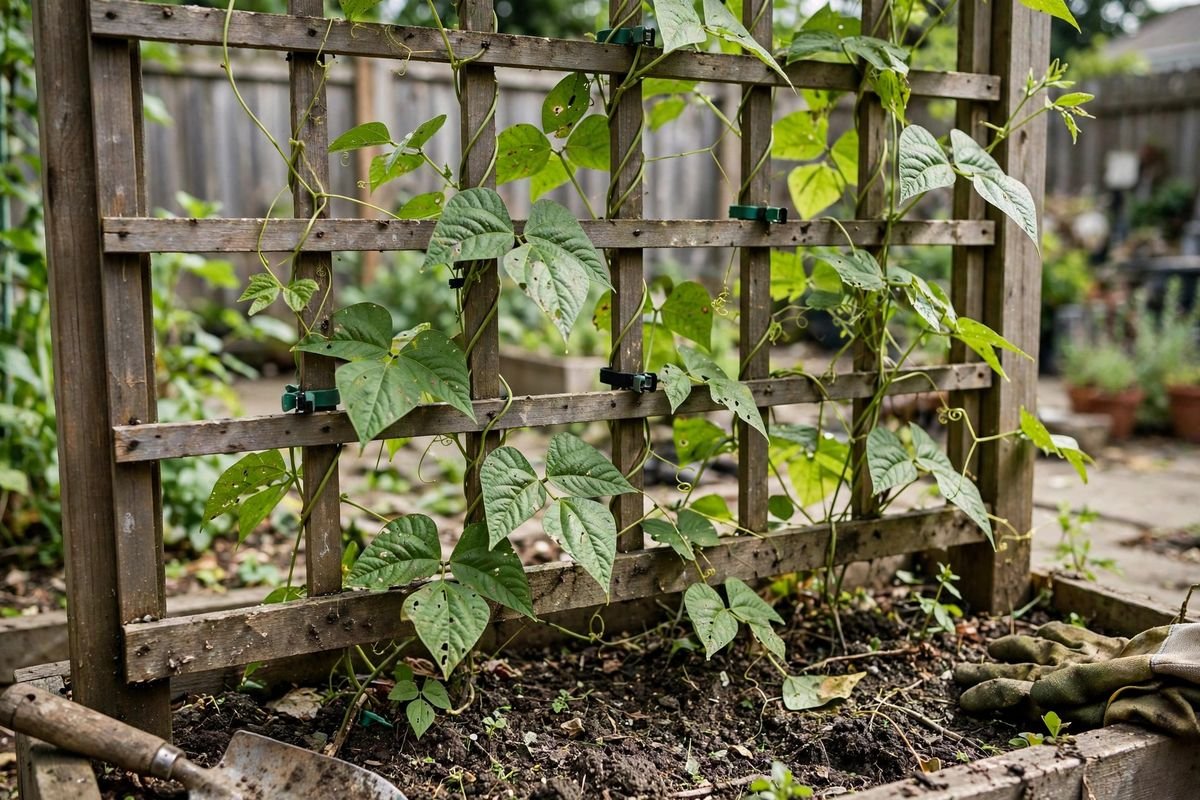
A trellis panel turns a whole row into one shared structure. Cattle panels, welded wire panels, and sturdy nylon netting on posts all count here. Vines weave through the mesh and hold each other, which is why a well-filled bean trellis rides out wind that would snap individual poles. The vulnerable moment is early, when the panel stands empty like a sail. Braced end posts and, on long runs, a mid-span post keep that sail from taking the whole row over. Listings under garden trellis panels vary widely in gauge, so compare wire thickness and panel height against your crop. Small plant support clips help young vines find the mesh without flapping loose.
Pros
- Covers a full row with two to three ground contact points per panel
- Harvest is easy, with fruit hanging at hand height on both sides
- Panels store flat and last for many seasons
Cons
- Needs real end bracing in open, gusty sites
- Empty panels catch wind before vines fill in
- Not the right tool for bushy, non-climbing plants
Our take: for beans, peas, and cucumbers in a windy yard, nothing else comes close. Set posts 18 to 24 inches deep, angle a brace stake back from each end post, and tie the panel to the posts at three heights.
Grow-Through Grids: Quiet Help Against Flopping
A grow-through grid is a low ring or mesh held on short legs, set over a young plant so stems rise through the openings. The grid does not fight a storm head-on. Instead, it stops the slow lean that turns into a flop after rain, and it keeps stems separated so air moves through the canopy. This is the support we suggest for peonies, bushy peppers, and herbs that splay open just as they fill out.
Pros
- Nearly invisible once foliage covers it
- Prevents the rain-soaked flop that breaks stems at the base
- One grid per plant, quick to set in spring
Cons
- Only moderate help in a direct, hard gust
- Must be placed early; forcing a mature plant through a grid breaks stems
- Too low for tall indeterminate tomatoes on its own
Our take: use grids as the first line for medium plants, and combine a grid with one deep stake for peppers in exposed beds. That pairing handles both the slow lean and the sudden gust.
Depth, Spacing, and Tie Rules That Hold in Real Weather
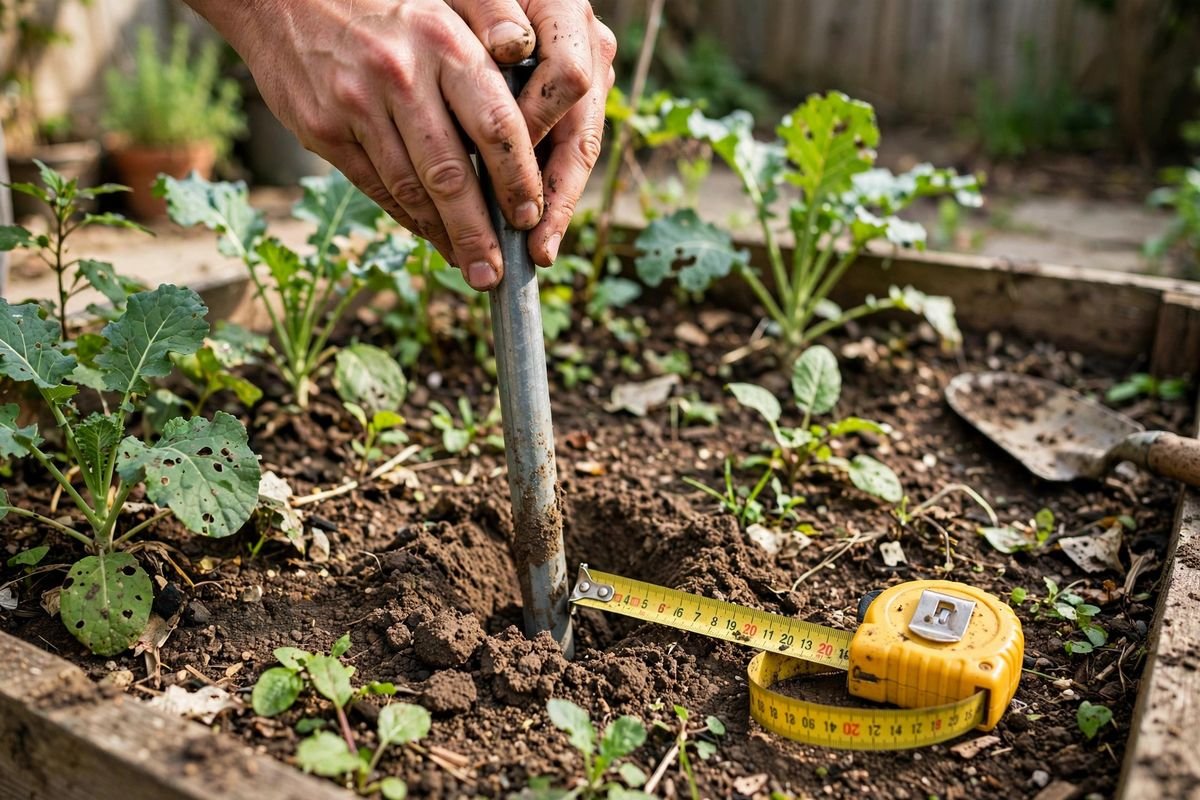
Most support failures we hear about trace back to installation, not to the product on the shelf. These rules come straight out of the load math above and standard extension guidance on staking.
- Bury one-third of the support. For a 6-foot stake, aim for about 2 feet below ground in loose soil and at least 18 inches in firm soil. Cage legs should go 10 to 12 inches down.
- Set supports at planting time. Driving a stake beside an established plant severs roots and can invite disease. Early placement also lets stems grow into cages and grids naturally.
- Tie loose, tie often. A figure-eight loop with a finger’s width of slack, repeated every 12 to 18 inches, beats one tight tie at the top. Soft, slightly stretchy material protects bark and stems.
- Face the wind on purpose. In a bed that takes gusts from one direction, put the stake on the windward side so the plant leans into its support, not away from it. For rows, a second angled brace stake on that same side adds cheap insurance.
- Reduce the sail. Pruning tomatoes to one or two stems, spacing plants for airflow, and picking off excess suckers all shrink the area the wind can push. Support and pruning work as a pair.
Use your local frost dates and regional planting guidance — not your USDA hardiness zone alone — to choose planting dates. Setting supports on planting day, rather than weeks later, is part of that same timing habit: the plant never spends an unsupported week at its most tender stage.
Verdict: Which Support Should You Choose?
- Choose a heavy-duty cage if you grow bushy or determinate tomatoes and want the least weekly upkeep in an open bed.
- Choose a spiral stake if you prune tomatoes or peppers to a single stem and like a tidy row with few ties to manage.
- Choose a single deep stake with soft ties if your budget is tight, your plants vary in size, and you do not mind a quick tie check each week.
- Choose a trellis panel if you grow beans, peas, or cucumbers by the row and can brace the end posts well.
- Choose a grow-through grid if your main problem is flopping after rain on medium plants like peonies and peppers, rather than direct storm gusts.
- Choose a combination if your site is truly exposed: cage plus one windward stake for tomatoes, or grid plus one stake for peppers, covers both slow lean and sudden load.
Whatever you pick, buy for the plant at full size, not the transplant in your hand. A support that looks oversized in May tends to look exactly right in late July.
Troubleshooting Wind-Damaged Plants
My tomato leaned over but the stem did not snap. Can it recover?
Often, yes. Water the bed first so the soil is workable, ease the plant upright over a few minutes rather than in one haul, and re-set or add a deeper stake before you re-tie. Loosen any tie that bit into the stem and replace it with a wide, soft loop. A plant that stands again within a day usually keeps growing with little setback.
The stake pulled out of wet soil. What now?
Reset it deeper and a few inches farther from the stem, then firm the soil in layers as you backfill. In chronically loose beds, switch to a cage with multiple legs or add an angled brace stake tied to the main stake near the top. Avoid re-driving the stake into the same loose hole.
Leaves look torn and wind-whipped after a storm. Should I prune them off?
Leave lightly torn leaves in place; the plant still uses them. Remove only leaves that are fully shredded, blackened, or resting on wet soil where disease can start. Hold off on fertilizer until you see fresh, upright growth, since a stressed root system takes up nutrients poorly for a few days.
My trellis panel rocks as one piece in gusts.
The panel itself is rarely the weak point; the end posts are. Deepen the posts, add diagonal brace stakes running back from the top of each end post to a ground anchor, and tie the panel to the posts at the top, middle, and bottom. On long runs, one braced mid-post cuts the rocking in half.
Frequently Asked Questions
How tall should a tomato support be in a windy garden?
Plan for a support that still stands 4 to 5 feet above ground after the buried portion is accounted for. A 6-foot stake buried 18 to 24 inches leaves about 4 feet of working height, which suits many pruned plants. Tall indeterminate varieties may need a 7 to 8 foot total stake or a cage-plus-stake combination.
Can we add support after a plant is already tall?
You can, but gently. A cage can be opened or worked down over a plant with a helper lifting branches, and a stake can be driven a safe distance from the stem and the plant tied over gradually across two or three days. Grids are the exception: they really need to go on while the plant is young.
Are bamboo stakes strong enough for windy sites?
Thick bamboo stakes handle peppers and shorter tomatoes in moderate wind, especially when buried deep and tied well. For tall tomatoes in open sites, steel or hardwood stakes hold up better over multiple seasons, since bamboo can split at tie points and soften at the soil line.
Should supports stay in the ground over winter?
Metal cages, spirals, and panels store well after a rinse and a dry day in the sun, and pulling them lets you rest and amend the bed. Wooden stakes left in wet winter soil rot faster at the ground line, so we pull and store those under cover where we can.
Sources & Further Reading
- University of Minnesota Extension, Staking and supporting vegetable plants — practical guidance on cages, stakes, and trellises for home vegetable gardens.
- Clemson Cooperative Extension, Tomato fact sheet (HGIC) — culture and support recommendations for tomatoes in home gardens.
- Iowa State University Extension and Outreach, Staking tomatoes — step-by-step staking and tying guidance for gardeners.