
This post may contain affiliate links. If you buy through links on this page, we may earn a commission at no extra cost to you.
As an Amazon Associate I earn from qualifying purchases.
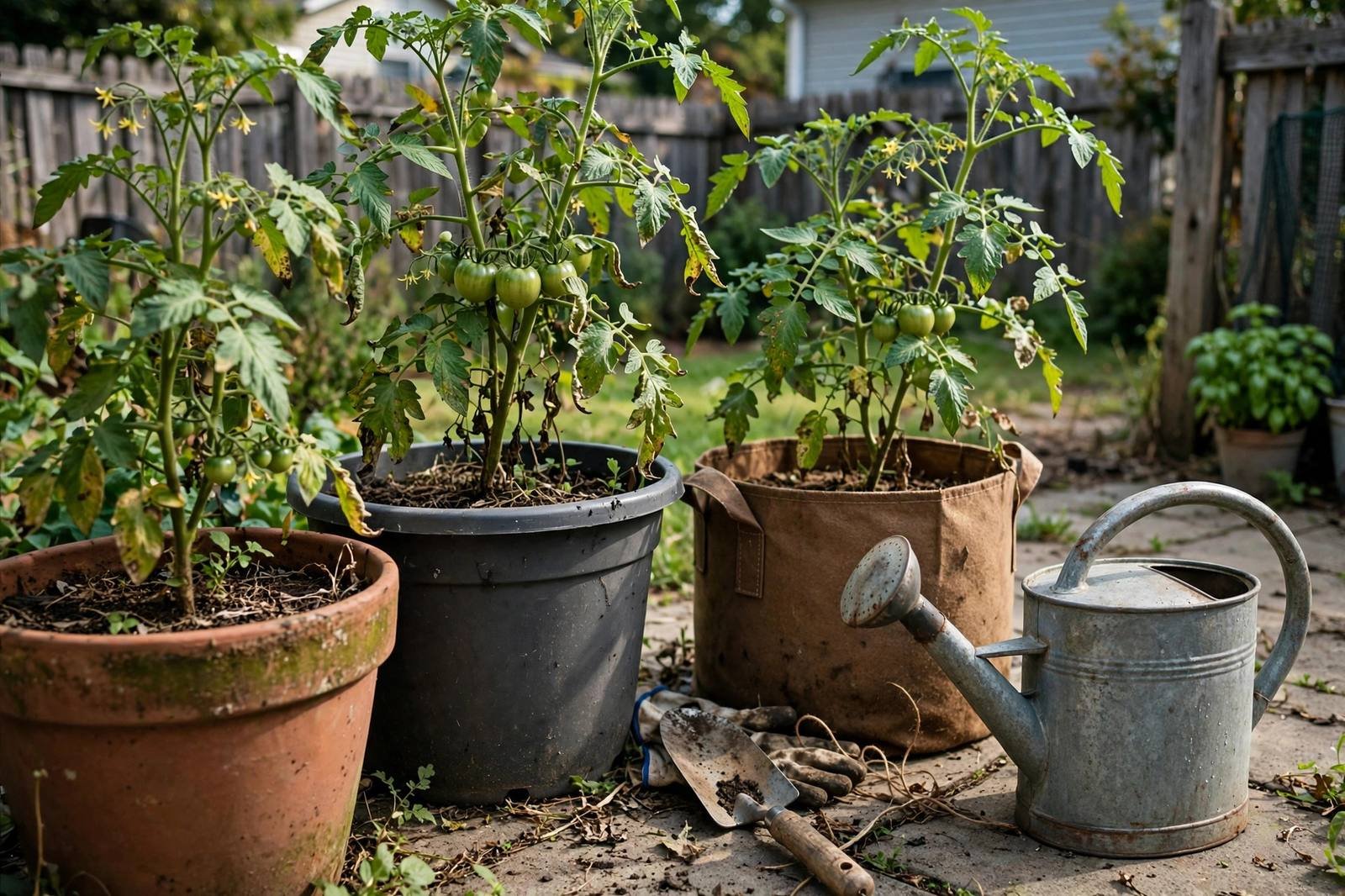
Tomatoes ask more from a pot than most patio crops do. A mature plant carries a large root system, drinks heavily in summer heat, and keeps growing for months, so a container that looks generous in spring can feel tight by July. The right choice balances root room, water storage, and weight, and it starts with matching the pot to the type of tomato we plan to grow.
This guide is research-based. We compare sizes and materials using extension guidance on container tomatoes, stated dimensions from common listings, and our own volume and watering math with assumptions shown. We do not claim side-by-side trials or hands-on testing of specific products, and we do not invent prices or specifications here. Our detailed sizing explainer on what size pot a tomato plant needs covers the minimums in depth; this page helps us pick the material and the exact size for our space.
| Tomato Type | Size We Plan For | Why That Size Fits |
|---|---|---|
| Determinate patio types | 5 gallons minimum; 7 to 10 gallons if we have room | Compact vines that set fruit over a shorter window; 5 gallons can work with steady watering, while extra soil steadies moisture |
| Indeterminate slicers and beefsteaks | 10 gallons minimum; 15 gallons preferred | Vines keep growing and fruiting all season; larger soil volume holds more water between waterings and gives roots room to spread |
| Cherry and grape types | 10 gallons for most; 5 gallons only for dwarf patio cherries | Standard cherries are vigorous indeterminate vines; dwarf types bred for pots stay compact and suit a smaller container |
One plant per container is the rule we follow for full-size tomatoes. Two vigorous plants in one pot compete for water and nutrients from the start, and the pot dries in half the time. Dwarf patio types are the exception many growers make for a wide, shallow planter, and even then we keep expectations modest.
What Pot Size Means: Gallons, Diameter, and Depth
Listings mix gallons, inches, and liters, which makes comparison harder than it needs to be. Gallons describe soil volume, while diameter and depth describe shape. Both matter. Roots use the whole soil column, and a deep pot holds moisture lower down where midday heat reaches last. A shallow, wide pot of the same gallon rating dries faster at the surface and suits a compact plant better than a tall vine.
As a rough guide from the pots we reviewed, a 5-gallon container often runs about 12 inches wide and 12 inches deep, a 10-gallon about 16 to 18 inches wide and 14 to 16 inches deep, and a 15-gallon about 18 to 20 inches wide and 16 to 18 inches deep. Actual dimensions vary by brand and shape, so we check the stated width and depth on each listing rather than trusting the gallon number alone. Depth of at least 12 inches is a practical floor for determinate types, with 14 to 18 inches more forgiving for indeterminate vines.
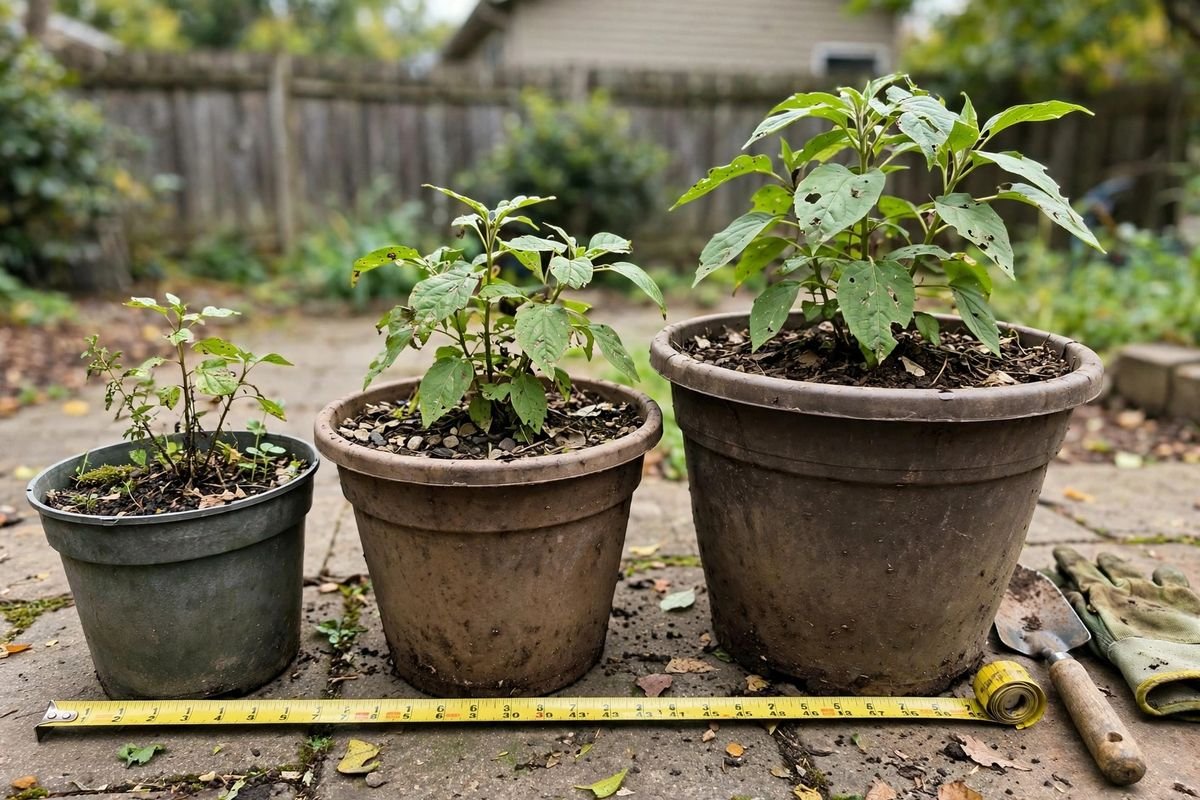
The tape measure matters more than the label. If a listing gives only gallons, we look for a photo with a known object or a dimension line in the specifications. When neither appears, we move to a listing that states its size clearly, since a short, wide 10-gallon tub and a tall 10-gallon pot water very differently in July.
Materials Compared: Root Room, Water, and Daily Handling
Size sets how much soil and water a pot can hold. Material decides how fast that water leaves, how heavy the full pot feels, and how many seasons the container lasts. The table below compares the four options we see most often for tomatoes.
| Material | Root Room | Water Use | Mobility | Season Length Fit |
|---|---|---|---|---|
| Fabric grow bag | Strong; roots air-prune at the walls instead of circling | Highest; breathable walls dry faster, especially in wind | Lightest when empty; full bags are awkward to lift and best moved with help or a caddy | Good for a full season; folds flat for winter storage |
| Plastic pot | Good; smooth walls can lead to circling roots in undersized pots | Moderate; holds moisture longer than fabric or terracotta | Light to moderate; rigid shape is easier to shift than a full fabric bag | Good; UV exposure can make thin plastic brittle over several seasons |
| Terracotta | Good; thick walls buffer soil temperature swings | High; porous clay wicks moisture from the mix, so we water more often | Heaviest, especially at 10 to 15 gallons when wet; best set in place and left there | Good in frost-free months; porous clay can crack if wet soil freezes, so we store it dry under cover in cold winters |
| Self-watering planter | Good when the soil chamber is truly 5 gallons or more above the reservoir | Lowest daily demand; the reservoir refills the mix between our visits | Moderate to heavy once filled; wheels help at larger sizes | Good for a full season; we still check the reservoir and flush salts midseason |
Fabric grow bags earn their place on sunny patios where drainage and root health worry us most. Air reaches the root zone from all sides, and roots that reach the wall tend to branch rather than circle. The tradeoff is water. A fabric wall loses moisture to wind and sun across its whole surface, so a 10-gallon bag in full sun often needs water a day sooner than the same volume in plastic. Bags also slump as mix settles, which lowers the soil line over the season.
Plastic pots are the steady middle option. They hold moisture longer than fabric or terracotta, weigh less than clay, and cost less at larger sizes, which matters when we need 10 or 15 gallons per plant. Dark plastic heats up in strong sun, so in hot climates we favor light colors or shade the pot wall while the canopy gets full sun. Thin nursery plastic can crack after a few seasons of sun; thicker resin holds up longer.
Terracotta suits gardeners who value stability and a classic look and who can water often. Clay breathes, so the mix dries evenly and roots rarely sit wet, but that same breath means daily water in midsummer for a fruiting plant. Weight becomes the deciding factor at tomato sizes: a wet 15-gallon terracotta pot is a two-person move. Our head-to-head on terracotta vs plastic pots walks through weight, cost, and winter storage in more detail.
Self-watering planters help when our schedule keeps us away for two or three days at a time. A reservoir below the soil feeds water upward as the mix dries, which smooths the wet-dry swings that stress fruit. The catch is honest sizing. Some planters list total volume including the reservoir, so the soil chamber may hold far less than the headline gallons. We look for listings that state soil capacity separately, and we still lift or probe the mix weekly, since a full reservoir cannot fix a mix that has pulled away from the walls.
Pros and cons in short. Fabric: pro — best root pruning and drainage; con — fastest drying and awkward to move full. Plastic: pro — holds moisture longer and stays light for its size; con — roots can circle in small pots and thin walls can heat or turn brittle. Terracotta: pro — stable, breathable, and buffers temperature; con — heaviest and thirstiest, with freeze-crack risk. Self-watering: pro — steadiest moisture between visits; con — headline size can overstate soil volume and reservoirs need midseason checks.
Our quick verdict. Choose fabric if we want healthy roots and easy storage and can water often. Choose plastic if we want a light, affordable 10 to 15-gallon pot that holds moisture longer. Choose terracotta if the pot will stay in one place, looks matter, and daily watering fits our routine. Choose self-watering if we travel or miss days and still want a determinate or cherry tomato to stay evenly moist.
Our Soil-Volume and Watering Math
Gallon ratings become more useful once we translate them into soil we have to buy and water we have to supply. The numbers below are ours, computed from stated inputs, and they are planning estimates rather than guarantees. Weather, mix, mulch, and plant size shift the result every week.
How Much Mix Each Pot Takes
Assumptions. One U.S. gallon equals 0.1337 cubic feet. We fill to about 1 to 2 inches below the rim to leave room for water and mulch, so usable soil is roughly 90 percent of the rated volume once the mix settles. Bagged potting mix is commonly sold in 1.5 and 2.0 cubic foot bags; we use the 1.5 cubic foot bag for the bag counts.
The math. A 5-gallon pot holds 5 × 0.1337 = 0.67 cubic feet at the brim, or about 0.60 cubic feet at our fill line. A 10-gallon pot holds 1.34 cubic feet, or about 1.20 cubic feet filled. A 15-gallon pot holds 2.01 cubic feet, or about 1.81 cubic feet filled.
Bags needed. At 1.5 cubic feet per bag, one 5-gallon pot takes about 0.4 of a bag, so one bag fills two 5-gallon pots with a little left for topping up. One 10-gallon pot takes about 0.8 of a bag, so we plan one bag per pot. One 15-gallon pot takes about 1.2 bags, so two pots need about two and a half bags; we buy three and keep the extra for midseason settling. For four plants, that works out to roughly 2 bags at 5 gallons each, 4 bags at 10 gallons each, and 5 bags at 15 gallons each, using the filled volumes above.
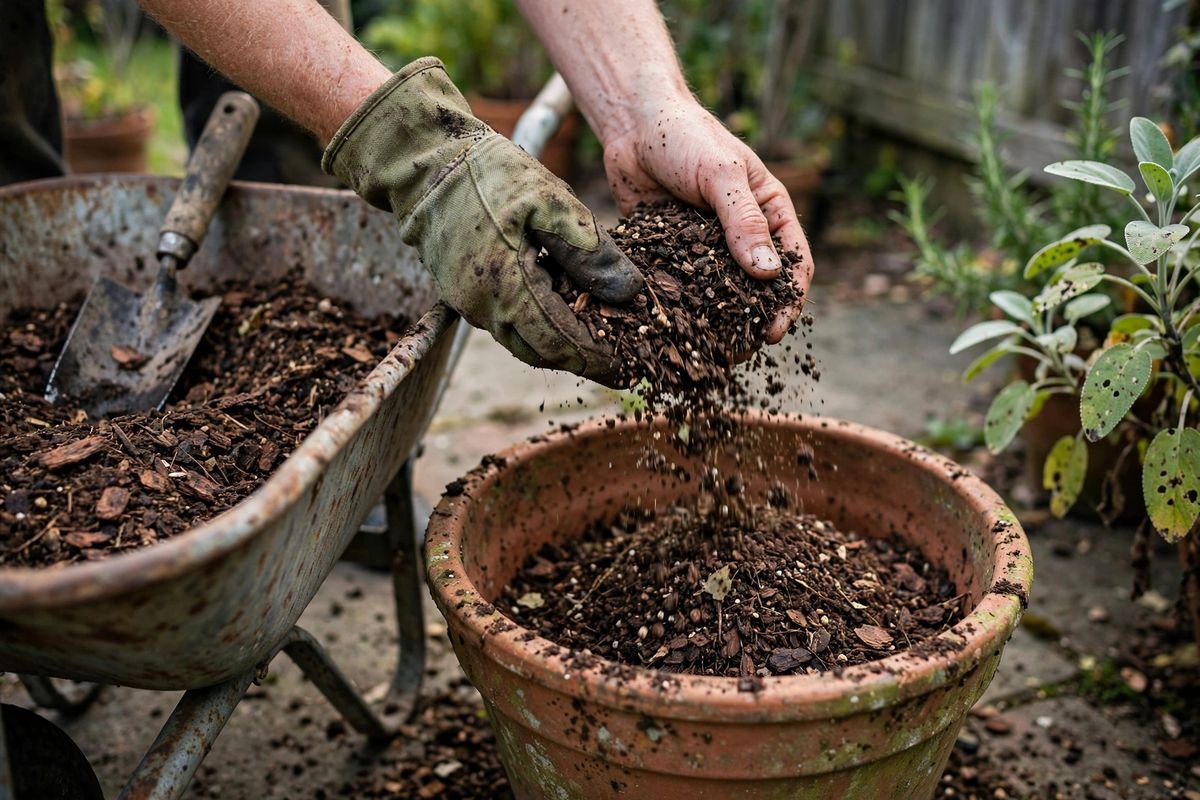
We mix in a slow-release fertilizer or compost at planting per the product label and our soil plan, since fresh bagged mix carries only a light starter charge. Midseason, the soil line in fabric bags often drops an inch or more as organic matter breaks down; we top up with fresh mix rather than mounding against the stem. Our walkthrough of container gardening for beginners covers mix choices and fertilizer rhythm for pots in general, and the same habits carry over to tomatoes.
How Long Each Size Goes Between Waterings in Midsummer
Assumptions. A mature, fruiting tomato in full sun on an 85 to 90°F day uses roughly 0.5 to 1.0 gallons of water per day, counting plant uptake plus surface evaporation; we use 0.75 gallons per day as the middle estimate. After a thorough watering and full drainage, a typical peat or coir based mix holds roughly 20 percent of its volume as water the plant can reach before stress begins. Mulch, shade on the pot wall, and calm air stretch the interval; wind, dark pots, and fabric walls shorten it.
The estimate. At 20 percent, a filled 5-gallon pot stores about 1.0 gallon of reachable water, which the middle estimate spends in a little over a day. In practice we check a 5-gallon tomato daily in midsummer and expect to water daily once fruit swells. A 10-gallon pot stores about 2.0 gallons, or roughly two to three days at that rate; we still check daily and usually water every one to two days, since the top dries well before the bottom. A 15-gallon pot stores about 3.0 gallons, or roughly three to four days in theory; most of us water every two to three days because uneven drying and hot walls use the reserve faster than the simple math suggests.
We treat these as planning ranges, not a calendar. The finger test decides: if the mix is dry 2 inches down in the morning, we water deeply that morning until a little drains from the bottom, then empty any saucer so roots do not sit in standing water. Self-watering reservoirs extend the gap between refills, but we still probe the mix, since a plant can wilt over a full reservoir if the wicking path dries out.
Drainage and Roots: The Two Details That Decide the Season
Every tomato pot needs drainage the plant can count on. We look for several holes rather than a single small one, and we raise the pot slightly on feet or slats so water can leave instead of pooling under the base. A layer of gravel in the bottom does not improve drainage in a potting mix; it raises the saturated zone closer to the roots. Better drainage comes from a coarse, well-structured mix and clear holes.
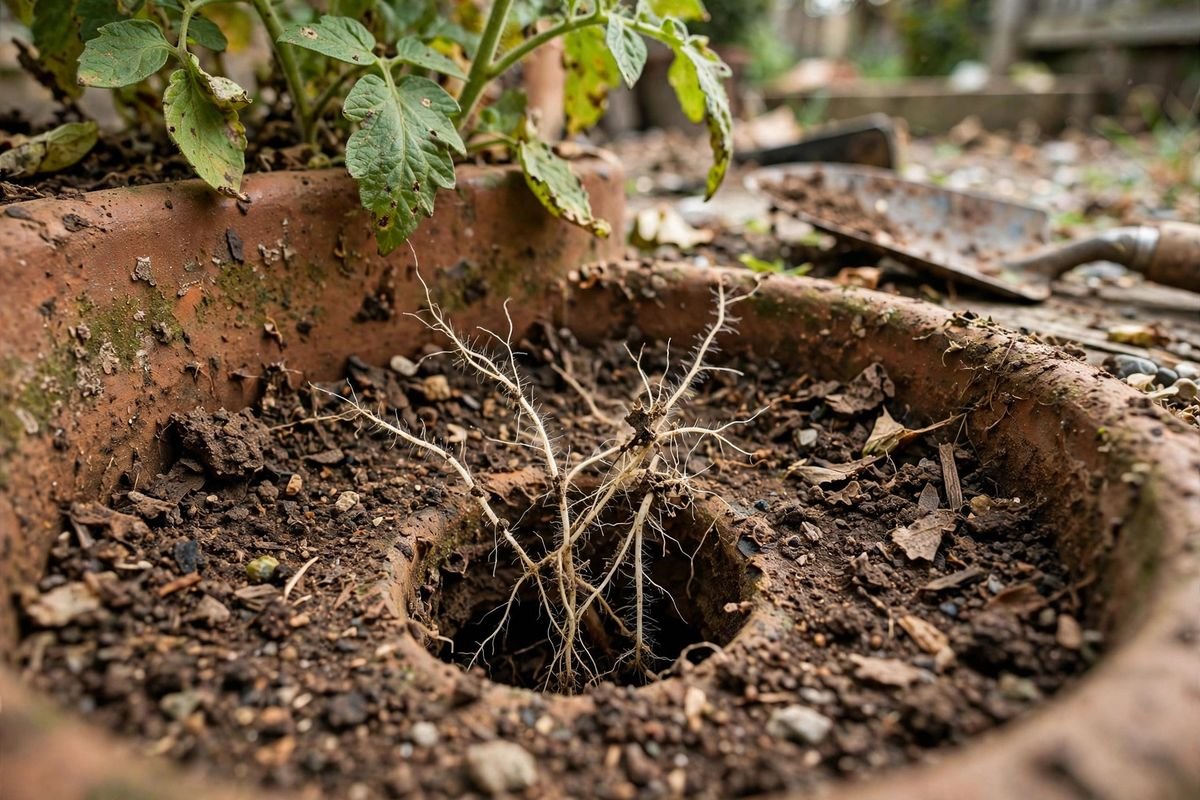
Roots tell us when size runs short. White roots circling tightly at the wall, water running straight through without wetting the center, and afternoon wilt that recovers overnight all point to a pot that has filled with roots faster than it fills with soil. Potting up midseason is rough on a fruiting vine, so we start at the size the mature plant needs rather than planning a late rescue. When we transplant, we set the seedling deep, burying part of the stem as our tomato guide describes, and water the mix in layers so no dry pocket remains around the root ball. Our full-season notes on how to grow tomatoes cover staking, pruning, and feeding once the pot is chosen.
Our Picks by Use Case
We organize picks by job, since the best pot for a windy rental patio differs from the best pot for a permanent sunny corner. Each link goes to a category search so we can compare current sizes and read recent reviews; we favor listings that state dimensions, soil capacity, and drainage clearly.
Best All-Around for Most Patios: 10-Gallon Fabric Grow Bags
For one indeterminate cherry or a compact slicer on a typical patio, a 10-gallon fabric bag gives enough root room without the weight of clay. Air-pruning suits tomatoes well, and the bag folds away in fall. We accept the faster drying and plan on near-daily checks in July and August. Compare options among 10-gallon fabric grow bags on Amazon, and favor bags with reinforced handles if we ever need to shift a full pot.
Best for Large Indeterminate Vines: 15-Gallon Pots and Bags
Beefsteaks and vigorous heirlooms reward the extra soil. Fifteen gallons holds more water between waterings and gives us room for a sturdy cage or stake base. In plastic, that size stays movable on a caddy; in fabric, we set it once and leave it. Browse 15-gallon fabric grow bags with handles on Amazon or rigid pots of the same volume, and confirm the depth reaches at least 14 inches.
Best for Small Balconies and Determinate Types: 5-Gallon Self-Watering Planters
Where floor space caps us at 5 gallons, a self-watering planter with an honest 5-gallon soil chamber makes a determinate patio tomato workable. The reservoir covers a missed day, and the compact vine does not outgrow the soil as fast as an indeterminate would. Look at 5-gallon self-watering planters on Amazon, and check that the listing separates soil volume from reservoir volume before we buy.
Best Stable, Long-Lived Setup: 10 to 15-Gallon Terracotta or Thick Plastic
When a pot will live in one sunny corner for years, weight becomes a virtue. Terracotta resists tipping and buffers day-night temperature swings, while thick plastic gives similar stability with less weight and no freeze-crack worry. We water terracotta more often and store it dry under cover where winters freeze. See large terracotta pots on Amazon and compare wall thickness and hole count in the photos, or choose a heavy-duty plastic pot of the same size if lifting matters.
Setting Up a Tomato Pot Well
- Place first, fill second. A filled 10 or 15-gallon pot is heavy. We set it in full sun, on feet or a caddy, before any soil goes in, with room for a cage or stake.
- Check drainage. We confirm holes are open, add feet if the base sits flat, and skip the gravel layer.
- Fill with a coarse container mix to 3 to 4 inches below the rim, water it to settle, then top up to 1 to 2 inches below the rim per our volume math above.
- Transplant deep and stake early. We bury part of the stem, set the cage or stake at planting so roots stay undisturbed, and tie loosely with soft material. Use your local frost dates and regional planting guidance — not your USDA hardiness zone alone — to choose planting dates.
- Mulch the surface with 1 to 2 inches of straw, shredded bark, or similar material to slow evaporation and keep soil from splashing onto lower leaves.
- Water in and start the rhythm. We water until a little drains out, check moisture daily the first week, and settle into the midsummer pattern our size estimate suggests.
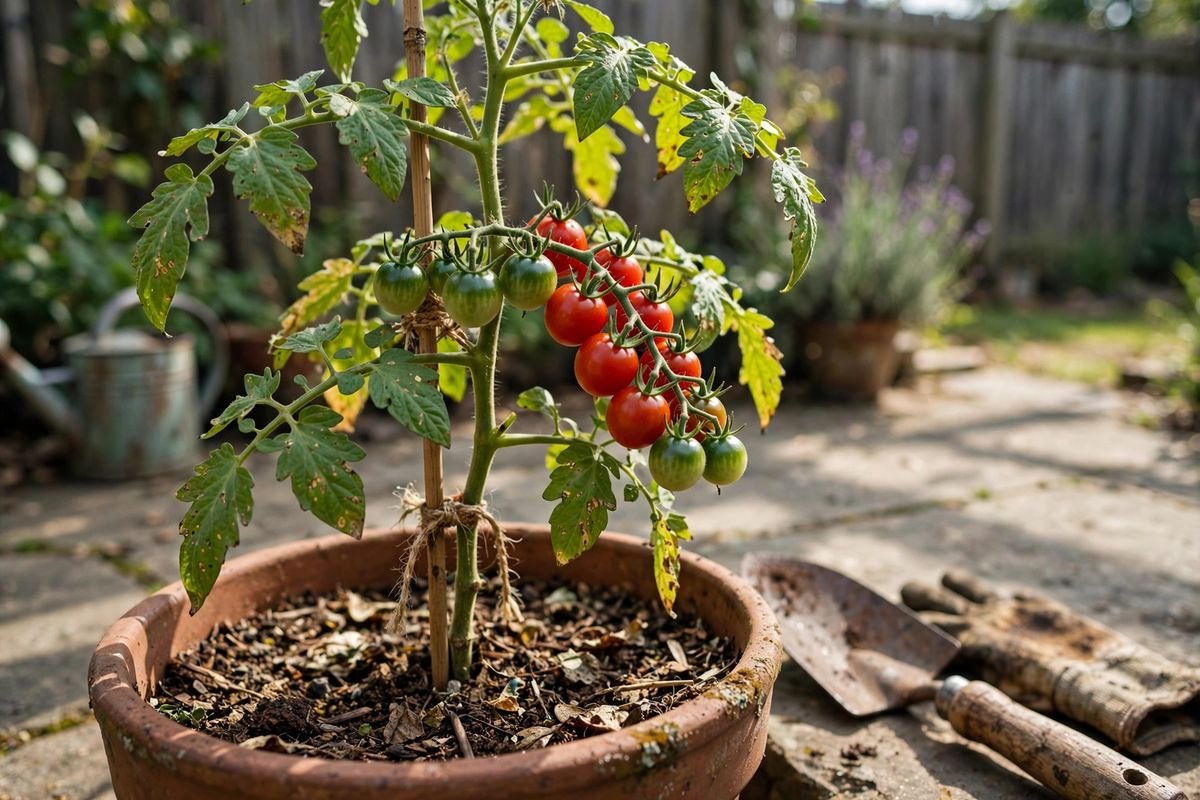
A staked cherry in a well-sized pot shows the payoff: steady moisture, fruit ripening in clusters, and foliage we can inspect leaf by leaf. A few spotted lower leaves over a long season are normal on patio plants; we remove badly affected leaves, keep water off the foliage where we can, and give the canopy air room rather than crowding pots together.
Common Problems We Trace Back to the Pot
Afternoon wilt that recovers by morning usually means the soil volume has run short of the plant size, not that the plant needs fertilizer. We check size first, then mulch and shade the pot wall. Blossom end rot on the first fruit often follows uneven watering in a small or fast-drying pot; steady moisture matters more than any single additive. Water running down the sides means the mix has dried and pulled from the wall; we water slowly in two passes and press the mix gently back to the edge. Green algae on terracotta is cosmetic, but it tells us the wall stays damp, which suits the plant if drainage still runs clear.
FAQ
Can we grow a tomato in a 3-gallon pot?
Dwarf patio types bred for containers can produce in 3 to 5 gallons with careful watering and feeding. Standard determinate and indeterminate tomatoes crowd a 3-gallon pot quickly, and we do not recommend it for a full season.
Is one big pot better than two smaller pots for two plants?
One plant per pot is the steadier rule. Two vigorous tomatoes sharing even a 15-gallon pot compete for water from the start. Two separate 10-gallon pots give each root system its own reserve and make watering simpler to judge.
Do fabric bags need a saucer?
On a deck or balcony where runoff matters, a large tray catches the first flush. Outdoors on soil or gravel, we set bags directly down and skip the saucer, since standing water against the base defeats the drainage we chose fabric for.
When should we replace a pot or bag?
We retire fabric bags that tear at the handles or seams, plastic that cracks or turns brittle, and terracotta with spreading freeze cracks. Any pot that held a diseased plant gets washed and disinfected before reuse, and we refresh the mix rather than reusing tomato soil for another tomato the next season.
Sources & Further Reading
- West Virginia University Extension — container gardening container sizes and tomato variety guidance (extension.wvu.edu).
- University of Arizona Cooperative Extension — container gardening sizing, watering, and fertilizing basics (extension.arizona.edu).
- Colorado State University Extension — container gardens: five-gallon minimums for tomatoes and moisture management (extension.colostate.edu).
- Oregon State University Extension Service — container gardening for vegetables, drainage, and container choices (extension.oregonstate.edu).
Keep Growing With These Guides
The pot is only the start. How we water, stake, and feed across the season decides what the plant makes of that root room. Which tomato type are we potting first this year — a compact patio plant in 5 gallons, or a tall cherry with 15 gallons to run in?