
This post may contain affiliate links. If you buy through links on this page, we may earn a commission at no extra cost to you.
As an Amazon Associate I earn from qualifying purchases.
Seedlings grown indoors in still air tend to grow tall, thin stems that flop once they move outside. A small fan changes that pattern. Gentle moving air makes stems sway a little each day, and that sway helps stems grow sturdier over the weeks before transplant. A fan also moves damp air away from leaf surfaces, which lowers the damp conditions that favor damping off in crowded trays.
This guide compares three fan forms for a seed starting shelf: clip-on fans, small USB desk fans, and small oscillating fans. We compare them by airflow reach, noise approach, power source, and fit for one shelf versus several shelves. We have not tested the products linked here, and we do not present any price below as a current store price. Where we give numbers, we state the assumptions so readers can redo the math with their own shelf size and rate.
What gentle airflow should do
A seedling fan should rustle leaves lightly, not bend stems flat or dry the soil surface in a few hours. Set the fan so air passes across the tops of the plants rather than straight down onto one pot. If soil dries much faster on the side nearest the fan, move the fan back or angle it away. Run the fan during the same hours as the grow lights, and turn it off at night with the lights.
Three small fan forms at a glance
| Form | Airflow reach | Noise approach | Power source | Fit for shelves |
|---|---|---|---|---|
| Clip-on fan | One shelf section or one tray, aimed by hand | Usually quiet at low speed; check the listing for a speed control | USB or plug-in, by listing | One shelf per fan; add a fan per shelf |
| Small USB desk fan | One shelf section at close range, from a flat surface | Usually quiet at low speed; larger blades at low speed tend to sound softer | USB port or USB adapter | One shelf per fan; needs a flat spot beside or below the trays |
| Small oscillating fan | Sweeps across a wider shelf or more than one tray | Motor sound plus sweep sound; a low-speed setting matters in a living room | Plug-in, by listing | One shelf, or two close shelves from a shared position |
Reach in the table means how far useful moving air travels before it fades to a faint draft. Place the fan close enough that leaves sway lightly at the far end of the trays.
Clip-on fans
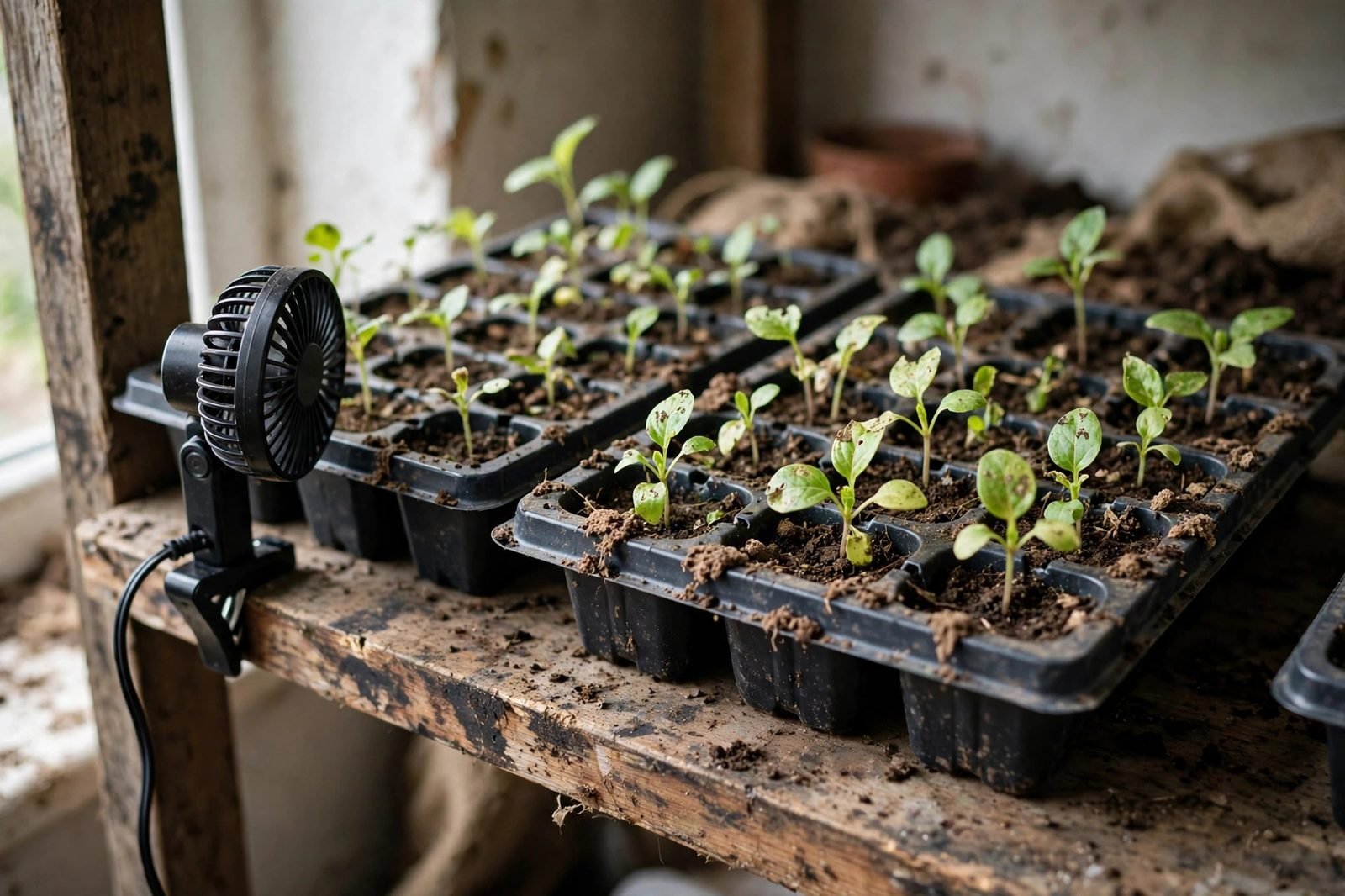
A clip-on fan grips a shelf edge, a wire rack, or a table edge, and aims air across the trays without taking up shelf space. That grip is the main strength of the form. Trays keep their full footprint, and we can move the fan by unclipping it. It suits a wire shelving unit well, since the clip has open bars to grip.

The limits of a clip-on fan come from its fixed aim. It blows in one direction until we move it, so one end of a long shelf may get more air than the other end. A clip also needs an edge thick enough to hold it, and a thin wire or a rounded edge may let the fan slip. Test the clip on an empty part of the shelf before placing pots in the air path. Search listings for a small clip-on fan for seedlings and confirm clip range, speed settings, cord length, and power source before ordering.
Small USB desk fans
A small USB desk fan sits on a flat surface and blows across a shelf section at close range. Its strength is simple placement. We set it beside the trays, plug in the USB cable, and aim it by turning the base or tilting the head. USB power keeps season electricity cost small, as the worked example below shows.
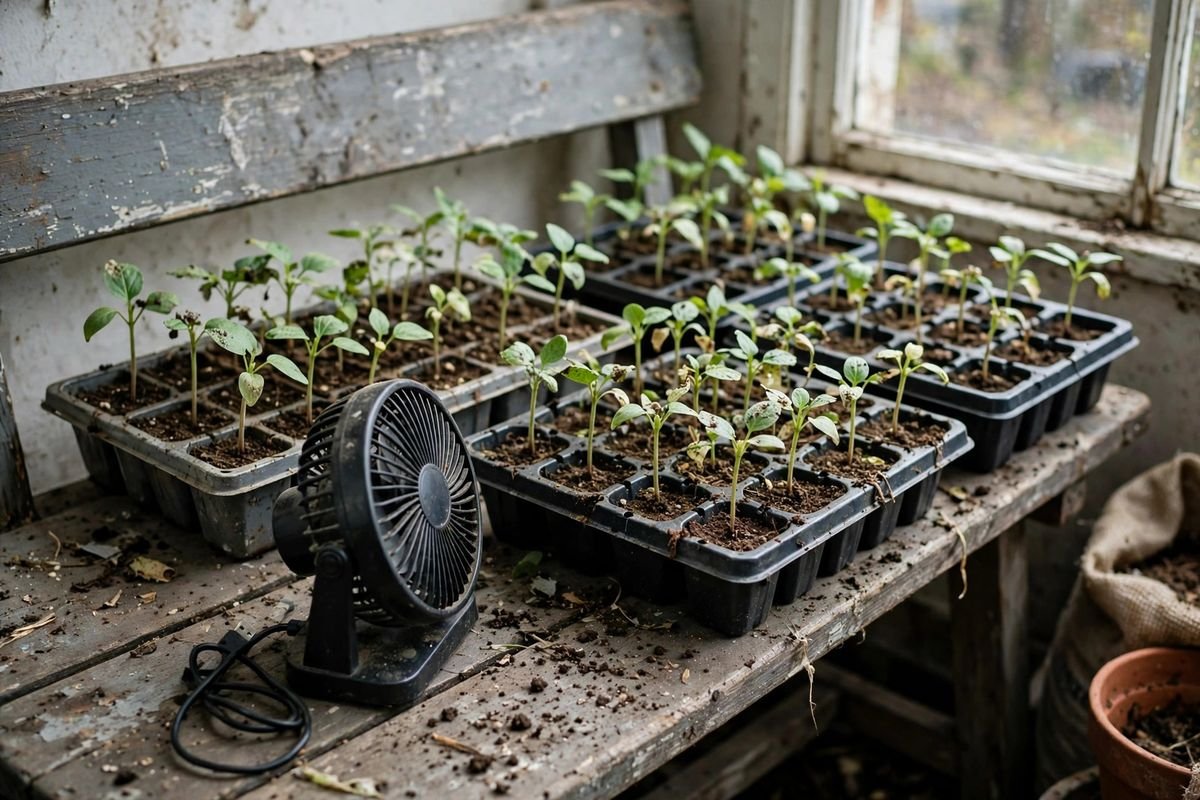
The limits of a USB desk fan come from its footprint and its short reach. It takes up space that could hold a tray, and its air fades fast past a few feet, so it suits one shelf section rather than a long row of trays. A USB fan also depends on a port or adapter that stays powered during light hours, so check that the port does not shut off with a computer that sleeps. Search listings for a small USB desk fan for seedlings and confirm blade size, speed settings, and whether the listing includes an adapter or expects a port we already own.
Small oscillating fans
A small oscillating fan sweeps its head from side to side, so one fan can cover a wider shelf than a fixed fan can. That sweep is the main strength of the form. Air reaches each tray in turn instead of drying one spot all day. An oscillating fan suits a shelf 3 to 4 feet wide, where a fixed fan would leave one end still.
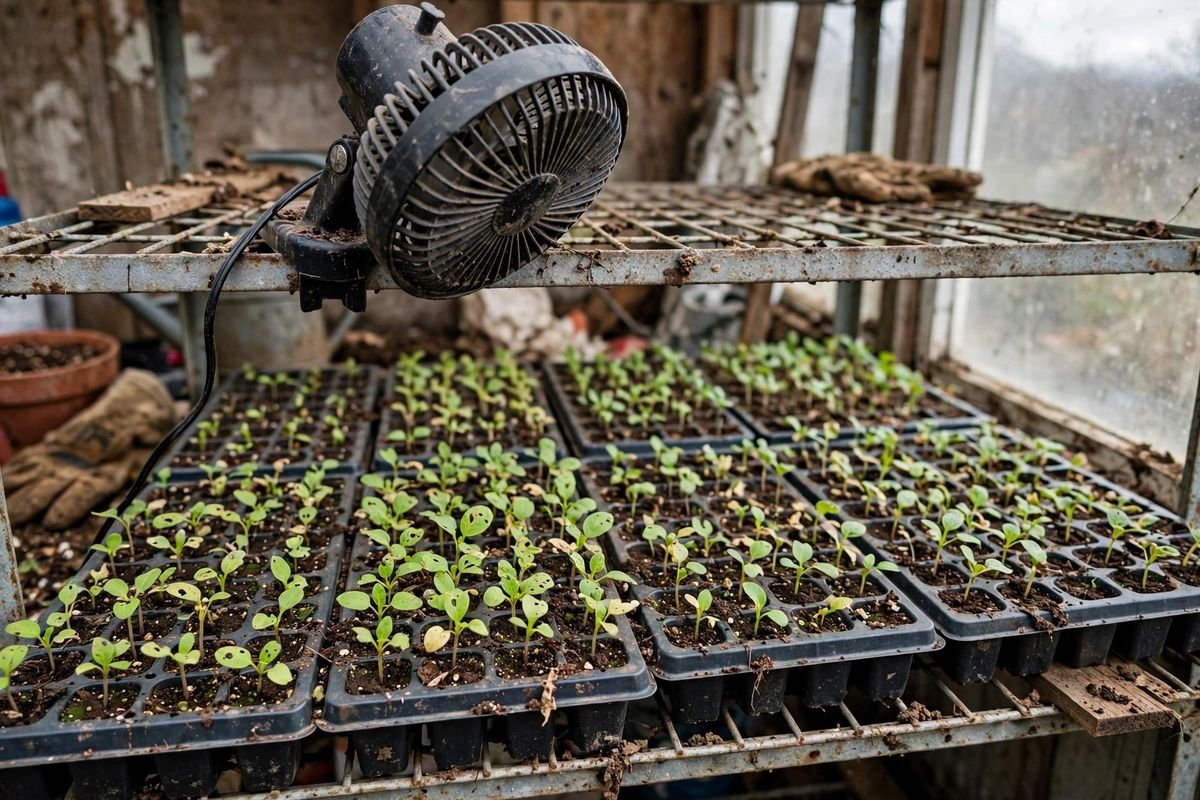
The limits of an oscillating fan come from size and sound. It needs a flat base wider than a clip, and the sweep needs clearance so the head does not hit trays or light cords. The motor and the sweep add sound, so a low-speed setting matters when the shelf sits in a room we use each evening. Search listings for a small oscillating fan for seedlings and confirm base size, sweep range, speed settings, and cord length before ordering.
Worked example: placement and run-time math for a two-shelf setup
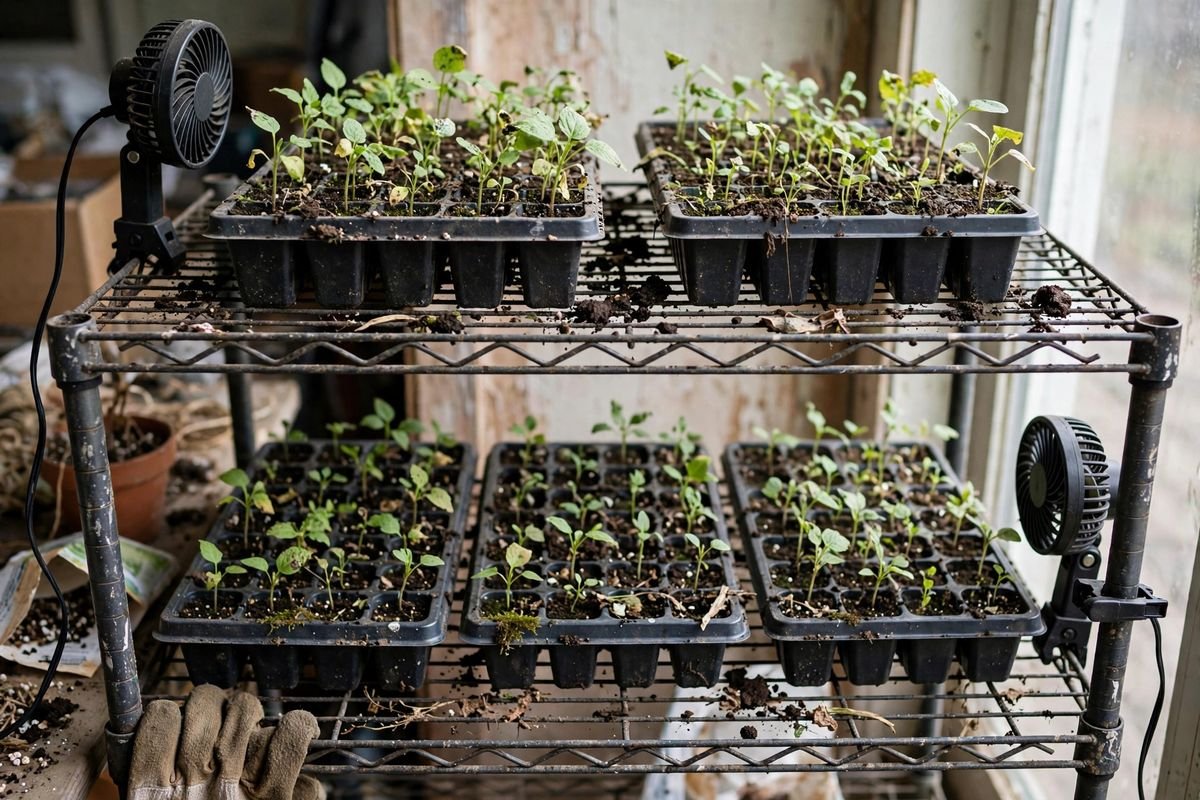
Assume a two-shelf setup where each shelf holds one tray, each shelf measures 2 feet by 1 foot, and we use one 5-watt USB fan per shelf. Place one fan at the left end of the top shelf, aimed across the trays toward the right end, and place the second fan at the right end of the bottom shelf, aimed across the trays toward the left end. Staggering the fans keeps cords on opposite ends and gives each shelf its own air path.
Run-time math for one fan follows four steps. Divide 5 watts by 1,000 to get 0.005 kilowatts. Multiply by 16 hours per day and 90 days to get 7.2 kilowatt-hours for the season. Multiply 7.2 kilowatt-hours by $0.17 per kilowatt-hour to get $1.22 per fan for the season. Two fans on this two-shelf setup cost $2.45 in electricity for the season under these assumptions, before any fan purchase price. Replace $0.17 with our own rate, or 16 with our own daily hours, to redo the math.
Check the placement after one week of growth. If leaves at the far end do not sway, move that fan closer to the trays. If soil on the fan side dries much faster than soil on the far side, move the fan back a few inches or aim it slightly above the plants. Our guide to how to set up grow lights on a shelving unit covers cord routing for a shelf with more than one item plugged in, and our guide to best seed starting shelves for small spaces covers narrow shelves for a corner or desk area.
How to choose
Choose a clip-on fan if we grow on a wire rack, want to keep the full tray footprint, and need one fan per shelf that moves easily between shelves. Choose a clip-on fan if we have a solid shelf edge for the clip and a short shelf where one fixed aim covers the trays.
Choose a small USB desk fan if we have a flat spot beside the trays, want low season electricity cost, and need air for one shelf section at close range. Choose a USB desk fan if we already have a powered USB port or adapter that stays on during light hours.
Choose a small oscillating fan if we have a shelf 3 to 4 feet wide, want one fan to sweep across several trays, and have room for a base plus sweep clearance. Choose an oscillating fan if the shelf sits where a low-speed setting keeps sound comfortable in the evening. Start with the shelf count, then pick the form that fits our shelf edge, our flat space, and our tolerance for sound. Our guide to best grow lights for seedlings pairs fan placement with light placement, and our guide to how long grow lights should stay on for seedlings covers the light hours fan hours should match.
Sources & Further Reading
University of Minnesota Extension, Starting seeds indoors: https://extension.umn.edu/planting-and-growing-guides/starting-seeds-indoors
North Carolina State Extension, Extension Gardener Handbook Chapter 13 Propagation: https://content.ces.ncsu.edu/extension-gardener-handbook/13-propagation