
This post may contain affiliate links. If you buy through links on this page, we may earn a commission at no extra cost to you.
As an Amazon Associate I earn from qualifying purchases.
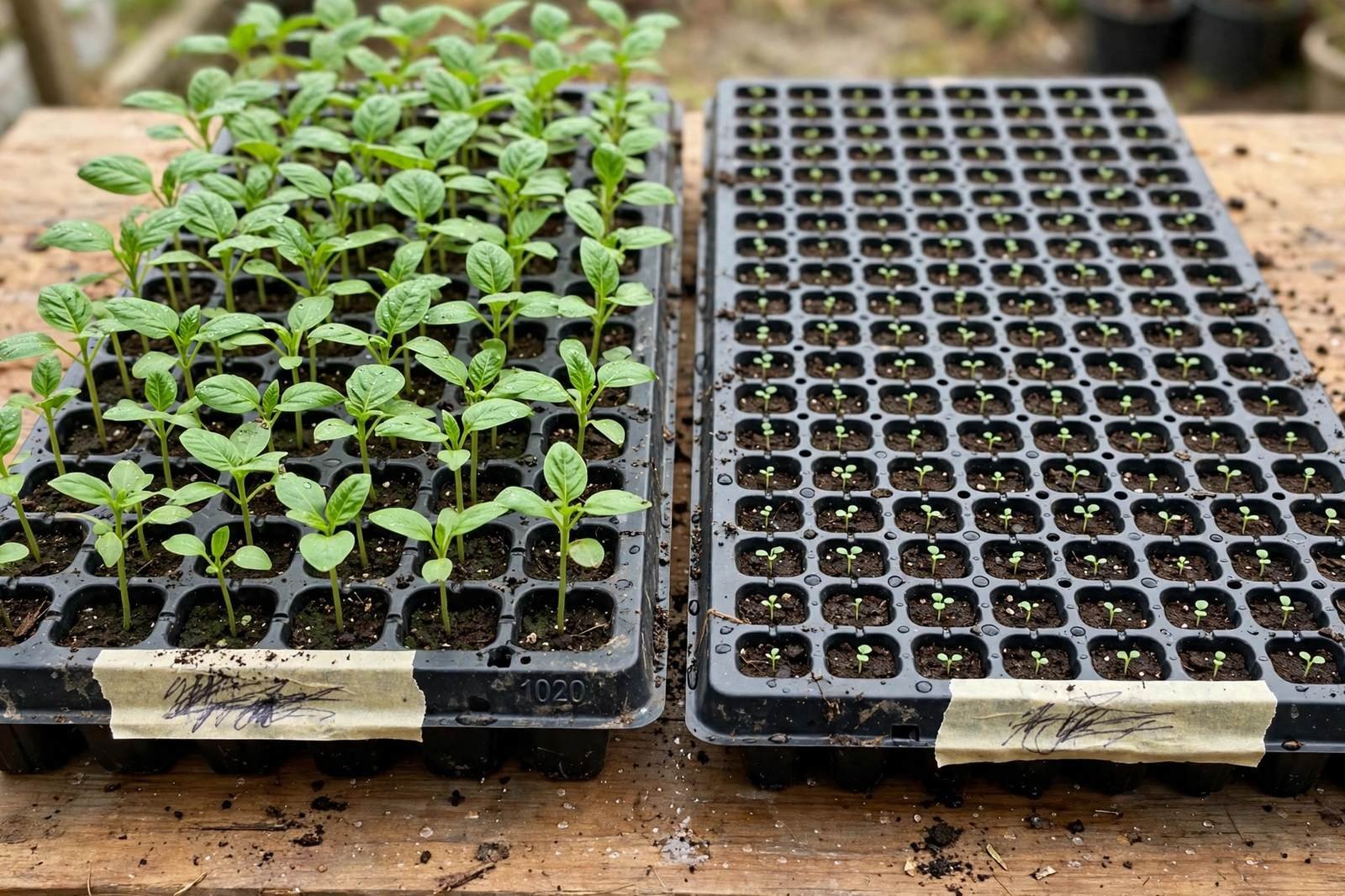
The number on a seed tray is its cell count per standard 1020 tray. More cells means more plants per tray, but less soil per plant, and that trade-off decides how long seedlings can stay put before they need potting up. Pick too small and you are transplanting twice; pick too big and you waste shelf space and mix. Here is how the two most common sizes compare, with the soil-volume math and a days-to-outgrow worked example by crop.
72-cell vs 128-cell at a glance
| 72-cell | 128-cell | |
|---|---|---|
| Cells per 1020 tray | 72 | 128 |
| Mix per cell (approx.) | 2.7 fl oz | 1.1 fl oz |
| Mix per tray (approx.) | 1.5 gallons | 1.1 gallons |
| Watering frequency | Every 1 to 2 days at peak | Daily at peak; dries fast |
| Time before potting up | 5 to 8 weeks for most crops | 3 to 5 weeks for most crops |
| Best for | Tomatoes, peppers, larger transplants | Lettuce, herbs, flowers, big sowings |
What a 72-cell tray gives you
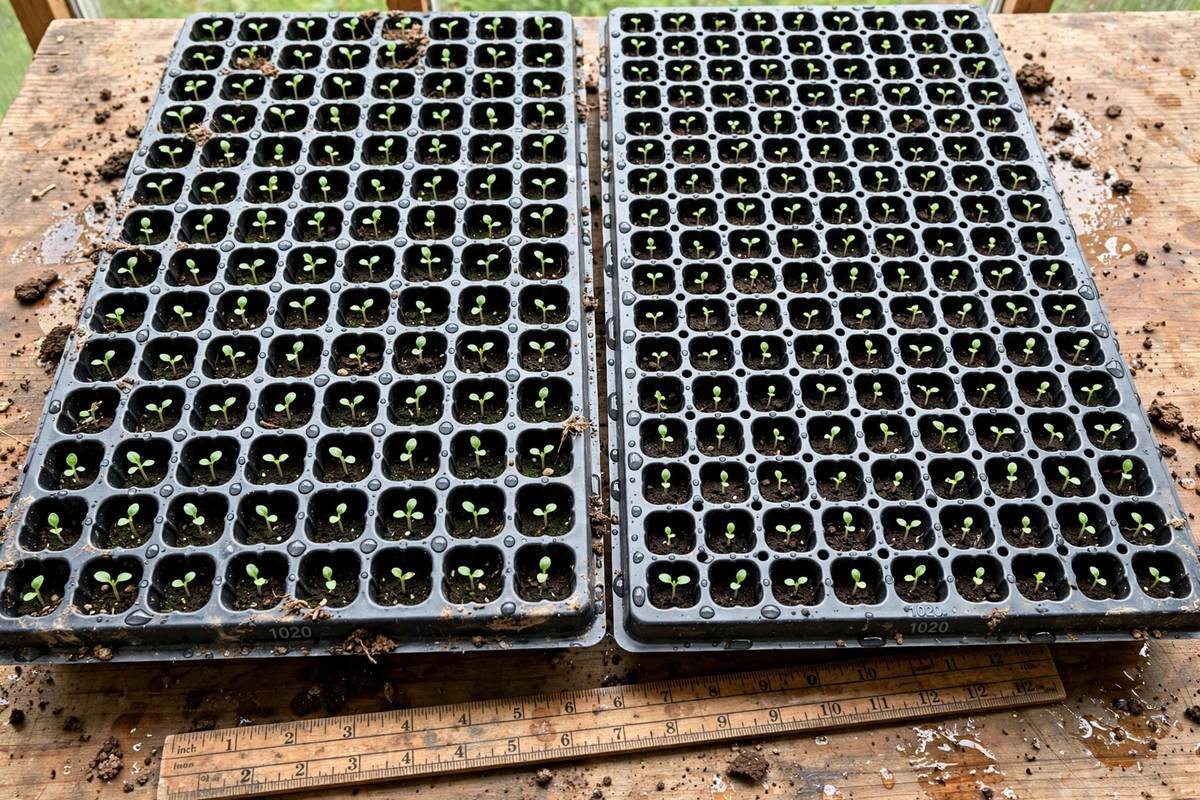
Each cell in a 72-cell insert is roughly an inch and a half square and a little over two inches deep. That is room for a real root system: seedlings can sit in these cells for well over a month, which covers the full indoor run of tomatoes and peppers for most gardeners. The price is density. You fit 72 plants per tray instead of 128, so a big sowing eats shelf space fast. If you are deciding between tray types for the season, our roundup of the best seed-starting trays compares sturdy options in both sizes.
What a 128-cell tray gives you
Cells run about an inch square and hold roughly a fluid ounce of mix each. You get nearly twice the plants per tray, per shelf, and per bag of mix, which is why market growers and flower sowers love them. The catch is the calendar: with that little soil, seedlings outgrow the cell in weeks, not months, and a tray at peak growth can need water every day. Miss a day in a warm room and the whole tray wilts. Cell depth matters as much as count here; see how deep seed-starting cells should be for why shallow cells dry out first.
Pros and cons: 72-cell trays
72-cell pros
- More soil per plant, about two and a half times the volume of a 128-cell.
- Seedlings stay put for 5 to 8 weeks, often skipping a potting-up step entirely.
- Forgiving of a missed watering; the larger soil reserve buys you a day.
- Sturdier transplants with bigger root balls at plant-out time.
72-cell cons
- Fewer plants per tray, so big sowings need more trays, shelves, and lights.
- Uses more mix per tray, about a third more than a 128-cell fill.
- Overkill for fast crops like lettuce that transplant in three weeks anyway.
Pros and cons: 128-cell trays
128-cell pros
- Nearly twice the plants per tray, shelf, and bag of mix.
- Less mix per tray, so filling and carrying trays is quicker and cheaper.
- Ideal for crops that transplant young: lettuce, basil, marigolds, and most flowers.
- Seedlings pop out easily for transplanting with minimal root disturbance.
128-cell cons
- Tiny soil reserve means daily watering at peak growth, sometimes twice daily.
- Seedlings outgrow cells in 3 to 5 weeks; slow crops need potting up.
- Less room for error with fertilizer; small cells burn faster.
- Not enough root room for vigorous crops like tomatoes grown to transplant size.
Soil volume per cell, worked out

Assumptions, stated plainly: a 72-cell insert cell measures about 1.5 by 1.5 inches and 2.3 inches deep, tapering toward the bottom, which works out to roughly 2.7 fluid ounces of mix per cell. A 128-cell cell measures about 1 by 1 inches and 2 inches deep, or roughly 1.1 fluid ounces. Multiply out: a 72-cell tray holds about 194 fluid ounces of mix (around 1.5 gallons, or 0.2 cubic feet), while a 128-cell tray holds about 141 fluid ounces (around 1.1 gallons, or 0.15 cubic feet).
So each plant in a 72-cell gets about two and a half times the soil of a plant in a 128-cell, while the 128 tray fits about 1.8 times the plants. The mix cost difference per tray is small: at $0.25 per quart for bagged potting soil, a 72-cell fill runs about $1.50 against about $1.10 for a 128-cell fill. The real cost of the smaller tray is labor: more frequent watering and an extra potting-up step for slow crops. Starting from zero? Our seed-starting kit picks bundle trays, domes, and mix so the sizes match.
Days to outgrow, by crop: a worked example
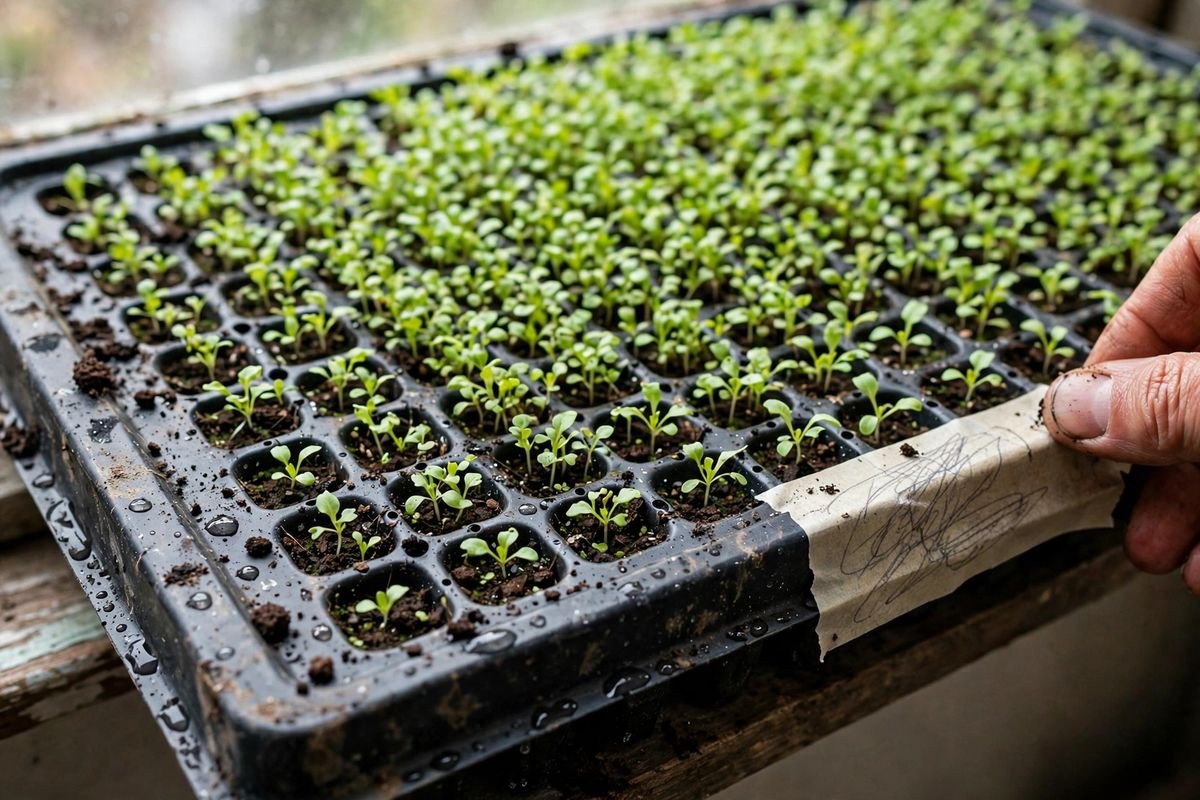
The table below is a planning estimate, not trial data. Assumptions: strong light 14 to 16 hours a day, room temperature 65 to 70°F, and watering when the tray feels light. Your light, temperature, and watering move these numbers, so treat the observable signals as the real rule: pot up when roots circle the cell bottom or the tray starts needing water every day.
| Crop | 128-cell: comfortable weeks | 72-cell: comfortable weeks |
|---|---|---|
| Tomato | About 3 | 5 to 6 |
| Pepper | 4 to 5 | 6 to 8 |
| Lettuce | About 3 | 4 to 5 |
| Basil | About 4 | 5 to 6 |
Read it as a sowing calendar. Tomatoes for a May transplant, started in a 128-cell in March, need potting up in April; in a 72-cell they can go straight from tray to garden. Lettuce barely cares which tray you use, since it transplants at three weeks either way. For crop-specific timing, our tomato growing guide and pepper growing guide give weeks-before-frost sowing dates. Use your local frost dates and regional planting guidance — not your USDA hardiness zone alone — to choose planting dates.
Our verdict: which tray for which sowing
Choose 72-cell trays if you grow tomatoes, peppers, or other vigorous transplants; you want to skip potting up; you water once a day at most; or your sowing list is short enough that 72 plants per tray is plenty. Browse 72-cell trays on Amazon to compare rigid reusable options against thin disposable ones.
Choose 128-cell trays if you sow lettuce, herbs, or flowers in volume; you transplant young; you check trays daily anyway; or shelf space is the limiting factor. They also suit microgreens-style dense sowings; see how to grow microgreens indoors for a setup that never needs transplanting at all.
Mistakes that waste a tray

- Starting tomatoes in 128-cells with no plan to pot up, then watching them stall at four weeks.
- Sowing lettuce in 72-cells and giving up half your shelf to a crop that transplants in three weeks.
- Watering both tray sizes on the same schedule. The 128-cell tray always drinks first.
- Reusing thin trays until they crack mid-season. Rigid trays survive years; see our tray picks above.
- Skipping labels because you “will remember.” You will not; label every tray at sowing time.
Frequently asked questions
Can I mix tray sizes on the same shelf?
Yes, and most gardeners do. Group trays by water needs rather than by crop so the thirsty 128-cells get checked together.
Do seedlings grow faster in bigger cells?
Not exactly faster, but steadier. Bigger cells buffer water and nutrients, so growth does not stall between waterings the way it can in a 128-cell.
How many trays do I need for a home garden?
Count your transplants, divide by the cell count, and add one tray for succession sowing. A family vegetable garden usually fits in two to four 72-cell trays or one to two 128-cell trays.
Sources & further reading
- University of Minnesota Extension, Starting seeds indoors: https://extension.umn.edu/planting-and-growing-guides/starting-seeds-indoors
- Iowa State University Yard and Garden, Starting seeds indoors: https://yardandgarden.extension.iastate.edu/how-to/starting-seeds-indoors
- Clemson Cooperative Extension HGIC, Starting seeds indoors: https://hgic.clemson.edu/factsheet/starting-seeds-indoors/