

This post may contain affiliate links. If you buy through links on this page, we may earn a commission at no extra cost to you.
As an Amazon Associate I earn from qualifying purchases.
Spider Farmer lights are the budget-friendly LED panels that show up in a lot of home grow setups: efficient diodes, a fair price, and a simple hanging kit. If you are shopping for one, the short answer is that Spider Farmer is a solid pick for small tents on a budget, and brands such as Mars Hydro, VIVOSUN, AC Infinity, and HLG each beat it in some corner: warranty, build, app control, or top-end efficiency. The right light depends on your tent size, your budget, and how much heat and noise you can live with.
We have not run side-by-side light tests in a lab, and we will not pretend we did. This comparison pulls together maker-stated specs, common grower experience, and plain math on coverage, so you can weigh the tradeoffs with real numbers. For seedling basics, see our best grow lights for seedlings guide, our LED vs fluorescent lights for seedlings comparison, and our guide to grow light height above seedlings.
Spider Farmer lights and the alternatives at a glance
| Light | Style | Typical wattage range | Tent size it suits | What you pay for |
|---|---|---|---|---|
| Spider Farmer SF series | Board and bar lights | About 100 to 400 watts across the range | 2 x 2 ft to 4 x 4 ft | Efficient diodes at a fair price |
| Mars Hydro TS and FC series | Board and bar lights | About 100 to 450 watts across the range | 2 x 2 ft to 5 x 5 ft | Wide range, frequent sales, long track record |
| VIVOSUN VS series | Board lights | About 100 to 200 watts for most models | 2 x 2 ft to 4 x 4 ft | Low price, simple setup, wide retail presence |
| AC Infinity Ionboard and Ionframe | Board and bar lights | About 100 to 400 watts across the range | 2 x 2 ft to 5 x 5 ft | Build quality, app control, quiet drivers |
| HLG quantum boards | Board lights | About 100 to 600 watts across the range | 2 x 2 ft to 5 x 5 ft | Top-end efficiency, US assembly on many models |
Wattage ranges in this table come from maker listings and common model sizes. Check the listing before you buy, since model names and wattages change and two lights with the same wattage can cover very different areas.
What Spider Farmer does well
Diode efficiency is the headline strength. Many Spider Farmer models use Samsung LM301B diodes, per the maker, and those diodes turn more of each watt into light plants can use than the older blurple panels did. That shows up as lower power draw for the same brightness, and less waste heat in a small tent.
Price is the second strength. Spider Farmer sits in the budget-to-mid range, and the kits include what you need to hang the light: rope hangers, a dimmer knob on most models, and a driver you can often mount outside the tent to keep heat down. Setup takes minutes, and the smaller boards run quietly with passive cooling, no fan noise at all.

- Efficient diodes at a fair price, per maker specs
- Dimmer included on most models, so one light covers seedlings and mature plants
- Simple hanging kit in the box, with rope hangers
- Quiet passive cooling on smaller boards, with no fan noise
- Driver can often mount outside the tent to cut heat inside
Where Spider Farmer falls short
Warranty and support are the weak spots most often raised by growers. Coverage terms vary by seller and region, so read the warranty on the listing you actually buy from, not on a review of a different seller. Smaller boards also cover less area evenly: a single board over a 4 x 4 ft tent leaves dim corners, and the fix is a bar-style light or two boards, which costs more.
Heat is the other practical limit. The driver adds warmth inside a small tent unless you mount it outside, and a 400-watt light in a sealed 2 x 4 ft tent needs real airflow. Most Spider Farmer models also lack app control, so if you want schedules and dimming from your phone, look elsewhere.
- Warranty terms vary by seller, so check the listing you buy from
- A single board leaves dim corners in larger tents
- Driver heat builds up in small tents unless mounted outside
- No app control on most models
- Bar-style models cost notably more than the basic boards
The alternatives, one by one
Mars Hydro
Mars Hydro is the closest direct rival, with a similar range of board and bar lights at similar prices. The TS series covers small tents well, and the FC series bar lights spread light more evenly across larger canopies. Mars Hydro runs frequent sales, and its lights have a long track record in home grows, which means plenty of real grower reports to read before you buy.
The tradeoff is much the same as Spider Farmer: budget build, warranty terms that vary by seller, and drivers that add heat in small tents. Pick between the two on current price, the exact tent size you own, and recent grower reports for the model you are eyeing.
VIVOSUN
VIVOSUN is the budget pick of this group. Its VS series boards cost less than Spider Farmer or Mars Hydro at the same wattage, and the brand is widely stocked, so parts and replacements are easy to find. For a first light over seedlings or a small herb tent, VIVOSUN is hard to beat on price.
The tradeoff is efficiency and coverage. VIVOSUN boards generally sit a step below Spider Farmer on diode efficiency, per maker specs, and the range tops out lower, so large tents need two lights. If you plan to grow fruiting plants to harvest, the savings may cost you yield. For seedlings and leafy greens, that gap matters less.
AC Infinity
AC Infinity is the pick for growers who want control and quiet. Its Ionboard and Ionframe lights pair with the brand’s controllers and app, so you can set schedules, dimming, and fan triggers from your phone. Build quality is a step up from the budget brands, drivers run cool and quiet, and the warranty terms are clearer than most.
The tradeoff is price. AC Infinity lights cost more than Spider Farmer at the same wattage, and the app features only pay off if you buy into the wider AC Infinity system of fans and controllers. If you run one tent with one light and a manual timer, the extra cost buys you little.
HLG
HLG, short for Horticulture Lighting Group, is the efficiency leader of this group. Its quantum boards are known for high light output per watt, and many models are assembled in the US with clear specs and honest coverage ratings. Serious growers who measure yield per watt tend to land here.
The tradeoff is price and looks. HLG boards cost the most of the lights in this comparison, often twice the price of a budget board at the same wattage, and the bare-board design looks unfinished next to a cased bar light. If you grow for maximum harvest in a fixed space, the premium can pay for itself. If you grow herbs and seedlings, it is more light than you need.
Worked example: light for a 2 x 4 ft tent
A 2 x 4 ft tent has 8 square feet of floor. The worked example below uses example figures from maker listings, not our measurements, to show how coverage math works.
Take a 200-watt bar light listed by its maker for a 2 x 4 ft flowering footprint. Watts per square foot is 200 divided by 8, which is 25 watts per square foot. Now take a 100-watt board over a 2 x 2 ft area, which is 4 square feet. Watts per square foot is 100 divided by 4, also 25 watts per square foot. The two setups give the same watts per square foot, but they cover different shapes: the bar spreads light across the full 2 x 4 ft canopy, while the board suits a square tent.
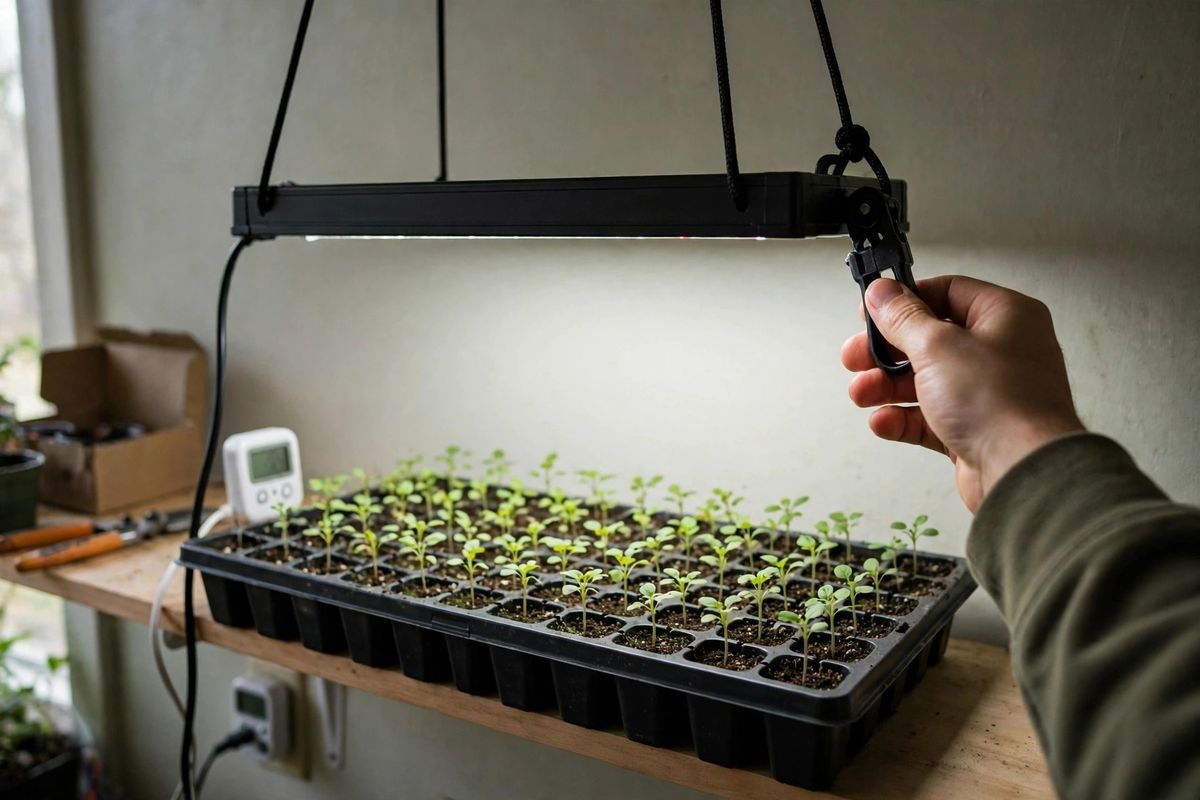
Hanging height matters as much as wattage. Maker guidance for seedlings commonly starts at about 18 to 24 inches above the tops of the plants, then lowers as plants grow and can take more light. Watch the leaves: pale or stretched seedlings want the light closer or brighter, and scorched leaf edges mean the light is too close. Our guide to grow light height above seedlings walks through the signs in detail.
One more number to check before you buy: power draw at the wall. A light sold as a 200-watt model should draw about 200 watts at full power. Some listings quote a larger equivalent number, so look for the actual power draw in the spec sheet, not the headline.
How to choose
Choose Spider Farmer if…
- You want efficient diodes at a budget-to-mid price
- Your tent is 2 x 2 ft to 4 x 4 ft and a single board or bar covers it
- You are happy with a manual dimmer and a simple timer
- You want quiet passive cooling with no fan noise
Choose an alternative if…
- Your budget is tight and you only grow seedlings or leafy greens, so VIVOSUN saves you money
- You want app control, schedules, and fan triggers, so AC Infinity fits better
- You grow for maximum harvest and want the highest efficiency, so HLG earns its premium
- Mars Hydro has the exact size you need on sale this week
What to check before you buy
Match the light to your tent size first, and go by the maker coverage rating for flowering plants, which is stricter than the seedling rating. Confirm the light has a dimmer, since one light must cover both delicate seedlings and mature plants. Check where the driver sits and whether it can mount outside the tent. Read the warranty terms on the exact listing you buy from, and check the actual power draw at the wall in the spec sheet. Plan airflow too: any light above 200 watts in a small tent needs an exhaust fan or an open vent, or heat will build up fast.
Sources & Further Reading
- University of Minnesota Extension, lighting for indoor plants
- Cornell Cooperative Extension, indoor growing and lighting guides
- USDA, indoor and controlled-environment growing resources