

This post may contain affiliate links. If you buy through links on this page, we may earn a commission at no extra cost to you.
As an Amazon Associate I earn from qualifying purchases.
Fall is the best time to test garden soil. The beds are empty or nearly empty, the soil is still warm enough to dig, and you have months before spring planting to act on what the results say. A test taken now tells you what to add in fall, so amendments have all winter to work into the soil.
This guide walks through the whole job: how to take a sample the right way, when a home kit is enough and when a lab test is worth the wait, and how to read the numbers on the report. The worked example uses one 4-by-8-foot bed, and the math scales to any bed size.
Why test soil in fall
A soil test answers three questions: how acid or alkaline the soil is, which nutrients are low, and how much organic matter the soil holds. Guessing at those answers leads to the two most common mistakes in a vegetable garden: adding lime the soil does not need, and feeding plants that are already well fed.
Fall timing helps in two ways. First, lime and sulfur need months to change soil pH, so a fall application is already working by spring. Second, labs are less busy in fall than in the spring rush, and many gardeners get results back a few days sooner.
Test every two to three years for an established bed, and test every new bed before the first planting. If a crop grew poorly for no clear reason, a test is the fastest way to rule soil out or point at it.
What a soil test tells you
A standard lab test reports soil pH, the levels of phosphorus, potassium, calcium, and magnesium, and the percentage of organic matter. Some labs also report micronutrients and soluble salts. The report pairs each number with a rating, such as low, medium, or high, and a recommendation for what to add.
Soil pH matters because it controls whether plants can take up the nutrients already in the soil. Most vegetables grow well between pH 6.0 and 7.0. Below that range, phosphorus and calcium get harder for roots to reach. Above it, iron and manganese can run short.
Organic matter is the quiet number on the report. It feeds soil life, holds moisture, and helps sandy soil keep nutrients. A bed under 3 percent organic matter will almost always do better with a regular compost top-up.
How to take a soil sample
A good sample represents the whole bed, not one spot. The most common error is scooping soil from a single place, often the spot that was just fed, and treating that one scoop as the bed.
For our worked example, take one 4-by-8-foot bed. Walk a zigzag path across the bed and pull 10 cores, each 6 inches deep, spacing them evenly. A soil probe makes this fast, and a clean trowel works too. Put all 10 cores in a clean bucket, mix them well, and remove stones and roots. Scoop about 2 cups of the mixed soil into the sample bag. That one bag now stands for the whole 32-square-foot bed.
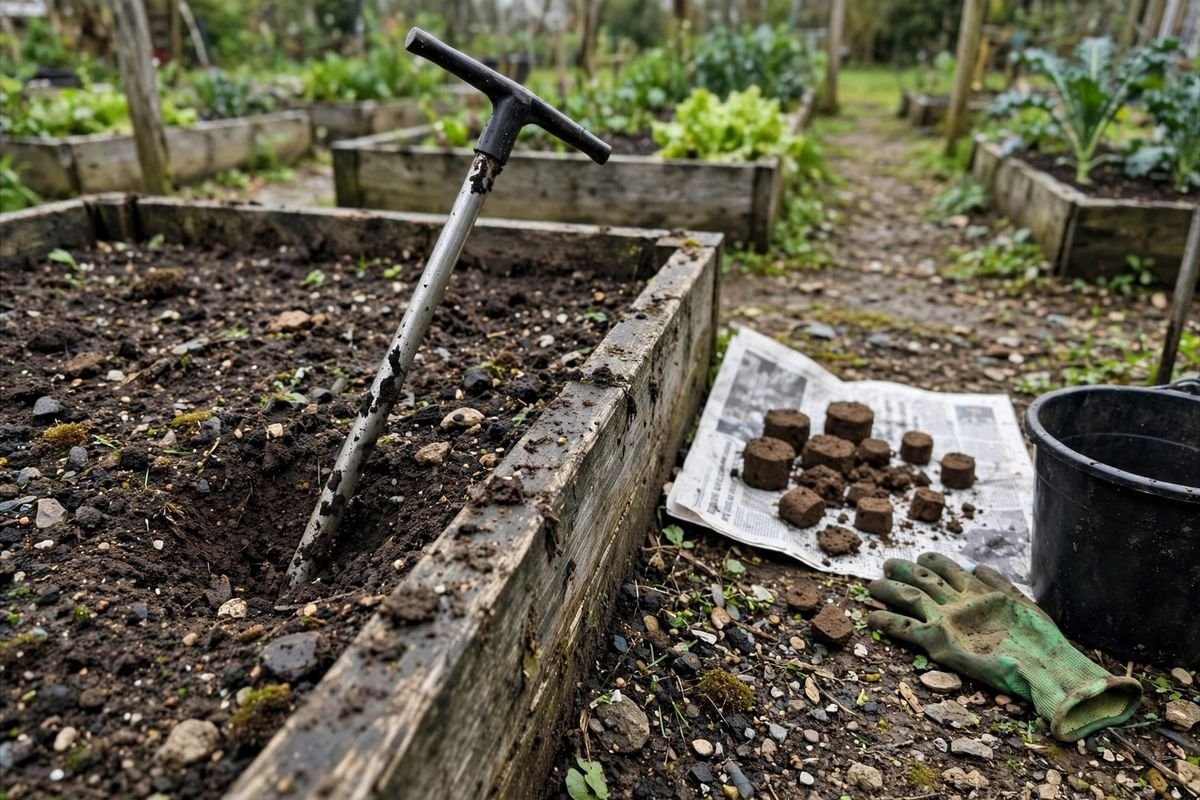
Sample each bed separately. A bed that held tomatoes all summer and a bed that held beans will not have the same nutrient levels, and mixing their soil into one bag hides both stories. Label each bag with the bed name and the date before it leaves the garden.
Take samples when the soil is moist but not wet, and skip sampling right after fertilizing or liming. Wait at least four weeks after an application, or the report will measure the fresh amendment rather than the soil itself.
Home test kits vs lab tests
A home test kit gives a rough pH reading and a rough nutrient rating in minutes. It suits a quick check, such as confirming whether a bed is strongly acid, and it costs little. Its limits are real: color matching is approximate, and the kits say nothing about organic matter or exact nutrient levels.
A lab test costs more and takes one to three weeks, but it gives numbers you can plan from, plus a written recommendation for lime and fertilizer rates. For a bed that will feed a family all season, the lab test is the better spend. Many state extension services run soil labs and charge a modest fee per sample.

Use a home kit to decide whether a lab test is urgent, and use a lab test to decide what to buy. If the home kit shows pH near 5.0, that bed needs lime, and a lab report will say how much. You can browse soil test kits on Amazon to compare home kit types before you buy.
For a lab test, check your state extension service first. The University of Minnesota Extension, Colorado State University Extension, and the University of Georgia Extension all publish soil sampling guides and run or list soil labs, and their sampling steps match the method in this guide.
How to read your results
Start with pH. If the report calls for lime, it will give a rate, often in pounds per 100 square feet. Scale that rate to your bed. Here is the arithmetic for our 4-by-8-foot bed, which is 32 square feet: a report calling for 5 pounds of lime per 100 square feet means 5 times 32 divided by 100, which is 1.6 pounds for the bed. Always follow the lab report, not this example, since the right rate depends on your soil type and the starting pH.
Next, read the nutrient ratings. A “low” rating means the crop will likely respond to feeding. A “high” rating means you can skip that nutrient this season and save the money. A bed that tests high in phosphorus, which is common in gardens that get compost every year, does not need a fertilizer that adds more phosphorus.
Read the organic matter number last. If it sits under 3 percent, plan a compost top-up of 1 to 2 inches over the bed in fall. Compost raises organic matter slowly, over seasons, so treat it as a habit rather than a one-time fix. Our guide to making compost at home covers the pile method, and our roundup of soil test kits for home gardeners compares kit types in more detail.
What to do with the results
Fall is the season to act. Spread lime now if the report calls for it, and work it into the top few inches of soil. Add compost as a top layer, and let winter rain and worms pull it down. Plant a cover crop on any bed that will sit empty, since bare soil loses nutrients to rain over winter.

Cover crops also feed the soil. Clover and winter rye are common picks for a home vegetable bed, and they protect the surface while adding organic matter when they are turned under in spring. See our guide to cover crops for winter vegetable gardens for varieties that suit a small bed.
Write the results down. A notebook line per bed, with the date, the pH, and the nutrient ratings, turns next year’s test into a comparison instead of a fresh mystery. Note the frost dates for your area when you plan fall work, and use your local frost dates and regional planting guidance, not your USDA hardiness zone alone, to choose planting dates.
Troubleshooting
The report says the soil is fine, but plants still struggle
Check drainage and sunlight before doubting the test. Soil that stays soggy after rain starves roots of air, and a bed that gets under six hours of sun will grow slowly no matter what the nutrient numbers say. A test measures chemistry, not water or light.
Two samples from the same bed disagree
One of the samples was probably taken from a single spot or right after feeding. Re-sample with 10 cores mixed well, and wait four weeks after any fertilizer or lime application before sampling again.
The pH barely moved after liming
Lime works slowly, and heavy clay soil needs more of it than sandy soil. Re-test after six months rather than adding more lime on a guess. A second test is cheaper than a bed that swings too far the other way.
Frequently asked questions
When is the best time to test soil?
Fall is the best time, because results arrive while you still have months to add lime or compost before spring planting. Spring testing also works, but it leaves less time for amendments to take effect.
How often should I test my garden soil?
Every two to three years for an established bed, and every time you start a new bed. Test again sooner if a crop fails for no clear reason or after a major change, such as adding a large load of new soil.
Can I test soil myself, or do I need a lab?
A home kit gives a rough pH and nutrient reading in minutes. A lab test gives exact numbers and a written recommendation, and it is the better choice when you plan to buy lime or fertilizer based on the result.
Sources and further reading
- University of Minnesota Extension, Soil testing for lawns and gardens
- Colorado State University Extension, Soil sampling
- University of Georgia Extension, Soil Testing for Home Lawns, Gardens and Wildlife Food Plots
Related reading: Best Soil Test Kits for Home Gardeners, How to Make Compost at Home, Best Cover Crops for Winter Vegetable Gardens