
This post may contain affiliate links. If you buy through links on this page, we may earn a commission at no extra cost to you.
As an Amazon Associate I earn from qualifying purchases.
Overwatering kills more container plants than drought, and fall is when it does the most damage. Days get shorter, air turns cool, and a pot that dried out in a day during July can stay wet for a week in November. Indoor pots face an even sharper trap: heated air dries the leaves while the soil in the pot stays damp, so the plant looks thirsty while its roots sit in water.
The fix is not a stricter calendar. It is a habit of checking the soil before every watering, a pot that can drain, and a plan sized to each pot. This guide covers the signs of a pot that is too wet, the finger test with real depth numbers, a worked watering plan for six pots, and how to bring a soaked plant back.
Why fall and winter make overwatering worse
Three things change when the weather cools. First, plants grow slower, so they drink less. A tomato in July can empty a pot in a day; the same pot holding herbs in November may need water only once a week. Second, evaporation drops. Cool air holds less moisture, but it also pulls less water from the soil surface, and short days give the sun fewer hours to dry the top layer. Third, pots move inside or under cover, where wind and direct sun no longer help dry them out.
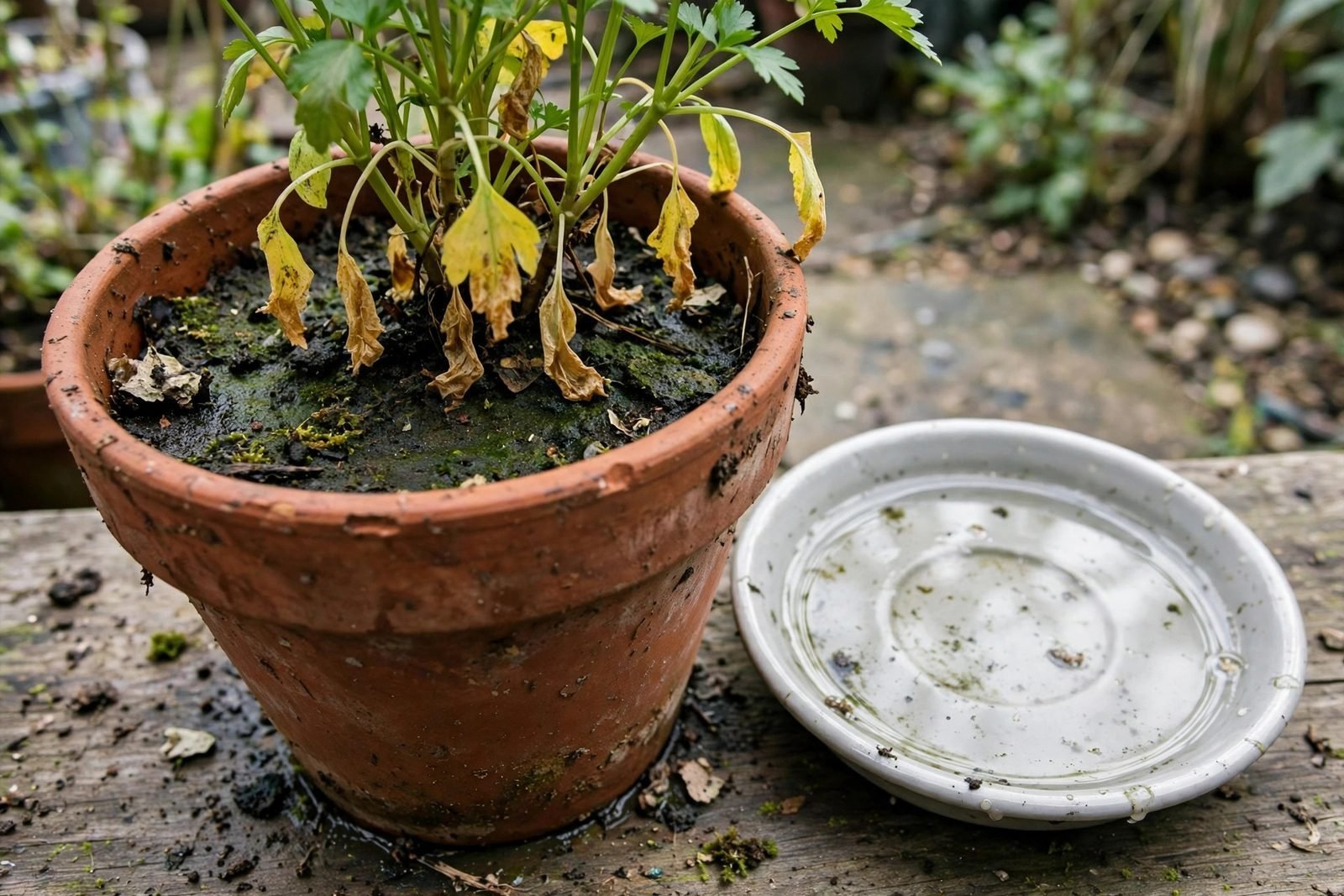
The result is a pot that looks dry on top and stays wet underneath. The top half inch of mix dries out and turns pale, which tempts a watering, while the bottom half is still soaked. Repeat that for a few weeks and the roots run out of air. Roots need oxygen as much as they need water, and soil that stays saturated pushes the air out. That is why a plant can wilt in wet soil: the roots have stopped working, not because they are dry, but because they are drowning.
Saucers make the problem worse in cold weather. A saucer that catches a little runoff in summer dries out by evening. The same saucer in November can hold water for days, and the pot wicks it straight back up. Empty every saucer within 30 minutes of watering, or skip the saucer and set the pot on pot feet so air moves under it.
Signs your container is too wet
Yellow leaves are the first sign most people notice, and they usually start on the lower leaves. The leaves turn soft and yellow rather than dry and crisp, which is how overwatering differs from underwatering. A plant short of water gets dry, papery leaf edges. A plant with too much water gets limp, yellow leaves that drop off with a light touch.
Other signs show up at the soil line. A sour or musty smell from the pot means the mix has gone airless. Green algae on the soil surface means the top stays wet for days at a time. Tiny black flies hovering near the pot are usually fungus gnats, and their larvae feed in damp mix. Mushy stems at the base, or a plant that wilts in the morning even though the soil is wet, mean the roots are already damaged and the pot needs action, not another drink.
One sign alone is not proof. Yellow leaves can also mean a plant needs feeding, and gnats can show up in any damp pot. Check two or three signs together, then check the soil with your finger before you decide what to do. For a full check of whether a pot drains at all, see our guide to how to test soil drainage in a pot.
The finger test, with real numbers
The finger test is the most reliable watering check a container gardener has, and it costs nothing. Push your index finger into the mix beside the plant, not right against the stem, and feel how damp the soil is at depth. The top surface lies. The soil an inch or two down tells the truth.
Use these depths as the rule. In pots up to 8 inches wide, check 1 inch down. In 10 to 12 inch pots, check 2 inches down. In pots 14 inches wide and larger, check 2 to 3 inches down. If the mix at that depth feels cool and damp and sticks to your finger, wait. Water only when it feels dry at that depth, or barely damp with loose crumbs that fall off your finger.
Test in two spots when the pot is large, because one side of a pot can dry faster than the other. A pot against a sunny wall dries on the sunny side first. A pot under a roof overhang dries on the sheltered side last. Checking both sides takes ten seconds and stops the common mistake of watering a pot that is wet on one side and dry on the other.
A soil moisture meter can help when a pot is too deep to reach into, or when you want a number instead of a feel. Read our guide to how to read a soil moisture meter correctly before trusting the dial, because a meter pushed into dry surface mix reads dry even when the bottom is soaked.

A worked example: a six-pot watering plan
Here is a watering plan for six pots on a cool-season patio, worked out in numbers so you can adapt it to your own pots. The plan assumes standard potting mix, pots with drainage holes, cool weather between 50 and 65 degrees, and leafy herbs and lettuce rather than fruiting plants. Adjust the amounts down if your pots sit indoors with no direct sun, and up if a warm spell arrives.
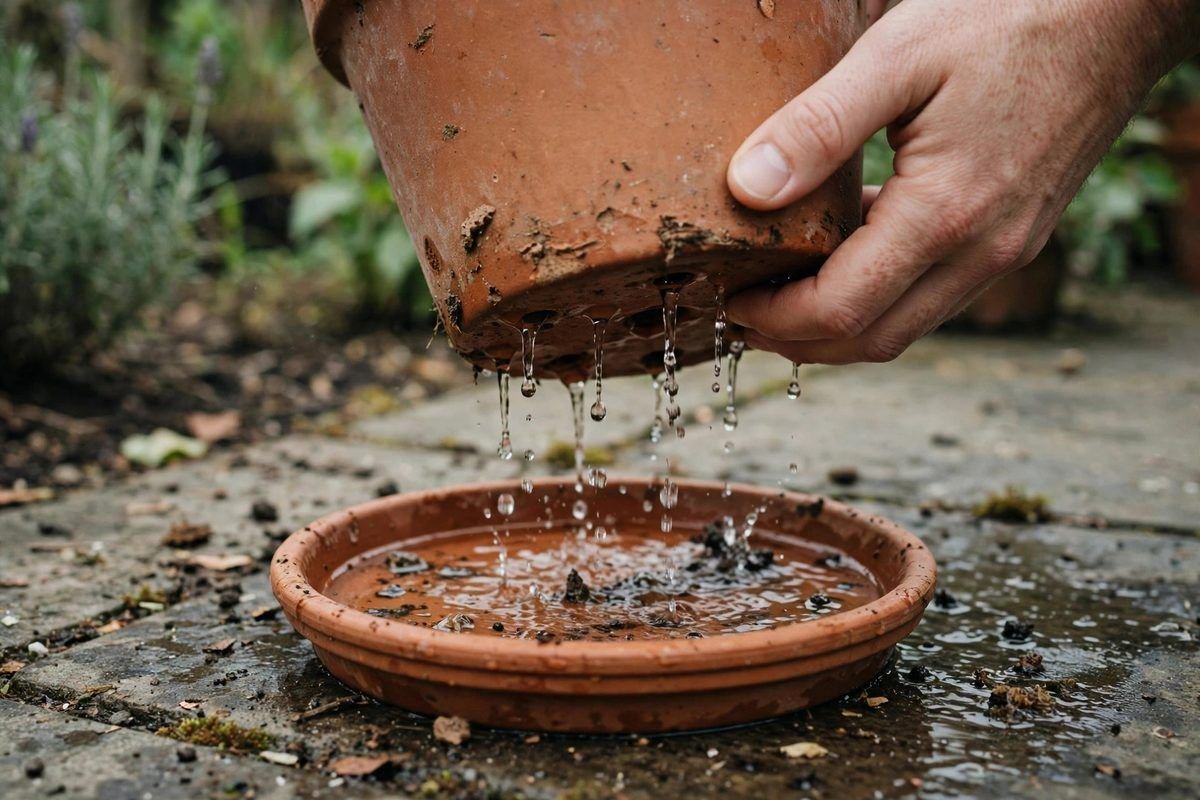
The rule behind the table is simple: each watering should be about one-tenth of the volume of mix in the pot, poured slowly, until a little water runs from the drainage holes. That amount wets the mix through without flooding it. Water that runs out within a few minutes means the mix drains well. Water that keeps dripping after 20 minutes, or that sits in the saucer after half an hour, means the mix is too dense or the holes are blocked.
| Pot | Mix it holds | Water per watering | Should stop dripping in | Check again in |
|---|---|---|---|---|
| 6-inch herb pot | about 3 quarts | 1 cup | 3 to 5 minutes | 4 to 5 days |
| 8-inch pot | about 1.5 gallons | 2 cups | 4 to 6 minutes | 5 to 6 days |
| 10-inch pot | about 3 gallons | 5 cups | 5 to 8 minutes | 5 to 7 days |
| 12-inch pot | about 5 gallons | 2 quarts | 6 to 10 minutes | 7 days |
| 14-inch pot | about 6 gallons | 2.5 quarts | 8 to 12 minutes | 7 to 10 days |
| 5-gallon pot | about 5 gallons | 2 quarts | 10 to 15 minutes | 7 to 10 days |
Notice how wide the gaps are between waterings. In cool weather, even the smallest pot in this plan goes 4 to 5 days between checks, and the large pots go a week or more. If you have been watering every two or three days out of habit, this table alone may fix the problem. The “check again” column is a check, not a watering date: test the soil first, and water only if the finger test says the mix is dry at depth.
Compare this with the opposite problem in summer, when pots dry out fast and need water daily. Our guide to how to keep container soil from drying out too fast covers that side of the year. The two guides together give you the full seasonal swing: water generously in hot weather, and hold back once the days shorten.
Fixing drainage before you water again
A watering plan only works if the pot can drain. Check three things before the next watering. First, look at the drainage holes. Tip the pot and confirm the holes are open, not sealed by a mat of roots or a plug of fine mix. A pot with one small hole drains far slower than a pot with three or four holes, and a hole blocked by a saucer pressed tight to the base drains hardly at all.
Second, look at the mix. Good potting mix feels loose and springy when you squeeze a handful, and it falls apart when you let go. Mix that stays in a wet clump is too dense for containers, and it will hold water no matter how careful your watering is. If the mix has compacted into a solid mass, the honest fix is to repot with fresh mix rather than to keep watering a pot that cannot drain. Mix with perlite or coarse bark mixed through it drains faster than fine, peaty mix, and it keeps its structure through the winter.
Third, lift the pot after watering. A pot that feels heavy for its size is holding water, and a pot that feels light is ready for more. After a few weeks of lifting pots before and after watering, you will know the weight of a wet pot versus a dry one without thinking about it, and that sense becomes a faster check than the finger test on a busy morning.
Self-watering planters need the same care, with one extra step: check the reservoir. A reservoir left full through a cool, cloudy week keeps the mix wet from below, which is exactly the condition that rots roots. Our roundup of the best self-watering planters for patio gardens covers which designs let you see and empty the reservoir easily. In winter, let the reservoir run dry between refills and water from the top only when the finger test says the mix is dry.
How to rescue a plant that is already too wet
Start by stopping the water. Move the pot out of the rain and into a spot with good air movement, and empty the saucer. Do not water again until the finger test says the mix is dry at depth, even if that takes a week or more. A plant with damaged roots uses very little water, so watering it “to help it recover” only keeps the soil wet longer.
If the plant wilts and the mix still smells sour after a few days of drying, tip the plant out of the pot and look at the roots. Healthy roots are firm and pale, while rotted roots are dark, soft, and pull apart easily. Trim away the soft, dark roots with clean snips, shake off the sour mix, and repot in fresh, dry mix in a clean pot with open drainage holes. Water lightly, just enough to settle the mix, and set the pot where it gets bright light and moving air.
Some plants come back from this and some do not. Leafy herbs such as mint and parsley often regrow from the base once the roots can breathe again. Plants with soft stems that have already turned to mush at the base rarely recover, and the better move is to take a cutting from any firm growth above the rot, if the plant allows it, and start again. Either way, the lesson is the same: a dry week never killed a container plant as fast as a wet month did.
A cold-season watering routine
Pick one morning a week as the check day, and test every pot with the finger test before you water any of them. Water only the pots that test dry, and write down which ones those were, because the pattern repeats. Pots against a sunny wall dry first, pots in shade dry last, and the same pots will be the dry ones next week. That note saves you from testing every pot from scratch each time.
Water in the morning, so the plant has the warmest part of the day to use the water and the surface can dry before night. Water slowly, in two passes: pour half the amount, wait a minute for it to soak in, then pour the rest. A single fast pour runs down the gap between the mix and the pot wall and out the bottom, wetting almost nothing on the way.
When a hard frost is forecast, bring tender pots inside or under cover the evening before, and use your local frost dates and regional planting guidance, not your USDA hardiness zone alone, to choose planting dates. A pot holds far less soil than the ground, so its roots feel a cold night sooner than a plant in a bed. Grouping pots together against a wall, as in our container garden layout ideas for a 6-foot patio, also helps: pots shelter each other from wind and share a little warmth on a cold night.
Overwatering is a habit problem more than a plant problem. Check the soil, trust the finger test over the calendar, and let the pot tell you when it is thirsty. Do that through the cold months and your containers will come into spring with live roots, ready to grow.
Sources & Further Reading
University of California Agriculture and Natural Resources
Cornell Cooperative Extension
North Carolina State University Extension