

This post may contain affiliate links. If you buy through links on this page, we may earn a commission at no extra cost to you.
As an Amazon Associate I earn from qualifying purchases.
The best time to plan next year’s vegetable garden is now, while this year’s garden is still fresh in your mind. You remember which bed stayed wet, which tomato outgrew its cage, and which crop never got picked. That memory fades by February, so write it down while it is still clear.
A good plan has three parts: a rotation that moves each plant family to fresh soil, seed-start dates counted back from your last frost, and a seed list that matches the plan. This guide builds all three for one 4-by-8-foot bed, with the numbers shown so you can copy the method for the rest of your garden. For the basics of starting a bed, see our guide on how to start a vegetable garden.
Start with last year’s notes
Before you draw anything, spend an evening with last year’s notes. Write down what grew well, what failed, and where each crop sat. Note the spots that stayed wet, the corners that got too little sun, and the crops that produced more than your household could eat. Those notes are the raw material for next year’s plan.
If you kept no notes, walk the garden now and look at what is left. Bare patches, weed pressure, and the state of the soil tell you a lot. Take a photo of each bed from the same spot each year, and you will have a record even without written notes.
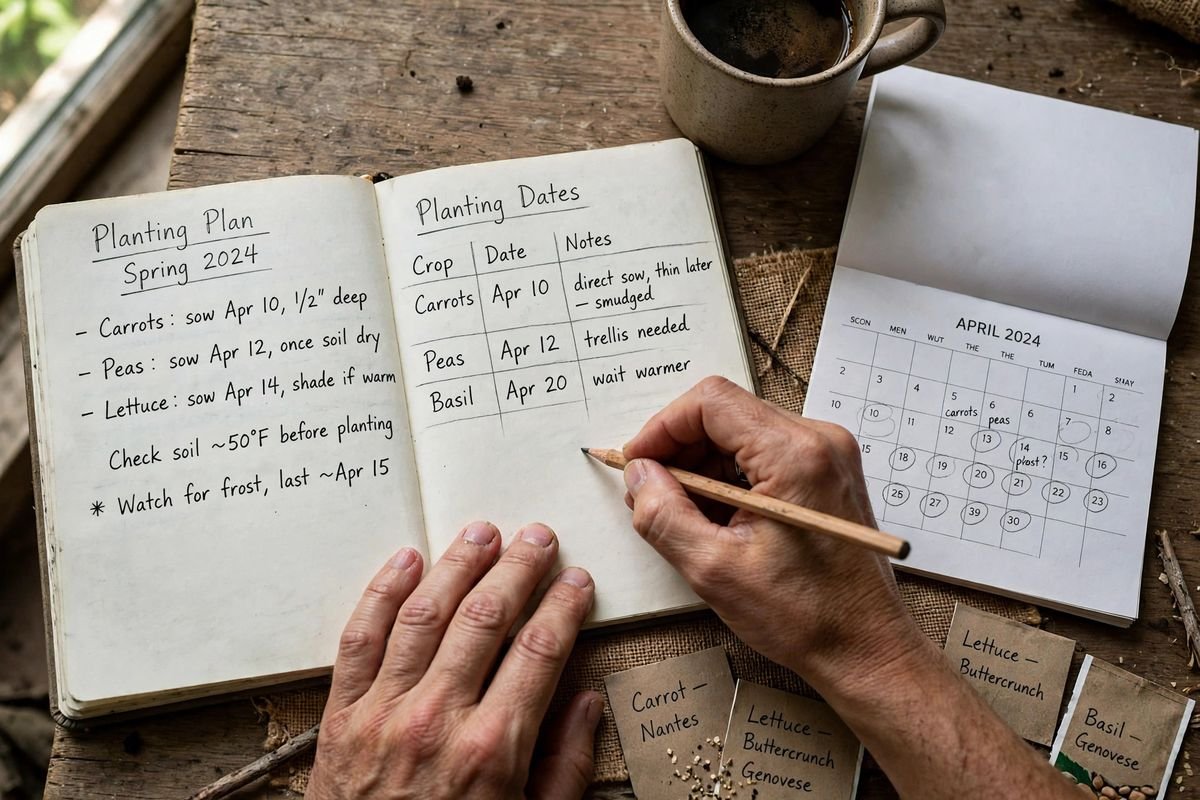
Put the notes in one place. A garden journal, a notebook, or a simple spreadsheet all work, and the format matters less than the habit. You can browse garden planner journals on Amazon if you want a ready-made one, or use any notebook you already own.
The four-bed rotation
Rotation is the heart of a garden plan. Planting the same crop in the same soil year after year lets soil-borne diseases and pests build up, and it drains the same nutrients from the same spot. Iowa State University Extension advises waiting 3 to 4 years before a plant family returns to the same spot, and that rule is the reason a rotation plan runs for four years.
Rotation works by plant family, not by individual vegetable. Tomatoes, peppers, potatoes, and eggplant are all nightshades, and they share pests and diseases, so swapping tomatoes for peppers is not a rotation at all. Group your crops by family first, then move the families around.
Most home gardens need four family groups: nightshades, legumes, brassicas, and roots with alliums. Nightshades are the heavy feeders. Legumes, the peas and beans, add nitrogen to the soil. Brassicas are the cabbage family, and roots with alliums are the light feeders that do well in soil other crops have already used.
Our worked example: one 4-by-8 bed, four years
Here is a rotation plan for a single 4-by-8-foot bed, divided into four sections of 2 by 4 feet, each section 8 square feet. Each section hosts one family group per year, and the groups shift one section over every year. After four years, every section has hosted every family once, and no family returns to the same soil within four years.
| Section | Year 1 | Year 2 | Year 3 | Year 4 |
|---|---|---|---|---|
| Section 1 (north end) | Nightshades | Legumes | Brassicas | Roots and alliums |
| Section 2 | Legumes | Brassicas | Roots and alliums | Nightshades |
| Section 3 | Brassicas | Roots and alliums | Nightshades | Legumes |
| Section 4 (south end) | Roots and alliums | Nightshades | Legumes | Brassicas |
In year 1, section 1 holds tomatoes and peppers, section 2 holds peas and beans, section 3 holds kale and cabbage, and section 4 holds carrots and onions. In year 2, each family moves one section over, and the pattern repeats until year 5, when the layout returns to year 1.
The plan also puts the tallest crops at the north end of the bed, so they do not shade the shorter crops. Tomatoes and pole beans go north, and lettuce and carrots go south. A 4-by-8 bed gives 32 square feet, and the four sections of 8 square feet each make the rotation easy to track on paper.
Perennial herbs and asparagus stay out of the rotation. They live in the same spot for years, so give them their own permanent corner and do not count them in the four-year plan. The same goes for a raspberry patch or any other perennial planting.
Counting seed-start dates back from your last frost
Seed-start dates come from your last frost date, counted backward by the weeks each crop needs indoors. We assume a last frost of April 15 for the dates below, and that assumption is stated here so you can shift every date by the same number of days for your own last frost. Use your local frost dates and regional planting guidance — not your USDA hardiness zone alone — to choose planting dates.
Peppers need the longest head start: sow them indoors around February 15, about 8 weeks before the April 15 last frost. Tomatoes follow around March 1, about 6 weeks before the last frost. Kale starts indoors around February 15 as well, and it moves outside around April 1, about two weeks before the last frost, because it tolerates light frost.

Peas sow directly outdoors around March 15, about four weeks before the last frost, because they like cool soil. Carrots sow directly around March 25, about three weeks before the last frost. Lettuce sows directly around April 1, about two weeks before the last frost, and you can sow a second batch two weeks later for a longer harvest. Beans and squash wait until after the last frost: sow beans directly around May 1, and sow squash indoors around April 15 to transplant around May 15.
Onions from seed need the earliest start of all: sow them indoors around January 20, about 12 weeks before the last frost. If that feels too early, buy onion sets in spring instead and skip the January sowing entirely. Write every date in your journal as you count it back, and set a reminder for the first sowing date so the season does not slip past you.
Counting the seed packets
A plan is only useful if you can buy the seed it needs. Here is the packet count for the year-1 layout of the example bed, counted section by section. Tomatoes need 1 packet, peppers need 1 packet, kale needs 1 packet, lettuce needs 2 packets for two sowings, peas need 1 packet, beans need 2 packets for two sowings, carrots need 1 packet, squash needs 1 packet, and onions need 1 packet.
That is 11 packets in total for the whole bed. At a planning assumption of about $3 per packet, the seed for the year costs about $33. Buying the seed in winter, when seed catalogs arrive, is cheaper and calmer than buying in April when the racks are picked over. Check what you already have before you order, because many seeds keep for two or three years in a cool dry spot.
Order one extra packet of the crops you eat most. A second packet of beans or lettuce costs little, and it covers a failed sowing or a second planting. Do not order extra packets of crops you have never grown; one packet is enough to learn whether your household likes them.
Drawing the plan
Draw the plan on paper, one bed per page, with north at the top. Mark each section with the family and the crops, and write the spacing next to each crop. Tomatoes go 18 inches apart, peppers 12 inches apart, kale 12 inches apart, lettuce 6 inches apart, peas 2 inches apart in a row, beans 4 inches apart, carrots 2 inches apart after thinning, and squash one plant per 4 square feet.
Keep the drawing simple. A rectangle divided into four sections, with a few words in each, is enough. The drawing is a tool for you, not a work of art, and a simple plan you actually use beats a detailed plan that stays in a drawer. For winter crops to fill the gaps in your plan, see our guide to the best winter vegetables to grow, and for the tomato section of the plan, see our guide on how to grow tomatoes. For fall planting dates, see our guide on what to plant in October.
Winter work on the beds
Planning season is also bed-care season. Pull the last spent crops, add a layer of compost to each section, and sow a cover crop on any section that will sit empty until spring. A cover crop protects the soil from winter rain and adds organic matter when you turn it under in spring.

Mark the sections now, while the plan is fresh. String lines, small stakes, or a photo with the sections labeled all work. When spring comes, you will know exactly where the tomatoes go and where the beans go, and you will not have to guess from memory.
Order seeds in January, start the first indoor sowings in February, and the plan carries itself from there. A winter of planning turns into a spring of planting, and the garden runs on the plan you wrote when you still remembered what worked.
Troubleshooting
The plan has more crops than the bed can hold
A 4-by-8 bed holds about 32 square feet, and every crop needs its share. Cut the list to the crops your household actually eats, and give the rest of the space to the crops that earn it. A bed of five crops grown well beats a bed of twelve crops grown badly.
The same family keeps landing in the same section
This happens when a favorite crop dominates the plan. If tomatoes take two sections, the rotation breaks. Keep each family to its own section, and if you want more tomatoes, add a container or a second bed rather than bending the rotation.
Seed-start dates slip past
Missed sowing dates are the most common planning failure. Set a phone reminder for each sowing date, and keep the seed packets in a box with the earliest date on top. A seedling bought from a garden center can rescue a missed sowing for tomatoes and peppers, and direct-sown crops such as beans and peas can be sown late with a shorter harvest.
The soil in one section stays poor
A section that stays poor year after year may need more than rotation. Add compost to that section in fall, sow a cover crop there over winter, and keep the legumes in that section the following year so the soil gets a nitrogen boost. Test the soil if the problem persists, because a pH problem looks like a fertility problem.
Frequently asked questions
Do I need to rotate if I only have one bed?
Yes, and the example above shows how. Divide one bed into four sections and rotate the families between sections. It is not as good as four separate beds, and it still breaks the disease cycle well enough for most home gardens.
How long before the same family can return to a section?
Three to four years, according to Iowa State University Extension. The four-section plan gives each family a four-year rest before it returns to the same soil, which meets that guidance.
Can I plan around containers too?
Yes. Treat each large container as a section, and move the family to a different container each year. Replace the potting mix in a container every year or two, because containers do not get the same soil-building benefit as a bed.
When should I start planning?
Start in late fall, while this year’s garden is still fresh in your mind, and finish the plan before seed catalogs arrive in January. A plan finished in January gives you time to order seed, and a plan started in April is already late.
Sources and further reading
- Iowa State University Extension, Planning Your Vegetable Garden
Related reading: How to Start a Vegetable Garden, Best Winter Vegetables to Grow, How to Grow Tomatoes, What to Plant in October