

This post may contain affiliate links. If you buy through links on this page, we may earn a commission at no extra cost to you.
As an Amazon Associate I earn from qualifying purchases.
A garden does not have to shut down when the first frost arrives. A small group of vegetables keeps growing through cold weather, and a few of them taste better after a light frost. Kale sweetens, leeks stand through the coldest months, and garlic planted now becomes next summer’s harvest. A winter bed asks for less work than a summer bed: no daily watering, almost no pests, and a slow pace that suits a short afternoon.
This guide lists the vegetables that earn a place in a winter bed, with planting dates counted back from a first frost, spacing that fits a standard 4-by-8-foot bed, and a worked example you can copy. For more fall planting ideas, see our guide on what to plant in October.
What makes a vegetable a winter vegetable
A winter vegetable is one that keeps growing, or at least holds its quality, when nights drop near freezing. Most of them are cool-season crops that grow best between 40 and 65 degrees. A few, like kale and Brussels sprouts, turn sweeter after frost because cold turns some of their starches into sugars. That change is real and easy to taste: a kale leaf picked in January is milder than the same leaf picked in September.
Cold tolerance has limits. A hard freeze below about 20 degrees will damage most leafy greens, even the tough ones, unless they sit under a row cover. Root crops fare better because the soil holds warmth around them. The crops below all handle at least a few light frosts, which is what most gardens get in November and December.
The best winter vegetables at a glance
| Vegetable | Plant by (first frost Nov 15) | Days to harvest | Cold tolerance |
|---|---|---|---|
| Kale | Transplant by Sep 21 | About 55 days from transplant | Down to about 20 degrees |
| Leeks | Transplant by Sep 12 | About 120 days from seed | Down to about 20 degrees |
| Garlic | Plant cloves Oct 1 to 15 | Next June or July | Needs winter chill |
| Spinach | Sow by Oct 6 | About 40 days from seed | Down to about 20 degrees |
| Swiss chard | Sow by Sep 15 | About 60 days from seed | Down to about 25 degrees |
| Carrots | Sow by Sep 1 | About 70 days from seed | Roots hold in mulched soil |
The dates in the table count back from a first frost of November 15, which fits a mild-winter garden. Your date will differ, so shift every date by the same number of days. Use your local frost dates and regional planting guidance — not your USDA hardiness zone alone — to choose planting dates.
Our worked example: a 4-by-8-foot winter bed
Here is one bed, planned end to end, so you can see how the numbers fit together. We assume a first frost of November 15 and a 4-by-8-foot raised bed, which gives 32 square feet of planting space. The bed holds three crops, plus spinach sown in the gaps.
Kale takes 8 plants at 12-inch spacing, in two rows of four. Each plant gets about 1 square foot, so kale uses 8 square feet. Leeks take 24 plants at 6-inch spacing, in two rows of twelve, which uses about 6 square feet. Garlic takes 32 cloves at 4-inch spacing, in two rows of sixteen, which uses about 3.5 square feet. The three crops together use about 17.5 square feet, which leaves room for a row of spinach and space at the bed ends for reaching in.

Now the dates. Kale needs about 55 days from transplant to harvest, so counting back from November 15 gives a transplant date of September 21. Kale seed sown indoors takes about four weeks to reach transplant size, so sow indoors around August 24. Leeks need about 120 days from seed, so counting back from November 15 gives a sowing date of July 18. Leek seedlings move outside about eight weeks after sowing, around September 12. Garlic cloves go in October 1 to 15, four to six weeks before the first hard frost, and they sit through winter to size up in spring. Spinach needs about 40 days from seed, so sow it by October 6 in the gaps between the kale and leeks.
The bed asks for one watering at planting time, then very little. Fall rain usually covers it, and cool air slows evaporation. A light feeding of compost at planting time carries the bed through winter; hold off on extra fertilizer once growth slows, because soft new growth is the first thing frost damages.
Kale: the workhorse of the winter bed
Kale is the most reliable winter green we grow. It tolerates frost, keeps producing leaves for months, and needs little more than sun and steady moisture. Curly kale handles cold a little better than lacinato types, and it holds up well under a row cover when the temperature drops into the teens.
Space plants 12 inches apart so air moves between them; crowded kale stays damp and invites disease. Pick outer leaves first and leave the center growing point alone, and one plant can feed a household for weeks. For a full guide to the crop, see our post on how to grow kale in fall and winter.
Leeks: slow, steady, and worth the wait
Leeks take the longest of any crop in this guide, and they repay the wait. A leek sown in July and transplanted in September stands in the bed all winter and harvests from November through February. The white stem thickens slowly, and cold weather does not hurt it.

Plant leeks 6 inches apart in a shallow trench, then pull soil up around the stems as they grow. The soil banking blanches the stems white and keeps them tender. Mulch the row with 3 to 4 inches of straw once the weather turns cold; the mulch holds soil warmth and keeps the bed from freezing solid. A leek pulls cleanly from damp soil, so water the row the day before harvest if the ground has dried out.
Garlic: plant now, harvest next summer
Garlic is the one crop in this guide that you plant in fall and harvest the following summer. The cloves need a cold period to form bulbs, which is why fall planting works and spring planting often gives small single-clove bulbs. Plant cloves 4 inches apart and 2 inches deep, pointed end up, then cover the bed with 4 inches of straw mulch.
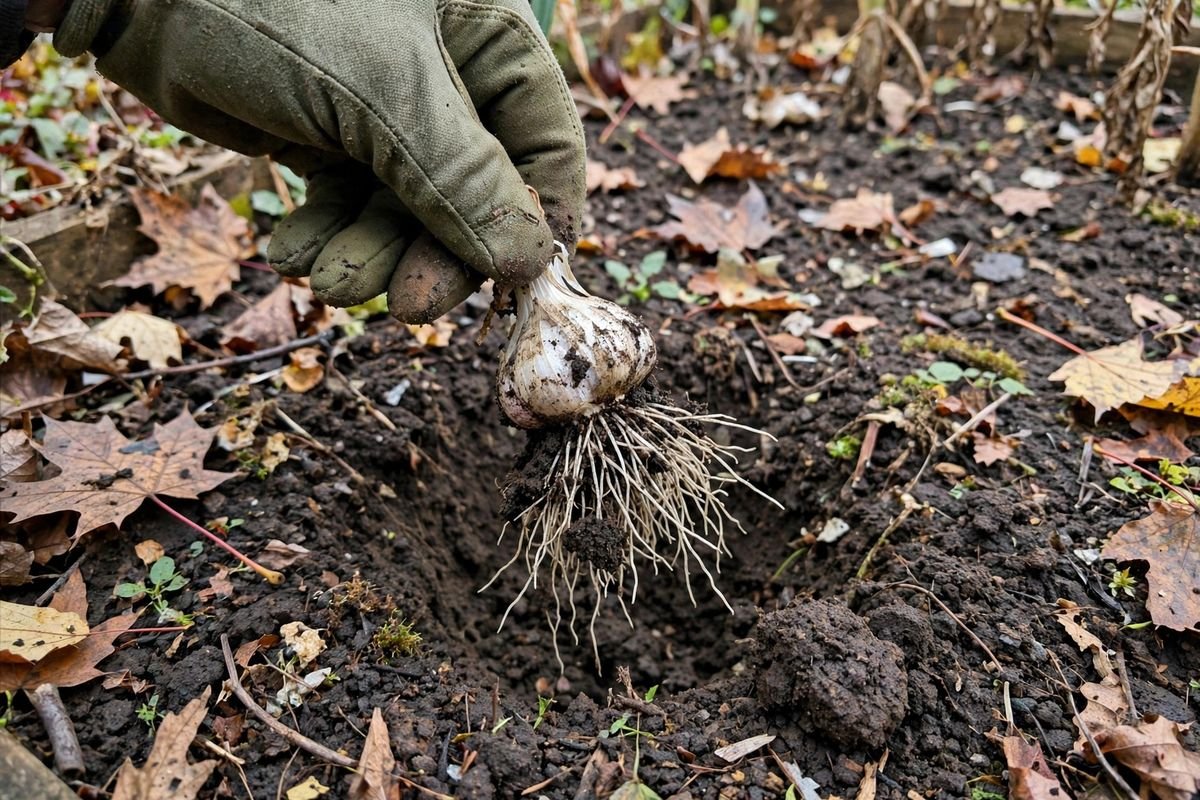
Garlic takes almost no care through winter. The shoots may show above the mulch in a mild spell, and that is normal; they stall when cold returns. In spring, the plants grow fast, and you harvest when about half the leaves have yellowed, usually in June or July. Save the largest bulbs from the harvest for next fall’s planting, and the bed will pay for itself year after year.
More crops for the winter bed
Spinach sows directly into the bed in early October and gives cut-and-come-again leaves through December in mild climates. Sow it thickly and thin the seedlings to 3 inches apart; the thinnings go straight into a salad. A floating row cover adds a few degrees on cold nights and stretches the harvest into January.
Swiss chard handles light frost and keeps producing colorful stems into December. Sow it by mid-September so plants have size before cold slows them. Pick outer stems first, and the plant keeps sending up new growth from the center.
Carrots sown by early September size up before the ground cools, then hold in the soil under mulch for weeks. The cold sweetens them the same way it sweetens kale. Mark the row well, because the tops die back and a forgotten row is easy to lose. Brussels sprouts need the longest season of the bunch, so start them in midsummer for a November harvest; the small sprouts along the stem sweeten after the first frost and hold on the plant for weeks.
Protecting the bed through frost
A floating row cover is the single most useful piece of winter gear in this guide. It is a light fabric that rests on hoops or directly on the plants, and it holds in a few degrees of warmth on cold nights. It also keeps drying wind off the leaves. You can browse floating row covers on Amazon to compare weights; a medium-weight cover suits most winter beds.
Mulch does the same job from below. A 3-to-4-inch layer of straw around leeks, garlic, and carrots holds soil warmth and keeps the ground from freezing solid, which matters most for crops you plan to pull from the ground in midwinter. Our guide to how to mulch perennials for winter covers the same technique for beds and borders. After the last harvest, a cover crop sown into the empty bed protects the soil until spring; our post on the best cover crops for winter vegetable gardens lists the options by climate.
Troubleshooting
Leaves turn yellow in the cold
Some yellowing on outer leaves is normal in cold weather, and the plant usually keeps growing from the center. If the whole plant turns yellow, check the soil: wet, cold soil starves roots of air, and the fix is better drainage, not more fertilizer. Raise the bed or add compost to open up heavy soil before the next planting.
Seedlings stall and never size up
A crop sown too late runs out of warm days before it reaches harvest size. Count back from your first frost using the days-to-maturity on the seed packet, then add two weeks for the slower growth of short fall days. That extra two weeks is the margin most gardeners skip, and it is the usual reason a fall sowing disappoints.
Row cover flattens the plants
Fabric laid straight on tender seedlings can press them flat in wet weather. Use simple wire hoops to hold the cover a few inches above the leaves, and weigh the edges down with bricks or soil so wind cannot lift it. Check under the cover once a week for slugs, which love the damp shelter it creates.
Garlic shoots appear, then the cold returns
Early shoots are normal and rarely a problem. Garlic tolerates a light freeze on its shoots, and the plant keeps growing from the clove. A thick straw mulch, 4 inches deep, gives the shoots enough shelter in most climates.
Frequently asked questions
Can I plant winter vegetables in containers?
Yes, with one change: containers freeze faster than the ground, so they need a sheltered spot against a south-facing wall and a wrap of burlap or bubble wrap around the pot on the coldest nights. Kale, spinach, and chard all grow well in a deep container; leeks and garlic need a pot at least 12 inches deep.
Do winter vegetables need fertilizer?
Usually not, beyond compost mixed into the bed at planting time. Growth slows in cold weather, so plants use little nitrogen. A light side-dressing of compost in early spring, when growth resumes, does more than a fall feeding.
What if I missed the planting dates?
Transplants from a garden center can rescue a late start: a kale or chard seedling bought in October has a head start of four to six weeks over seed. Garlic is the one crop with no shortcut, because cloves planted after the ground freezes will not root. For garlic, wait for next fall and plant on time.
How do I know when to harvest leeks?
Harvest leeks when the white stem is at least 1 inch thick. They hold in the ground for months, so there is no rush; pick them as you need them through winter, and leave the rest in the bed until spring.
Sources and further reading
- University of Minnesota Extension, Growing collards and kale in home gardens
- Oregon State University Extension, Get your garlic on: A primer on planting, growing and harvesting
- University of Georgia Cooperative Extension, Fall Vegetable Gardening
Related reading: How to Grow Kale in Fall and Winter, Best Cover Crops for Winter Vegetable Gardens, What to Plant in October, How to Mulch Perennials for Winter