

This post may contain affiliate links. If you buy through links on this page, we may earn a commission at no extra cost to you.
As an Amazon Associate I earn from qualifying purchases.
Rosemary in a pot is the herb most likely to die indoors in winter, and the cause is usually water, not cold. The plant comes from dry, sunny hillsides, so it wants bright light, air moving around its leaves, and soil that dries out between waterings. A heated house gives it the opposite: dim corners, still air, and soil that stays wet for weeks. The fix is a bright window, a light hand with the watering can, and a move indoors before the first hard freeze.
This guide covers the whole winter for rosemary in pots: the move indoors, light and water through the cold months, and the move back out in spring. Our guide to protecting potted plants from frost covers the same move for other tender pots, and our guide to growing herbs indoors in winter covers the indoor setup in more depth.
Whether rosemary can stay outside in winter
It depends on where you live and which rosemary you grow. Hardy types such as Arp and Hill Hardy survive winters down to about 10 degrees Fahrenheit once they are in the ground, with roots deep in soil that rarely freezes solid. The same plant in a pot is far less safe: the soil in a pot freezes through from all sides, and the roots have no deep ground to draw on.
As a rule, bring potted rosemary indoors when night temperatures start dropping below 30 degrees Fahrenheit. In places where winter lows stay above freezing, a pot can stay outside all winter against a warm house wall, with a frost cloth over it on the coldest nights. In places with regular hard freezes, the pot comes inside, and no amount of wrapping saves the roots once the soil in the pot freezes solid.
Move the pots in before the first hard freeze
Start the move when nights begin to dip toward freezing, not after the first frost has already blackened the tips. Check each plant before it comes in: look under the leaves for aphids and whiteflies, and shake the pot gently to knock off loose debris. A plant that comes inside with pests will spread them to every other houseplant in the room, so a week of watching on a porch or in a garage is time well spent.
Trim the plant lightly as you move it in. Cut back the longest stems by a third, and take off any dead or crossing growth. Keep the trimmings: rosemary cuttings root easily in water or damp mix, and a few cuttings in small pots give you backup plants by spring. Do not cut the plant back hard in autumn, since a hard cut pushes out soft new growth that suffers in dry indoor air.

Light: the part most people get wrong
Rosemary needs six or more hours of direct sun a day indoors, and a south-facing window is the best spot in most homes. A west-facing window is the next best choice. A north-facing window will not give the plant enough light, and the stems will stretch, thin out, and drop needles within a month.
If your brightest window gives only three or four hours of sun, add a small LED grow light. Hang it 6 to 12 inches above the plant and run it for 12 to 14 hours a day, on a timer so the plant still gets a dark night. A basic LED bar made for herbs is enough, and you can find one by searching for a small LED grow light for herbs. Turn the pot a quarter turn each week so all sides get their share of the window light.

Water: less than you think
Water rosemary only when the top inch of soil feels dry to the touch. Indoors in winter, that usually means watering every 10 to 14 days, not every few days. Water until a little runs out of the drainage holes, then empty the saucer so the pot never sits in water. A pot with no drainage hole is a bad home for rosemary in winter, so move the plant to a pot with holes before it comes inside.
Watch the leaves for the two signs of trouble. Needles that turn brown from the tips inward usually mean the soil stayed wet too long and the roots are struggling. Needles that drop in large numbers when you brush the plant usually mean the air is too dry or the plant went too long without water. Both problems share one fix: check the soil with your finger before you water, and water only when the top inch is dry.
Do not mist the leaves. Rosemary leaves stay healthier in dry air than in damp air, and misting invites the gray mold that kills indoor rosemary. If the room air is very dry, set the pot on a tray of pebbles with a little water in the tray. Keep the bottom of the pot above the water line. The water in the tray lifts the humidity around the plant without wetting the leaves.
Worked example: three pots through winter
The numbers below are a worked example with the assumptions stated, so you can scale them to your own pots. Take three rosemary plants in terracotta pots: one 8-inch pot, one 10-inch pot, and one 12-inch pot. A pot holds roughly as much mix as a cylinder of its own size, so the 8-inch pot holds about 1 gallon of mix, the 10-inch pot about 2 gallons, and the 12-inch pot about 3 gallons. The three pots together hold about 6 gallons of mix.
For water, the 8-inch pot needs about 1 cup per watering, the 10-inch pot about 1.5 cups, and the 12-inch pot about 2 cups, each time watering until a little runs from the drainage holes. At a 12-day watering interval, that is about 4.5 cups per round for all three pots, or roughly 45 cups across a 120-day winter, a little under 3 gallons in total. Outdoors in summer, the same three pots would need water every 2 to 3 days, so the winter routine uses about a fifth as much water.
For light, the three pots need a window that gives at least six hours of direct sun, or a grow light running 12 to 14 hours a day. A south-facing windowsill 3 feet wide holds all three pots side by side, with the smallest pot on the end where the light is weakest. If the sill holds only two pots, put the third on a small stool just behind them, and rotate the pots weekly so each one gets its turn at the bright end.
Temperature and air
Rosemary does best indoors at 60 to 65 degrees Fahrenheit during the day, with nights a little cooler. A room that stays above 70 degrees all winter dries the plant out and pushes weak growth. A cool room, a bright sunroom, or a spot near a window that runs cool at night suits it better than a warm living room. Keep the pot away from heating vents, radiators, and fireplaces, since hot dry air browns the needle tips fast.
Give the plant fresh air when the weather allows. On a mild winter day above 45 degrees, set the pots outside for a few hours and bring them back in before dark. The fresh air and the sun slow the mold that grows in still indoor air. Do not leave the pots out overnight on a day that started mild, since a clear night can drop 20 degrees after sunset.
Outdoor overwintering in mild climates
In places where winter lows stay above 25 degrees, rosemary in a large pot can stay outside against a south-facing wall. The wall holds daytime heat and shields the plant from wind. On nights when frost is forecast, drape a frost cloth over the plant and weight the edges with bricks so the cloth does not blow off. Remove the cloth in the morning so the plant gets sun and air.
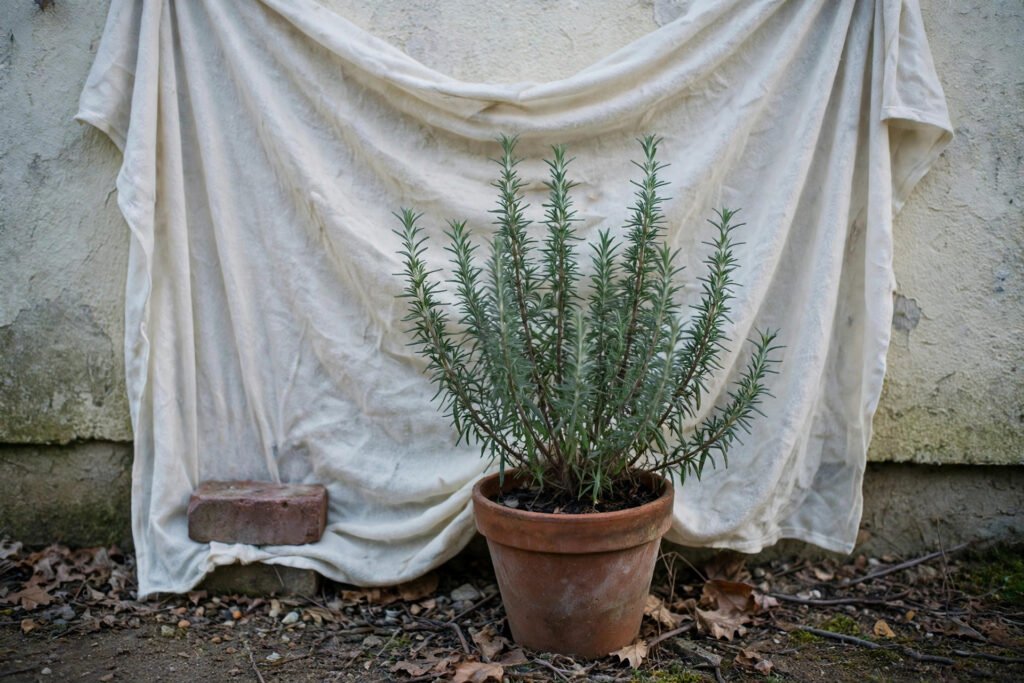
A large pot survives a cold night far better than a small one, since more soil freezes more slowly. If your pot is small and the forecast calls for a hard freeze, move it into a garage or shed for the night, even in a mild climate. A night in the garage costs nothing, and a frozen root ball costs the plant. Our guide to overwintering pepper plants uses the same move-it-in-for-the-night logic for another tender crop.
Moving rosemary back outside in spring
Wait until the last frost has passed and night temperatures stay above 40 degrees before the pots move out for good. Harden the plants off over a week: set them outside in a sheltered spot for a few hours on the first day, and add a few hours each day until they stay out all day. A plant moved straight from a windowsill to full sun will scorch, and the pale new growth will crisp at the edges.
Use your local frost dates and regional planting guidance — not your USDA hardiness zone alone — to choose planting dates. The same local dates tell you when the move back outside is safe, and your county extension office publishes last frost dates that fit your area far better than a zone number does.
Repot in spring if the roots circle the bottom of the pot or the plant dries out within a day of watering. Move up one pot size, use a free-draining mix with perlite or coarse sand, and trim back any stems that went bare over winter. Feed lightly once the plant is growing again outdoors, with a balanced liquid feed at half strength, once a month through summer.
Questions we hear often
Why does rosemary die indoors every winter?
The usual cause is wet soil in a dim room. Rosemary roots rot in soil that stays wet for weeks, and the plant drops needles when it cannot get enough light. A bright window, a pot with drainage holes, and watering only when the top inch is dry solve most cases.
Can we grow rosemary from the trimmings?
Yes. Take 4-inch cuttings from healthy stems, strip the lower leaves, and set them in water or damp mix. Roots form in two to three weeks in a bright spot. Pot them up once the roots reach an inch long, and keep them in the same bright window as the parent plant.
Do we need to feed rosemary in winter?
No. Rosemary grows slowly in winter and needs no feed until it starts growing again in spring. Feeding a slow plant in a dim room pushes soft growth that the plant cannot support, so wait until the move back outside.
Sources & further reading
Cornell Cooperative Extension: guidance on growing rosemary and other Mediterranean herbs indoors, including light and watering needs. University of California Cooperative Extension: advice on overwintering container herbs and frost protection for potted plants. Clemson Cooperative Extension: rosemary culture fact sheet covering varieties, cold tolerance, and indoor care.