
This post may contain affiliate links. If you buy through links on this page, we may earn a commission at no extra cost to you.
As an Amazon Associate I earn from qualifying purchases.
Full-spectrum lights suit most indoor growing, while red-blue lights suit a grower who wants a low-cost light for seedlings and does not mind the pink-purple glow. The difference comes down to the light color our eyes see and the range of wavelengths the fixture sends out. A full-spectrum fixture sends out a broad mix that looks white to our eyes, close to ordinary daylight indoors. A red-blue fixture sends out mainly red and blue wavelengths, so the light looks pink or purple in the room. Plants use red light and blue light heavily for growth, which is why red-blue fixtures exist at all. But the missing middle wavelengths change how the room looks and how we judge plant color under the light.
We have not tested the products linked here, and we do not present any price below as a current store price. Where we give numbers, we state the assumptions in plain text so readers can redo the math with their own fixture wattage and electricity rate.
Full-spectrum and red-blue at a glance
| Feature | Full-spectrum | Red-blue |
|---|---|---|
| Light color in the room | White, close to ordinary indoor daylight | Pink or purple, clearly colored |
| Wavelength mix | Broad mix across the visible range | Mainly red and blue, with little in between |
| Best fit | Houseplants in a living room and seedlings we check daily | Seedlings in a spare room or garage where glow does not matter |
| Judging plant color | Leaf color reads close to true color under the light | Leaf color looks shifted, so yellowing is hard to spot |
| Daily use in a living space | Comfortable to sit near for hours | Tiring to sit near and it tints the whole room |
| Fixture choice | Wide choice in panels, bars, and bulbs | Common in low-cost panels and clip lights |
The table leaves out one point that matters for seed starting. Either type can grow seedlings if the fixture gives enough light at plant level and runs long enough each day. The choice is less about whether plants will grow and more about where the light will live, how we will check plants under it, and how much we care about the glow in the room.
Full-spectrum lights
A full-spectrum light earns its place on a shelf we use every day. Because the light looks white, we can sit beside the shelf, water plants, and spot pale leaves or stretched stems without moving pots into another room. A white light also suits houseplants in a living room, since the shelf blends with ordinary lamps and does not tint furniture, walls, or skin tones in photos.

Full-spectrum fixtures come in more forms than red-blue fixtures, from bars that span a shelf to bulbs that fit an ordinary lamp. That range helps when we already own a shelf or a lamp and want a light to fit it, rather than rebuilding the whole setup around one fixture shape. Our guide to best grow lights for seedlings places full-spectrum bars beside other fixture forms for a first indoor setup.
The tradeoffs are price and choice overload. Full-spectrum fixtures often cost more than a basic red-blue panel of similar wattage, and listings use loose terms for color, so two lights sold as full-spectrum can look different side by side. Read the listing for color temperature and wattage, and treat vague claims about coverage with care.
Red-blue lights
A red-blue light earns its place where cost matters more than looks. These fixtures tend to be cheap to buy, simple in design, and easy to find in panel form for a single tray. For seedlings in a spare room, a garage corner, or a closet shelf, the pink glow causes no trouble, since no one sits beside the shelf for hours. Seedlings get the red and blue wavelengths they use most, and the grower spends less at the start.
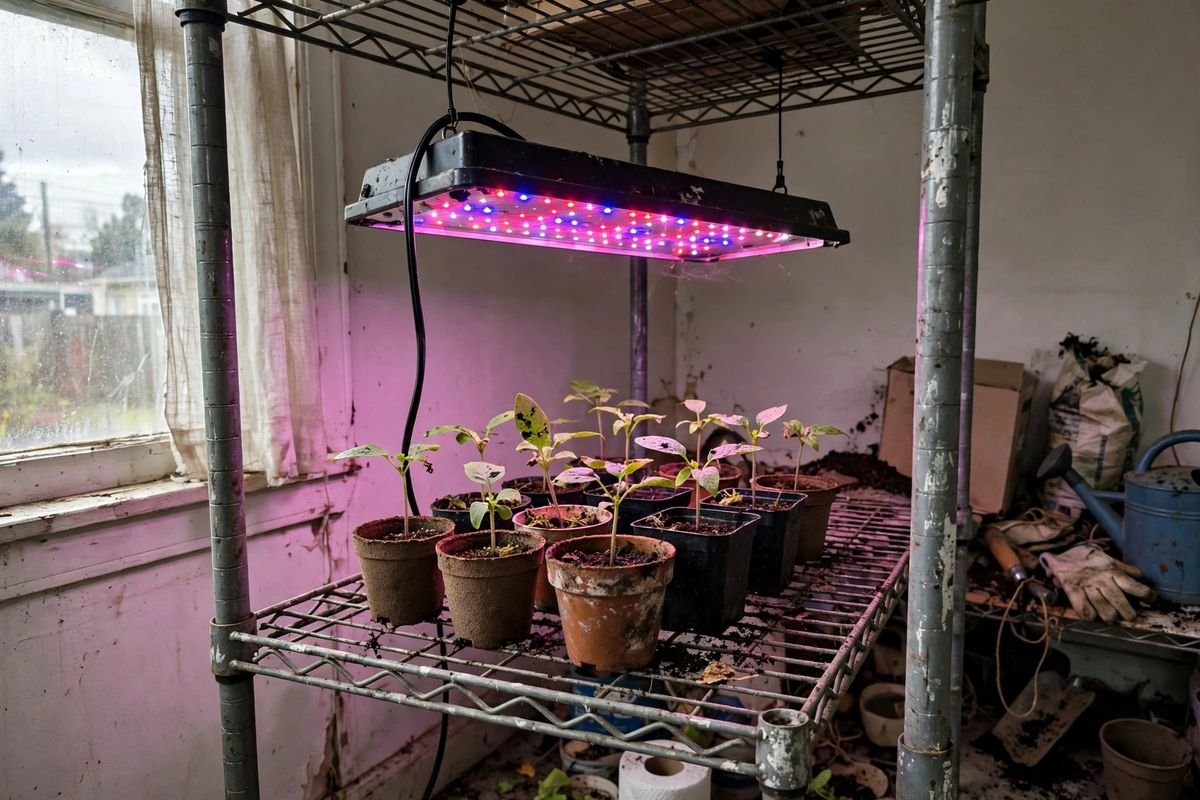
The tradeoff shows up in daily checks. Under pink-purple light, green leaves look dark and gray, and yellow leaves look far less yellow than they do in daylight. That makes it hard to spot early stress, pests on leaf undersides, or a tray that needs water. We can work around this by carrying one tray at a time into daylight for checks, but that adds a step to every watering round. The glow also rules out a living room shelf for most households, since the whole corner turns pink each evening.
Red-blue fixtures also tend to come in fewer forms. Panels dominate the low-cost end, while bars and bulbs in this color are less common. Search listings for a red-blue grow light panel and confirm wattage, panel size, and whether the listing includes a timer or hanging kit.
Electricity math for one fixture
Running cost follows the same steps for either light type, since it depends on wattage, hours, and rate, not on light color. Take one 40-watt fixture that runs 16 hours a day for 90 days, at $0.17 per kilowatt-hour. Divide 40 by 1,000 to get 0.04 kilowatts. Multiply 0.04 by 16 hours and 90 days to get 57.6 kilowatt-hours for the season. Multiply 57.6 by $0.17 to get $9.79 in electricity per fixture per season under these assumptions, before any fixture price. Our guide to how long grow lights should stay on for seedlings covers daily run times and why 16 hours suits most seedlings.

To redo the math for a different fixture, swap in its wattage and our own rate from the power bill. A 20-watt fixture at the same hours and rate costs half as much, or $4.90 per season. A 60-watt fixture costs $14.69 per season. The gap between two fixtures of the same wattage is zero on the power bill, so light color alone does not change running cost. Fixture price, not color, decides which option costs more over one season.
A simple two-week reading plan
Light choice shows up in plant response within two weeks, and a short check at that point tells us whether the setup works. On day 14, look at four signs in daylight, away from the grow light: stem length, leaf color, spacing between leaves, and lean direction. Short, sturdy stems with tight leaf spacing point to enough light. Long, pale stems with wide gaps between leaves point to light that is too dim or too far above the plants. Plants that lean hard to one side point to uneven coverage, with one edge of the tray getting less light than the other.
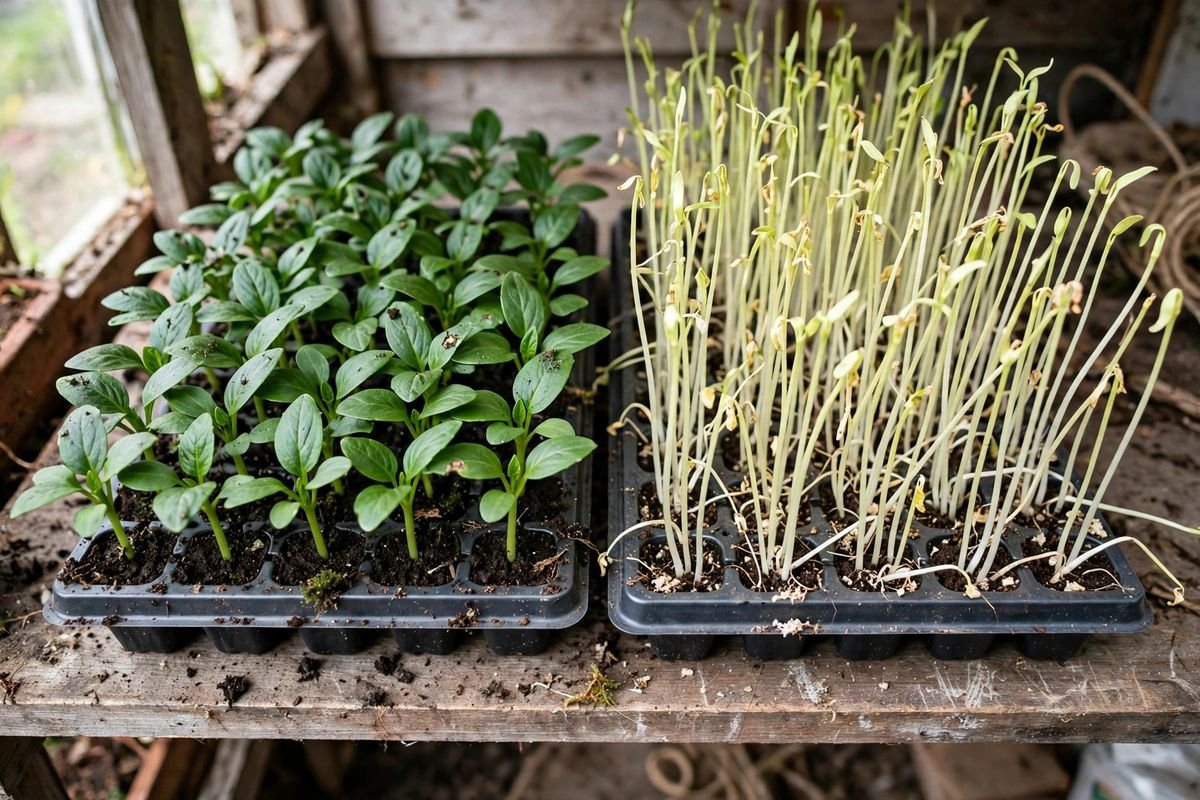
If the signs point to weak light, move the fixture closer to the plants before buying a second fixture, and recheck after a few days. Our guide to how high grow lights should be above seedlings covers starting gaps and how to adjust them as plants grow. If the signs look good at two weeks, keep the same height and hours, and check again each time we water.
How to choose
Choose full-spectrum if we start seedlings for transplant and check trays daily, since white light lets us spot pale leaves and stretched stems without moving pots. Choose red-blue if we start seedlings for transplant in a spare room or garage, want the lowest fixture price, and accept carrying trays into daylight for checks.
Choose full-spectrum if we grow houseplants in a living room, since white light blends with ordinary lamps and leaves the room looking normal each evening. Choose red-blue if we grow houseplants out of sight in a utility space and care more about fixture price than room appearance.
Choose full-spectrum if we use a shelf where light color matters for daily use, such as a desk shelf, a kitchen shelf, or a shelf beside a reading chair. Choose red-blue if we use a shelf where no one sits nearby, such as a garage shelf or a closet shelf, and the pink glow bothers no one in the household. Start with the room, then pick the light color that fits how we live with the shelf.
Sources & Further Reading
University of Minnesota Extension, Starting seeds indoors: https://extension.umn.edu/planting-and-growing-guides/starting-seeds-indoors
North Carolina State Extension, Extension Gardener Handbook Chapter 13 Propagation: https://content.ces.ncsu.edu/extension-gardener-handbook/13-propagation