
This post may contain affiliate links. If you buy through links on this page, we may earn a commission at no extra cost to you.
As an Amazon Associate I earn from qualifying purchases.
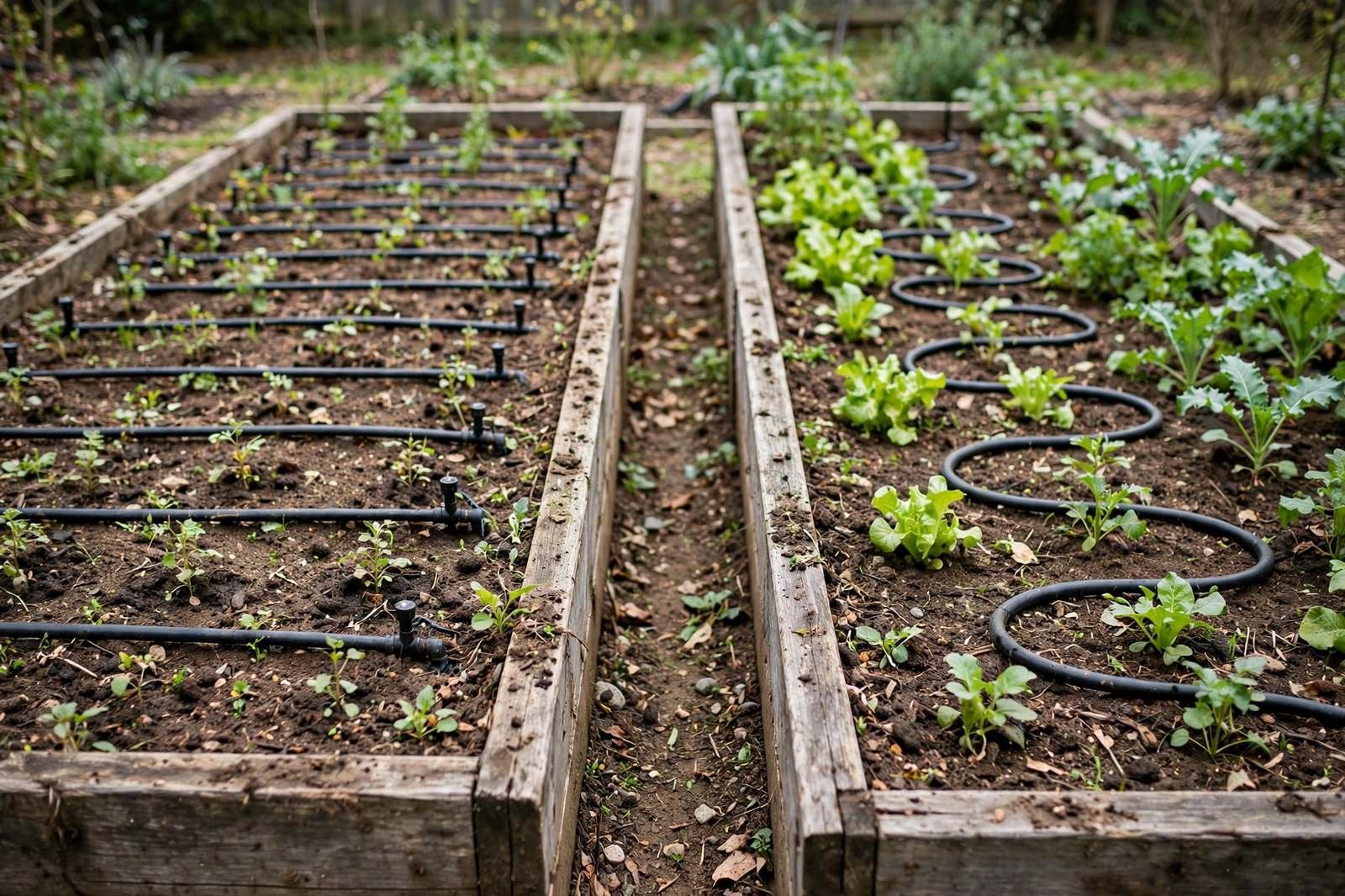
Both drip irrigation and soaker hoses put water at soil level instead of spraying it over leaves, and both beat an overhead sprinkler on a hot afternoon. The difference is control. Drip delivers a measured amount to each plant through emitters we place one by one. A soaker hose seeps along its whole length, watering a strip rather than a spot. Which one suits our beds depends on layout, water pressure, and how fussy we want the setup to be.
We have not run side-by-side product trials on the kits and hoses linked here, and flow rates vary by brand, water pressure, and hose length. Check the listing for emitter spacing, hose length, and pressure range before ordering. Our contribution is the water-use math below, worked from stated assumptions so we can compare the two systems on the same bed without invented test results.
| Factor | Drip Irrigation | Soaker Hose |
|---|---|---|
| Water placement | At each emitter, right at the plant base | Along the full hose length, in a wide strip |
| Uniformity | High when emitters match; pressure-compensating emitters stay even on slopes | Strongest near the faucet, weaker at the far end of long runs |
| Pressure needs | Low pressure, usually 15-30 psi with a regulator | Low to moderate; output drops as pressure falls |
| Clogging | Emitters can clog; a filter and occasional flushing help | Fine pores can clog with hard water or sediment |
| Layout flexibility | Very high; tubing bends around plants and beds of any shape | Moderate; hose follows rows but resists sharp turns |
| Cost pattern | Higher upfront for kit, tubing, and emitters; cheap to expand later | Lower upfront per hose; full replacement when the hose wears out |
| Best use | Mixed plantings, wide spacing, containers, precise watering | Dense rows, hedges, simple rectangular beds |
Read the table as a starting map. The sections below walk through how each system behaves in a real raised bed, where the water actually goes, and how much of it a single watering uses.
How Each System Puts Water Down
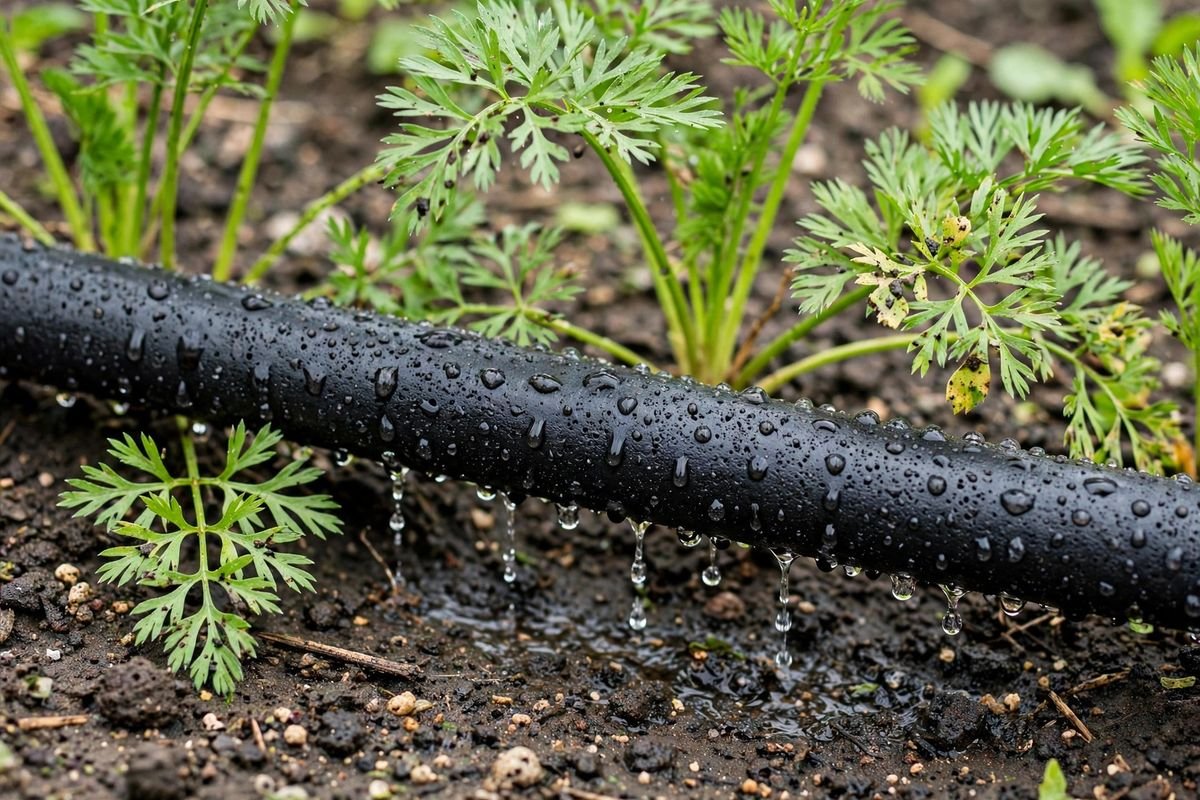
A soaker hose is a porous tube, often made from recycled rubber. Water seeps out through thousands of tiny openings along its length, soaking the soil in a band on either side. We lay it in a gentle S-curve down a row or loop it around a bed, bury it under mulch, and turn the faucet on low. The soil wets slowly and evenly near the hose, which suits dense plantings like carrots, beans, and salad greens where roots overlap and a wet strip is what the crop wants anyway.
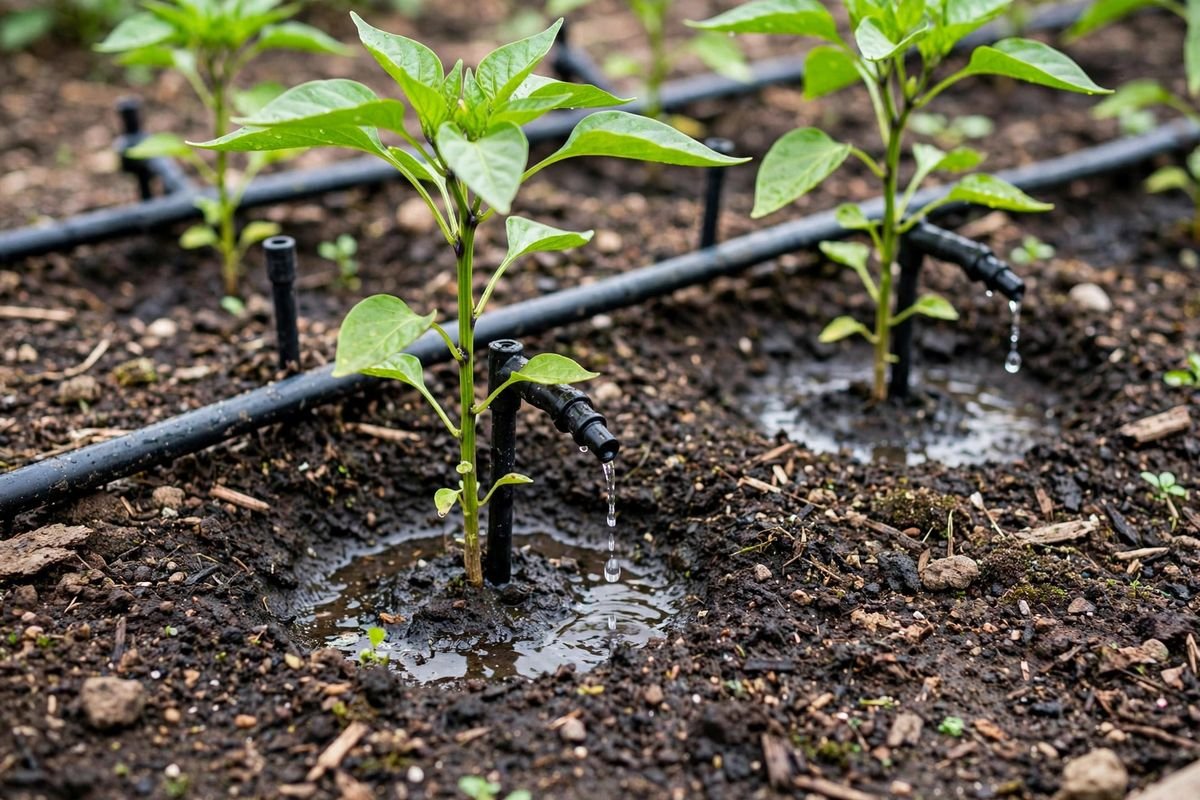
Drip irrigation starts with a mainline tube, usually half-inch polyethylene, that carries water to the bed. Smaller quarter-inch lines branch off, and emitters push water out at a rated flow — commonly a half gallon or one gallon per hour each — right where we punch them in. Spaghetti tubing and drip tape are close cousins. The point is placement: each emitter waters one plant, so a pepper and the bare corner beside it no longer get the same drink.
Our Water-Use Math for One 4×8 Bed
Assumptions. One raised bed, 4 by 8 feet, planted with a mixed crop. Our drip layout uses 32 emitters rated at 0.5 gallons per hour. Our soaker layout uses about 25 feet of hose snaked through the bed. These are planning numbers from published flow ratings, not measurements we took in a test garden, and real output shifts with pressure and hose age.
Drip math. 32 emitters × 0.5 gallons per hour = 16 gallons per hour for the whole bed. A deep watering that pushes moisture 6 to 8 inches down takes roughly 75 minutes in a loamy mix, so one session uses about 20 gallons (16 × 1.25 hours). Nearly all of it lands inside the root zones we aimed at.
Soaker math. A typical soaker hose releases roughly 0.5 to 1 gallon per hour per foot at household pressure. At 25 feet, that is about 12 to 25 gallons per hour. The near end gets more than the far end, so we either run the hose in a loop fed from the middle or accept that the far row drinks less. One hour of runtime puts down a similar total to our drip session, but spread across the whole bed surface instead of concentrated at each plant.
What the numbers tell us. Total gallons can end up close. The real gap is placement efficiency. In a bed of widely spaced tomatoes, drip sends water to 8 root zones and leaves the paths dry. A soaker hose wets the paths too, which feeds weeds and loses more to evaporation. In a solid block of carrots, the soaker’s wet strip matches the crop, and drip’s precision buys us little. Readers setting up a first bed will find the layout basics in our guide to raised bed gardening for beginners.
Drip Irrigation: Pros and Cons
Pros: precise placement at each plant, strong uniformity with pressure-compensating emitters, easy to automate on a timer, simple to expand bed by bed, and dry foliage that discourages leaf disease. A zoned system also lets thirsty crops and lean-water herbs run on different schedules.
Cons: more parts to buy and assemble, emitters that clog without a filter, tubing that can kink or get nicked by a trowel, and a fussier first setup. Rodents occasionally chew lines, and a bed replanted to a new layout may need the emitters moved.
Browse a drip irrigation kit for raised beds on Amazon and confirm the kit includes a filter, pressure regulator, and backflow preventer. Our companion guide to the best drip irrigation kits for raised beds compares kit types by what is in the box, and our walkthrough on how to set up drip irrigation for a raised bed covers the assembly order step by step.
Soaker Hose: Pros and Cons
Pros: the simplest setup in watering — unroll, connect, and turn the tap on low. Low upfront cost per bed, no emitters to place, gentle delivery that rarely erodes soil, and easy burial under mulch where it disappears from view.
Cons: uneven output on long runs, with the far end getting less; pores that clog in hard water; a hose that kinks on tight corners; and no way to give one plant more than its neighbor. A worn hose is replaced whole rather than repaired, and output changes as the material ages.
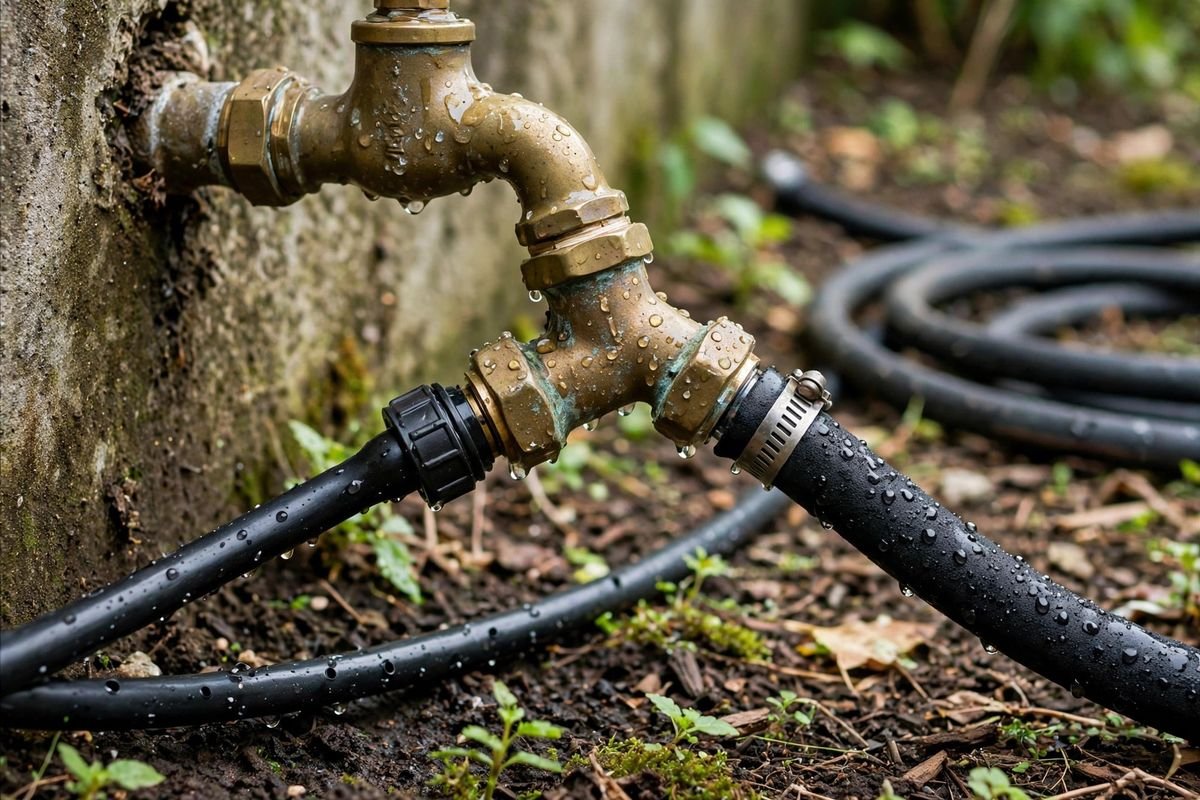
Compare soaker hoses for the garden on Amazon by length and stated flow rate, and keep runs short — most guidance caps a single run near 25 to 50 feet for even output. Both systems connect at the same faucet, and a simple splitter with a backflow preventer lets one tap feed either setup.
Which One Fits Our Beds?
Choose drip irrigation if our beds hold mixed plantings with wide spacing, like tomatoes beside peppers beside squash, and each plant deserves its own amount of water. Choose drip irrigation if we water containers too, since a few emitters on a side line handle pots neatly — our notes on container gardening for beginners show how small those root zones are. Choose drip irrigation if slopes or long beds make even pressure worth paying for, or if a timer will run the watering while we are away.
Choose a soaker hose if our beds are dense rows of carrots, beans, peas, or greens where a wet strip matches the planting. Choose a soaker hose if the budget covers one or two beds this season and simplicity beats precision. Choose a soaker hose if the bed is a simple rectangle near the faucet, where a short run keeps output even from end to end.
Plenty of gardens run both: drip on the tomato bed, a soaker hose through the carrot block. Our tomato notes in how to grow tomatoes explain why those deep, widely spaced plants reward targeted watering. Whichever system we pick, session length matters as much as hardware, and our guide on how often you should water a raised bed helps set a rhythm by soil and season. Use your local frost dates and regional planting guidance — not your USDA hardiness zone alone — to choose planting dates, since the watering calendar follows the planting calendar.
Common Problems and Plain Fixes
Far end of the soaker hose stays dry. The run is too long or pressure is low. We shorten the run, feed the hose from the middle with a Y-fitting, or loop it back so both ends share pressure. Drip emitters clog. Sediment or mineral scale is the usual cause. We add an inline filter, flush the mainline each spring, and soak clogged emitters in vinegar before replacing them. One plant wilts while neighbors thrive. On drip, we add a second emitter or step up the flow rate at that spot. On a soaker hose, we check for a kink uphill of the dry patch. Soil surface stays wet and algae grows. Both systems belong under mulch, and shorter, deeper sessions beat daily sprinkles.
FAQ
Can a soaker hose and drip line run off the same faucet?
Yes, with a splitter, a backflow preventer, and a pressure regulator on the drip side. The two systems want different pressures, so we run them one zone at a time rather than wide open together.
How long should each system run?
Long enough to wet the root zone 6 to 8 inches deep, then stop. In our worked example that was about 75 minutes for drip and about an hour for the soaker hose, but soil texture changes the answer, so we check with a trowel after the first run.
Do soaker hoses waste more water than drip?
Total gallons can be similar. Drip puts a higher share of its water inside root zones, so it wastes less in paths and bare corners. In dense plantings the gap nearly disappears.
Which lasts longer?
Drip mainline tubing often serves for years, with emitters replaced as they clog. Soaker hoses usually give a few seasons before output turns patchy, and the whole hose is replaced at once.
Sources & Further Reading
- University of California Agriculture and Natural Resources — drip irrigation basics: https://ucanr.edu/site/uc-master-gardeners/drip-irrigation
- Colorado State University Extension — drip irrigation for home gardens: https://extension.colostate.edu/topic-areas/yard-garden/drip-irrigation-home-gardens-4-702/
- University of Minnesota Extension — watering vegetable gardens: https://extension.umn.edu/watering/watering-vegetable-gardens
Keep Growing With These Guides
Both systems reward the same habit: water deep, water at the base, and let the soil surface dry between sessions. Which bed in our garden would change most if every plant got exactly its own share?