
This post may contain affiliate links. If you buy through links on this page, we may earn a commission at no extra cost to you.
As an Amazon Associate I earn from qualifying purchases.
A small patio forces a choice: give up floor space to pots, or grow up a wall, fence, or railing. Vertical planters promise herbs and greens on a footprint no bigger than a doormat, but “vertical” covers four formats with very different soil volume, drainage, and crop fit. This guide compares them using published listing specs, not any bench test of our own. We have not product-tested the models in shop listings, so treat each number as a spec to check, not a result we measured.
Our quick answer: a stacked tower gives the most soil per plant and the easiest watering for mixed herbs. Fabric pockets give the most holes per dollar for shallow greens. A rigid wall unit holds its shape and drains evenly. A railing tier suits a narrow balcony edge. The worked example below shows the soil and plant count for one five-tier tower.
Quick Comparison: Four Vertical Formats
The table compares the four formats we see most in listings for small spaces. Volumes are typical published ranges for mid-size units; use the per-pocket figure on any listing as the number that counts.
| Feature | Stacked tower | Fabric pocket | Rigid pocket / wall | Railing tier |
|---|---|---|---|---|
| Typical footprint | About 1.5 to 2 sq ft of floor | None; hangs on a wall or fence | None; mounts flat to a wall | None; hooks over a railing |
| Pocket volume (typical) | About 0.3 to 0.5 cu ft per tier | About 0.05 to 0.15 cu ft per pocket | About 0.1 to 0.25 cu ft per pocket | About 0.1 to 0.2 cu ft per tier tray |
| Drainage | Tier-to-tier flow, usually with holes per tier | Through the fabric itself, whole panel | Holes or slots per pocket, often with a shared channel | Holes per tray, drips fall below |
| Best-fit crops | Herbs, strawberries, small peppers | Lettuce, herbs, trailing flowers | Herbs, greens, small ornamentals | Herbs, lettuce, trailing plants |
| Watering habit | Top-down, one fill reaches lower tiers | Frequent light watering, dries fast | Pocket by pocket or top feed | Tray by tray, check often |
| Main limit | Top tiers dry faster than bottom tiers | Small pockets dry out quickly | Mounting must hold wet soil weight | Limited soil depth for hungry crops |
New to containers? Our guide to container gardening for beginners covers pot sizing and soil basics that apply to every format below.
Three Vertical Formats, Three Watering Habits
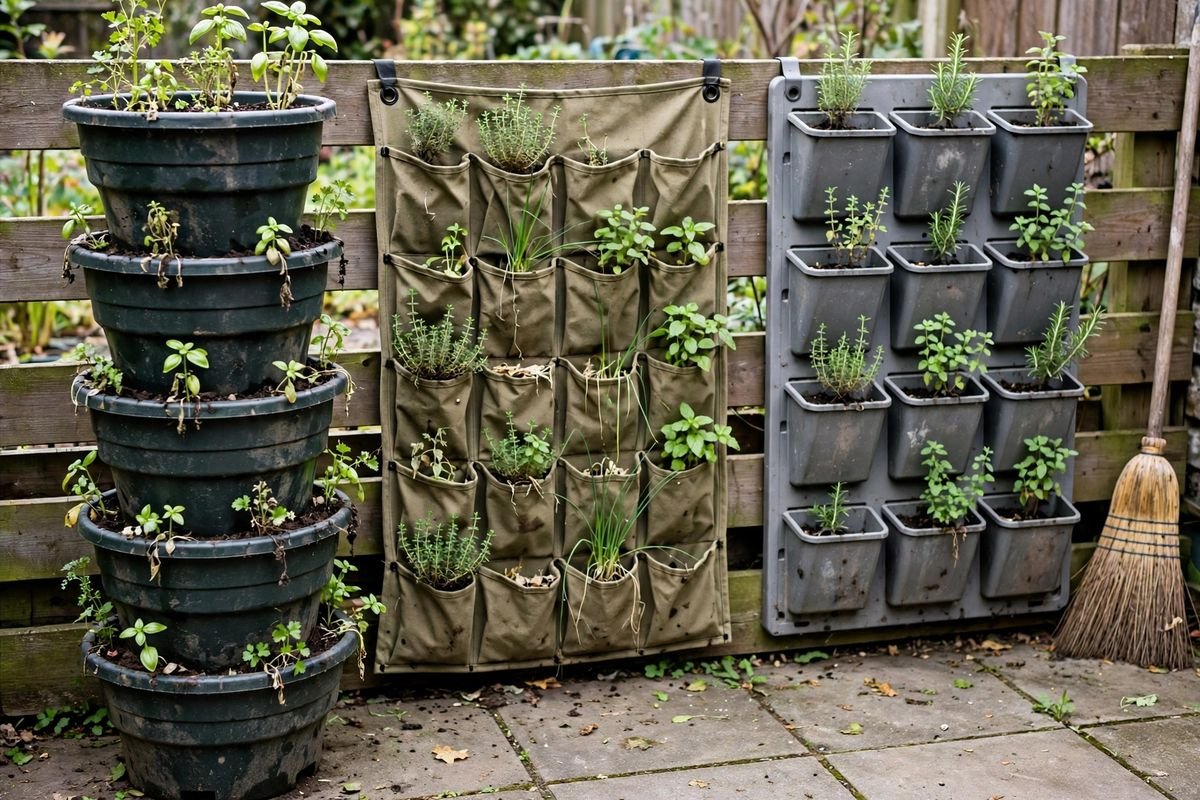
Format decides watering rhythm. A tower wants one slow pour at the top. A fabric panel wants a light drink most days. A rigid wall unit wants each pocket checked on its own.
Stacked Tower Planters
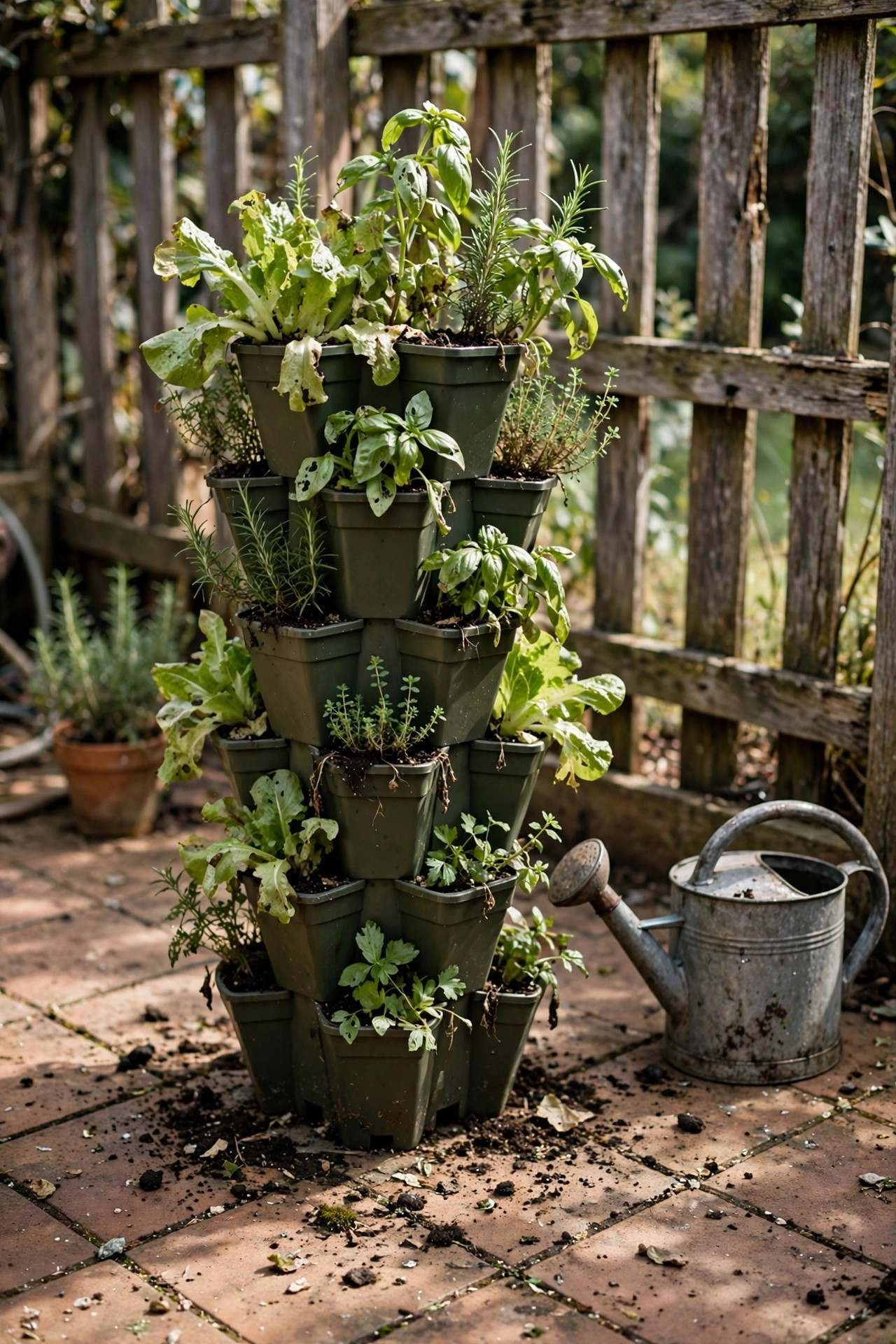
A stacked tower is a column of wide tiers around a central core. Soil volume per tier is the largest here, often 0.3 to 0.5 cubic feet on mid-size units. Most towers water from the top, with drainage flowing down tier to tier, so one pass serves the whole column.
Pros:
- Largest soil volume per planting spot of the four formats.
- Top-down watering reaches most tiers in one pass.
- Free-standing; no wall or railing needed.
- Tiers can rotate on some designs to chase light.
Cons:
- Top tiers dry faster than lower tiers, so planting should match water need by height.
- A tall tower full of wet soil is heavy and can lean on soft ground.
- Footprint, while small, is still floor space a wall unit does not use.
Browse stacked tower planters on Amazon and compare the per-tier volume and tier count rather than the headline plant count, which counts every small pocket as a full plant spot.
Fabric Pocket Planters
A fabric pocket planter is a hanging panel of stitched pockets, hung from grommets on a wall or fence. Pockets run small, about 0.05 to 0.15 cubic feet each, and the fabric breathes and drains freely, which also pulls moisture out fast.
Pros:
- Most planting holes per dollar of the four formats.
- Zero floor footprint; hangs on any sturdy vertical surface.
- Fabric drains freely, so overwatering damage is rare.
- Light to ship, store, and move.
Cons:
- Small pockets dry out fast, often daily in sun and wind.
- Shallow soil limits crop size; fruiting plants struggle.
- Panels weather and fade after a few seasons outdoors.
- Runoff can stain the wall or fence behind the panel.
Compare fabric pocket planters on Amazon by pocket count and pocket size together; a 36-pocket panel with tiny pockets holds less soil than a 12-pocket panel with deep ones.
Rigid Pocket and Wall Planters
Rigid pocket units are hard plastic or resin pockets that clip or screw onto a wall frame. They keep a consistent soil depth of about 0.1 to 0.25 cubic feet per pocket and drain through slots or a shared channel.
Pros:
- Consistent pocket depth and shape season after season.
- Drainage slots or channels keep runoff more controlled.
- Sturdier feel and longer outdoor life than fabric.
- Modular frames can grow a row at a time.
Cons:
- Mounting must hold the full wet weight, soil plus water.
- Higher cost per planting hole than fabric.
- Dark plastic pockets heat up on a sun-baked wall.
Railing Tier Planters
A railing tier planter hooks over a balcony rail, stacking two or three shallow trays at about 0.1 to 0.2 cubic feet each. Nothing touches the floor or screws into a wall, which suits renters. Our guide to how to start a balcony garden covers rail weight and sun checks first.
Pros:
- Uses no floor or wall space at all.
- No drilling; hooks suit rented balconies.
- Plants sit at hand height for picking and checking.
Cons:
- Shallow trays dry quickly and limit root depth.
- Drips fall to the balcony or neighbor below.
- Load limits on older rails cap how many tiers are safe.
Look at railing tier planters on Amazon and check the hook width against your rail before anything else; rail profiles vary more than planter listings admit.
Drainage and Root Room Decide What Thrives
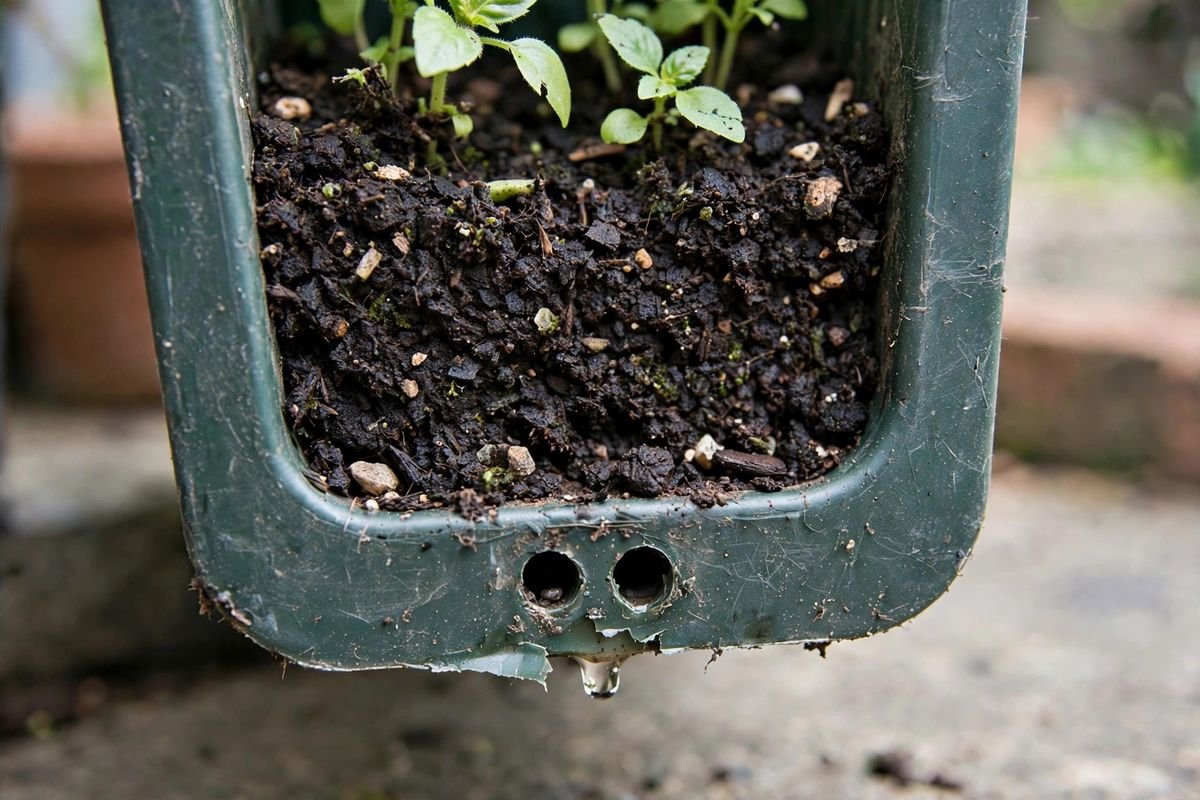
Two numbers decide whether a crop thrives: soil per pocket and how fast water leaves. Pockets under about 0.1 cubic feet suit lettuce and small herbs. Pockets from 0.15 to 0.3 cubic feet handle bushy herbs and strawberries. Peppers want a deep tower tier, 0.4 cubic feet or more. Our comparison of terracotta vs plastic pots covers how material changes dry-down speed.
Drainage style matters too. Tower drainage can leave top tiers dry and bottom tiers wet. Fabric drains everywhere, preventing soggy pockets but shortening time between waterings. Rigid pockets drain more evenly. Railing trays drain straight down, so a drip tray helps.
A Worked Example: Soil and Plants Per Square Foot of Floor
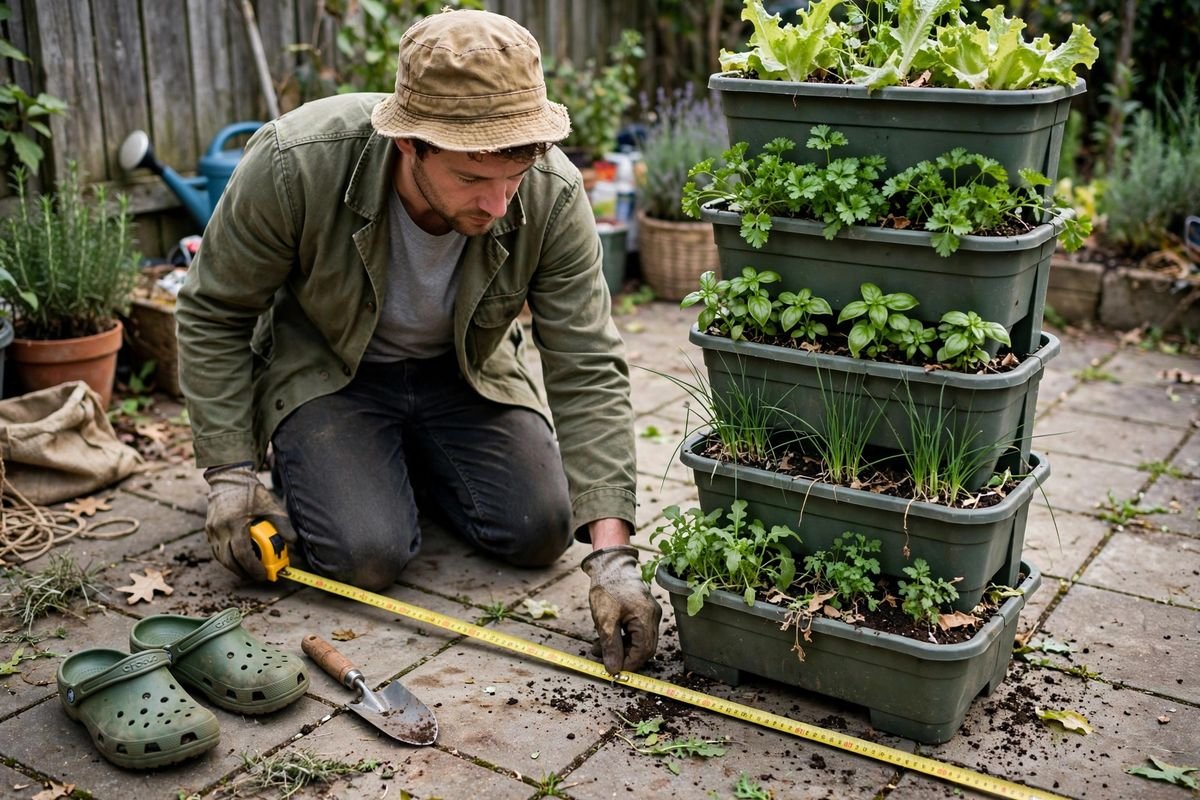
Headline plant counts can mislead, since a “36-plant” tower may count 36 small pockets. Here is our worked example with stated assumptions, using typical listing specs for a mid-size tower.
Assumptions. One stacked tower with 5 tiers. Each tier holds 0.4 cubic feet of soil, a typical published mid-size tier volume. Each tier has 6 planting pockets, a common pocket count per tier. The tower base measures 2 feet by 2 feet, giving a 4-square-foot footprint. For the ground comparison, one flat bed or row of pots on that same 2-by-4-foot patch (8 square feet) holds 8 herb plants spaced 1 foot apart.
Step 1: total soil volume. Soil per tier times tier count: 0.4 cubic feet times 5 tiers equals 2.0 cubic feet of soil in the whole tower. That is roughly 15 gallons of mix, or about two mid-size bags of potting mix.
Step 2: plant count. Pockets per tier times tier count: 6 pockets times 5 tiers equals 30 planting spots. At one herb or lettuce plant per pocket, the tower holds 30 plants.
Step 3: plants per square foot of floor. Tower: 30 plants divided by 4 square feet of footprint equals 7.5 plants per square foot of floor. Ground comparison: 8 plants divided by 8 square feet equals 1 plant per square foot. On floor space alone, the tower holds about seven times the plants per square foot, which is the entire point of growing up.
Step 4: soil per plant. 2.0 cubic feet divided by 30 plants equals about 0.067 cubic feet per plant, close to a 4-inch pot. The tower wins on count per square foot, not soil per plant. Planting every other pocket doubles soil per plant to about 0.13 cubic feet at 15 plants.
Buying Checks Before You Order
Drainage per pocket. Look for holes or slots in every pocket or tier, not just the bottom one.
UV resistance. Listings stating UV-resistant material suit a sunny patio; thin unlabelled plastic often cracks within a season or two.
Mounting and weight. Wet soil weighs roughly 40 to 50 pounds per cubic foot, so a 2-cubic-foot wall unit can pass 80 to 100 pounds watered. Check screws, brackets, and rail hook width.
Watering path. Decide how water gets in first. Towers need a reachable top tier, fabric panels a wand for each row, and rigid units pocket-by-pocket watering or a drip line.
Pocket volume honesty. Divide total soil volume by pocket count. Under 0.05 cubic feet per pocket means lettuce and small herbs only, whatever the photos show.
Our Verdict: Match the Format to the Space and the Crop
No format wins everywhere. The right pick depends on the surface you have, the crops you want, and how often you can water.
Choose a stacked tower if floor space exists but wall and rail space do not, and the crop list runs to herbs and strawberries.
Choose a stacked tower if one top-down watering pass should serve the whole planter.
Choose a fabric pocket planter if the goal is many small greens and herbs on a fence at the lowest cost per hole.
Choose a fabric pocket planter if daily light watering fits your routine and shallow roots are fine.
Choose a rigid pocket or wall planter if the planting stays up for years and even pocket depth matters.
Choose a rigid pocket or wall planter if controlled drainage over a patio or indoor wall matters.
Choose a railing tier planter if you rent, cannot drill, and the balcony rail is the only growing surface.
Choose a railing tier planter if hand-height herbs outside the kitchen door are the whole goal.
Our bottom line: towers give the most forgiving soil volume, fabric the cheapest holes, rigid units the steadiest pockets, and railing tiers space where nothing else fits.
Frequently Asked Questions
What grows best in a vertical planter?
Lettuce, basil, thyme, strawberries, and trailing flowers suit most pockets. Tomatoes and squash outgrow pocket soil fast and belong in full-size containers.
How often do vertical planters need watering?
Fabric pockets in sun can need water daily. Tower tiers may go a day or two, top tiers first. Check soil with a finger at pocket depth rather than watering on a schedule.
Can a vertical planter damage a wall or fence?
It can if runoff sits against wood. A small gap behind the unit and sound screws into studs or masonry keep most setups trouble-free.
Sources & Further Reading
- University extension guidance on container soil volume, drainage, and watering frequency for small containers.
- Regional extension notes on balcony and small-space vegetable growing, rail loading, and sun exposure.
- Manufacturer listing specs for tower, pocket, and railing planter volumes, checked against per-pocket math at the time of writing.