
This post may contain affiliate links. If you buy through links on this page, we may earn a commission at no extra cost to you.
As an Amazon Associate I earn from qualifying purchases.
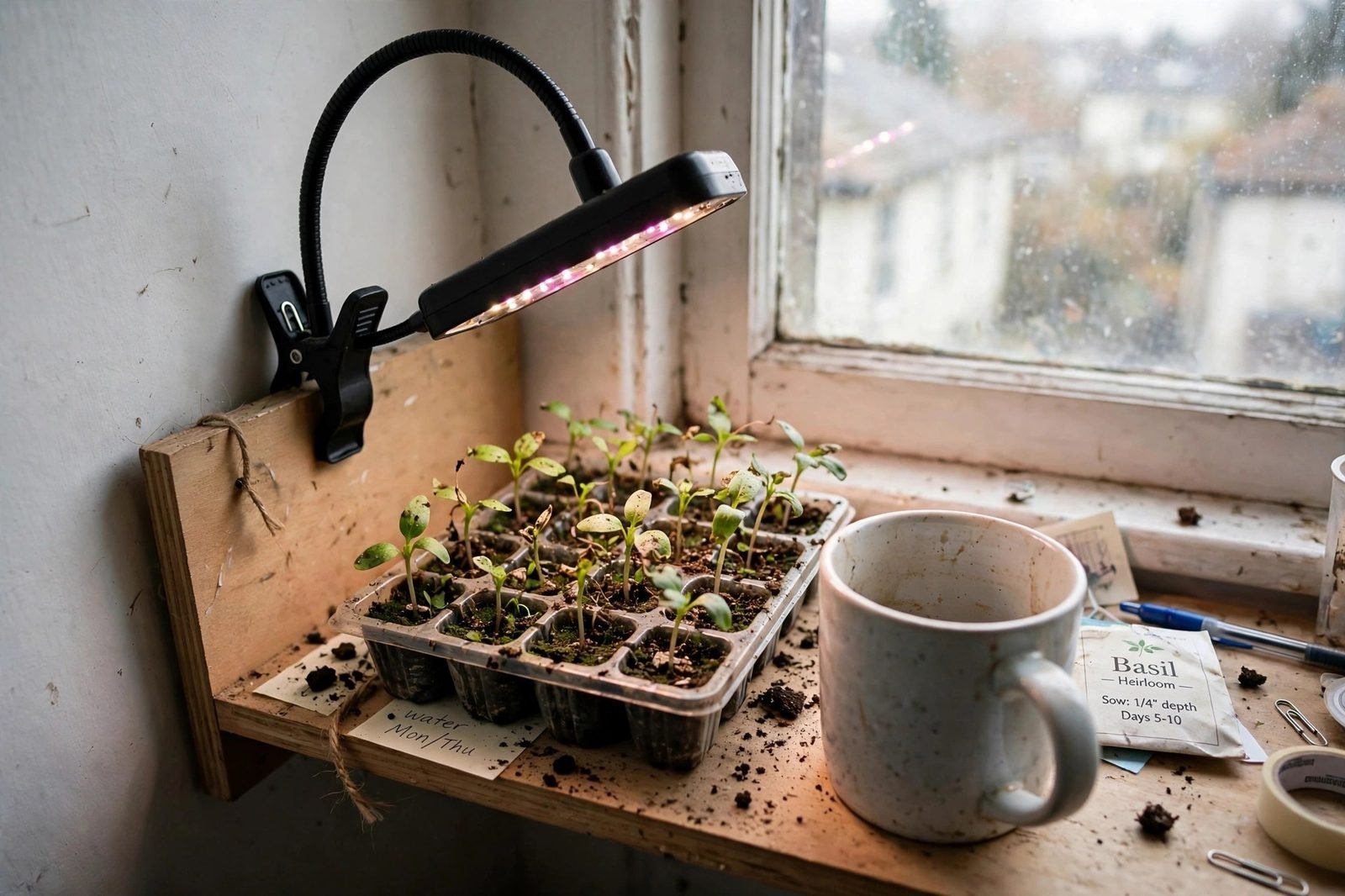
Small-space seed starting runs into one hard limit before any other: shelf space. A full tube fixture needs a long shelf and headroom for chains, while a windowsill gives uneven light and leggy plants. A clip-on grow light solves the space problem by gripping a shelf edge, a desk edge, or a table edge, and aiming light down at a small group of pots. It will not cover a room full of trays, but for a corner shelf or a desk, it fits where larger fixtures cannot.
This guide compares three clip-on forms: a clamp lamp, a gooseneck clip, and a desk-arm clip. We have not tested the products linked here, and we do not present any price below as a current store price. Where we give numbers, we state the assumptions in plain text so readers can redo the math with their own shelf size and electricity rate.
Three clip-on forms at a glance
| Form | Clamp range | Coverage | Adjustability | Limits |
|---|---|---|---|---|
| Clamp lamp | Grips a shelf or table edge; confirm the maximum thickness in the listing | One pot or a small cluster under one bulb | Aims by tilting the shade; moves by re-clamping | One light cone; edges sit dimmer than the center |
| Gooseneck clip | Clips to a shelf, desk, or pot rim where the listing allows it | One pot or a narrow row of small pots | Bends to aim light and to set height without moving the clamp | Arm can droop over time; arm length limits reach |
| Desk-arm clip | Clamps to a desk or thick shelf edge; confirm the maximum thickness in the listing | One or two pots, or a short row under an arm | Swivels and folds to park the arm flat when not in use | Needs a sturdy edge; arm joints add bulk behind the shelf |
Clamp range varies by listing, so we do not give a single range that would apply to every product in a form. Measure shelf thickness, desk thickness, and the depth of the edge lip before ordering, and compare those numbers with the listing. A clamp that grips a thin wire shelf may not grip a thick wooden desk.
Clamp lamp form
A clamp lamp is a shade with a socket and a spring clamp, fitted with a grow bulb. It suits one pot or a small cluster on a shelf edge, and it costs little to start because the lamp and the bulb are separate parts we can replace on their own. The shade directs light down and shields our eyes from glare when we sit near the shelf, which helps on a desk in a room we use each evening. Our guide to best grow lights for seedlings places clamp lamps beside longer fixtures for a first indoor setup.

The tradeoff is a single light cone. Pots at the edge of that cone get less light than pots under the center, so we need to rotate pots or group them tight under the shade. A clamp lamp also needs a new clamp position for every move, since the shade does not bend or reach across a shelf. That makes it a poor fit for a long row of pots, even though it serves a small cluster well. Search listings for a clamp lamp grow light and confirm socket type, shade size, cord length, and whether a bulb is included.
Gooseneck clip form
A gooseneck clip light pairs a flexible arm with a clamp base, and it suits a gardener who wants to aim light without moving the clamp. We bend the arm down over a pot, bend it up as the plant grows, and bend it sideways to share light between two small pots. That flexibility helps on a desk where pots move around, and it helps in a corner where a straight fixture would hit a wall.
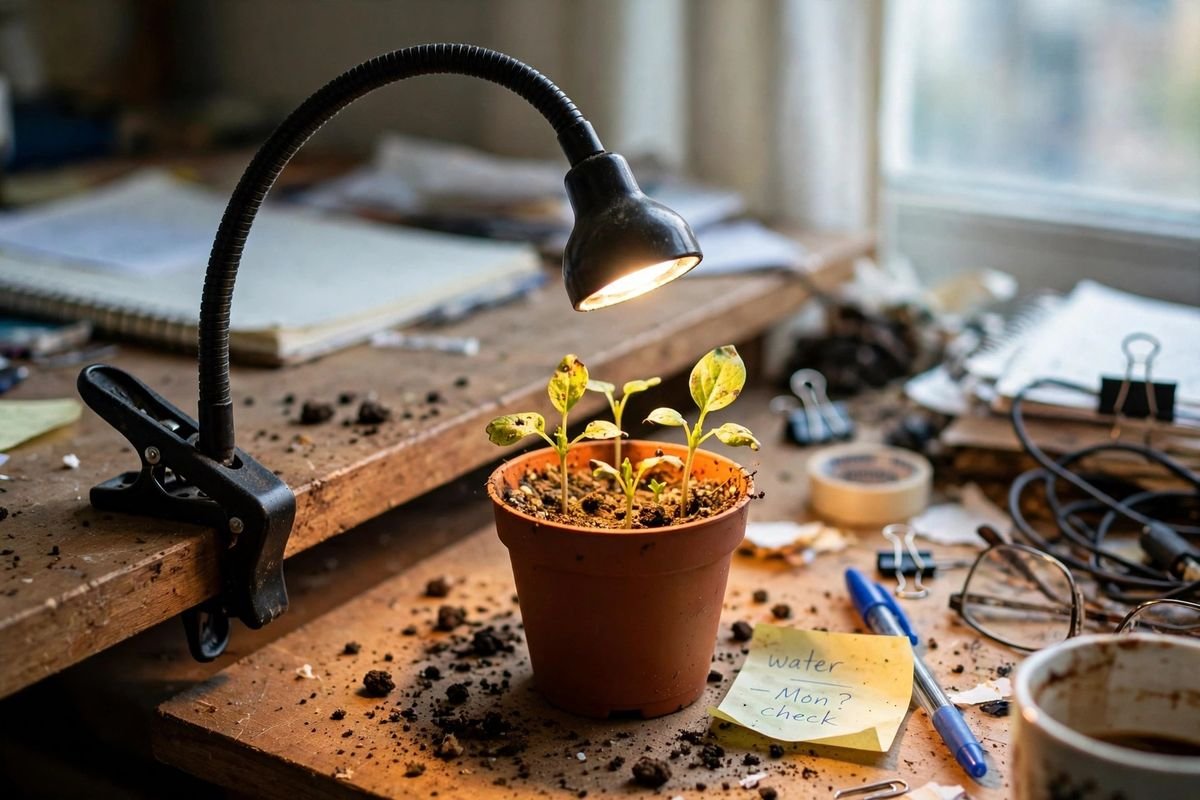
The tradeoff is arm strength. A long gooseneck can droop under the weight of its own head over a season, and the reach of the arm limits how far from the clamp edge we can place a pot. A gooseneck also lights a small area, so a full tray needs more than one light. Treat a gooseneck as a one-pot or two-pot tool, not as a tray light. Search listings for a gooseneck clip grow light and confirm arm length, head size, and whether the listing includes a timer or dimmer.
Desk-arm clip form
A desk-arm clip light uses a jointed arm that folds and swivels, and it suits a gardener who wants to park the light flat when the shelf is not in use. We swing the arm over the pots during the light hours, fold it back at night, and use the desk for other work without removing the clamp. That pattern suits a shared desk or a kitchen counter where seed starting shares space with daily work. A desk arm also holds its position better than a gooseneck once locked, which helps when we need a steady gap above seedlings.
The tradeoff is bulk and edge strength. Joints sit behind the shelf and need clearance, and the clamp needs a sturdy edge that can hold the arm without flexing. A thin wire shelf may flex under a desk arm, and a shelf with a shallow lip may not give the clamp enough grip. Measure the edge and test the clamp on an empty part of the shelf before placing pots under it. Search listings for a desk arm clip grow light and confirm clamp thickness range, arm reach, and folded depth.
How many clip lights a shelf needs
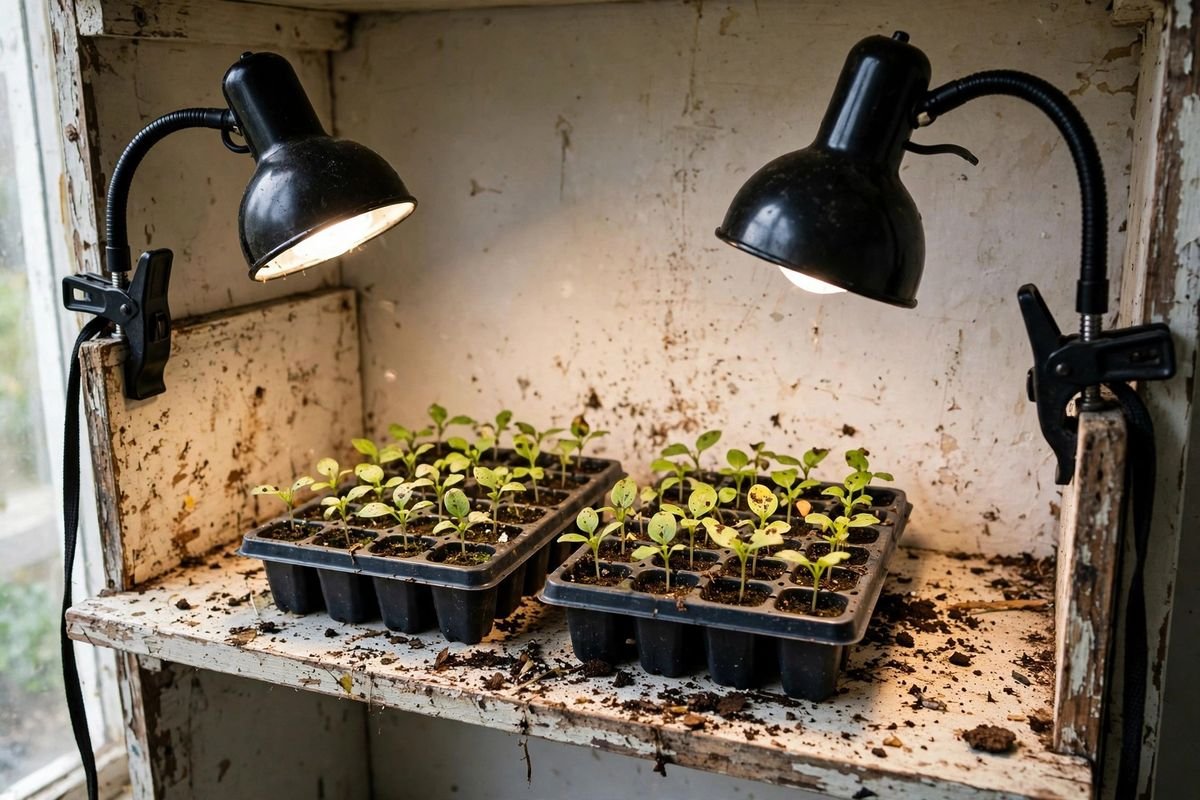
Plan on one clip light per square foot of seedlings, with the light 6 to 12 inches above the plants. That rule gives a simple way to size a shelf before ordering. A shelf 2 feet by 1 foot equals 2 square feet, so it needs 2 clip lights under this rule. A shelf 3 feet by 1 foot equals 3 square feet, so it needs 3 clip lights. Spread the lights evenly across the shelf so each square foot gets its own light cone.
Electricity per light follows the same steps for every clip form. Take one 20-watt clip light, running 16 hours a day for 90 days. Divide 20 by 1,000 to get 0.02 kilowatts. Multiply by 16 hours and 90 days to get 28.8 kilowatt-hours for the season. At $0.17 per kilowatt-hour, that comes to $4.90 per light per season. Two lights on a 2-foot by 1-foot shelf cost $9.80 in electricity per season under these assumptions, before any fixture price.
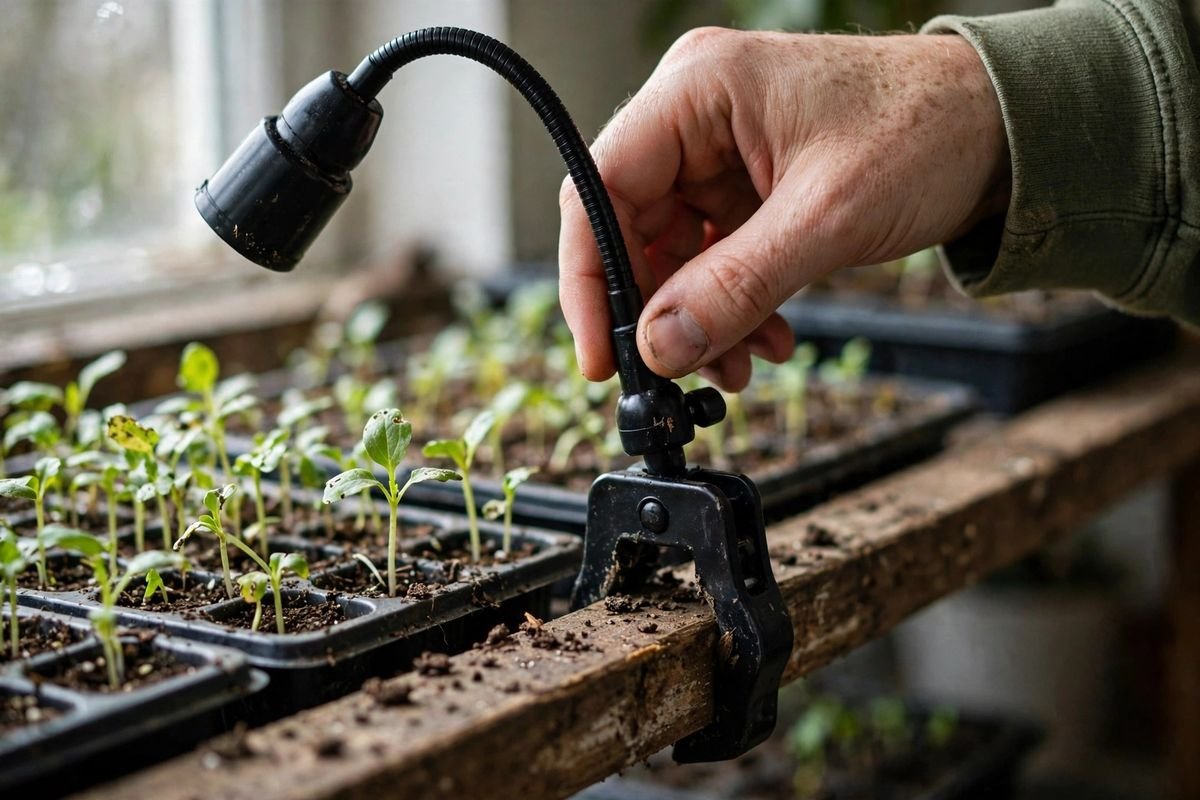
Height matters as much as light count. A clip light set too high gives dim light at plant level, and a clip light set too low can harm tender leaves. Check the gap each time we water, and raise the arm or re-clamp the light as plants grow. Our guide to how high grow lights should be above seedlings covers starting gaps and how to adjust them. Our guide to how to set up grow lights on a shelving unit covers cord routing and timer placement for a shelf with more than one light.
Our guide to best seed starting shelves for small spaces covers narrow shelves that fit a corner or a desk area. Match shelf width to the light count, leave a gap behind the shelf for cords, and keep a timer within reach.
How to choose
Choose a clamp lamp if we grow one pot or a small cluster, want a low entry cost with a replaceable bulb, and sit near the shelf where a shade helps with glare. Choose a clamp lamp if we can rotate pots under one light cone and do not need to light a long row.
Choose a gooseneck clip if we need to aim light in small steps, move pots around a desk, or set height without moving the clamp. Choose a gooseneck clip if we grow one or two pots and want the arm to bend over each pot in turn.
Choose a desk-arm clip if we share the desk or counter with other work, want to fold the light flat when not in use, and have a sturdy edge that can hold a jointed arm. Choose a desk-arm clip if we need a steady gap above seedlings and can give the joints clearance behind the shelf. Start with the light count from the shelf math, then pick the form that fits our edge and our daily pattern.
Sources & Further Reading
University of Minnesota Extension, Starting seeds indoors: https://extension.umn.edu/planting-and-growing-guides/starting-seeds-indoors
North Carolina State Extension, Extension Gardener Handbook Chapter 13 Propagation: https://content.ces.ncsu.edu/extension-gardener-handbook/13-propagation