

This post may contain affiliate links. If you buy through links on this page, we may earn a commission at no extra cost to you.
As an Amazon Associate I earn from qualifying purchases.
A week away from home can undo a whole season of steady watering. Pots dry out in two or three hot days, and a raised bed can go from damp to dusty while you are still at the airport. The fix is an automatic watering system that keeps working after you lock the front door.
Four systems cover almost every garden: a hose timer with a drip kit, a watering spike fed by a bottle, a wick that pulls water from a bucket, and a simple timer on a soaker hose. Each one suits a different trip length, a different number of pots, and a different budget of effort before you leave. This guide compares them side by side, with the water math for seven days away, so you can pick the one that fits your garden and your travel dates. The same setups work for a winter holiday trip, when indoor heat dries potted plants fast even while the garden outside rests.
The four systems at a glance
| System | Best for | Water source | Setup effort | Main limit |
|---|---|---|---|---|
| Hose timer with drip kit | Many pots or a raised bed, trips of 7 to 14 days | Outdoor spigot | About an hour to lay tubing and set the timer | Needs a working spigot and a timer battery |
| Watering spikes with bottles | One to six indoor or patio pots, trips up to a week | Filled bottles, usually 1 to 2 liters each | Minutes per pot | Small reservoir runs dry on long trips |
| Wicks from a bucket | Indoor plants, trips of 3 to 7 days | Bucket or basin of water | Minutes per pot | Slow flow, only suits small pots |
| Timer on a soaker hose | Beds and borders, trips of 7 to 14 days | Outdoor spigot | Minutes to lay the hose and set the timer | Less even than drip emitters on slopes |
If you only remember one line from this guide, let it be this: match the reservoir to the trip. A bottle that lasts three days does not become a seven-day system because you hope it will. The math in the next section shows how to check that before you pack.
How much water do your plants need for 7 days away?
Start with a rough count, not a guess. Our working example uses six containers, each holding a tomato, pepper, or herb plant in summer sun. We assume each pot uses about 0.5 gallon of water per day, which is a fair middle figure for a medium pot in warm weather. Small pots use less, large tomato pots in full sun use more, and a cool cloudy week uses less than a hot one.
The math is simple: 6 pots times 0.5 gallon per day times 7 days equals 21 gallons for the week. That single number sorts the four systems fast. A 2-liter bottle holds about 0.5 gallon, so one bottle per pot covers roughly one day, not seven. A 5-gallon bucket covers about ten pot-days, which is less than two days for all six pots. A hose timer has no reservoir limit at all, because it draws from the spigot on a schedule.
Count your own pots the same way. Multiply the number of pots by the daily use per pot, then multiply by the days away. If the total is larger than your reservoir, either add reservoirs or pick a spigot-fed system. For a full rundown of manual watering while you are away, see our guide on how to water plants while you are on vacation.
Hose timers and drip kits
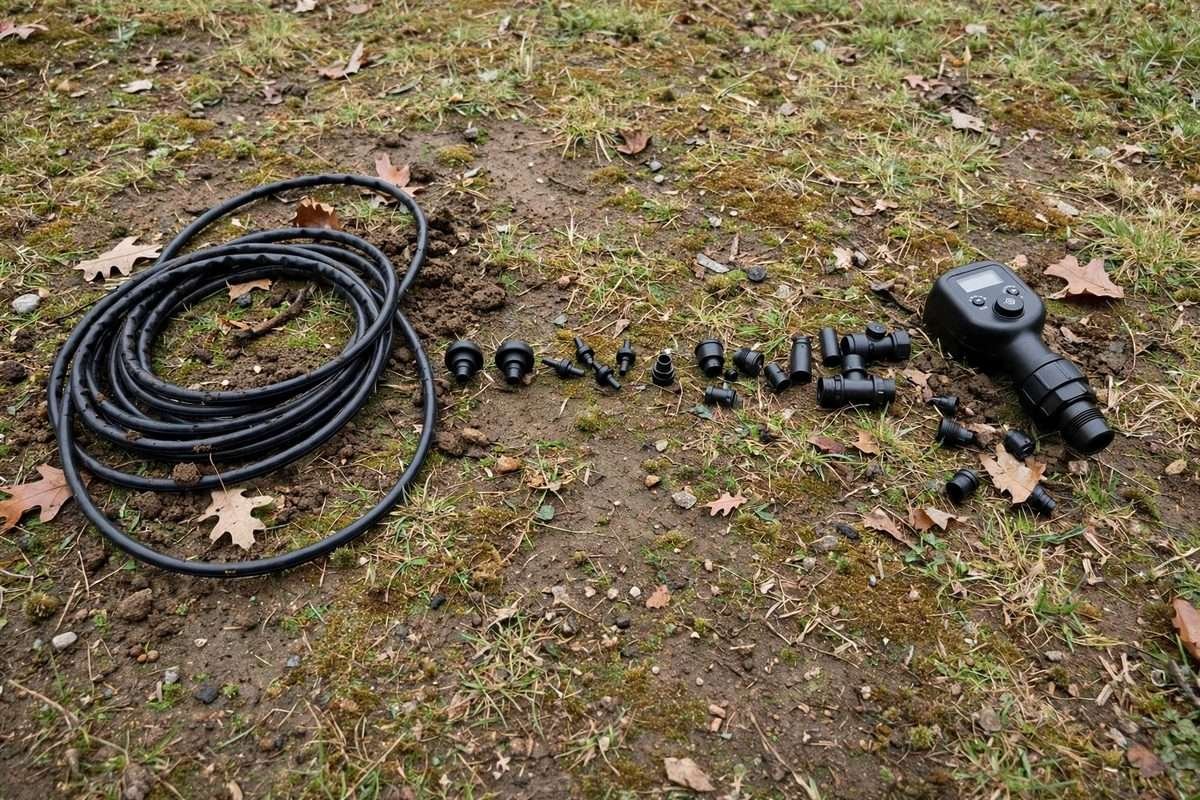
A hose timer plus a drip kit is the most capable setup for a garden with many pots or a raised bed. The timer opens the spigot on a schedule you set, and thin tubes carry water to an emitter at each plant. You can water at dawn, when leaves dry fast and less water is lost to the air, and you can set short runs on cool days and longer runs in a heat wave.
Look for a timer with a clear dial or screen, a rain-delay button, and a battery you can swap without tools. For the kit itself, check that it includes enough emitters for your pot count, plus a few spares, and that the tubing reaches your farthest pot. Our roundup of drip irrigation kits for raised beds covers what to check in a kit, and our guide to setting up drip irrigation for a raised bed walks through the layout step by step. You can also browse hose timers on Amazon to compare dial types and battery styles.
Pros
- Waters many plants from one spigot, on a schedule you control.
- No reservoir to refill, so it suits trips of two weeks or more.
- Emitters put water at the soil, which keeps leaves dry.
- Easy to expand by adding tubing and emitters.
Cons
- Takes about an hour to lay out and test the first time.
- Needs a working outdoor spigot and a fresh timer battery.
- A clogged emitter leaves one plant dry while the rest get water.
- Costs more up front than bottles or wicks.
Run the full system for two or three days before you leave. Walk the line, check every emitter, and look for puddles that mean a fitting is loose. A test run catches the one dry pot that would have cost you a plant.
Watering spikes and bottles
A watering spike is a hollow plastic cone that screws onto a bottle and pushes into the soil. Water seeps out slowly through the tip, which keeps the root zone damp for a few days. Spikes suit a small group of indoor or patio pots, and they cost very little, which makes them a good backup even if your main system is a timer.
Use a bottle of at least 1 liter per pot, and 2 liters for a thirsty tomato or a pot in full sun. Push the spike deep enough that it stays upright, and poke a small hole near the base of the bottle so air can enter as water leaves. Without that air hole, the flow can stall. You can browse self-watering spikes on Amazon to compare spike sizes and bottle threads.

Pros
- Cheap, with almost no setup time per pot.
- Works indoors, where there is no spigot.
- Easy to add one more pot by adding one more bottle.
- Good as a backup for a timer system.
Cons
- A 2-liter bottle lasts about two to four days per pot, not a full week.
- Flow varies with soil type, so a spike can drain fast in sandy mix.
- A tipped bottle empties at once and soaks one pot.
- Not practical past about six pots.
For a trip longer than five days, pair spikes with a neighbor or a friend who can swap in fresh bottles halfway through. Two bottle swaps turn a short-trip system into a two-week system.
Wicks and capillary mats
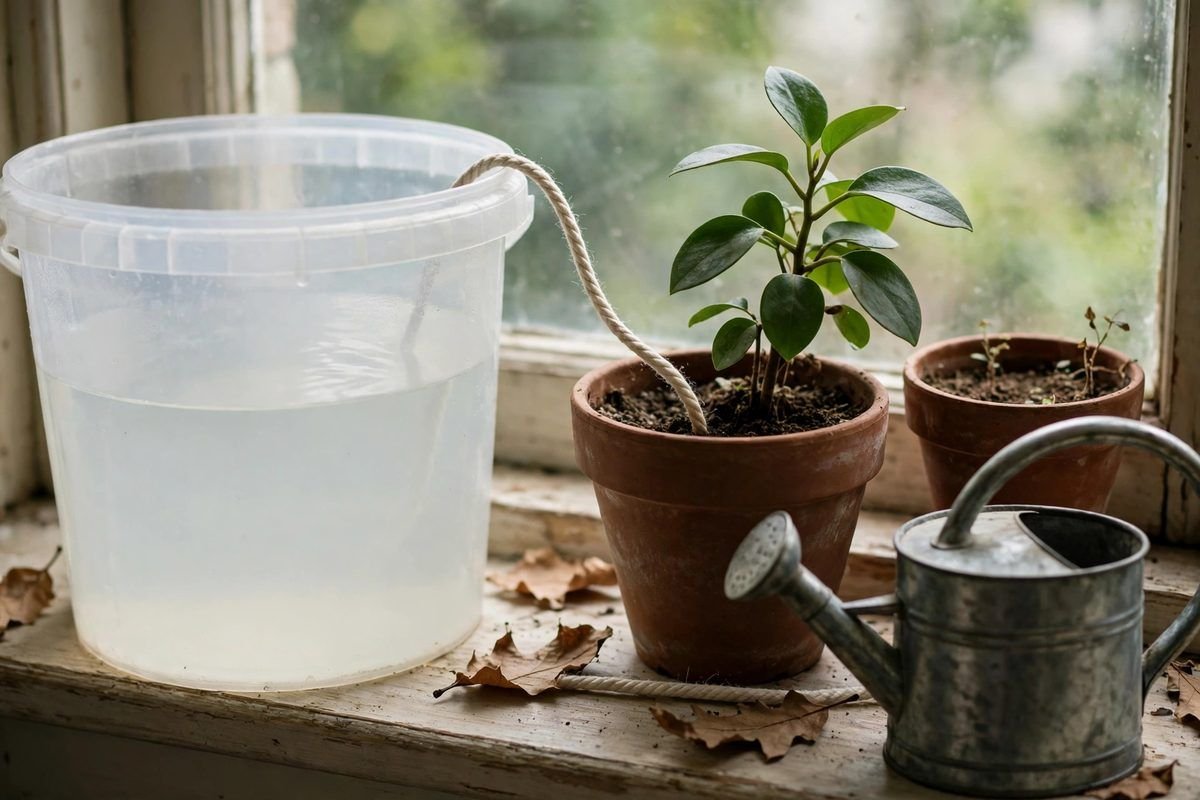
A wick is a cotton or nylon cord with one end in a bucket of water and the other end buried in the potting soil. Capillary action pulls water along the cord and into the soil as it dries. The flow is slow and steady, which suits small indoor plants that dislike wet feet.
Set the bucket slightly above the pots, so gravity helps the flow, and bury at least 3 inches of cord in the soil. Use one cord per pot, and keep the bucket covered so it does not breed mosquitoes. A 5-gallon bucket holds enough water for about four small pots for a week, using our 0.5-gallon-per-day figure as a rough guide for larger pots and less for small ones. You can browse wick watering kits on Amazon to compare cord materials.
Pros
- No power, no timer, and no moving parts to fail.
- Gentle flow that suits small indoor plants.
- Cheap to set up from a bucket and cord.
- Silent, so it works in a flat or a bedroom full of plants.
Cons
- Too slow for large pots or thirsty vegetables.
- Flow drops if the cord dries out or the bucket sits too low.
- One bucket serves only a few pots.
- Hard to judge how much water each pot is getting.
Test a wick for three days before the trip. Mark the water level on the bucket with tape, then check how far it drops in a day. That one check tells you whether the bucket will last until you are home.
Timer on a soaker hose
A soaker hose is a porous hose that weeps water along its length. Laid through a bed or a row of pots and paired with a hose timer, it waters a wide area with very little setup. It suits beds and borders better than scattered pots, because the hose needs to lie flat along the soil.
Snake the hose in loops about 12 inches apart through the bed, hold it down with metal ground pins, and cover it with a thin layer of mulch to slow evaporation. Set the timer for early morning runs of 30 to 45 minutes, then check how deep the water soaked by pushing a finger into the soil after a run. If the top 2 inches are damp and the soil below is still dry, lengthen the run. Our guide to garden hose timers covers timer features worth paying for, such as a rain delay and a manual override.
Pros
- Fastest setup of the spigot-fed systems.
- Waters a whole bed evenly with one hose.
- Cheap per square foot of bed covered.
- Works well under mulch.
Cons
- Less even than drip emitters, and worse on slopes.
- Hard to aim at single pots scattered across a patio.
- A kinked hose leaves a dry stretch behind the kink.
- Old hoses weep unevenly as pores clog with minerals.
Which system fits your trip?
Use the water math from earlier, then match the system to the trip length and the pot count. These lines cover the cases we hear about most.
Choose a hose timer with a drip kit if you have more than six pots or a raised bed, and you will be away for a week or more. It is the only system here with no reservoir limit, and it is the one to pick for a two-week holiday.
Choose a timer on a soaker hose if you have beds or borders to water and you want the fastest setup. It is a good pick for a vegetable bed that needs steady water while you are away.
Choose watering spikes with bottles if you have one to six indoor or patio pots and you will be back within five days. Keep a spare bottle per pot, and ask someone to swap bottles if the trip runs longer.
Choose wicks from a bucket if you have a few small indoor plants and you want a setup with no power and no timer. It is the quietest option, and it suits a flat where a hose timer is not possible.
Set it up before you leave
Every system here needs a test run. Set it up at least three days before departure, run it on the schedule you plan to use, and check the soil each morning. Look for the dry pot, the clogged emitter, and the bottle that drains in a day. Fix those now, while you still have time to buy a spare part.
Water every pot deeply the night before you leave, so the soil starts the trip fully damp. Move patio pots into a shadier spot for the week, which slows drying without harming most vegetables. Group indoor plants together on a tray, which raises the humidity around them a little and makes one bucket or bottle station serve several pots.
Leave a note for your plant sitter, if you have one, with the timer schedule and the location of the spigot shutoff. A sitter who knows how to stop the water can save a flooded patio if a fitting pops off mid-trip.
Troubleshooting
One pot stays dry while the rest are damp
Check the emitter or spike for that pot first. Emitters clog with grit, and spikes clog with fine soil. Pull the emitter, rinse it, and run the line for a minute before you refit it. If the spike keeps clogging, wrap the tip in a small piece of fine mesh cloth before you push it into the soil.
The timer never starts
Swap in a fresh battery, then check that the timer dial is set to auto and not to off or manual. A timer left on manual after a test run is the most common cause of a dry garden after a trip.
Bottles drain in a day
The soil is either very dry or very sandy, so water runs straight through. Water the pot deeply first, then fit the spike, and use a larger bottle. A 2-liter bottle in a 5-gallon pot lasts far longer when the soil starts damp.
The wick stops pulling water
The cord has dried out or the bucket sits too low. Soak the cord fully before you set it up, and raise the bucket on a stool or a shelf so its water level sits above the pots.
Frequently asked questions
How long can I leave plants with an automatic watering system?
A spigot-fed timer system can run for two weeks or more, as long as the timer battery holds and the water stays on. Bottle and wick systems last three to seven days, depending on pot size and weather, so they suit shorter trips unless someone refills them.
Do automatic watering systems work indoors?
Yes, spikes and wicks work indoors, and they are the usual pick for houseplants. Hose timers need an outdoor spigot, so they suit patios and beds rather than rooms.
Will a drip system overwater my plants while I am away?
It can, if the timer runs too long. Set short runs, test for three days, and check the soil depth after each run. Short daily runs in the morning beat one long soak that leaves soil soggy.
What should I do if the forecast changes while I am away?
If your timer has a rain-delay button, ask your sitter to press it after heavy rain. If you have no sitter, set the schedule for the dry forecast and accept that a rainy week may leave soil damp for a few days, which most vegetables tolerate better than drought.
Sources and further reading
- University of Minnesota Extension, Watering the vegetable garden
- Clemson Cooperative Extension, Watering Vegetable Gardens
- Colorado State University Extension, Watering a Home Vegetable Garden
Related reading: How to Water Plants While You Are on Vacation, Best Garden Hose Timers, Best Drip Irrigation Kits for Raised Beds, How to Set Up Drip Irrigation for a Raised Bed