
This post may contain affiliate links. If you buy through links on this page, we may earn a commission at no extra cost to you.
As an Amazon Associate I earn from qualifying purchases.
A bag of seed starting mix looks simple on the shelf, and the price does not look bad either, until the third or fourth bag. Once the trays stack up in late winter, the cost adds up fast, and the texture inside the bag is never quite the same from one brand to the next. Some bags run dusty and fine, some run chunky with bark, and some hold water like a sponge while others dry out by noon.
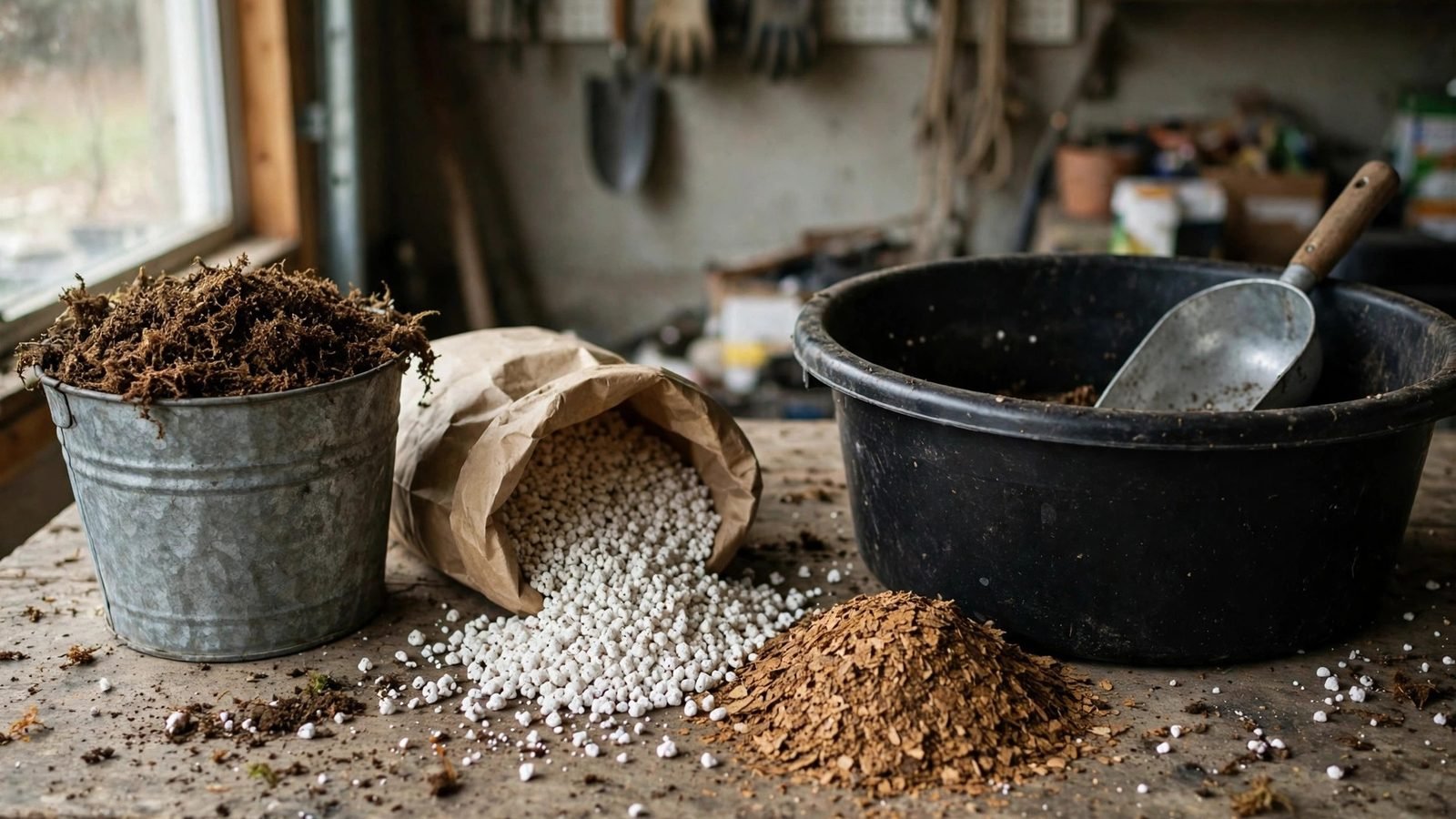
Making the mix at home fixes most of that. Three ingredients, measured by volume in equal parts, give a light, even blend that drains well and holds enough water for seeds to sprout. The recipe comes from university extension services, and each ingredient does one clear job: peat moss or coir holds water, vermiculite holds water and a little nutrition, and perlite opens the mix up so air can reach the roots.
This article gives the recipe, the batch math, and the moisture test that tells you when the mix is ready to fill trays. It does not repeat buying advice for bagged mixes. What follows is the from-scratch version: what to buy, how much to mix, how to wet it, and how to store what is left.
One note before the scoop comes out: seed starting mix is not soil, and it is not meant to feed plants for long. Seeds carry their own food for the first days of growth. The mix only has to hold water, hold air, and stay clean while roots form. Feeding starts later, once true leaves appear.
What seed starting mix has to do
A seed needs four things to sprout: water, air, warmth, and contact with something damp. The mix supplies the first two and helps with the fourth. If the mix packs down tight, air cannot reach the seed, and the seed can rot before it breaks the surface. If the mix dries out between waterings, the seed stalls. If the mix stays wet for days, fungi move in and seedlings fall over at the soil line, a problem called damping off.
Garden soil fails at this job for three plain reasons. It packs down when wet, it carries weed seeds and fungi, and its texture changes from one shovelful to the next. A soilless mix avoids all three: it stays loose, it starts clean, and every scoop behaves like the last one.
The mix also has to be fine. A seed the size of a lettuce seed cannot push through a chunk of bark. Screening the finished mix through quarter-inch hardware cloth takes out sticks, lumps, and bark pieces. Coarse material belongs in potting soil for large containers, not in a cell tray.
The standard recipe
The recipe used here follows the equal-parts formula published by University of Georgia Extension: one part peat moss or coconut coir, one part vermiculite, and one part perlite, all measured by volume. Oregon State University Extension gives a close cousin of the same idea, one third coir or peat, one third sand, vermiculite or perlite, and one third pasteurized soil or compost. The equal-parts version is the simplest to remember and the easiest to scale, so it is the one used for the batch math below.
Parts mean volume, not weight. A part is whatever container you measure with: a quart tub, a gallon pitcher, or a scoop. Fill the same container level for each ingredient and the ratio holds, no matter the size of the batch. Weighing the ingredients would give a different result, because perlite weighs almost nothing and wet peat weighs a lot.
Two small additions are optional. A spoonful of dolomitic lime per gallon of mix offsets the natural acidity of peat moss, and Purdue Extension includes lime in its own peat and vermiculite recipe for that reason. A little screened, finished compost, no more than one part in ten, adds gentle nutrition for seedlings that stay in trays for weeks. Any mix that includes garden soil or compost should be pasteurized before use.
What each ingredient does
Peat moss or coir is the sponge. It holds water in its fibers and releases it slowly to the seed, and it gives the mix most of its bulk. Peat holds water a bit longer than coir, and coir wets again more easily after it dries out. What does not work is swapping in garden soil or un-screened compost for the whole part, because those bring weed seeds, fungi, and a texture that packs down.
Vermiculite is the second sponge, with a different job. It is a flaky mineral that holds water and holds on to nutrients, so it keeps moisture near the seed longer than perlite does. Fine grade vermiculite suits seed trays best, because coarse flakes leave gaps that small seeds fall into. Look for fine vermiculite for seed starting at a garden center or online, and check that the bag says fine grade before you buy.
Perlite is the air. It is expanded volcanic rock, white and light, full of tiny air pockets. It holds almost no water, and that is the point: it keeps the mix open so extra water drains away and air reaches the roots. Without perlite, a peat mix can sit wet for days after watering. Perlite dust is a nuisance, so wear a dust mask and dampen the perlite before you pour it, or mix outdoors. Look for perlite for potting mix in a size that suits your batch.
Peat moss comes in compressed bales that expand when the bale is opened. A standard bale makes far more mix than one batch needs, so store the rest dry. Look for sphagnum peat moss sold for garden use. Coir bricks are the compact alternative when storage space is tight, since one brick expands to several gallons of fiber once soaked.
How to mix a batch step by step
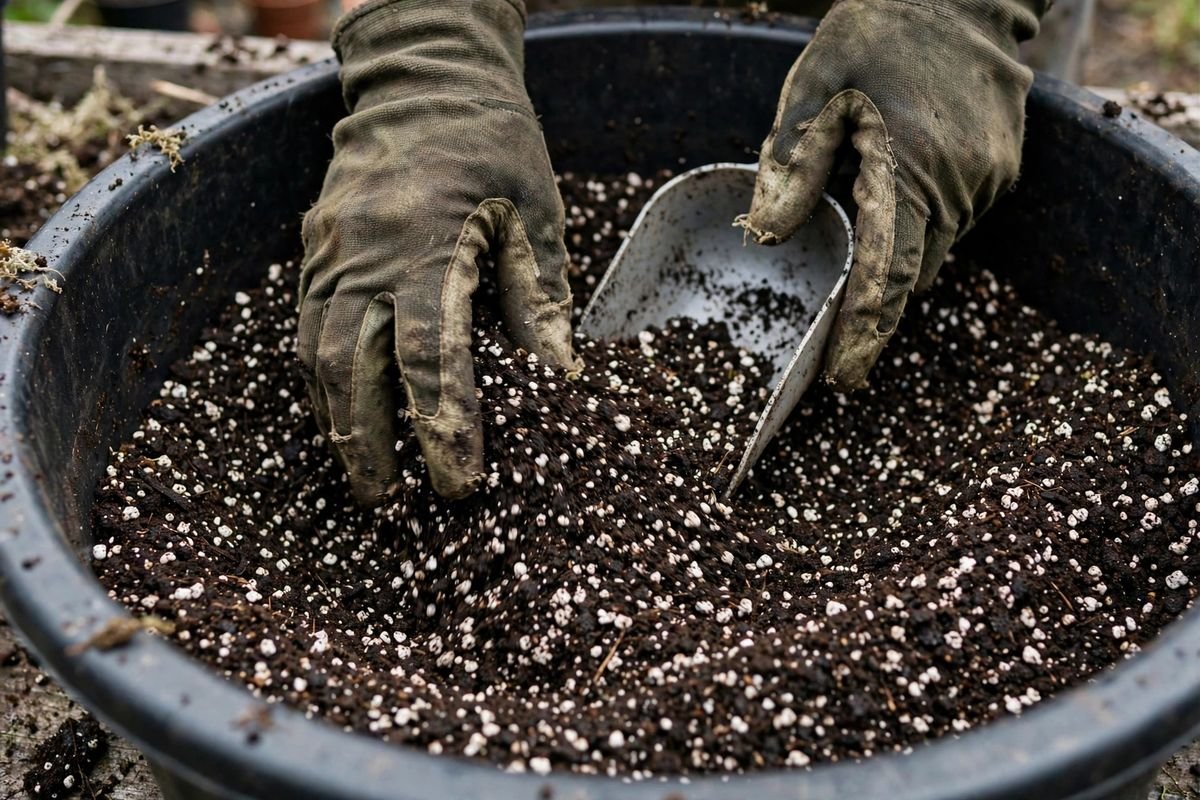
Work outdoors or in a garage with the door open, and put on a dust mask and gloves before you open the bags. Dry peat and perlite both throw up dust. A large tub, a wheelbarrow, or a clean 5-gallon bucket all work as a mixing container, as long as there is room to turn the mix over without spilling it.
Measure the three ingredients with the same container, level scoops, and pour them into the tub. Break up any slabs of compressed peat by hand first, until the fibers are loose, since lumps of dry peat will not wet evenly later. Turn the pile over with a scoop or a small shovel until the white perlite specks are spread evenly through the dark peat, with no pale patches and no dark patches left. This takes about two minutes of steady turning for a 5-gallon batch. A mix that looks streaky in the tub will behave streaky in the tray, with some cells draining fast and others staying wet.
Screen the mix if you plan to sow small seeds: set a piece of quarter-inch hardware cloth over a second tub and push the mix through with your hands. What stays on top goes back to the compost pile or into potting soil for large pots. Large seeds such as beans and squash do not need this step, but lettuce, celery, and petunia seed do.
Wet the mix before you fill trays, not after. Dry mix in a cell tray resists water, and water poured on top runs down the sides and leaves the center dry. Wet mix in the tub first, using the moisture test in the next section, then fill the trays. Fill each cell to the top, tap the tray once on the bench to settle the mix, and top up any cells that sank. Do not press the mix down hard with your fingers. A firm press packs the cells, and packed cells drain poorly.
The batch math: how far 5 gallons goes
Most seed starting happens in standard 1020 trays, the flat trays that measure about 10 by 20 inches. A 72-cell insert and a 36-cell insert both fit that tray, and both hold about the same total volume of mix. The math below uses stated assumptions, so you can redo it for any tray size you own.
Assumptions: one 5-gallon batch means 5 gallons of dry mix, measured loose in the tub. Each cell of a 72-cell tray holds about 2 fluid ounces of mix when filled level, and each cell of a 36-cell tray holds about 4 fluid ounces. A gallon holds 128 fluid ounces.
For the 72-cell tray, 72 cells times 2 fluid ounces equals 144 fluid ounces per tray, which is 1.125 gallons. For the 36-cell tray, 36 cells times 4 fluid ounces also equals 144 fluid ounces, or 1.125 gallons. Divide the batch by the tray: 5 gallons divided by 1.125 gallons per tray equals about 4.4 trays. In practice, one 5-gallon batch fills four standard trays and leaves about half a gallon for topping up cells that settle after the first watering.
The parts for that batch are simple. Five gallons equals 20 quarts. Split three ways, each part is 6 and two thirds quarts. Using a quart tub as the scoop, that works out to 7 scoops of peat or coir, 7 scoops of vermiculite, and 6 scoops of perlite, for 20 scoops in total. The slight unevenness does not matter, because the ratio only needs to be close, not exact to the spoonful.
Scale the same math up or down. A 6-gallon batch takes 2 gallons of each ingredient and fills about five trays. A 2-gallon batch takes about two thirds of a gallon of each ingredient and fills about one and three quarter trays. Measure with the same container each time, and write the scoop count on a card taped to the tub so the next batch matches this one.
The squeeze test: getting moisture right
The squeeze test is the fastest way to judge moisture, and it needs no tools. Take a fistful of damp mix, squeeze it hard over the tub, and watch what happens. Mix that is ready holds its shape when you open your hand, and only a few drops of water fall during the squeeze. Mix that is too dry falls apart the moment you open your hand. Mix that is too wet drips in a stream and leaves your glove wet.
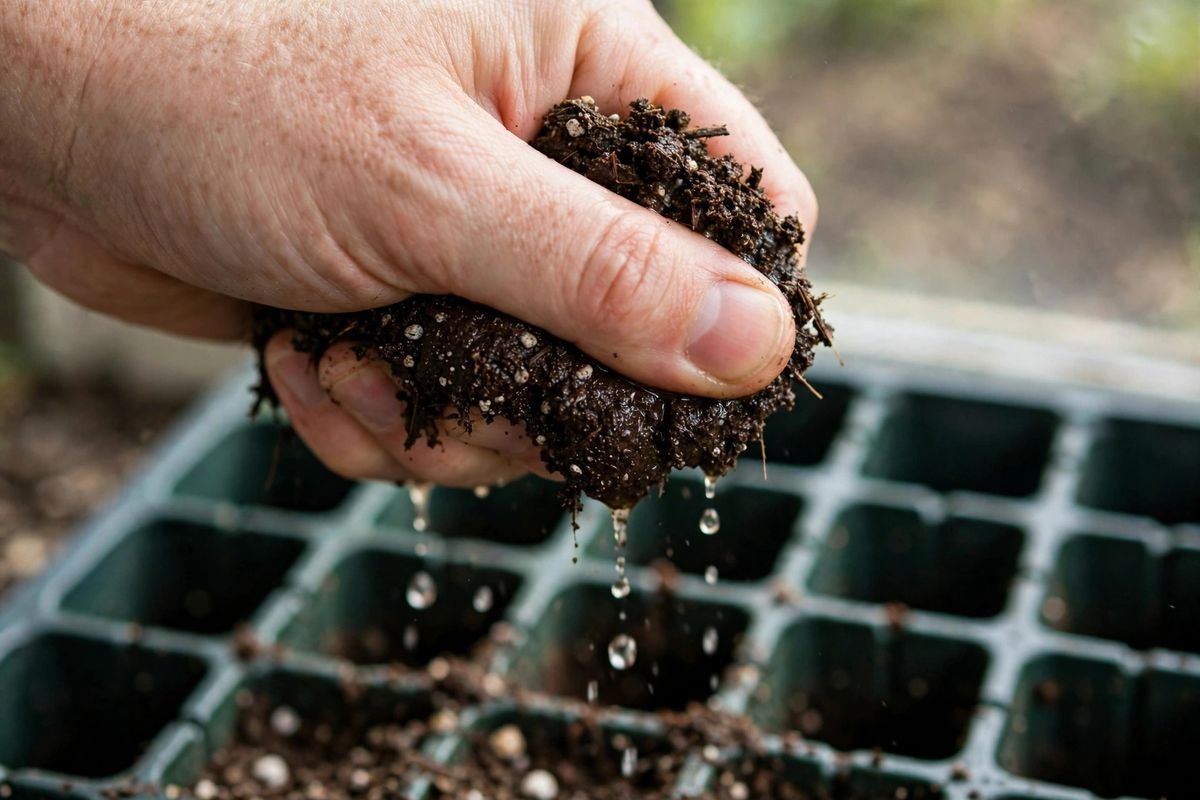
The worked example below gives measured amounts, so you can repeat it with your own ingredients. Assumption: the dry ingredients come straight from sealed bags, stored dry indoors, and the water is added at room temperature. Start with 1 gallon of dry mix in a bucket. Add half a cup of water, stir well, and wait two minutes for the peat to drink. Squeeze a fistful. If it falls apart, add another half cup, stir, and test again.
In this worked example, the mix passed the squeeze test after about 1 and a half cups of water per gallon of dry mix. That scales to about 7 and a half cups of water for a full 5-gallon batch, added a cup or two at a time with stirring between additions. Your own batch may need a little more or a little less. Coir that was soaked and squeezed still holds water, so a coir batch needs less added water than a peat batch.
Two cautions belong here. First, dry peat resists water at first, so a mix that looks wet on top may still be dry in the middle. Stir after every addition and wait before you judge. Second, water added after the trays are filled does not fix a dry center. Wet the mix in the tub, fill the trays with damp mix, and then water the trays from the bottom so the moisture rises evenly through each cell.
Sterilizing and pasteurizing: when it helps and when to skip it
Soilless ingredients from sealed bags are usually clean enough to use as they come, with no weed seeds and few fungi. Pasteurizing earns its place in three cases: the mix includes garden soil or unfinished compost, the mix is reused from last season, or seedlings keep dying at the soil line even with clean trays and good airflow.
Penn State Extension gives the standard method: heat potting soil to about 180 degrees Fahrenheit and hold it there for 30 minutes, checking with a meat thermometer in the center of the pan. Most commercial soilless mixes are free of damping-off fungi and do not need this treatment, and overheating can damage the mix. A microwave method from University of California Cooperative Extension uses the same target, about 200 degrees Fahrenheit, in short bursts, and suits only small amounts.
Heat treatment has downsides: it smells, it takes time, and it leaves the mix open to recontamination the moment it cools. A pasteurized mix stored in a dirty bin or scooped with a dirty shovel picks up fungi fast, so clean trays and tools matter as much as clean mix. Wash reused trays with soap and water, rinse with one part household bleach to nine parts water, and let them dry in the sun. Never use garden soil straight from the bed in a seed tray without pasteurizing it first.
Storage and shelf life
Store the mix dry, in a lidded tub or a tied bag in a dry garage, and label the tub with the recipe and the date. Only wet as much as you plan to use within a day or two, since moist mix in a sealed tub can turn sour and grow mold.
Peat-based mix does not improve with age. The Royal Horticultural Society advises using fresh seed compost each year, since stored compost deteriorates. Leftover mix from last season is fine for potting on larger plants or for outdoor containers. For seed trays, mix a fresh batch each season.
Frequently asked questions
Can I use garden soil instead of peat in this recipe?
No, not as a straight swap. Garden soil packs down, carries weed seeds and fungi, and varies from one shovelful to the next. A soil-based mix needs pasteurizing and a different recipe. For seed trays, the soilless recipe above is the safer start.
Can I reuse seed starting mix from last season?
Reuse is possible, but only after the old mix is screened, pasteurized, and mixed with at least half fresh ingredients. Old mix may hold fungus gnat eggs, damping-off fungi, and leftover fertilizer salts. For seed that cost a lot or a small number of trays, fresh mix is the better choice, and old mix can go to outdoor containers instead.
Do seedlings need fertilizer in this mix?
Not at first. Seeds carry their own food, and this mix holds almost no nutrition by design, which is part of why it stays clean. Once the first true leaves appear, feed at quarter strength with a balanced liquid fertilizer, about once a week, and water from the bottom so the feed reaches the roots.
Is coir a fair swap for peat moss?
Yes, in equal volume, with one adjustment. Coir holds water well and wets again easily after drying, which is a plus. It also holds almost no nutrition, like peat, and it may need a rinse if the brick leaves salty water behind. Soak the brick, drain it, and measure the loose fiber the same way you would measure peat.
Sources and further reading
- University of Georgia Extension: Cut Veggie Garden Costs by Making Your Own Seed Starting Mix, the equal-parts recipe of peat or coir, vermiculite, and perlite used in this article.
- Oregon State University Extension: Set Seeds on the Right Path with Homemade Planting Medium, the one-third recipe and the oven pasteurizing method at 180 degrees for 30 minutes.
- Royal Horticultural Society: Vegetable Seeds Sowing Guide, peat-free seed compost, fresh compost each year, and sowing in trays and modules.
- Penn State Extension: Damping Off, how damping-off fungi spread, and why pasteurized soil, sterile trays, and even moisture prevent it.
Related reading: Seed Starting Mix vs Potting Soil, Best Seed Starting Trays, How to Set Up a Seed Starting Station, How Deep Should Seed Starting Cells Be, How to Bottom Water Seedlings.
By the Pot and Plot Team