
This post may contain affiliate links. If you buy through links on this page, we may earn a commission at no extra cost to you.
As an Amazon Associate I earn from qualifying purchases.
A fig tree in a pot gives you fresh figs on a patio, a balcony, or a driveway, and it does it in places where a fig in the ground would take over the garden. The trade is winter. A fig planted in the ground in a mild zone can stand a frost with little damage. The same fig in a pot has its roots in a small ball of mix that freezes from every side, and one hard night can kill the roots while the branches still look fine. The good news is that figs are forgiving: they drop their leaves, sleep through the cold, and grow back from the base even after a rough winter. The job is to keep the damage small enough that spring growth starts from the branches, not from the ground.
This guide covers the three ways to protect a potted fig: move it into shelter, wrap it where it stands, or bury the pot for the winter. It includes a worked cold-night plan that matches the outside temperature to the protection level, so you can decide in a minute what your tree needs tonight. For a second potted fruit tree with the same problem, see our guide on how to overwinter lemon trees in pots.
How cold can a potted fig tree take?
Most common figs (Ficus carica) are rated hardy to about 15 to 20 degrees Fahrenheit in the ground, and a mature tree with thick wood can take a brief dip a little lower. A potted fig is less hardy by a clear margin. The pot exposes the root ball to cold air, and the mix in a 14-inch pot can freeze solid on a night when the ground a few feet away stays near freezing. Most growers treat 25 degrees as the line for an unprotected potted fig: below that, expect dieback on the youngest wood, and below 20 degrees the roots themselves are at risk.
Figs show cold damage late. A branch that froze in January can look normal until March, when the buds that should open stay shut and the bark under them turns brown and dry. That delay is why protection has to happen before the cold, not after you see the damage. If you wait for a freeze warning to act, the night the root ball froze is already behind you.
Use your local frost dates and regional planting guidance — not your USDA hardiness zone alone — to choose planting dates. Frost dates tell you when cold actually arrives where you live; the zone number only tells you the average coldest night of the year.
Option 1: move the pot into shelter
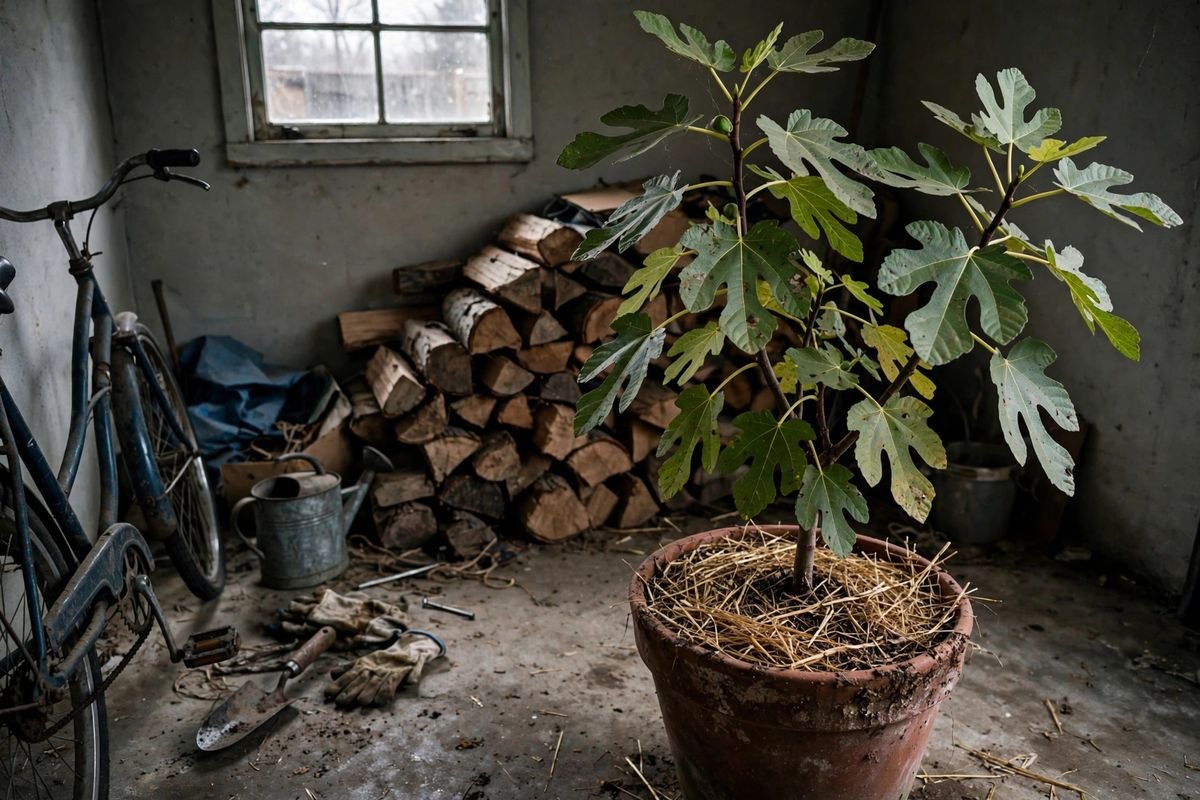
Moving the pot into an unheated garage, a shed, or a cold porch is the most reliable protection, and it is the right choice in zone 7 and colder. A dormant fig needs almost no light in winter, so a dark garage is fine. What it needs is a spot that stays above about 20 degrees and below about 50 degrees. A garage that holds 30 to 40 degrees on a cold night is ideal: the tree stays dormant, the roots stay unfrozen, and the tree wakes up slowly in spring.
Move the pot after the leaves drop in fall, which is usually after the first light frost. Waiting for leaf drop matters: a fig still in leaf is still feeding its roots, and moving it early into a warm, dark garage can push soft growth that dies in the first cold snap. Once the leaves are off, water the pot once, lightly, and set it in the garage. Check the mix once a month through winter and water only if it feels dry 3 inches down. A dormant fig in a cool garage needs about a quart of water a month for a 14-inch pot, and often less.
Keep the pot off the concrete floor if you can. A pallet, a piece of foam board, or a few bricks under the pot stops the cold floor from drawing heat out of the mix. If the garage has a window, set the pot near it, but do not worry if there is no light at all: a dormant fig without leaves uses no light until the buds swell in spring.
Option 2: wrap the tree where it stands
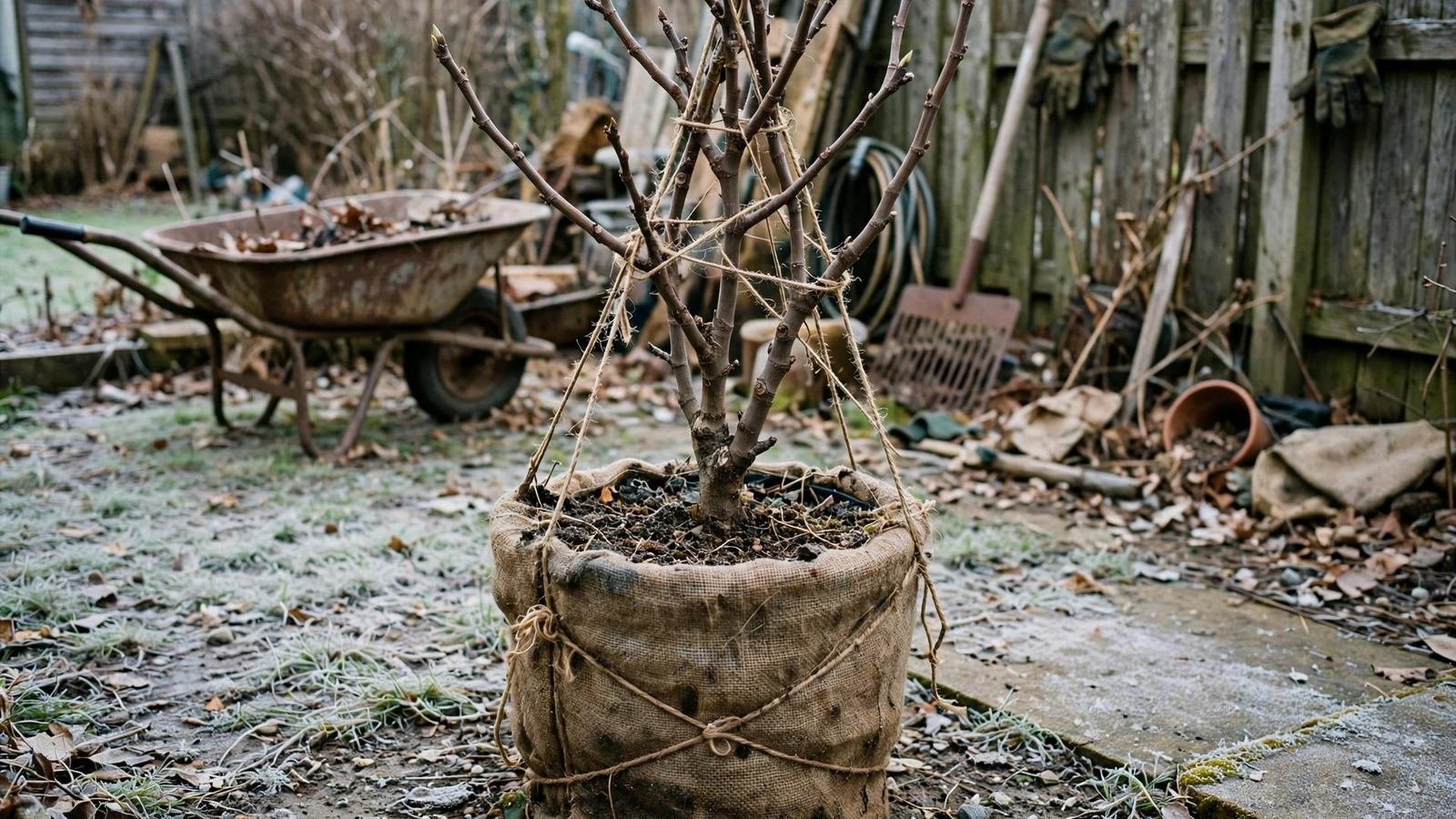
In zone 8 and warmer, a potted fig can stay outside all winter with a good wrap. The wrap has two jobs: keep the root ball from freezing and keep the branches from drying out in cold wind. Start with the pot. Wrap two layers of bubble wrap around the pot walls and tie them with twine, then set the pot on foam board or a pallet so it does not sit on cold stone or concrete. A wrapped pot holds 5 to 10 degrees above the air temperature overnight, which is often the difference between frozen roots and a tree that wakes up clean in spring.
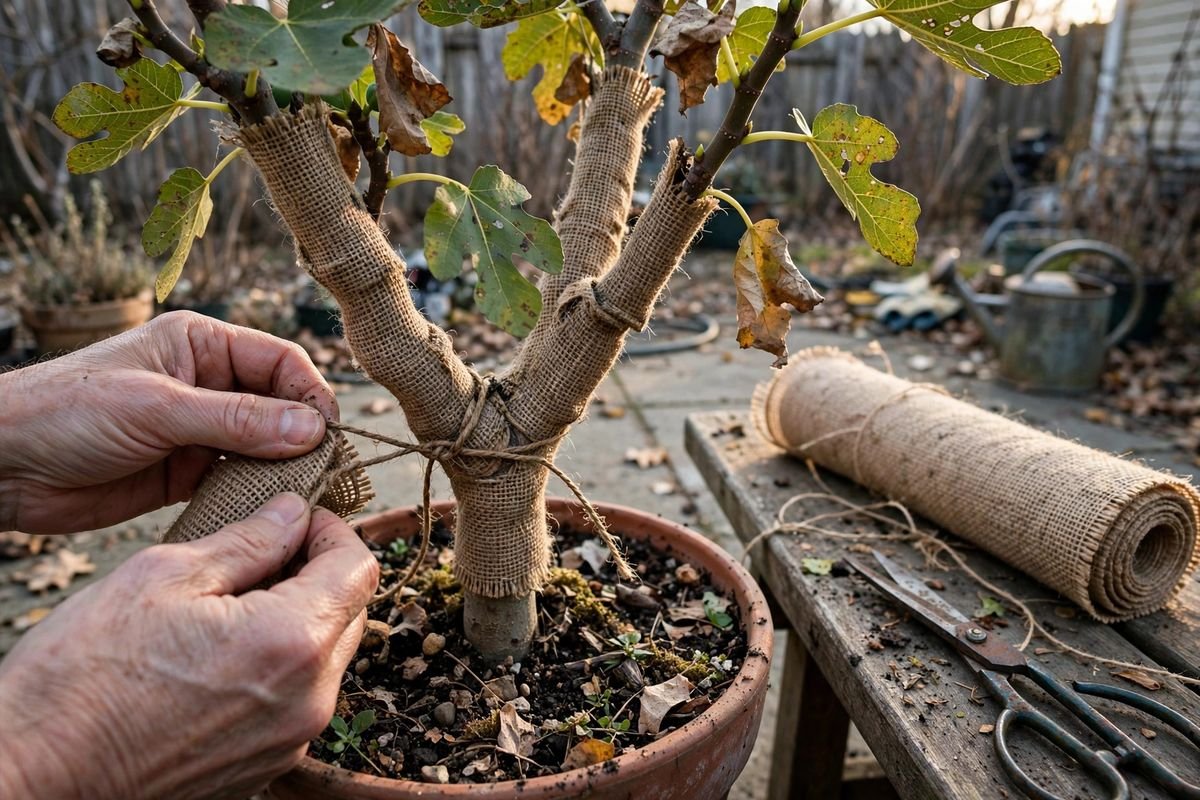
Next, protect the branches. Tie the branches loosely together with soft twine so they form a narrow bundle, then wrap the bundle in burlap from the bottom up, tying it at intervals so wind cannot peel it open. Burlap breathes, which matters: a plastic sheet wrapped tight around the branches traps damp air, and damp air in a cold snap rots buds. For extra cold nights, throw a frost cloth over the burlap and anchor the edges to the ground. You can search burlap rolls for gardening on Amazon. We have not tested the products linked here, and we give no current store prices. Check each listing for current roll sizes.
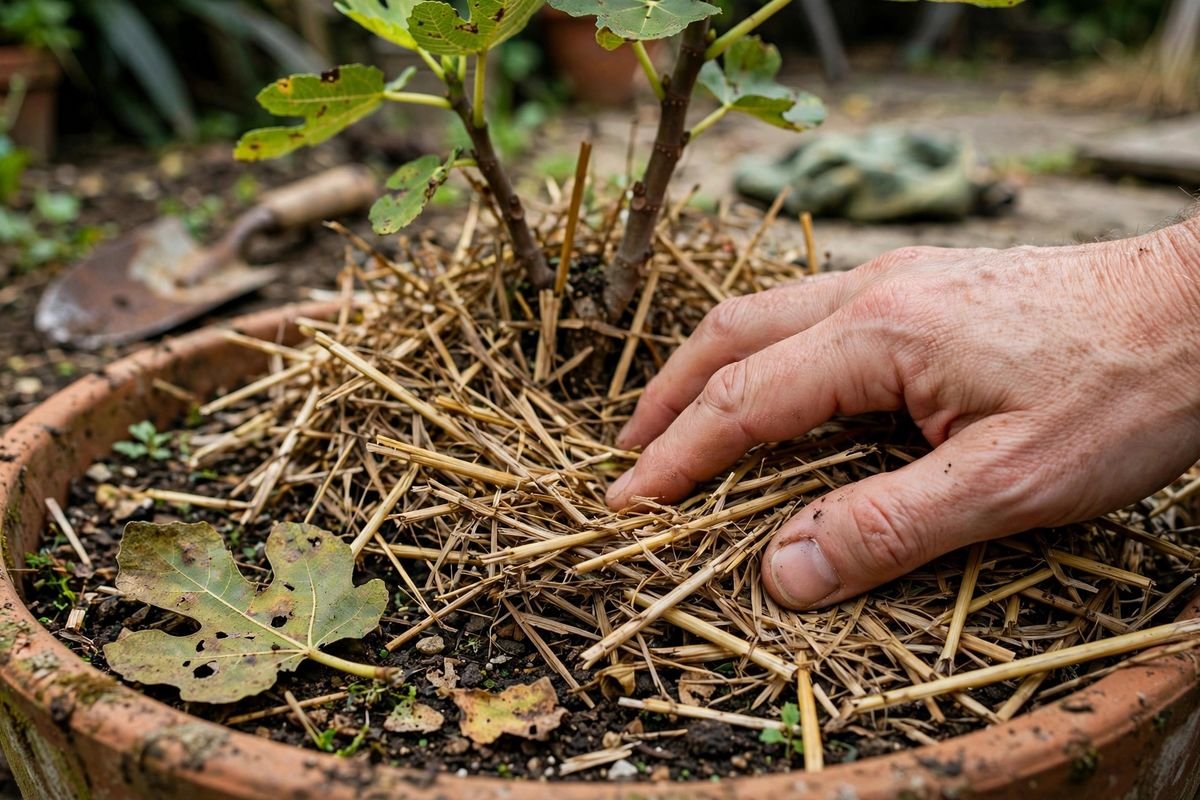
Finish with mulch. A thick layer of straw or shredded leaves on the soil surface insulates the top of the root ball, which is the part most exposed to cold air. Pile it 4 to 6 inches deep and keep it a few inches away from the trunk so damp mulch does not sit against the bark all winter. For a mulch comparison, see our guide on straw vs leaves as winter mulch.
Option 3: bury the pot for the winter
Burying the pot is the old method, and it works well where the ground does not freeze deep. Dig a hole as deep as the pot and a few inches wider, set the pot in so the rim sits at ground level, and backfill around it with soil. The earth around the pot holds the root ball near the ground temperature, which stays above freezing far longer than the air. In most of zone 7, soil at pot depth stays above 32 degrees even when the air drops into the teens.
This method suits a fig you do not plan to move again until spring, and it suits a heavy pot that is hard to carry into a garage. The cost is the digging: a 16-inch pot needs a hole about 18 inches deep and 20 inches wide, which is real work in cold soil. Mark the spot with a stake so you remember where the pot is under the mulch, and pile straw over the top once the pot is in.
Our worked example: matching protection to the forecast low
Here is a cold-night plan for a potted fig about 4 feet tall in a 16-inch pot, in a yard where the overnight low is the number that decides the work. These are our own computed numbers, with the assumptions stated: the pot is wrapped with two layers of bubble wrap, the tree is tied and wrapped in burlap, and the garage holds 12 degrees above the outside temperature on a cold night.
| Forecast overnight low | What to do | Root ball stays near |
|---|---|---|
| 35 degrees or warmer | Nothing; the tree is fine as it stands | Above 35 degrees |
| 28 to 34 degrees | Wrap the pot; move it against the house wall | About 33 to 38 degrees |
| 20 to 27 degrees | Wrap pot and branches in burlap; add a frost cloth | About 28 to 33 degrees |
| Below 20 degrees | Move the pot into the garage or shed | Garage holds about 30 degrees |
The table rests on two numbers worth checking in your own yard. First, a wrapped pot holds about 5 to 10 degrees above the air temperature: a pot wrapped at 25 degrees outside sits near 30 to 33 degrees inside the wrap. Second, an unheated garage typically holds 10 to 15 degrees above the outside temperature once the door stays shut. On a 15-degree night, a garage that started the evening at 40 degrees will still be near 28 to 30 degrees by morning. Those two buffers are why wrapping handles a light freeze and moving handles a hard one, and why a fig left unwrapped on an open patio is the one that suffers.
The material cost is small. A roll of burlap, a roll of bubble wrap, twine, and a bale of straw run about 20 to 30 dollars at most garden centers, and the same materials wrap two or three pots. Compare that with the cost of replacing a 4-foot fig, and the wrap pays for itself the first winter it saves a tree.
Pruning a fig before winter
Prune a potted fig in late fall, after the leaves drop and before you wrap or move it. The goal is a smaller, tighter tree that is easy to wrap and easy to carry: remove dead wood, crossing branches, and any branch that sticks out past the pot rim. Keep the main structure of three to five upright branches and cut the rest back to a bud or a branch joint.
Do not prune hard in fall. A fig pruned to stubs in November puts its energy into the wrong place and can push soft growth on a warm spell that dies in the next frost. Save the hard pruning for late winter, just before the buds swell, when you can see which wood survived and cut back to live buds. For the tools, see our guide on best pruning saws for fruit trees, and for the dormant pruning routine, see how to prune roses in winter, which covers the same clean-cut rules.
What to do when spring comes
Bring the pot out after the last frost date, when overnight lows stay above 40 degrees. A fig that spent the winter in a garage needs a week to adjust: set it in a sheltered spot with morning sun for a few days, then move it into full sun. A fig that stayed outside under wraps needs the burlap removed on a mild day, not during a cold snap: pulling the wrap off while the air is still near freezing shocks the buds.
Check for dead wood before the buds open. Scratch the bark on each branch with a thumbnail: green underneath means the branch is alive, brown and dry means it is dead. Cut dead branches back to live wood, then wait. A fig that lost its top growth often sprouts from the base or from low buds, and those shoots can grow 3 to 4 feet in one season. Give the tree a month of warm weather before you decide it is gone: figs leaf out late, and a tree that looks dead in April can be full of leaves by June.
Resume watering once the tree is outside and the buds swell. A fig in active growth drinks far more than a dormant one: a 16-inch pot in full sun can need a gallon of water every two or three days in late spring. Feed lightly with a balanced fertilizer once the leaves are out, at half the label rate for the first month.
Frequently asked questions
Will a potted fig tree survive winter in a garage with no light?
Yes, if the tree is dormant and the garage stays above about 20 degrees. A fig without leaves uses no light, and a dark garage is fine from leaf drop until the buds swell in spring. Move it out once the buds start to open, so the new leaves get light from the start.
Can I leave my fig outside if I wrap it in plastic?
Plastic alone is a poor wrap. It traps damp air against the branches, and damp air in a cold snap rots buds and invites mold. Use burlap for the branches and bubble wrap for the pot, and save plastic for a loose cover over the top on the coldest nights only, removed in the morning.
How much should I water a fig in the garage?
Very little. Check the mix once a month and water only if it feels dry 3 inches down. A dormant fig in a 14-inch pot needs about a quart of water a month in a cool garage. More than that risks root rot in mix that never dries out.
My fig lost all its branches to frost. Is it dead?
Probably not. Figs grow back from the base and from low buds even after the top dies. Cut the dead wood back in spring, keep the pot watered, and wait until June. If no shoots appear by then, the roots are gone, but a fig that survives the winter at the roots will show green shoots well before summer.
Sources and further reading
- University of Georgia Extension, Figs in the Home Garden
- North Carolina State University Extension, Fig Culture in North Carolina
- North Carolina Extension Gardener Plant Toolbox, Fig Tree – Ficus carica ‘Brown Turkey’
Related reading: How to Overwinter Lemon Trees in Pots, Best Pruning Saws for Fruit Trees, How to Prune Roses in Winter, Straw vs Leaves as Winter Mulch, Fall Garden Cleanup: 12 Things to Do Before Winter
By the Pot and Plot Team