
This post may contain affiliate links. If you buy through links on this page, we may earn a commission at no extra cost to you.
As an Amazon Associate I earn from qualifying purchases.
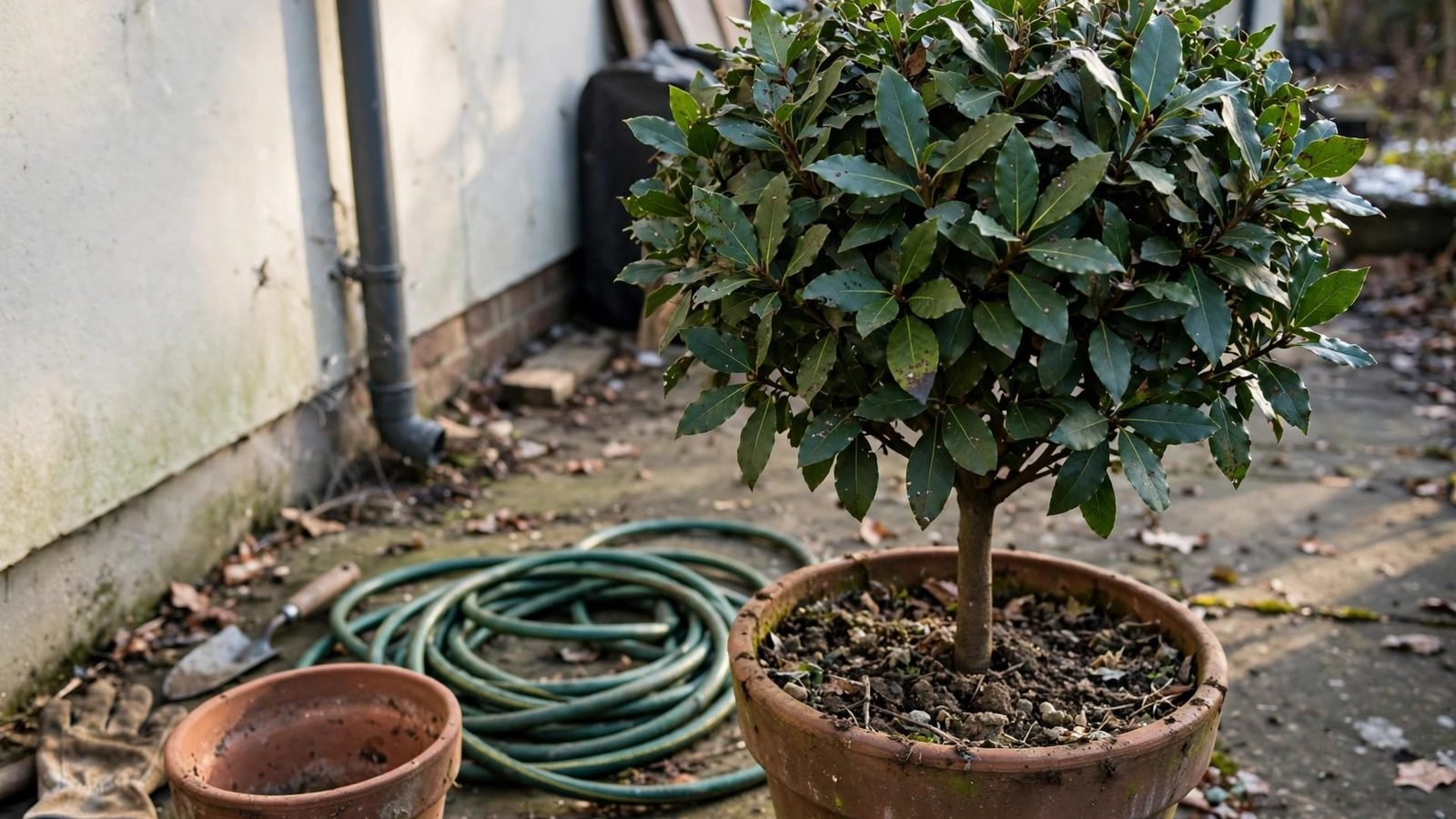
A bay tree in a pot is a kitchen garden in miniature: a few leaves in a soup, a snip for a roast, and a tidy evergreen on the patio all year. The trouble starts when the temperature drops. Bay (Laurus nobilis) handles a light frost, but a potted bay is far less hardy than one planted in the ground. The roots sit in a small volume of mix with no earth around them to hold warmth, so a cold night that a garden bay shrugs off can damage a potted one. The fix is simple and cheap: move the pot at the right time, give it the right spot indoors, and water it far less than you did in summer.
This guide covers the move-in date, the two indoor spots that work, a watering plan you can run from a calendar, how to insulate a pot that stays outside in a mild zone, and the spring move back out. It ends with a worked watering example for a 14-inch pot, so you can scale the numbers to your own tree. For a second potted tree that needs the same treatment, see our guide on how to overwinter lemon trees in pots.
How cold can a potted bay tree take?
A bay tree planted in open ground is usually rated hardy to about 20 degrees Fahrenheit, and a mature tree in a sheltered spot can take a brief dip a few degrees lower. A potted bay is a different plant in practice. The pot walls expose the root ball to cold air on all sides, and the mix in a 14-inch pot can freeze solid overnight while the ground a few feet away stays above freezing. Most growers treat 28 to 30 degrees as the line for a potted bay: below that, leaves blacken and the roots start to take damage.
That gap between 20 and 30 degrees is the whole reason for this guide. A bay in the ground in zone 8 or warmer can stay outside all winter with a mulch layer. A bay in a pot in the same zone needs a sheltered spot, a wrapped pot, or a move indoors on the coldest nights. In zone 7 and colder, the pot comes inside for the winter without question.
Use your local frost dates and regional planting guidance — not your USDA hardiness zone alone — to choose planting dates. Frost dates tell you when cold actually arrives where you live; the zone number only tells you the average coldest night of the year.
When to bring a potted bay tree inside
Move the pot indoors when the overnight low is forecast to fall to 32 degrees or below, and plan to keep it in for the season once lows settle into the 30s. A single night at 30 degrees rarely kills a healthy bay, but repeated nights in the 20s will. Waiting for a hard freeze warning is waiting too long: the damage happens on the first night the root ball freezes, and you cannot see root damage until the leaves drop weeks later.
Before the move, check the tree the way you would check any plant coming indoors. Look under the leaves for scale insects and whitefly, shake the branches gently over a sheet of paper, and wash the leaves with a strong spray of water. A bay that comes inside with pests spends the winter feeding them in warm, still air. Cut off any dead or crossing branches now, while the tree is still outside and the mess falls on the patio.
Give the pot a day outside in a sheltered spot after washing, so the leaves dry before the move. A wet tree in a warm room invites gray mold on the leaves, and mold on a bay is hard to clear without stripping leaves you want to cook with.
Where to keep a bay tree through winter
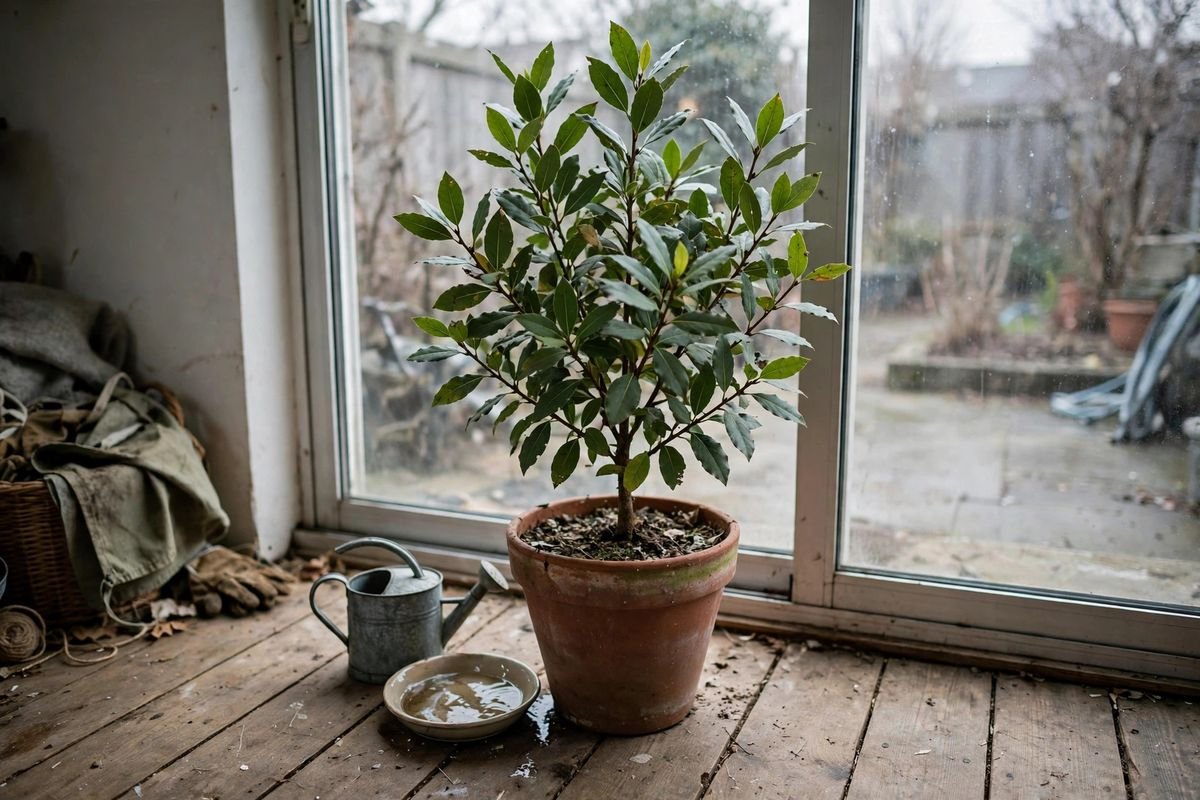
A bay tree needs two things indoors: bright light and cool air. The best spot in most homes is a bright window that stays cool, such as an east or south window in an unheated room, a sunroom, or a spot just inside a sliding glass door. The tree will accept a few hours of direct sun through glass and does fine with bright indirect light the rest of the day. A dark hallway or a north-facing room in midwinter gives it too little light, and the tree answers by dropping leaves from the inside out.
Cool air matters as much as light. A bay kept at 65 to 70 degrees all winter keeps growing slowly, drinks more water, and puts out soft growth that pests love. A room that holds 50 to 60 degrees is better: the tree rests, uses little water, and holds its leaves. An unheated garage with a window works if the temperature stays above freezing, and a cool porch or sunroom is ideal. Avoid placing the pot next to a radiator, a heat vent, or a fireplace. Hot, dry air dries the leaf edges brown and invites scale insects.
If the only bright spot is warm, put the pot on a wheeled plant caddy so you can move it. A caddy also saves your back on moving day: a 14-inch terracotta pot full of damp mix and a 4-foot tree weighs 35 to 45 pounds, and a 16-inch pot with a 5-foot tree can pass 60 pounds. You can search plant caddies with wheels on Amazon. We have not tested the products linked here, and we give no current store prices. Check each listing for current sizes and weight ratings.
How to water a bay tree in winter
Winter watering is where most potted bays are lost. A bay outdoors in summer can drink a quart of water a day in hot weather. The same tree indoors in a cool room uses a small fraction of that, and wet mix in a cold pot rots roots quietly for weeks before the leaves show it. The rule is simple: water only when the top 2 inches of mix feel dry, and water far less than you think the tree needs.
Check the mix with a finger, not a calendar. Push your finger 2 inches into the mix near the edge of the pot. If it feels damp, wait. If it feels dry, water slowly until a little water runs out of the drainage holes, then empty the saucer after 20 minutes. A bay sitting in a saucer of water all winter will lose roots to rot, and the first sign is leaves that yellow and drop from the lower branches.
Do not feed a bay tree in winter. Fertilizer pushes soft new growth that cold air and low light cannot support, and the salts build up in mix that is rarely flushed in winter. Wait until the tree goes back outside in spring and shows new growth, then feed at half the label rate for the first month.
Our worked example: watering a 14-inch pot through winter
Here is a watering plan for a common case: a bay tree about 3 feet tall in a 14-inch pot, kept in a bright room at 55 to 60 degrees from late November to early March. These are our own computed numbers, with the assumptions stated so you can adjust them for your pot and your room.
| Item | Assumption | Number |
|---|---|---|
| Pot volume | 14-inch pot, about 12 inches deep | About 5 gallons of mix |
| Water per watering | Water until a little runs out the drain holes | About 1 quart |
| Interval in a 55 to 60 degree room | Top 2 inches dry between waterings | Every 12 to 14 days |
| Interval in a 65 to 70 degree room | Warmer air dries mix faster | Every 8 to 10 days |
| Winter total, 15 weeks | At the cool-room interval | About 8 waterings, 2 gallons total |
The table shows why a calendar alone fails: the same tree needs water almost twice as often in a warm room as in a cool one. A 16-inch pot holds about 7 gallons of mix and needs about 1.5 quarts per watering at the same intervals, while a 10-inch pot holds about 2.5 gallons and needs about 2 cups. Scale the water to the pot, then check the mix with a finger before every watering. If the mix still feels damp at the usual interval, skip a watering and check again in three days.
One more number helps on moving day: a 14-inch pot of damp mix weighs roughly 30 to 40 pounds before the tree, and the tree adds 5 to 10 pounds. A 16-inch pot runs 45 to 60 pounds all in. If the loaded pot is too heavy to lift safely, move it with a caddy or ask for help rather than dragging it across the patio by the trunk.
Insulating a pot that stays outside
In zone 8 and warmer, a potted bay can stay outside all winter if the pot is insulated and the spot is sheltered. The goal is to keep the root ball from freezing, not to keep the leaves warm. Leaves handle a light frost; roots do not handle a frozen pot.
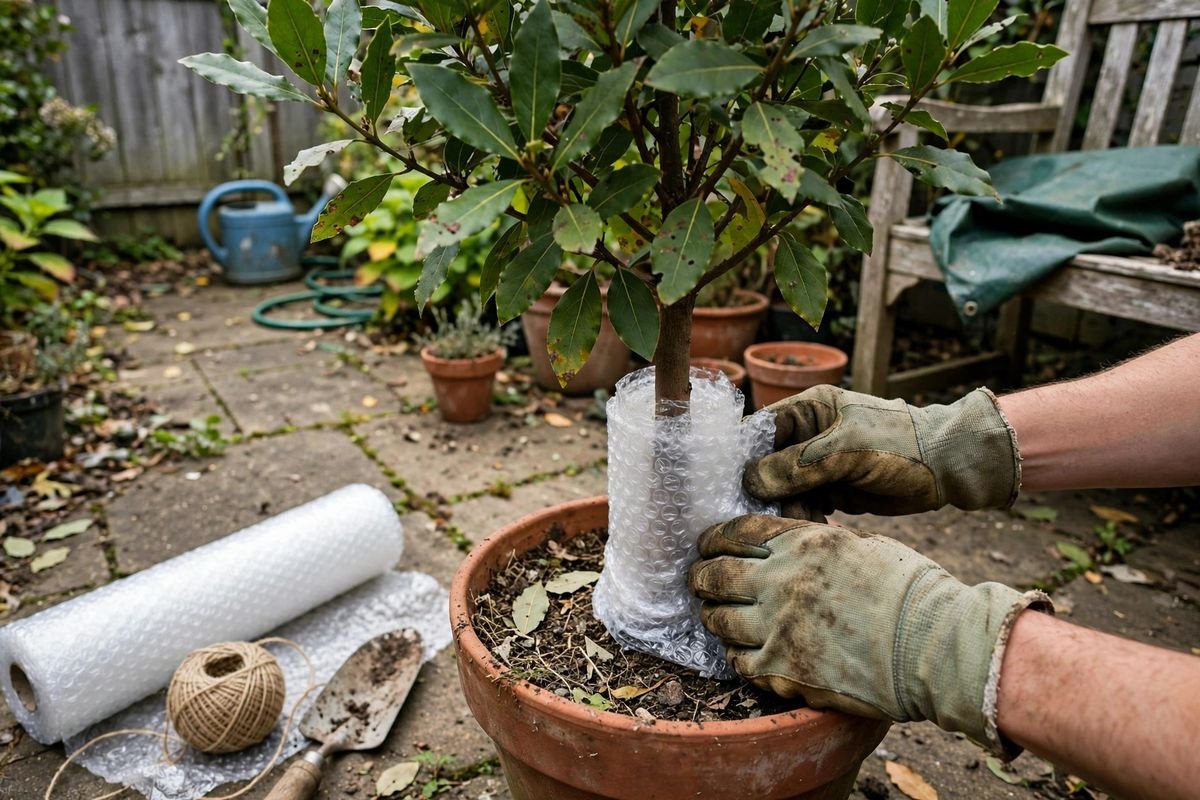
Wrap the pot, not the tree. Bubble wrap around the pot walls adds the most protection per dollar: two layers of large-bubble wrap held with twine, plus a piece of burlap or an old blanket over the top for looks. A pot wrapped this way holds 5 to 10 degrees above the air temperature overnight, which is often the difference between a root ball at 30 degrees and one at 22. For more on frost cover materials, see our comparison of frost cloth vs plastic cover.
Set the wrapped pot on a piece of foam board or a wooden pallet, not directly on cold concrete or stone. A pot sitting on a cold slab loses heat downward all night. Move the pot against the house wall on the south or west side, where the wall gives off stored heat and the eaves block some frost. On nights forecast below 28 degrees, throw a frost cloth over the whole tree and anchor it to the ground so cold air cannot blow in from below. Remove the cloth in the morning so the leaves get light and air.
Pests and leaf problems indoors
Scale insects are the pest to watch on an indoor bay. They look like small brown bumps on the stems and leaf undersides, and they feed all winter in warm rooms. Check the stems every two weeks, and scrape off any bumps with a thumbnail or an old toothbrush. A heavy outbreak needs the tree washed with insecticidal soap, but a light one is best handled by hand: sprays on a bay you cook with are a poor trade.
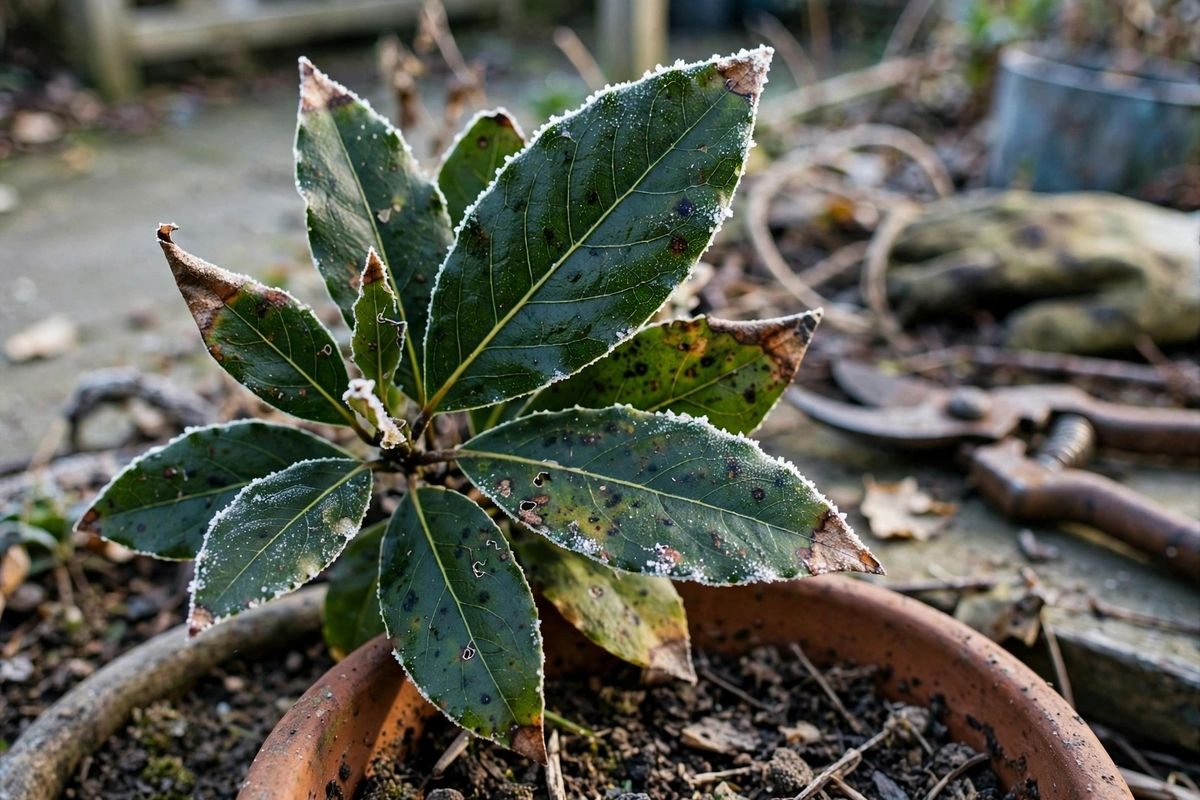
Leaves that yellow and drop from the lower branches in midwinter usually mean the mix stayed wet too long. Cut back on water, empty the saucer every time, and check that the drainage holes are open. Leaves with brown, dry edges usually mean hot, dry air: move the pot away from the heat source and set the saucer on a tray of pebbles with a little water, keeping the pot base above the water line. Brown leaf tips after a cold night mean frost touched the leaves; trim the damaged tips in spring and do not strip the whole leaf.
Moving the bay tree back outside in spring
Move the pot back outside after the last frost date, when overnight lows stay above 40 degrees. A bay that spent the winter indoors has soft leaves that sunburn easily, so harden it off over a week: two or three hours of morning sun on the first day, then a few more hours each day, until it can stand a full day outside. A tree moved straight from a window to full spring sun can drop half its leaves in a week, and those leaves take a season to grow back.
Once the tree is outside for good, resume normal watering and give it a light feed. Prune lightly to shape it, cutting just above a leaf joint so the cut heals cleanly. This is also the moment to repot if the roots circle the pot or water runs straight through the mix: move up one pot size, no more, and use a free-draining potting mix with a handful of perlite or coarse grit mixed in.
Frequently asked questions
Can a bay tree survive winter in a pot outside in zone 7?
Only with serious protection, and even then it is a risk. A zone 7 winter brings nights in the teens, which will freeze the root ball of a pot left outside. The safe move is to bring the pot into an unheated garage or a cool room for the coldest months and set it out again in spring.
Why is my bay tree dropping leaves indoors?
Leaf drop indoors usually comes from one of three causes: too little light, wet mix, or a sudden move. A bay needs a bright window, water only when the top 2 inches of mix are dry, and a gradual move inside rather than a jump from full sun to a dark corner. Fix the light and the water first, and the drop usually stops within two weeks.
Can I pick bay leaves from the tree in winter?
Yes, pick sparingly. Take a few leaves from the outer branches and leave the inner growth alone. The leaves you pick in winter are just as good for cooking as summer leaves, and a light picking does the tree no harm. Dry them on a rack for a week before storing them in a jar.
Should I wrap the whole tree or just the pot?
Wrap the pot. The roots are the part that freezes first and recovers slowest. Covering the whole tree with a cloth on the coldest nights helps, but a wrapped pot with exposed leaves survives far better than an exposed pot with wrapped leaves.
Sources and further reading
- Royal Horticultural Society, How to grow Bay
- North Carolina State University Extension, Laurus nobilis plant profile
Related reading: How to Overwinter Lemon Trees in Pots, How to Overwinter Herbs Outdoors, How to Grow Herbs Indoors in Winter, How to Water Indoor Plants in Winter, Fall Garden Cleanup: 12 Things to Do Before Winter
By the Pot and Plot Team