
This post may contain affiliate links. If you buy through links on this page, we may earn a commission at no extra cost to you.
As an Amazon Associate I earn from qualifying purchases.
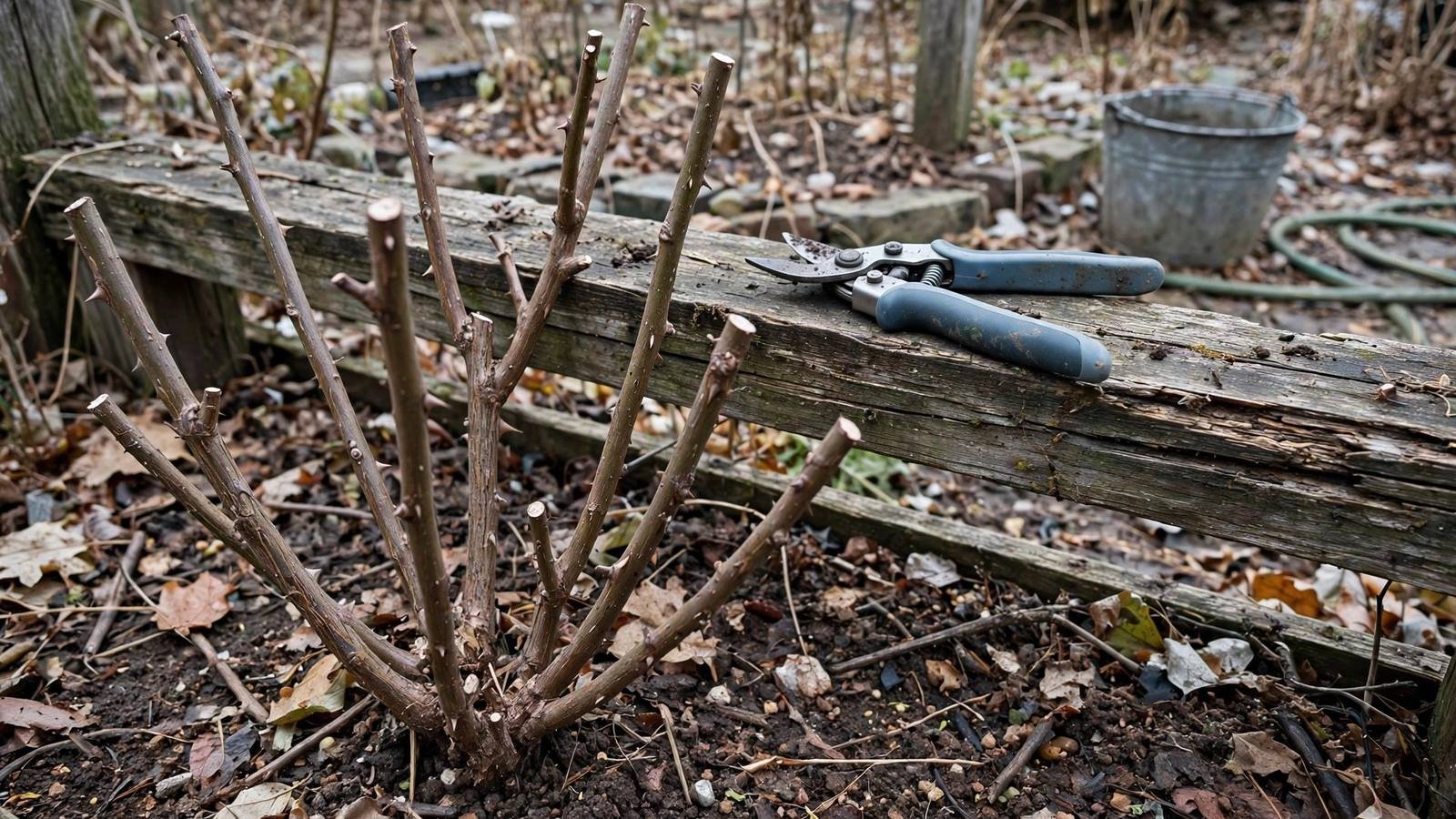
Winter is the season to prune roses. With the leaves gone, every cane is visible: the dead wood, the crossing stems, the thin twigs that will never carry a good bloom. A dormant prune clears that wood out, opens the center of the bush to air and light, and sets the shape for the flowers that follow in summer.
This guide covers dormant rose pruning from start to finish: when to cut in each zone, which tools to use, how to make each cut, how much wood to take from each type of rose, and how to clean up diseased leaves and canes so the problems do not carry into spring. It also works out a cane-count example for a hybrid tea bush, so the cuts can be planned before the pruners come out.
Why roses are pruned in winter
Roses pruned while dormant lose little sap, and the cuts heal as growth resumes in spring. The bare canes show their structure plainly, so dead wood is easy to spot: it is brown inside, with a dry, gray pith, while live wood is green under the bark with a white center. A dormant prune also removes the hiding places where fungal spores and pests wait out the winter in old leaves and stems.
Pruning shapes the bush as well as cleaning it. An open, vase-shaped center lets air move through the plant, and leaves dry faster after rain. Black spot spores need wet leaves for several hours before they can infect, so a bush that dries fast after rain gets less disease through the season.
Do not prune hard in fall. Iowa State University Extension advises against fall pruning, because the cut stimulates new growth that cold weather kills, and winter causes dieback that has to be cut out again in spring. In fall, only remove broken or diseased canes, and shorten very tall canes that could whip around in winter winds.
When to prune by zone
The cue is the plant, not the calendar: prune repeat-blooming roses in late winter or early spring, just as the buds begin to swell, before much new growth appears. The month shifts with the climate, so the table below gives the usual window for each band.
| Zones | Usual window for repeat bloomers | Notes |
|---|---|---|
| Zones 3 to 4 | Late April to early May | Prune after the winter protection comes off; much of the cane may be winter-killed |
| Zone 5 | Late March to mid-April | Wait for buds to swell; forsythia bloom is a common local cue |
| Zones 6 to 7 | Late February to late March | Prune as buds swell, before new leaves open |
| Zones 8 to 9 | January to February | Prune while the plant is dormant, in the coolest part of winter |
| Zone 10 | December to January | Prune during the coolest, slowest-growing weeks |
Once-blooming roses follow a different rule. Old garden roses and ramblers that flower once a year bloom on wood grown the year before, so a hard winter prune removes the coming flowers. Prune those right after they finish flowering in early summer, and take no more than a third of the bush at that time.
Timing and frost dates
Use your local frost dates and regional planting guidance — not your USDA hardiness zone alone — to choose planting dates. A zone number tells you how cold the winter gets, not when your last frost arrives, and two gardens in the same zone can sit weeks apart on frost dates. Your local extension planting calendar is the better guide for the exact dates in your town.
The same logic sets the prune date. Pruning during a mild spell in midwinter can push buds to open early, and a later freeze kills that new growth, so the bush has to be cut back a second time. Wait until the buds swell on their own, which means the plant has read the season correctly. In cold zones, prune after the winter protection comes off, and in mild zones, prune before the spring growth rush begins. For how to keep the bush safe through the cold months, see our guide on how to protect roses from winter cold.
Tools for the job
Three tools cover most rose pruning. Bypass hand pruners cut canes up to three-quarters of an inch thick. Loppers handle thicker canes and reach into the center of the bush without forcing a hand between thorns. A pruning saw takes the oldest, woodiest canes at the base, where pruners cannot close around them.
Start with sharp blades. Dull tools crush the cane instead of cutting it, and a crushed cut heals slowly and invites canker. Sharpen the pruners before the first cut, and test them on a scrap stem: a sharp blade leaves a smooth, pale surface, while a dull blade leaves a ragged, brown edge. Our guide on how to sharpen pruning shears shows the file and stone routine.
Thick leather gloves protect hands and forearms from thorns, and long sleeves help on a big bush. A pair of bypass pruners is the one tool worth spending a little more on, since it does most of the cuts. If you need a pair, you can browse bypass pruning shears on Amazon. We have not tested the products linked here, and we give no current store prices.
How to make each cut
Every cut follows the same pattern: about a quarter inch above an outward-facing bud, on a slant of roughly 45 degrees, sloping away from the bud so water runs off it. The outward-facing bud matters, because the stem that grows from it will grow away from the center of the bush. A cut above an inward-facing bud sends a new stem straight into the middle, where it will cross other stems within a season.
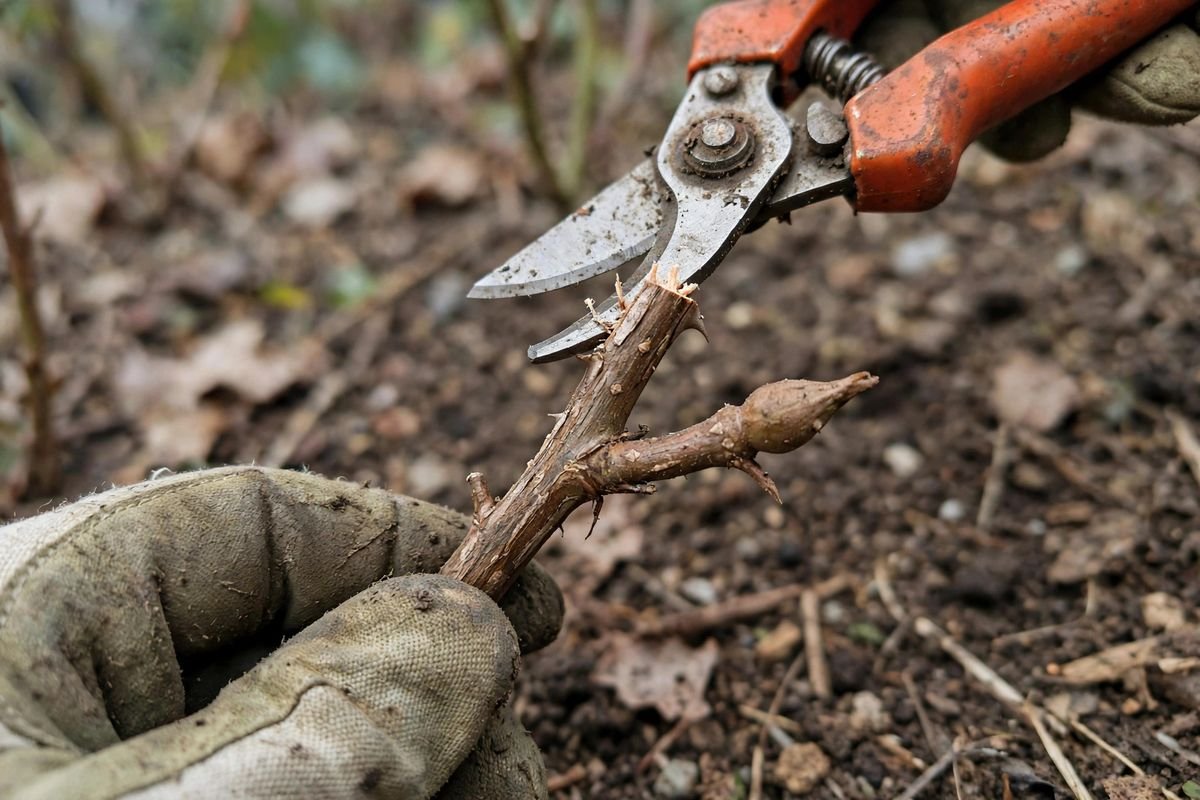
Cut dead wood first. Work down each cane until the pith turns white and the bark turns green, then cut at least one inch below any dead, brown area. If the whole cane is dead, cut it off at the base. Dead wood is easy to bend and snap, while live wood bends and springs back.
Next, remove crossing canes. Where two canes rub, the bark wears thin and disease gets in, so keep the stronger cane and cut the weaker one at its base. Then remove thin, weak growth: any cane thinner than a pencil rarely carries a good bloom, and it crowds the center. Finally, shorten the canes that remain, cutting each one to an outward-facing bud at the height the rose type calls for, which the table below gives.
Hold the cane steady with a gloved hand while cutting, and cut in one firm squeeze rather than nibbling at the wood. A half-closed cut that is finished with a twist tears the bark down the stem. For canes thicker than the pruners can close around, switch to loppers or the saw instead of forcing the blades.
How much to cut by rose type
How hard to prune depends on the rose. Repeat bloomers flower on new wood, so a hard cut still leaves a full season of blooms. Once-bloomers flower on old wood, so a hard cut removes the flowers.
| Rose type | When | How much |
|---|---|---|
| Hybrid tea, grandiflora, floribunda | Late winter to early spring, as buds swell | Hard: remove one-half to two-thirds of the height, keep 3 to 5 strong canes |
| Miniature roses | Late winter to early spring | Hard: cut back to 6 to 12 inches, keep 3 to 5 canes |
| Modern shrub roses | Early spring, as buds break | Light to moderate: remove the oldest third of canes each year |
| Climbing roses | Spring, as buds break | Light: remove dead and weak wood only, then train the long canes to the support |
| Old garden and species roses | Right after flowering, in early summer | Light: take no more than a third of the bush, mostly the oldest stems |
| Ramblers | Right after flowering | Remove the canes that flowered, keep the new long canes for next year |
In cold climates, winter often decides the height for you. Iowa State notes that in the upper Midwest, hybrid teas often lose so much wood to winter that the main job is removing the dead canes and saving as much live tissue as possible. Only after a mild winter does the cut come down to 8 to 12 inches.
Our worked example: cane count on a hybrid tea bush
A mature hybrid tea bush stands 3 feet tall and 4 feet wide at the start of winter, with 14 canes coming up from the base. The table below plans the cuts for a zone 7 bush pruned in late February, keeping 5 strong canes cut to 18 inches, so the same steps can be rerun on any bush by counting its canes first.
| Step | Canes | Cuts |
|---|---|---|
| Count the canes at the base | 14 | 0 |
| Remove dead canes at the base | 3 | 3 |
| Remove crossing canes at the base | 3 | 3 |
| Remove thin, pencil-width canes at the base | 3 | 3 |
| Shorten the 5 kept canes to 18 inches | 5 kept | 5 |
| Cut dead tips off 2 kept canes | 2 of the 5 | 2 |
| Total | 5 canes left | 16 cuts |
Nine base cuts remove the dead, crossing, and thin canes, leaving 5 strong canes. Five shortening cuts bring those canes to 18 inches, and two tip cuts clean up dead wood on the kept canes, for 16 cuts in total. The bush goes from 14 canes to 5, and the open center lets air and light reach the new growth. A shrub rose of the same size would keep more canes, about 8 to 10, and take only the oldest third out, which comes to 4 or 5 base cuts instead of 9.
Disinfecting tools between plants
Clean the blades between bushes, and always after cutting diseased wood. A wipe with rubbing alcohol or a 1-to-10 mix of household bleach and water kills the spores and bacteria on the blade, and a rinse and dry afterward keeps the steel from rusting. Our guide on how to disinfect pruners between plants shows the full routine and the mix ratios.
Disease cleanup: leaves, canes, and the bed
Winter pruning is also the disease cleanup for the year. Black spot, rust, and powdery mildew overwinter as spores in infected canes, buds, and fallen leaves. When spring rain arrives, those spores splash back onto fresh green growth within days. Removing the infected material now breaks that cycle before it starts.
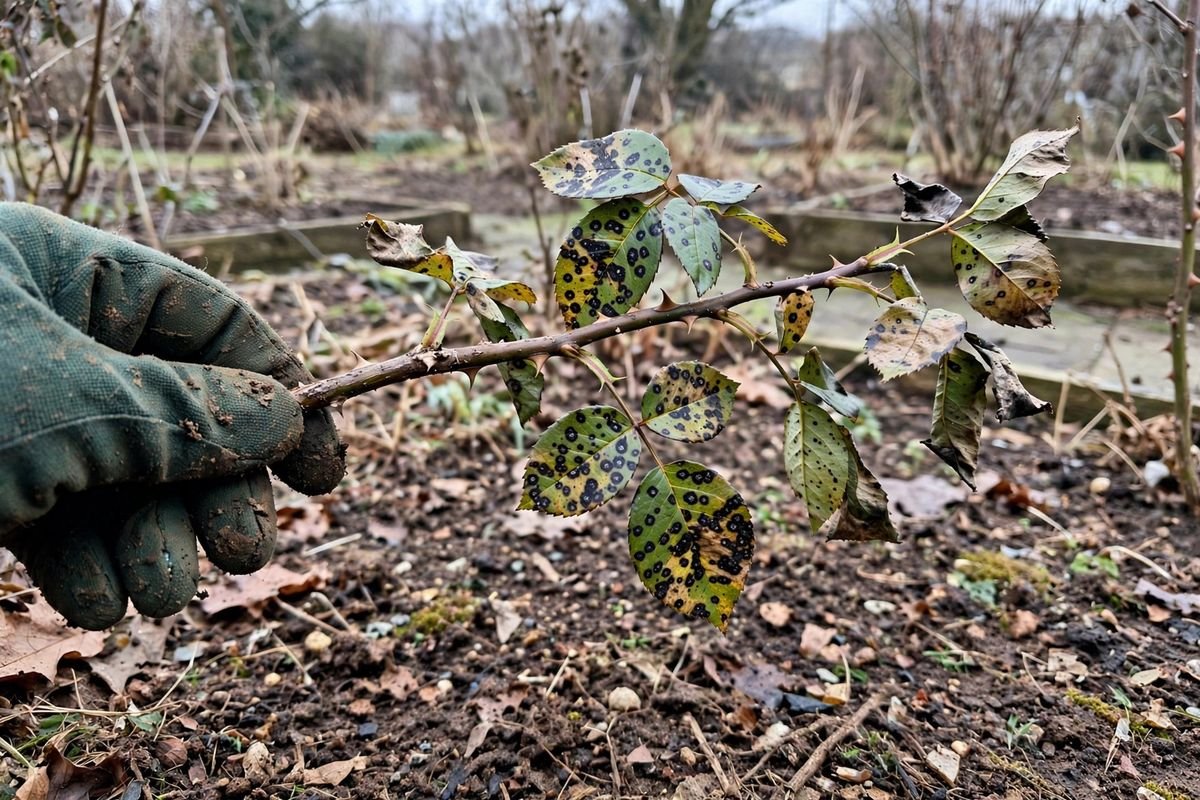
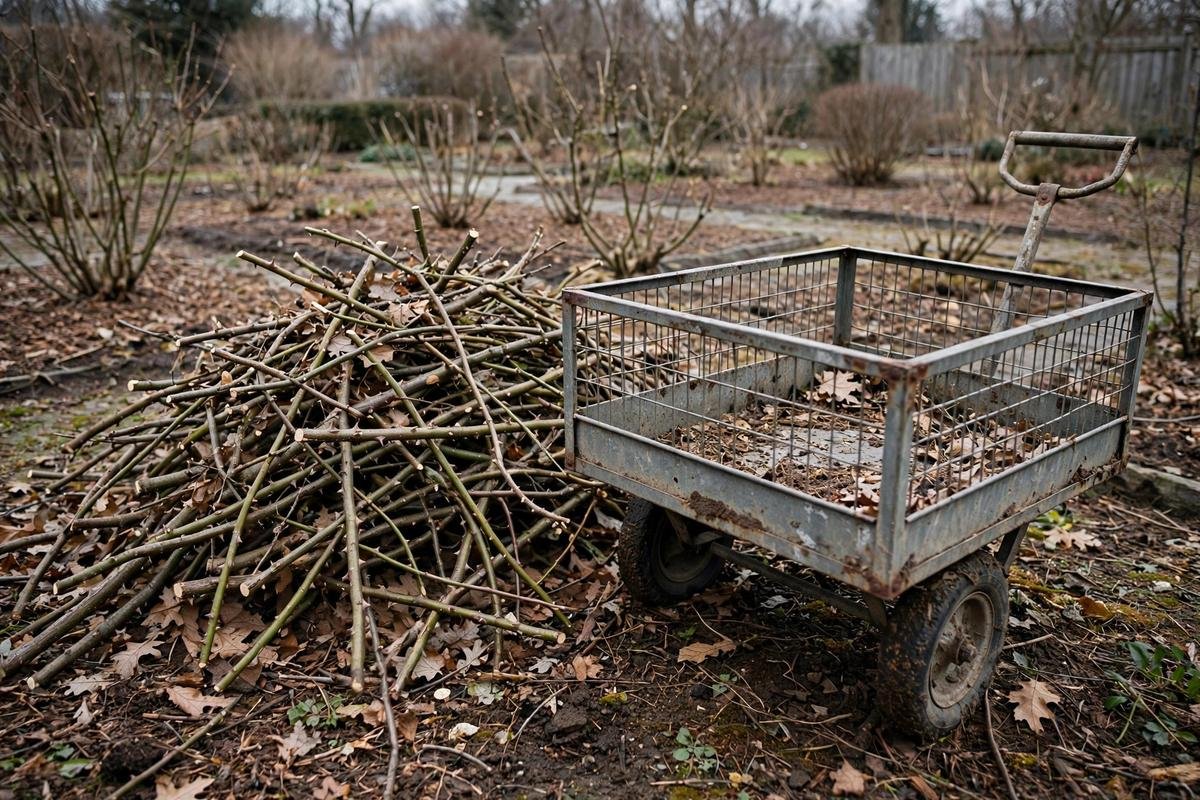
Strip any leaves still hanging on the canes after pruning, and rake up every fallen leaf under the bush. Leaves with black spot, rust, or mildew go in the trash or the municipal green bin, never in the home compost pile, because a home pile rarely gets hot enough to kill the spores.
Clear the mulch from the base of the bush as well, and replace it with fresh mulch once pruning is done. Old mulch holds the same spores as the leaves, and fresh mulch keeps soil from splashing onto the new leaves in spring. Spread the new mulch 2 to 3 inches deep, and keep it a few inches away from the base of the plant. For frost cover that goes over the bed after the cleanup, see our guide on the best frost cloths for garden beds.
After the prune: what happens next
Feed the bush once growth resumes in spring, not right after pruning. A rose pruned in late winter has no leaves to use the feed, and fertilizer spread on bare soil in February washes away before the roots wake up. Wait until the new leaves are out and the shoots are a few inches long, then feed at the rate on the product label.
Troubleshooting
The bush leafs out, then a late freeze blackens the new growth
New growth killed by a late freeze is cut back to live wood once the frosts pass, and the bush regrows from lower buds. The fix for next year is timing: wait for the buds to swell on their own rather than pruning during a mild spell, and keep frost cloth on hand for a late cold night after the prune.
Cuts turn black and die back below the cut
Dieback below a cut follows a dull blade, a cut made too far above the bud, or a cut left to face a hard freeze. Cut back to live white pith, keep cuts a quarter inch above the bud, and check the blade sharpness before the next bush. Sealing cuts is not needed on most roses, since the plant seals the wound itself when growth resumes.
Black spot comes back every year despite the cleanup
Black spot that returns each year usually means infected leaves were left under the bush or in the mulch. Rake the bed clean after pruning, replace the mulch, and space the plants so air moves between them. Water at the base of the plant rather than overhead, so the leaves stay dry.
Frequently asked questions
When is the best time to prune roses in winter?
Prune repeat-blooming roses in late winter or early spring, just as the buds begin to swell. In Iowa that falls between late March and mid-April, in zones 6 to 7 between late February and late March, and in zones 8 to 9 in January or February. Let the buds set the date, not the calendar.
How far back should a hybrid tea be cut?
Cut a hybrid tea back by one-half to two-thirds of its height, and keep 3 to 5 strong canes. In a mild winter, that usually means 12 to 18 inches of cane left above the ground. In a hard winter, remove the dead wood first and keep whatever live cane remains.
Should rose pruners be disinfected between bushes?
Yes. Wipe the blades with rubbing alcohol or a 1-to-10 bleach mix between bushes, and always after cutting diseased wood. A rinse and dry afterward keeps the steel from rusting, and clean blades make cleaner cuts.
What should be done with diseased rose leaves?
Bag them and throw them out, or put them in the municipal green bin. Do not compost them at home, because a home pile rarely gets hot enough to kill black spot and mildew spores.
Sources and further reading
- Iowa State University Extension, How to Prune Roses
- Iowa State University Extension, Rose Care by Season
- Oregon State University Extension, Take Steps in the Fall to Protect Roses in the Winter
Related reading: How to Prune Fruit Trees in Winter, How to Protect Roses From Winter Cold, Best Pruning Shears for Home Gardeners, How to Sharpen Pruning Shears, How to Disinfect Pruners Between Plants, Best Frost Cloths for Garden Beds
By the Pot and Plot Team