

This post may contain affiliate links. If you buy through links on this page, we may earn a commission at no extra cost to you.
As an Amazon Associate I earn from qualifying purchases.
A fruit tree can survive a cold winter and still lose its whole crop to a single night. Open blossoms are the most tender part of the tree: a few hours below freezing in bloom season can turn a promising crop into brown, dead flowers, while the tree itself leafs out fine in spring. Young trees are at risk too, because thin bark splits in cold snaps and a frozen root zone can dry out a new planting before it ever wakes up.
Frost protection is not one trick. It is a set of small moves that add up: covers that trap warm air, trunk wraps that stop bark splits, water that steadies soil temperature, and a planting spot that lets cold air drain away. This guide covers each one, with a worked example for cover sizing and watering so you can size the job for your own trees. For frost protection in the vegetable beds, see our guide on how to protect raised beds from frost.
How frost hurts fruit trees
Frost hurts fruit trees in three ways. First, it kills open blossoms and young fruit: peach, plum, and cherry blossoms die around 28 degrees, and the damage gets worse the longer the cold lasts. Second, it splits bark on young trees, when a sunny winter day warms the trunk and a freezing night contracts it, opening cracks that invite pests and disease. Third, it dries out roots in new plantings, when frozen soil locks water away from roots that are still small.
Dormant buds are tougher than open flowers by a wide margin. A peach bud in deep winter can take far more cold than the same bud in bloom, which is why a late frost after a warm spell is the most damaging kind. A warm week in early spring pushes buds open, and the next cold night catches them with no defense. That pattern is the one to watch for, and it is the reason frost protection focuses on bloom season, not midwinter.
Cover the tree
A frost cover works by trapping the heat that rises from the soil overnight. Drape a breathable frost cloth or an old bed sheet over the tree in the late afternoon, before the temperature falls, and let the edges reach the ground on all sides. Weight the edges with stones or bricks so wind cannot lift them, and take the cover off in the morning once the temperature rises above freezing, so the tree gets light and air and the cover does not cook the buds on a sunny day.
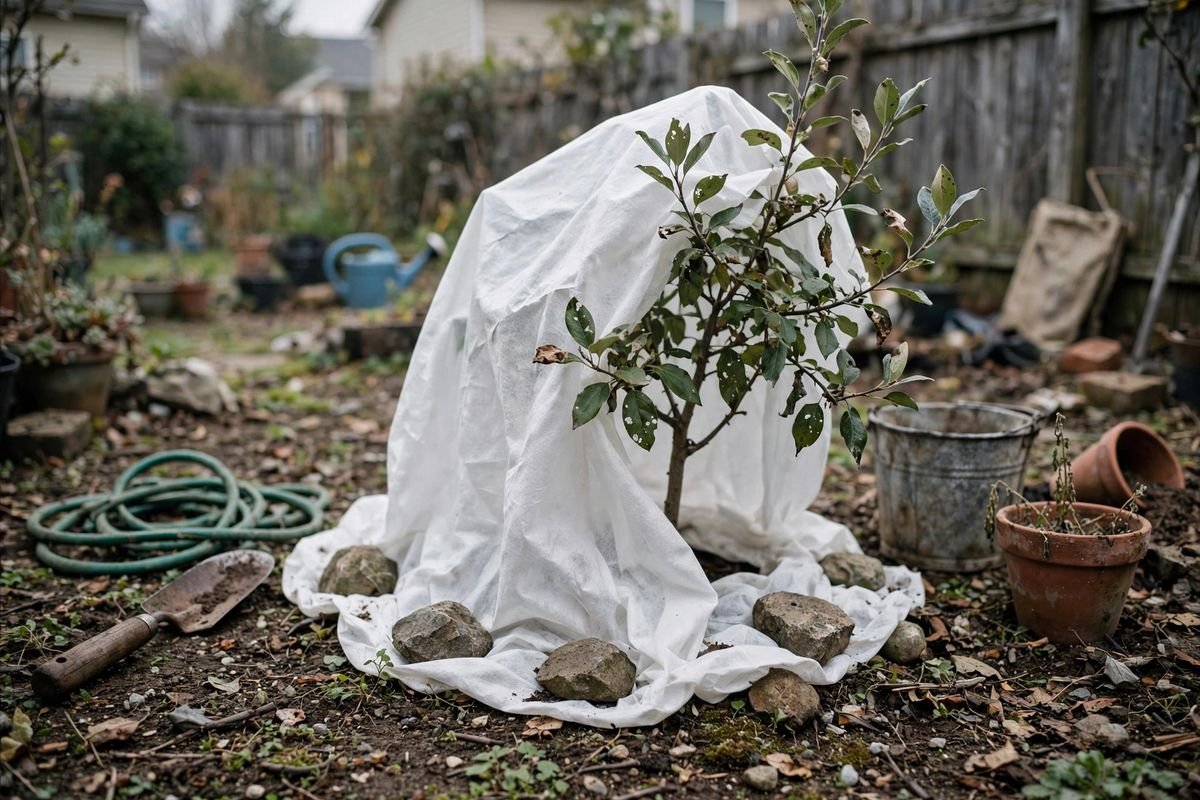
Use cloth, never plastic, against the tree. Plastic sheeting can trap cold air against the leaves and cause more damage than no cover at all, and it offers no insulation where it touches the foliage. Frost cloth is sold in rolls and as pre-cut covers, and you can browse frost cloth for fruit trees on Amazon. We have not tested the products linked here, and we give no current store prices. Check each listing for current sizes, materials, and prices before you buy. For ready-made covers, see our roundup of the best frost covers for raised beds and containers.
Wrap young trunks
Young fruit trees need their trunks wrapped for the first two or three winters. Wrap the trunk from the ground up to the first branches with burlap, tree wrap, or corrugated tree guards, and tie it snugly without cutting into the bark. The wrap shades the bark from winter sun, which stops the freeze-and-thaw cycle that splits it, and it also blocks rabbits and voles from chewing the bark in winter.
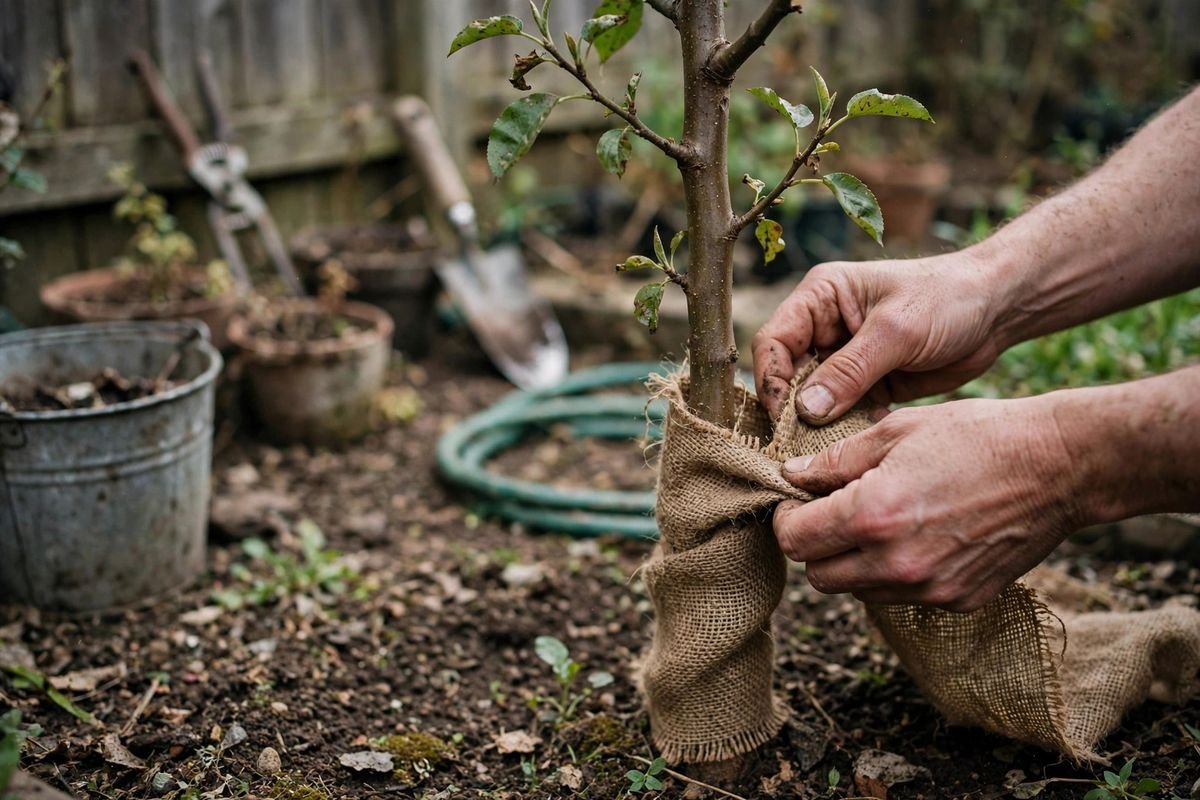
Put wraps on in late fall and take them off in spring, once the risk of hard frost has passed. Wraps left on through summer hold damp against the bark and give insects a place to hide. Check under the wrap once in midwinter: if you find gnawing or rot, replace the wrap and clear grass and mulch away from the base so rodents lose their cover.
Water the soil before a frost
Water the soil around a fruit tree the day before a forecast frost, while the air is still above freezing. Moist soil holds and releases more heat overnight than dry soil, and that small difference can keep the air around the lower branches a few degrees warmer. The effect is real but modest: watering will not save open blossoms from a hard freeze in the low twenties, but it can carry them through a light frost in the upper twenties.
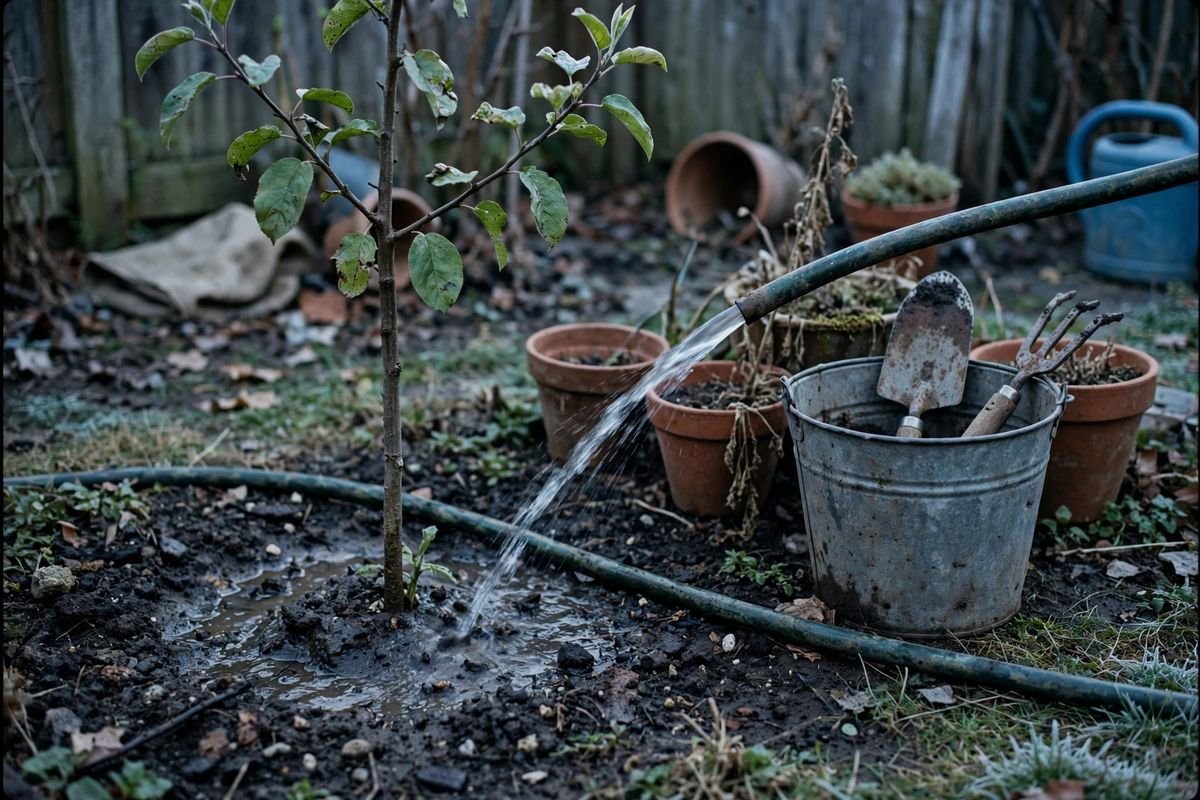
Water deeply and slowly, so the moisture reaches the root zone instead of pooling on the surface. A slow soak in the morning or early afternoon is the right timing, and the soil should be damp to about 8 inches deep by evening. Do not water in the evening right before the freeze, because surface water can freeze and give the roots nothing. The same rule applies to potted fruit trees: water them in the morning, and for the full cold-season routine see our guide on how to overwinter lemon trees in pots.
Our worked example: cover size and water for one tree
Cover sizing is the part most gardeners guess at, and a cover that is too small is worse than no cover, because it leaves gaps where cold air pours in. The rule is simple: the cloth must run from the ground on one side, up over the top of the tree, and down to the ground on the other side. That length equals the tree height, plus the canopy width, plus the tree height again. The table below runs our own computed numbers for three tree sizes, with the assumptions stated here: the trees are free-standing, the canopy is roughly as wide as it is deep, and the cloth is a single piece with no seams.
| Tree height | Canopy width | Cloth length needed | Water before frost |
|---|---|---|---|
| 4 feet | 4 feet | 12 feet | 5 gallons |
| 6 feet | 5 feet | 17 feet | 10 gallons |
| 8 feet | 6 feet | 22 feet | 15 gallons |
The water column uses a second stated assumption: about 5 gallons of water per inch of trunk diameter, measured at chest height, applied slowly enough to soak 8 inches deep. A young tree with a 1 inch trunk needs about 5 gallons, a 2 inch trunk needs about 10 gallons, and a 3 inch trunk needs about 15 gallons. A 12 foot cloth covers the smallest tree in the table, but the 8 foot tree needs a 22 foot cloth, which is why buying frost cloth by the roll and cutting it to length is usually the better buy than a pre-cut cover.
Site choice and bloom protection
The best frost protection is a good planting spot, chosen before the tree goes in. Cold air flows downhill like water, so a low spot where cold air pools is the worst place for a fruit tree. Plant on a gentle slope or a raised spot where cold air can drain away, and keep the tree clear of walls and fences that block that flow. A spot that catches morning sun is also a risk, because fast thawing after a frost damages buds more than a slow thaw in shade.
Use your local frost dates and regional planting guidance — not your USDA hardiness zone alone — to choose planting dates. The same local guidance tells you when the last frost usually arrives in your town, and that date decides which varieties are safe for your site. Late-blooming varieties dodge the worst of spring frost in cold pockets, and they are often the better pick where frosts run late. For bare-root trees planted in the cold season, see our guide on best bare-root fruit trees to plant in winter.
On a frosty night in bloom season, a few extra moves can help. A string of old-style incandescent holiday lights under the cover adds gentle heat, and a large bucket of water placed under the tree releases warmth as it cools. A smudge pot or heater is a commercial orchard tool, and it is not a fit for a home garden, where the cover, the water, and the planting spot do the real work.
Troubleshooting
Blossoms turned brown after a frosty night
Brown, limp blossoms after a frost are dead, and they will not set fruit. Leave them on the tree: picking them off does not help, and the tree will drop them on its own. Note the date and the low temperature, and use that record to pick a later-blooming variety next time, or to cover earlier next spring.
Bark split on the trunk over winter
A split in young bark usually comes from sun warming the trunk by day and freezing by night. Wrap the trunk next fall, from the ground to the first branches, and paint the southwest side with diluted white latex paint as extra sun shade. A small split often heals on its own if the bark is left alone and the tree is kept watered through the next season.
The cover blew off overnight
A cover that blew off gave the tree nothing. Weight the edges with stones, bricks, or sandbags, and run a line over the top tied to stakes on both sides so wind cannot lift the cloth. Check the forecast in the afternoon, not at bedtime, so the cover goes on while there is still light to fasten it properly.
Leaves wilted even though I watered before the frost
Watering before a frost helps the soil temperature, but it cannot stop a hard freeze from damaging tender growth. If the low fell into the low twenties, the damage is from the cold itself, not from a watering mistake. Wait until spring growth starts before pruning, so you can see which wood is truly dead and which leafs out again.
Frequently asked questions
What temperature kills fruit tree blossoms?
It depends on the stage and the fruit. Open blossoms of peach, plum, and cherry start to die around 28 degrees, and a few hours below that can wipe out a crop. Tight buds in early spring are tougher, often safe down to the low twenties. Apples and pears in bloom are a little hardier than stone fruit, but no open blossom is safe in a hard freeze.
Should I cover a fruit tree every cold night?
Cover only when frost threatens during bloom or when young growth is out. A dormant tree in midwinter needs no cover, and covering every night wastes effort and risks cooking the buds under the cloth on a sunny day. Watch the forecast, cover in the late afternoon when a frost is due, and take the cover off in the morning.
Does watering before a frost really help?
Yes, by a few degrees, and a few degrees is often the margin between a saved crop and a lost one. Moist soil stores daytime heat and releases it slowly overnight, which warms the air near the ground. It will not save blossoms from a hard freeze, but it is a free, simple step that pairs well with a cover.
When should I prune frost-damaged wood?
Wait until spring growth starts and you can see what is alive. Dead wood stays brown and brittle, while live wood leafs out. Prune back to live wood then, and leave any branch you are unsure about for another few weeks. Pruning too early can cut off wood that would have recovered.
Sources and further reading
- University of Minnesota Extension, Growing Apples in the Home Garden
- University of Florida IFAS Extension, Trees for Florida Gardens
- Colorado State University Extension, Fall and Winter Watering
Related reading: Best Frost Covers for Raised Beds and Containers, How to Protect Raised Beds From Frost, Best Bare-Root Fruit Trees to Plant in Winter, How to Overwinter Lemon Trees in Pots, How to Protect Roses From Winter Cold
By the Pot and Plot Team