

This post may contain affiliate links. If you buy through links on this page, we may earn a commission at no extra cost to you.
As an Amazon Associate I earn from qualifying purchases.
A small greenhouse turns a cold frame idea into a room you can walk into, and a heater decides what that room can grow through winter. Without heat, a small greenhouse holds a few degrees above the night air and suits only the hardiest greens. With the right heater, it keeps lettuce alive, starts seeds in February, and carries potted herbs through a freeze.
The hard part is picking the heater type, not the brand. Electric fan heaters, oil-filled radiators, propane heaters, and tubular heaters all warm a small greenhouse, but they spread heat in different ways, cost different amounts to run, and carry different risks. This guide compares the four types side by side, works out the sizing math for a common 8-by-10-foot greenhouse, and ends with a plain verdict for each setup.
We have not tested the products linked here, and we give no current store prices. Check each listing for current wattage, dimensions, and thermostat details before you buy, since specs vary by seller. The wattage and BTU figures in this guide are planning numbers from the sizing formula in the math section, not measurements from a test.
The four heater types at a glance
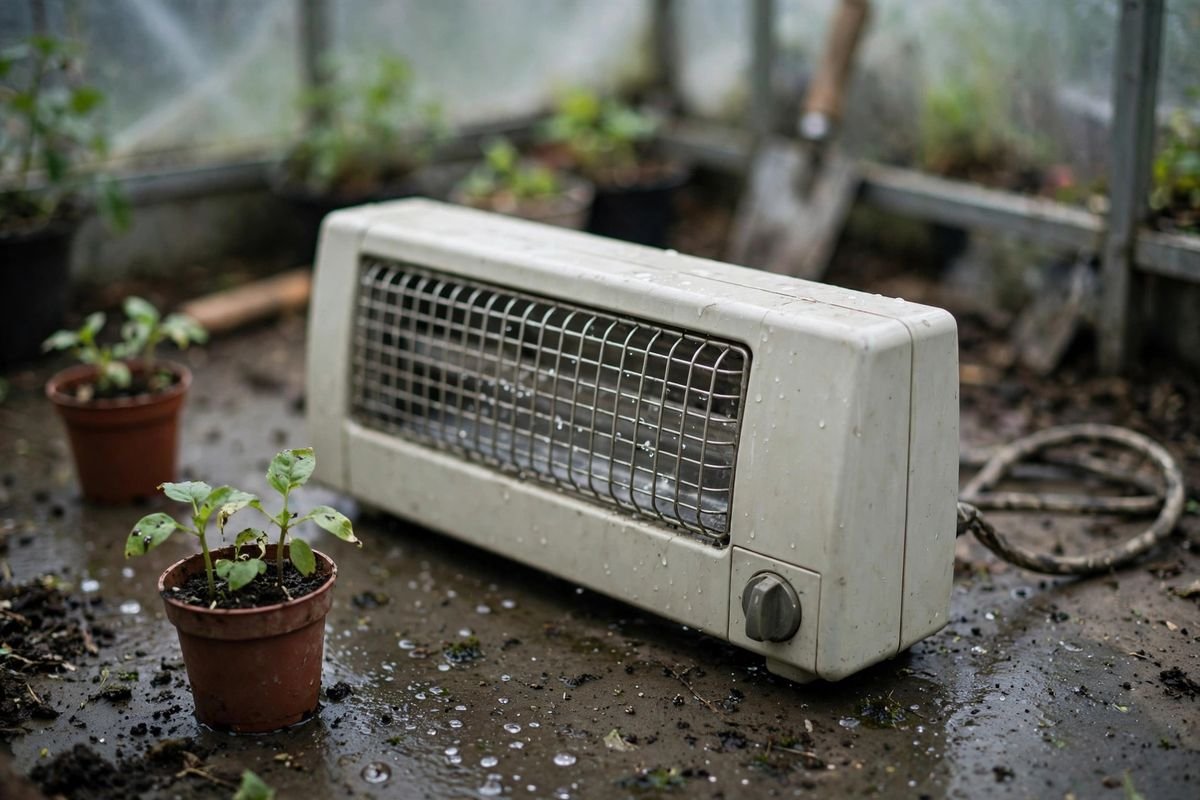
Most small greenhouses use one of four heater types. A fan heater blows warm air across the room. An oil-filled radiator warms the air around it by convection, with no fan. A propane heater burns gas and gives off strong heat with no cord. A tubular heater is a low, slim electric tube that runs along a wall and gives off steady background warmth.
| Heater type | Heat source | How heat spreads | Power or fuel | Needs an outlet |
|---|---|---|---|---|
| Electric fan heater | Electricity | Fan blows warm air across the room | Most models top out at 1,500 watts | Yes |
| Oil-filled radiator | Electricity | Slow convection, no fan | Common sizes run 700 to 1,500 watts | Yes |
| Propane heater | Propane gas | Radiant heat plus warm air | Sized in BTU per hour | No |
| Tubular heater | Electricity | Gentle heat along a wall | Common tubes run 60 to 240 watts each | Yes |
The table gives the shape of the choice. The sections below take each type in turn, with its strengths, its limits, and the running-cost math. If you want the short answer first, the verdict section at the end names the pick for each setup.
Electric fan heaters: fast heat, moving air
An electric fan heater is a small box with a heating element and a fan. Turn it on and warm air moves across the greenhouse within minutes, which makes it the fastest way to lift the temperature on a cold night. Most models sold for home use top out at 1,500 watts, the limit for a standard household outlet, and most have a built-in thermostat that switches the heater off when the air reaches the set point.
The fan is the reason to buy one and the reason to think twice. Moving air keeps the temperature even from one end of the house to the other, and it dries leaves after watering, which cuts down on mold. But the same fan dries the air and the soil surface, so a greenhouse heated this way needs more watering than one heated by a radiator. The fan also stops when the power stops, so a fan heater gives no protection in a power cut. You can browse electric fan heaters for greenhouses on Amazon.
Pros
- Fastest heat of the four types: warm air reaches the whole house within minutes.
- The fan keeps the temperature even and dries leaves after watering.
- Built-in thermostats are common, so the heater cycles on and off by itself.
- Light and cheap to move, and it stores on a shelf in summer.
Cons
- Dries the air and the soil surface, so the beds need more watering.
- Stops dead in a power cut, with no stored heat to carry the night.
- The fan adds noise, and a cheap fan can rattle after a season of damp air.
- One heater tops out at 1,500 watts, which may not cover a large lift in a single-glazed house.
Oil-filled radiators: slow, steady, silent
An oil-filled radiator is a set of sealed metal fins filled with oil. Electricity warms the oil, the fins warm the air, and warm air rises by convection. There is no fan and no open element, so it runs silent and the heat builds slowly and evenly. Common sizes run 700 to 1,500 watts, and most have a thermostat and a timer.
The slow pace is the trade. A radiator takes an hour or more to lift a cold greenhouse, so it suits a house that stays heated all winter rather than one warmed only on frost nights. It also warms the air near the floor first, which suits low benches and pots, but the far corners stay cooler than they would with a fan. The oil never needs topping up, and the sealed fins make it one of the safer electric types around damp soil and watering cans. If you want this type, you can browse oil-filled radiator heaters on Amazon.

Pros
- Silent and steady, with no fan to dry the air or the leaves.
- Sealed fins and no open element make it safe around damp soil and watering.
- Holds some warmth after it switches off, since the oil cools slowly.
- Thermostat and timer come standard on most models.
Cons
- Slow to warm a cold house, so it suits all-winter heating rather than frost nights alone.
- Heat pools near the floor, and the far corners stay cooler than with a fan.
- Heavy to move, and a tall radiator can block a bench or a path.
- Costs about the same to run per watt as a fan heater, with no speed advantage.
Propane heaters: strong heat, no cord
A propane heater burns gas from a cylinder and gives off strong heat with no power cord, which makes it the only type here that works where there is no outdoor outlet. A 20-pound cylinder, the size sold for backyard grills, holds about 4.6 gallons of propane, and a gallon gives about 92,000 BTU, so the fuel math is easy to work out once you know the heat loss of your greenhouse. The running-cost section below works through the numbers.
Gas heat comes with two duties that electric types do not have: venting and watching the flame. Burning propane gives off water vapor and carbon dioxide, and an unvented heater in a sealed house can use up oxygen and give off carbon monoxide. North Carolina State Extension warns that unvented heaters should not run for long in a closed greenhouse without fresh air, and that 50 BTU per square foot per hour should not run for more than two hours without ventilation. Crack a vent or a door whenever a propane heater runs, fit a carbon monoxide alarm, and never leave a gas heater running in a house you cannot check. You can browse propane greenhouse heaters on Amazon.

Pros
- Strongest heat of the four types, with no outlet needed.
- Keeps working in a power cut, which is when frost protection matters most.
- A single cylinder runs for days at low output, and refills are easy to find.
- Suits larger houses where one electric heater would fall short.
Cons
- Needs fresh air while it runs, so the house cannot stay sealed on a cold night.
- Burning gas adds water vapor, which can raise humidity and invite mold.
- Cylinders cost money to refill and take up floor space, and the heater must stay clear of plants and pots.
- An unvented heater in a closed house can use up oxygen and give off carbon monoxide.
Tubular heaters: low background warmth
A tubular heater is a slim electric tube, usually one to four feet long, that mounts low along a wall or under a bench. It gives off a small amount of steady heat, most often 60 to 240 watts per tube, and it runs for months at a time without attention. Gardeners use it to keep the air a few degrees above freezing, to keep a propagation bench warm, or to back up a bigger heater on the coldest nights.
One tube will not heat a whole greenhouse. The math section below shows that a single 120-watt tube covers only a small lift in an 8-by-10-foot house, so tubular heat works as frost protection and bench heat, not as the main heater for a cold climate. Two or three tubes along the walls spread the warmth better than one, and a thermostat plug keeps them from running on mild nights. You can browse tubular greenhouse heaters on Amazon.
Pros
- Cheapest to run of the four types, at a few cents a night per tube.
- Runs for months with no attention and no fan to fail.
- Mounts low along a wall or under a bench, out of the way of plants and paths.
- Gives steady background warmth that stops pipes and pots from freezing.
Cons
- Too weak to heat a whole greenhouse on its own in a cold climate.
- Heat stays near the tube, so the far side of the house gets little benefit.
- Needs an outlet and a thermostat plug to avoid wasting power on mild nights.
- Mounting takes screws and a drill, so it is not a heater you move from house to house.
Sizing math for an 8-by-10-foot greenhouse
Heater size is not a guess. The heat a greenhouse loses on a cold night follows a simple formula published by North Carolina State Extension: heat loss in BTU per hour equals 1.25 times the surface area in square feet times the temperature difference in degrees Fahrenheit, for a single-glazed house. For a double-film house, use 0.80 in place of 1.25. The worked example below uses a common hobby size, an 8-by-10-foot greenhouse with 6-foot walls and a gable peak at 8 feet, and the assumptions are stated so you can redo the math for your own house.
First, the surface area. The two long walls are 10 feet by 6 feet, or 60 square feet each, for 120 square feet. The two end walls are 8 feet by 6 feet, or 48 square feet each, plus a gable triangle of 8 square feet on each end, for 112 square feet. The roof has two slopes, each about 4.5 feet long and 10 feet wide, for about 90 square feet. Add them up and the house has about 320 square feet of surface.
Next, the temperature lift. If the coldest night drops to 20 degrees and you want the house to stay at 45 degrees, the difference is 25 degrees. Heat loss is 1.25 times 320 times 25, which is 10,000 BTU per hour for a single-glazed house. For the same house with double film, it is 0.80 times 320 times 25, which is 6,400 BTU per hour.
Electric heaters are sold in watts, and one watt gives 3.412 BTU per hour. The single-glazed house needs 10,000 divided by 3.412, or about 2,900 watts. The double-film house needs about 1,900 watts. A single 1,500-watt fan heater gives 5,118 BTU per hour, which lifts the single-glazed house by about 13 degrees, so it holds 45 degrees only when the night stays above 32. Two 1,500-watt heaters together give about 3,000 watts, which covers the full 25-degree lift with a small margin.
In volume terms, the house holds about 560 cubic feet: 480 for the walls and 80 for the gable. The 2,900-watt need works out to about 5.2 watts per cubic foot for a 25-degree lift in a single-glazed house. That figure is a planning shortcut for houses of this size and shape, not a rule for every greenhouse, since glass, wind, and insulation change the loss. North Carolina State Extension adds 10 percent for winter ventilation and 10 percent more for a windy site, which lifts the need to 12,000 BTU per hour, or about 3,500 watts, for an exposed single-glazed house.
Sizing is one half of the job; sealing the house is the other. Our guide on how to winterize a greenhouse walks through draft sealing, bubble wrap insulation, and door gaps, and every fix there cuts the wattage the heater has to supply. If your greenhouse is smaller than the one in this example, see our roundup of the best mini greenhouses for patios for houses that need far less heat.
What it costs to run
Wattage sets the running cost, and the math is plain once the rate is stated. The example below uses 17 cents per kilowatt-hour, a common residential rate in many areas. Use your own rate from your power bill in place of it.
A 1,500-watt heater running 8 hours a night uses 12 kilowatt-hours, which costs about $2.04 a night at 17 cents. Over 60 cold nights, that is about $122. Two heaters running together double it to about $245 for the season. A tubular heater at 120 watts running the same 8 hours uses about 1 kilowatt-hour a night, or about 17 cents, which is why tubes are cheap insurance against a light frost and poor main heat in a hard freeze.
Propane costs work out by the gallon. A gallon gives about 92,000 BTU, so at a heat loss of 10,000 BTU per hour, a gallon lasts about 9 hours. A 20-pound cylinder holds about 4.6 gallons, which is about 42 hours of heat at that rate. A cold week of 8-hour nights would use about two cylinders, so check the price of a refill near you before you pick gas as your main heat.
Start heating before the first hard frost, and plan your planting around it. Use your local frost dates and regional planting guidance — not your USDA hardiness zone alone — to choose planting dates. A heater stretches the season around your frost dates, but it does not move them.
What to check before you buy
A thermostat is the first thing to check. A heater with no thermostat runs at full power all night and cooks the house on a mild evening, while a heater with a thermostat holds the set point and saves power. Look for a thermostat that reads in degrees, so you can set the exact night temperature your crops need.
Tip-over protection comes next. A heater on a greenhouse floor can get knocked over by a hose, a dog, or a falling pot, and a heater with a tip-over switch cuts out the moment it falls. Check that the switch works before the first cold night, and set the heater on a flat, stable surface away from the path.
Water and power do not mix, so run the heater from a ground-fault outlet, and keep the cord off the floor where watering cans spill. A short cord that forces an extension lead across a wet floor is a hazard, so measure the distance from the outlet to the heater spot before you buy. For a small house that needs less heat, the mini greenhouse versus cold frame comparison shows when a cold frame does the same job for no running cost at all, and our roundup of the best cold frames for small gardens covers the sturdy types.
The verdict
Choose an electric fan heater if you want fast heat and even air in a small house, and you have a safe outdoor outlet. It is the best pick for starting seeds in late winter and for frost nights that come and go.
Choose an oil-filled radiator if the house stays heated all winter and you want silent, steady heat with no fan drying the leaves. It suits benches of potted plants and a gardener who checks the house daily.
Choose a propane heater if there is no power at the greenhouse, or if you need strong heat for a larger house. Accept the venting routine and the cylinder refills as part of the deal, and fit a carbon monoxide alarm.
Choose tubular heaters if you only need frost protection, or if you want backup heat under a bench. They are the cheapest way to hold a few degrees, and they will not carry a whole house through a hard freeze on their own.
Troubleshooting
The heater runs but the house stays cold
Check the drafts first. A gap under the door or a cracked panel can leak more heat than a 1,500-watt heater can replace. Seal the gaps, add a layer of bubble wrap on the north wall, and run the sizing math again for your house. If the math says you need 2,900 watts and you own one 1,500-watt heater, the fix is a second heater, not a bigger thermostat setting.
The leaves dry out and crisp at the edges
Fan heat dries the air, and dry air pulls water from the leaves. Move the heater so the fan does not blow straight at the benches, water in the morning so the soil is damp before the heater runs, and set a tray of water near the heater to put some moisture back in the air. If the problem keeps coming back, switch to a radiator, which dries the air far less.
Condensation drips from the roof onto the plants
Warm, damp air hits the cold roof panels and drips back down, which invites mold on the leaves. Vent the house for an hour in the morning so damp air escapes, and water early in the day so the soil surface dries before dark. A small fan running on low, apart from the heater, keeps the air moving and cuts the dripping.
The heater trips the breaker
Two 1,500-watt heaters on one household circuit draw 25 amps, which trips a standard 15-amp breaker. Run each heater from its own circuit, or use one heater plus a tubular tube on a second circuit. Never replace a breaker with a larger one to stop the tripping, since the wiring behind it is rated for the smaller load.
Frequently asked questions
What size heater do I need for a small greenhouse?
Work it out from the surface area and the temperature lift, using the formula in the sizing section. For an 8-by-10-foot single-glazed house holding 45 degrees on a 20-degree night, the need is about 10,000 BTU per hour, or about 2,900 watts. A smaller house or a milder night needs less, and double film cuts the need by about a third.
Can I use an indoor space heater in a greenhouse?
Only if it is built for damp conditions and has tip-over protection and a thermostat. A cheap indoor heater with no protection against water is a fire risk in a greenhouse, where watering cans spill and condensation drips. Look for a heater sold for greenhouse or garage use, and run it from a ground-fault outlet.
Do I need a thermostat on a greenhouse heater?
Yes. A thermostat holds the night temperature steady and stops the heater from running on mild nights, which saves power and keeps the plants from cooking. A heater with no thermostat runs at full power until you switch it off by hand, which wastes money and risks overheating the house on a sunny morning.
Is a propane heater safe in a small greenhouse?
It is safe when it is vented and watched. Crack a vent or a door while it runs, fit a carbon monoxide alarm, and never run an unvented heater for more than two hours in a closed house without fresh air. Keep the heater clear of plants, pots, and dry leaves, and store spare cylinders outside the house.
Sources and further reading
- North Carolina State Extension, What Size Greenhouse Heater?
- North Carolina State Extension, Greenhouse Oxygen Depletion by Unvented Heaters
- University of Arkansas Division of Agriculture, Heating Systems: Calculating Greenhouse Heat Requirements
- Cooperative Extension, How Should I Heat My Greenhouse?
Related reading: How to Winterize a Greenhouse, Best Mini Greenhouses for Patios, Mini Greenhouse Versus Cold Frame, Best Cold Frames for Small Gardens
By the Pot and Plot Team