
This post may contain affiliate links. If you buy through links on this page, we may earn a commission at no extra cost to you.
As an Amazon Associate I earn from qualifying purchases.
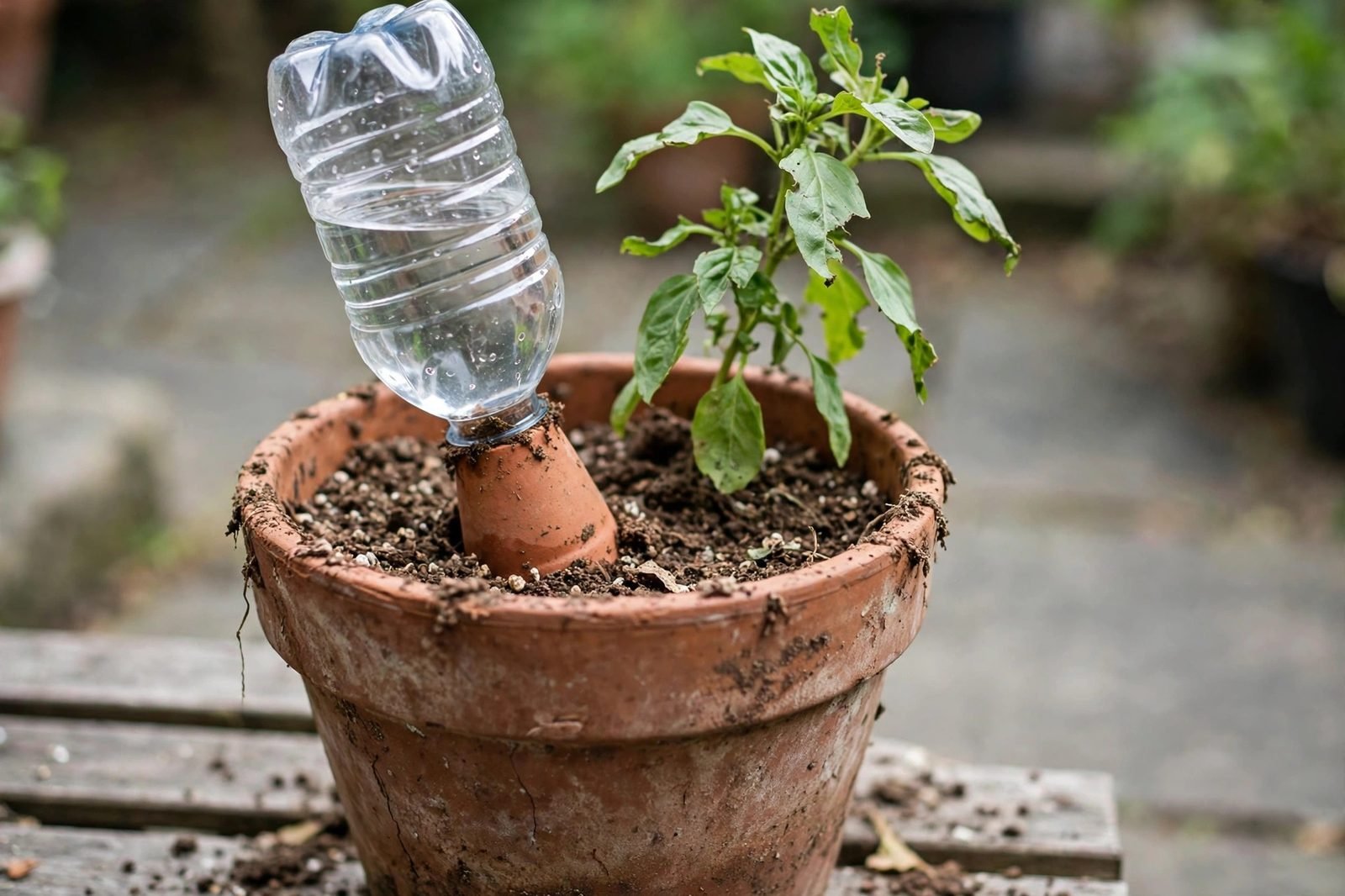
A self-watering spike is a small cone or stake that screws onto a bottle, or holds a bottle upside down, and lets water drip slowly into a pot. It is a simple fix for outdoor pots that dry out fast in warm weather, and for short trips away when no one can water for you. It does not replace regular watering for long, but it buys a few days of steady moisture.
We have not tested the products linked here, and we give no current store prices. The links below go to search pages for spike types, so you can compare current options, sizes, and prices at the time you shop.
How bottle spikes work
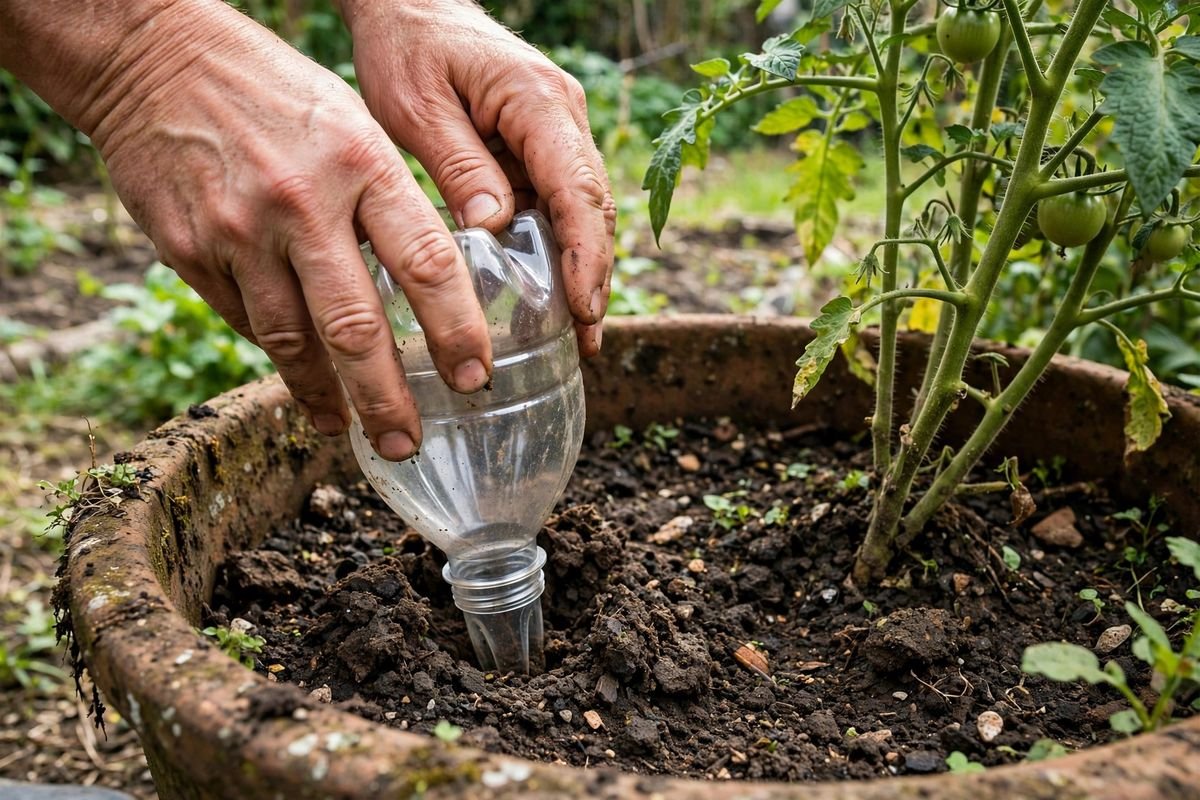
Most spikes work the same way. You fill a bottle with water, screw the spike onto the neck, flip the bottle, and push the spike into the soil near the plant. Water moves out through a small hole or a porous tip, and air moves in to take its place. The flow is slow by design: the soil pulls water out as it dries, and the narrow opening keeps the bottle from emptying in one rush.
Some spikes add a flow control, a small valve or a set of holes you can cover, so you can slow the drip for a small pot and open it up for a large one. Others are plain ceramic cones with no moving parts, and they release water more steadily than plastic spikes because the ceramic itself lets water through. Either type needs the spike buried deep enough that water goes to the roots, not onto the surface where it evaporates.

A worked example: six outdoor pots on bottles
Take six outdoor pots, each fitted with one bottle spike and one 500 millilitre bottle. Suppose each pot uses about 150 millilitres of water per day in warm weather. This is an assumption for the example, and real use varies with pot size, plant type, sun, and wind: a large pot in full sun may use more, while a small pot in shade may use less.
The arithmetic per pot is 500 divided by 150, which is 3.33, so one bottle lasts about 3 days, with a little water left into a fourth day. Across all six pots, daily use is 6 times 150, or 900 millilitres per day, and the six bottles together hold 3,000 millilitres. That total also lasts about 3 days before the bottles run low. In short, a set of 500 millilitre bottles on six pots covers a long weekend in warm weather, but not a full week.
That result sets a clear limit. For a trip of 2 to 3 days, spikes on 500 millilitre bottles are a fair match. For a week away, you need larger bottles, two spikes per large pot, or a different plan, such as a reservoir planter or a timed drip system. For trip planning, see how to water plants while you are on vacation, and for ways to slow drying in the first place, see how to keep container soil from drying out too fast.

What to look for in a spike
Start with bottle fit. Most spikes fit common plastic soda and water bottles, but neck sizes vary, so check the spike listing for the bottle types it fits before you buy a set. A spike that leaks at the neck empties fast and soaks one spot, which defeats the slow-drip idea.
Next, look at flow control and material. A spike with an adjustable valve lets you tune the drip to the pot, which matters when one pot holds a thirsty tomato and the next holds herbs that like drier soil. Ceramic spikes cost more than plastic, but they tend to drip more evenly and they do not crack in sun as fast. Plastic spikes are cheap and light, and they are fine for a season or two if they are not left out through winter.
Depth and placement matter too. Push the spike into the root zone, not right against the stem, and angle it slightly so the bottle sits clear of the plant. For a large pot, two spikes on opposite sides water more evenly than one spike in the middle. After fitting a spike, check the soil a few hours later: damp soil a few inches down means the drip is working, while a wet surface and dry soil below means the flow is too fast or the spike is too shallow.
Spikes compared with self-watering planters
Spikes and self-watering planters solve the same problem in different ways. A spike adds a slow drip to a pot you already own, using a bottle you fill by hand. A self-watering planter has a built-in reservoir under the soil, with a wick or a soil column that draws water up as the plant needs it. The reservoir holds far more water than one bottle, so a planter can go longer between fillings.
That difference sets the use for each. Spikes suit pots you already have, short trips, and a small number of pots where a bottle each is easy to manage. Planters suit a patio garden you water as a routine, where a built-in reservoir and a fill tube save daily trips with a can. Spikes are cheaper to try and easier to move from pot to pot, while planters are tidier and more steady over a full season. To compare planters on their own terms, see best self-watering planters for patio gardens and self-watering pots vs regular pots, and for a batch-mate comparison of hand watering and automatic systems, see manual watering vs automatic irrigation.
To compare current options, search for self-watering spikes for outdoor pots and ceramic self-watering spikes with adjustable flow. Check bottle fit first, then flow control, then whether the spike is long enough to reach the root zone of your pots.

When spikes fall short
Spikes struggle in very large pots, where one bottle cannot wet the whole root zone, and in hot wind, where surface evaporation outruns a slow drip. They also clog: fine soil and algae can block a small hole, so check the drip after the first day and clean the spike if the soil stays dry. In winter, bring spikes inside, since water left in a bottle can freeze and crack plastic or ceramic.
Spikes also need a check on the plant itself. Plants that like steady moisture, such as tomatoes, peppers, and leafy greens in pots, gain the most from a slow drip. Plants that like to dry between waterings, such as rosemary and lavender, may stay too wet with a spike left in all season. For those, use a spike only for a trip, then take it out and return to hand watering when you are home.
Questions
Can you use any bottle with a spike? Most spikes fit standard plastic bottles, but neck sizes differ by brand. Test one spike with the bottles you plan to use before you buy a full set, and keep a spare bottle per pot so a refill is quick.
Do spikes work in the rain? Rain helps, but a spike does not know it rained, so it keeps dripping until the bottle empties. In a rainy week, take the bottles out and let the rain do the work, then refit the spikes when dry weather returns.
How long can spikes cover a vacation? With 500 millilitre bottles and warm-weather use near 150 millilitres per pot per day, plan on about 3 days. Larger bottles stretch that to 4 or 5 days, but for a week or more, a reservoir planter or a timed system is a safer choice.
Sources & Further Reading
- University of Minnesota Extension, container gardening guides
- Cornell Cooperative Extension, container gardening guides
- Penn State Extension, watering container plants guides