
This post may contain affiliate links. If you buy through links on this page, we may earn a commission at no extra cost to you.
As an Amazon Associate I earn from qualifying purchases.
On a small balcony, where you place the pots matters more than how many pots you own. Put sun-lovers where the light lands, keep heavy pots close to the walls, tier tall plants behind short ones, and leave a path you can walk with a full watering can. Get those calls right and a 6-by-10 balcony can carry a tomato, herbs, and greens while still holding a chair.
If this is your first season on the slab, our guide on how to start a balcony garden covers lease, railing, and supply basics. This piece picks up at the layout itself, pot by pot, with numbers you can copy or rescale.
Start With Sun, Not With Pots
Balconies rarely get even light. A railing, the floor above, and the wall cut the day into bright bands and deep shade that shift with the season. Before any pot lands in its final spot, map the light on paper.
Check the floor at mid-morning, early afternoon, and late afternoon on one weekend day. Sketch the outline and shade in where direct sun sits at each hour. Most of us find three zones: a full-sun strip with six or more hours, a part-sun band with three to six hours, and a shade pocket near the wall with less than three. Tomatoes, peppers, and most herbs want the full-sun strip. Lettuce, spinach, and cilantro often do better in part sun, where they bolt more slowly. Mint and other tolerant herbs can live in the shade pocket, though growth slows.
Orientation changes the map. South- or west-facing balconies give the widest bright strip. East-facing balconies get morning light and afternoon shade, suiting greens. North-facing balconies may have no full-sun strip, favoring shade-tolerant herbs and greens.
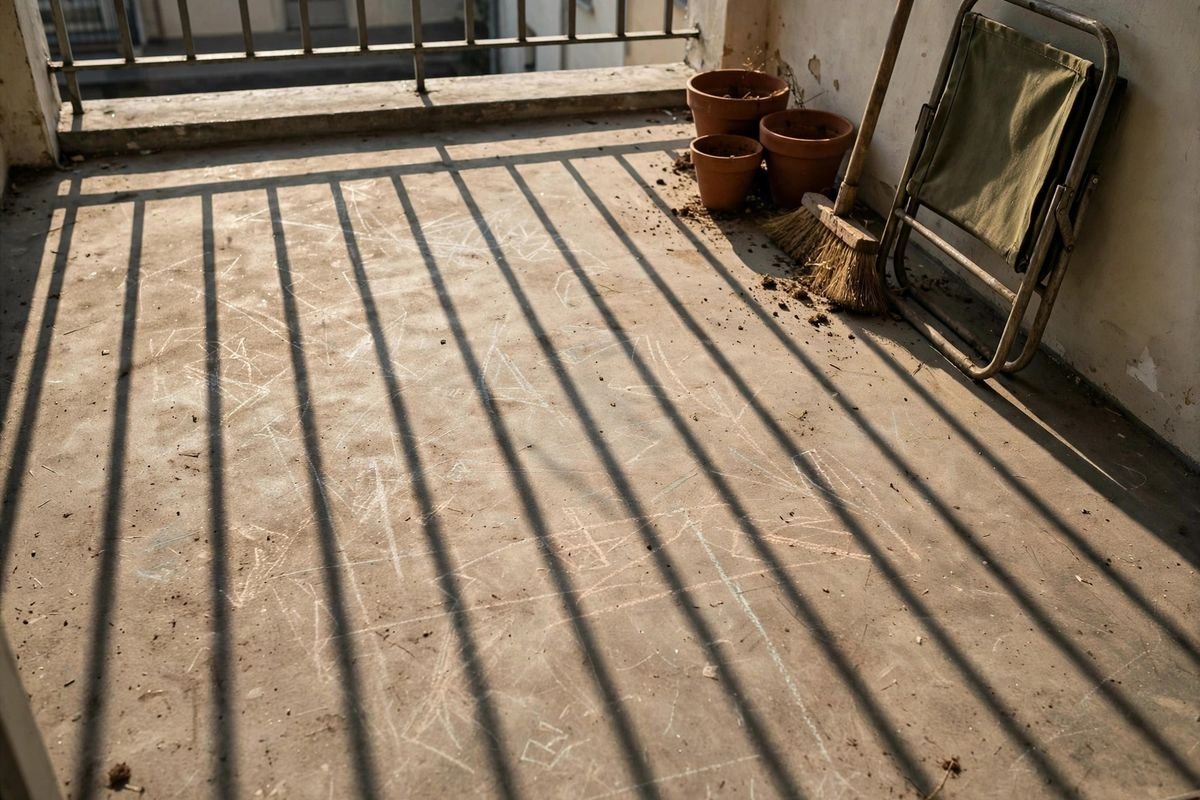
Keep the pots empty while mapping. An empty pot slides easily; a wet 10-gallon pot does not.
Put Weight Near Walls and Over Joists
Wet mix is heavier than it looks. A gallon of water weighs about 8.3 pounds, and a large pot holds several gallons of mix plus water after a soak. Placement does double duty: good light and sensible load paths.
As general practice, we set the heaviest pots against the building wall or near the sides where the slab meets its supports, rather than clustered at the far edge. We spread weight along the wall instead of stacking it in one corner, and we check lease or building rules first, since many set a load limit or ban railing-hung planters.
Material choice trims weight without shrinking the garden. Resin and plastic weigh far less than terracotta or ceramic at the same volume, and fabric grow bags weigh less still. Our overview of container gardening for beginners compares materials, drainage, and mix by cost and handling.
Saucers and feet matter too. A pot sitting flat traps water against the floor finish and can stain decking over a season. Low pot feet or a simple saucer lifts the base and lets air move under it. Browse pot feet and planter risers on Amazon sized for your pot bases before the first heavy watering.
Tier by Height So Nothing Shades the Rest
On a small slab, vertical space is free floor space: tall at the back, short at the front, with the back defined by where the sun comes from. On a south-facing balcony with an open railing, the back is the railing side. Where light comes over one short end, the back is the shaded end.
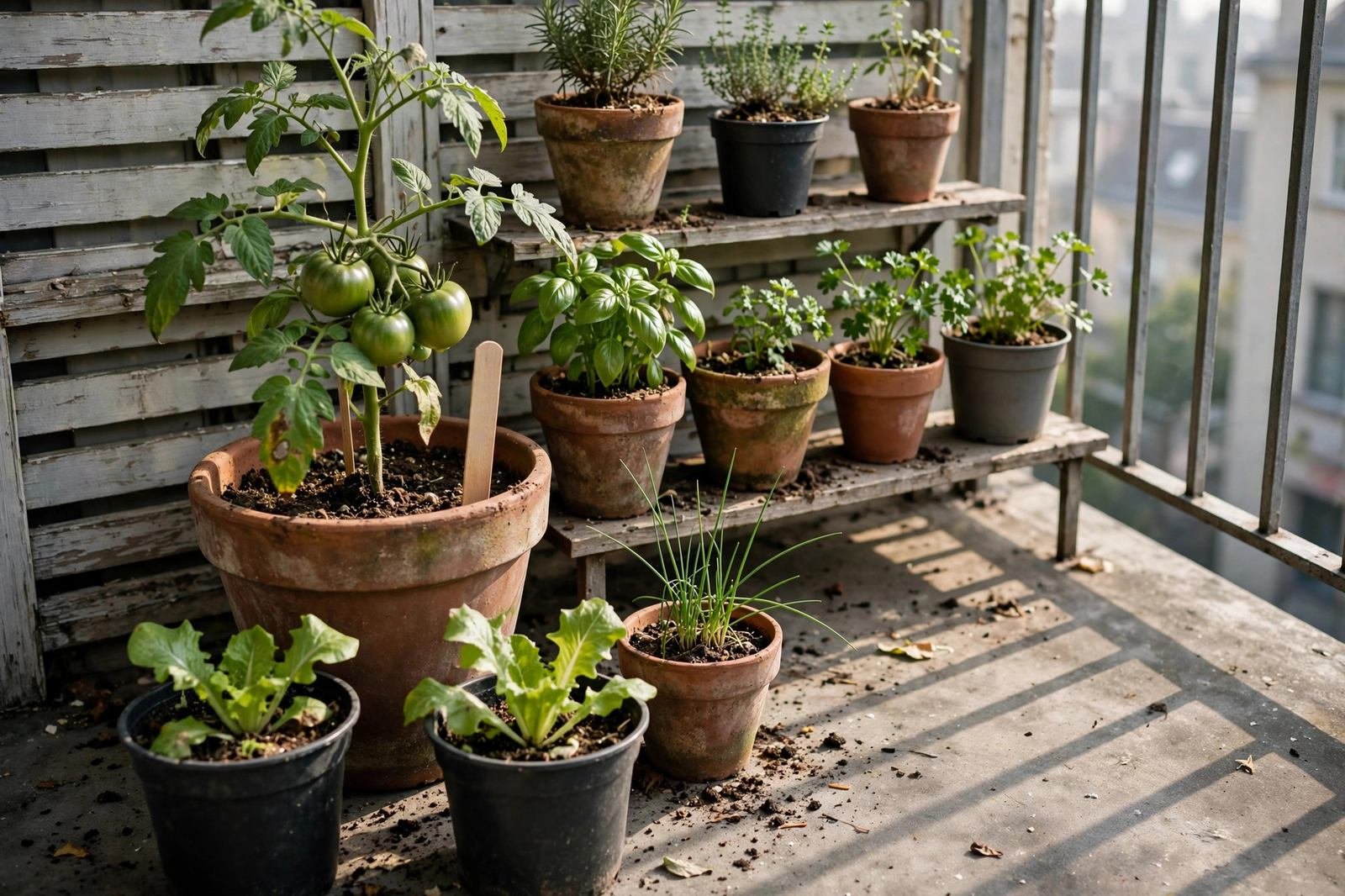
A tomato in a large pot belongs in the back row, staked early so it grows up rather than out. Peppers sit in the middle band. Herbs, lettuce, and strawberries take the front edge, where you can harvest without reaching over wet foliage. Our sizing guide on what size pot a tomato plant needs explains why the back-row pot needs real volume: a small pot dries twice a day in July and stunts the plant.
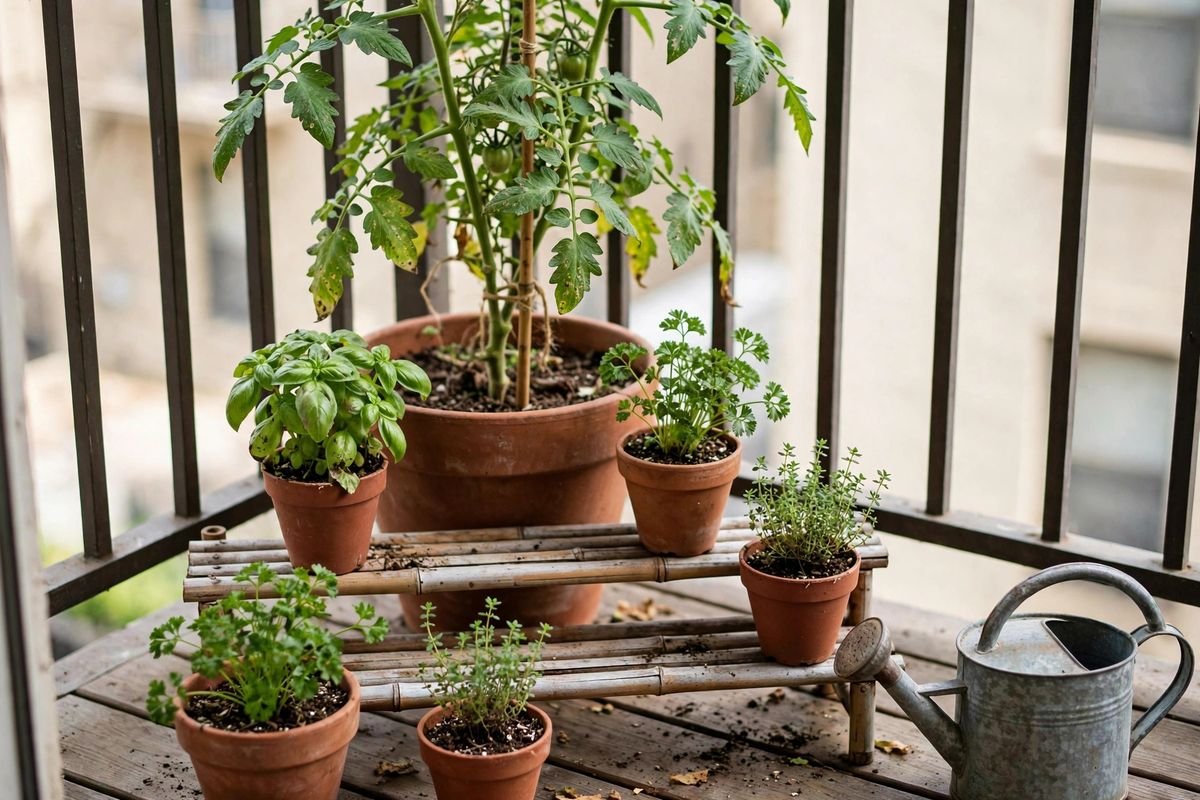
A low bench, a sturdy crate, or a tiered stand lifts the front rows by 8 to 16 inches, clearing sight lines and letting air move between pots. Keep any stand steady; a wobbling stand with a wet pot on top is worse than pots on the floor. Compare tiered plant stands for balconies on Amazon by shelf depth and stated load first.
Leave a hand’s width between pots where you can. Packed pots share pests, block airflow, and grow mildew in still pockets. A small gap also makes each pot easy to turn a quarter rotation each week, which keeps growth even on the shaded side.
Plan Watering Reach and Drip Control
A layout only works if you can water every pot without moving three others. Stand at the door with a full can and trace your route: each pot should sit within one step of the path, and none should hide behind a locked row of other pots.
Group pots by thirst rather than by looks. Tomatoes and peppers in large pots drink deeply every few days in mild weather and daily in heat. Small herb pots dry faster and may need water when the big pots are still moist. Keeping thirsty small pots near the front turns the daily pass into two minutes.
Drip control protects the floor and the neighbors below. Use saucers near the railing, water slowly so mix absorbs, and empty standing water after heavy rain. Self-watering pots steady moisture for the front row, though they add weight when full, so they belong near the wall above. Keep any drip tubing along the wall with short emitters.
Keep a Walkway You Can Actually Use
Protect a clear lane from door to railing at least 24 inches wide; 30 inches feels far better with a can in hand. That lane is the hallway for watering, harvest, pruning, and rescuing a wind-tipped pot.
Measure with your own body, not just a tape. Stand in the lane holding a can and turn around. If your elbows hit foliage on both sides, one pot needs to move, shrink, or go vertical where rules allow. Count the chair too: a folding chair takes about 4 to 5 square feet with leg room.
A Worked Example: A 6-by-10 Balcony That Still Has a Chair
Here is our layout for a common small balcony, with every assumption stated so you can rescale it. This is a planning example with typical pot sizes, not a structural recommendation; check your own building rules first.
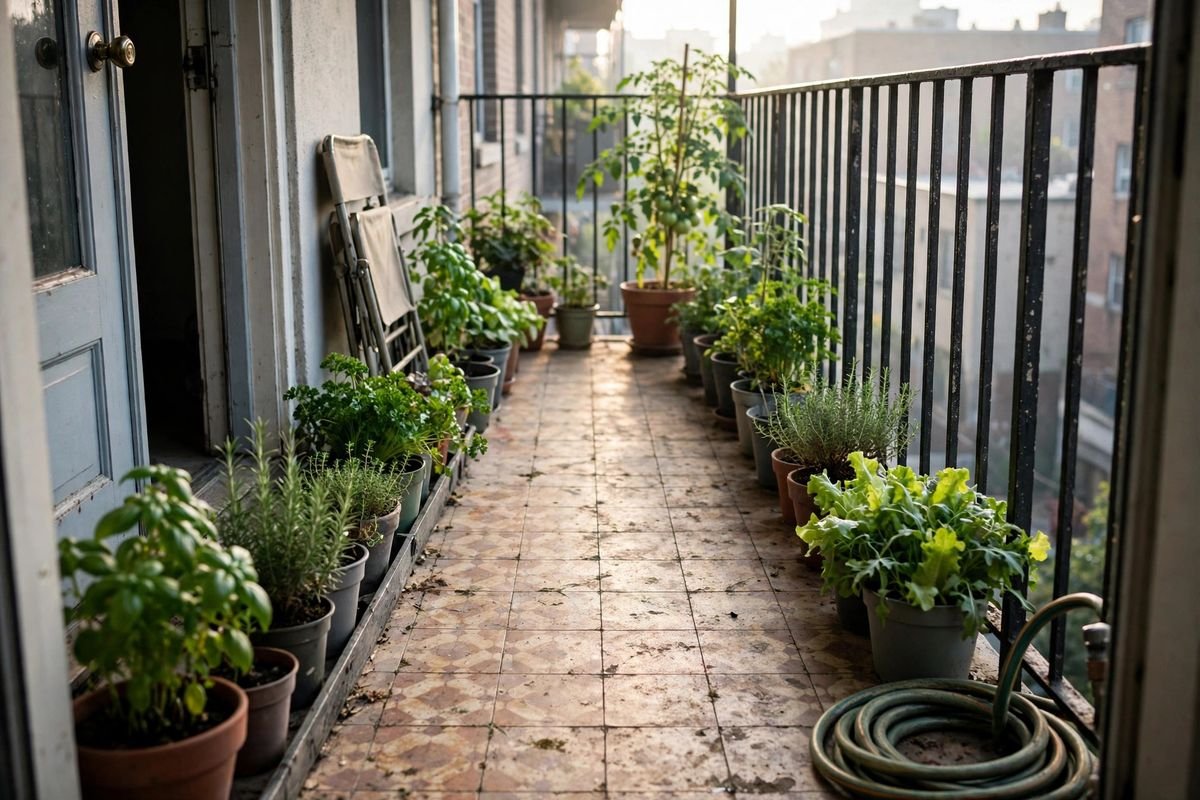
Assumptions. The floor measures 6 feet deep by 10 feet long, 60 square feet total. The long side faces south with an open railing, so the sun strip runs along the railing. The door sits at one short end. Pots: one tomato in a 10-gallon pot about 16 inches across; two peppers in 5-gallon pots about 12 inches across; six herb pots at 10 inches across; two lettuce planters about 24 by 8 inches each; one mint pot at 12 inches across, kept apart since mint spreads. A folding chair and small side table stay in the plan.
Step 1: floor area used. A round pot’s footprint is pi times radius squared. The tomato pot, radius 8 inches, covers about 201 square inches, roughly 1.4 square feet. Two pepper pots, radius 6 inches, run about 0.8 each, 1.6 total. Six herb pots, radius 5 inches, run about 0.55 each, 3.3 total. Two lettuce planters run about 1.3 each, 2.7 total. Mint runs about 0.8. Sum: 1.4 + 1.6 + 3.3 + 2.7 + 0.8 = 9.8 square feet, about 16 percent of the 60-square-foot floor. Even doubled for saucer spread, coverage stays near one-third.
Step 2: rows by sun zone. Back row along the railing, full sun: the tomato at the sunniest end, peppers beside it, mint at the far end. Middle band: the six herb pots on a low bench, lifted about 10 inches so the tomato never shades them. Front row near the wall: the two lettuce planters, where afternoon shade slows bolting and harvest is one step from the kitchen. Plant count: 1 tomato + 2 peppers + 6 herb pots (basil, parsley, thyme, rosemary, cilantro, chives) + 2 lettuce planters at roughly 4 heads each (8 heads) + 1 mint = 12 pots and planters, about 19 planting spots with the lettuce heads counted.
Step 3: what stays clear. The lane runs door to railing at 30 inches wide by 6 feet deep, about 15 square feet. Chair plus table take about 8. Pots at 10, walkway 15, seating 8: 33 of 60 assigned, 27 left open. On a 5-by-8 balcony (40 square feet), drop one lettuce planter and two herb pots; the same math leaves a workable lane.
Shuffle With the Seasons
No layout survives the year unchanged, and planning the shuffle keeps it easy. Spring suits cool greens along the railing. Summer moves the tomato and peppers into the longest sun and pulls lettuce into part sun. Fall brings the lettuce back to the railing, and tender herbs move closest to the wall, where the building holds a little warmth.
Keep the anchor still: the tomato pot stays put all season. Small pots do the moving, a few minutes per month, ideally right after watering when you can also check drainage holes and saucers. Label each pot with plant and sowing date; after two shuffles, memory blurs and the labels earn their space.
Questions We Hear About Small Balconies
How many pots can a small balcony hold?
By floor math, a 6-by-10 balcony can fit far more pots than it should carry. Weight, watering reach, and the walkway set the real limit. Our example lands at 12 pots and planters covering about 16 percent of the floor, which waters fast and still seats a person. Add pots only while the lane stays clear and every pot stays within one step of it.
Should pots sit on the railing or the floor?
Floor pots are the stable default, especially for anything heavy or tall. Railing planters suit light herbs and flowers where rules allow them, mounted securely on the inside face when possible. A fallen planter is a hazard below, so if a mount feels loose, that planter belongs on the floor.
How do we keep pots from shading each other as plants grow?
Plan for mature height, not seedling height. A tomato that starts at 8 inches may finish near 5 feet in a cage. Keep tall crops at the sun-side back, turn each pot a quarter rotation weekly, and prune lower suckers so air and light reach the front rows.
Is it fine to line every pot against the wall?
The wall row is usually the shadiest, since the building blocks part of the day. It suits the heaviest pots and shade-tolerant plants, but fruiting crops lined there usually underperform. Split the difference: heavy and tolerant near the wall, sun-hungry near the railing.
Sources & Further Reading
- University extension guidance on container gardening: pot sizing, mix, drainage, and watering practices.
- Regional extension notes on balcony and container sun exposure, plant spacing, and airflow.
- Local building and lease guidance on balcony load limits and railing planter rules (consult your property documents).