
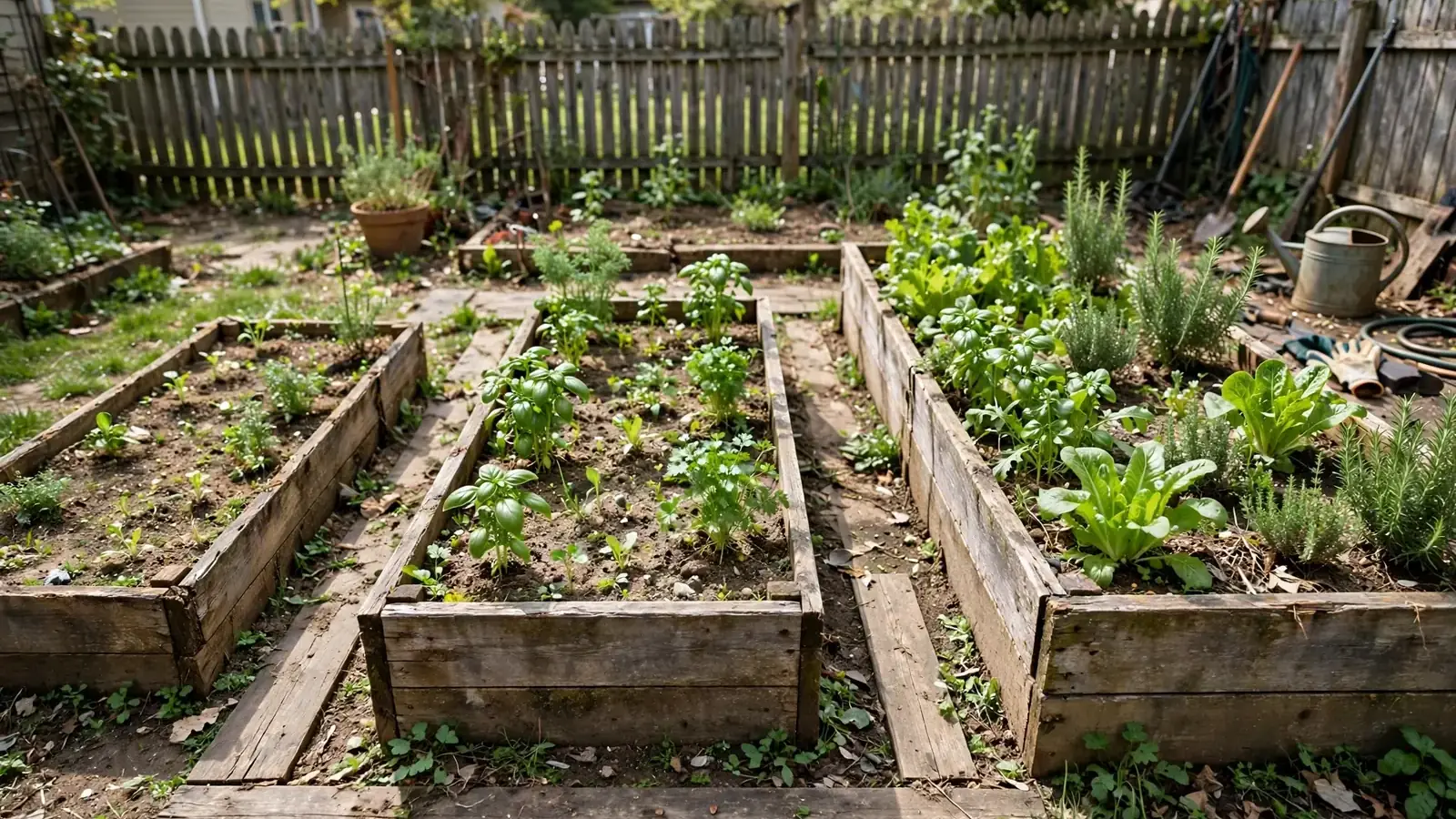
Pick the wrong raised bed size and you'll feel it every time you garden — stretching to reach the middle, squeezing between beds, or realizing you bought twice as much soil as you needed. Pick the right one and the bed just disappears into the background while you get on with growing.
New to raised beds? Start with our Raised Bed Gardening Hub — every soil guide in one place.
This guide covers the standard sizes, why they became standard, how much soil each one needs, and how to choose for your space.
The Golden Rule: Reach
Nearly every standard raised bed dimension traces back to one ergonomic fact: most adults can comfortably reach about 2 feet into a bed without stepping in it or straining. That single number explains the most common widths:
- A bed you access from one side (against a fence or wall) should be no more than 2 feet wide.
- A bed you access from both sides can be up to 4 feet wide — 2 feet of reach from each side, meeting in the middle.
Go wider than 4 feet and the middle becomes a no-go zone you'll either neglect or compact by stepping into. There are exceptions (a bed you can walk all the way around with long arms, or one tended by kids), but 4 feet is the practical max for most people. When in doubt, go narrower — a 3-foot-wide bed you can reach easily beats a 4-foot bed you can't.
The Standard Sizes, Compared
Soil volumes below assume 12 inches of fill depth — the most common target. Your actual number will differ with depth, so treat these as ballpark figures.
2×4 Feet — The Starter
- Soil at 12" deep: about 8 cubic feet
- Best for: small patios, balconies with floor space, kids' first garden, renters
- Why it works: you can reach everything from any side, it fits almost anywhere, and filling it won't break the bank — a handful of bags does it. It's also easy to cover with a cold frame or netting.
- Limitation: 8 square feet fills up fast. Great for herbs and salads; tight for a serious vegetable haul.
3×6 Feet — The Comfortable Middle
- Soil at 12" deep: about 18 cubic feet
- Best for: gardeners who want real growing space but find 4×8 imposing
- Why it works: 3 feet is reachable from both sides with zero stretching, and 6 feet is a comfortable length to work along. A nice compromise that doesn't dominate a small yard.
4×4 Feet — The Square Foot Classic
- Soil at 12" deep: about 16 cubic feet
- Best for: square foot gardening, beginners, small yards
- Why it works: the 4×4 grid is the canonical square foot garden — 16 one-foot squares, each with its own crop. Easy to plan, easy to reach the center from any side (it's exactly 2 feet to the middle).
- Limitation: the center squares are at full arm's extension. Fine for harvesting lettuce; annoying for wrestling with a tomato cage.
4×8 Feet — The Workhorse
- Soil at 12" deep: about 32 cubic feet
- Best for: serious vegetable growing, the "one big bed" gardener
- Why it works: 32 square feet grows a genuine amount of food, lumber comes in 8-foot lengths (less cutting, less waste), and the proportions suit row-style planting. This is the size behind much of the raised bed advice you'll find.
- Limitation: 32 cubic feet of soil is a real purchase — roughly a full cubic yard plus. Price it out before you build. Also, make sure you can access both long sides; a 4×8 against a fence wastes half its width.
2×8 Feet — The Narrow Runner
- Soil at 12" deep: about 16 cubic feet
- Best for: along fences, walls, and property lines; narrow side yards
- Why it works: full access from one side, fits dead spaces that would otherwise go to weeds. Great for a row of tomatoes against a sunny fence or a long herb run by the kitchen door.
How Deep Should the Bed Be?
Depth is the other half of sizing, and it interacts with everything:
- 6–8 inches: enough for herbs, lettuce, and other shallow-rooted crops — especially over decent native soil that roots can push into. The budget option.
- 10–12 inches: the sweet spot for most vegetables. Handles carrots, peppers, bush beans, and everything shallower with room to spare.
- 18–24 inches: for deep beds over concrete or terrible soil, or for gardeners who want less bending. Costs significantly more to fill — this is where layering cheaper material in the bottom (see our guide to what goes in the bottom of a raised bed) pays off.
Deeper isn't automatically better. Every extra inch across a 4×8 bed is nearly 3 more cubic feet of soil to buy. Match depth to what you're growing and what's underneath.
Spacing and Placement
A bed's footprint isn't its real footprint — you need working room around it:
- Leave 18–24 inches between beds at minimum. That's enough to kneel, haul a wheelbarrow, and not feel cramped. If you use a wheelbarrow often, 3 feet is more comfortable.
- Watch the sun. Most vegetables want 6+ hours of direct sun. Walk your yard through the day before you commit to a spot — the sunny patch in April may be shaded by the neighbor's tree in July.
- Think about water. Closer to a hose bib or rain barrel means you'll actually water consistently. A bed at the far end of the yard gets neglected in August.
- Level ground matters. A bed on a slope will have soil deeper on one end and will fight you forever. Shim it level during assembly.
- Plan the layout on paper first. Sketching bed positions, paths, and sun direction takes twenty minutes and saves expensive regrets. A garden bed planner can help you think through the arrangement before you buy lumber.
How Much Soil Will You Actually Need?
Here's where size decisions hit your wallet. Soil volume scales fast — doubling both dimensions quadruples the soil. The quick reference at 12 inches deep:
| Bed size | Soil at 12 in. deep |
|---|---|
| 2×4 | ~8 cubic feet |
| 2×8 | ~16 cubic feet |
| 3×6 | ~18 cubic feet |
| 4×4 | ~16 cubic feet |
| 4×8 | ~32 cubic feet |
But real beds are rarely exactly 12 inches deep, and lumber dimensions are nominal (a "12-inch" board is actually 11.25 inches). For an estimate matched to your real dimensions and depth — plus a bag count so you know what to buy — run it through the Raised Bed Soil Calculator. It takes thirty seconds and it's more reliable than mental math at the landscape yard.
Choosing for Your Space
- Tiny patio or balcony with floor space: start with a 2×4. Prove the concept, then expand.
- Small backyard, first vegetable garden: one 4×4 or two 3×6 beds. Manageable, reachable, enough for real harvests.
- Feeding the household: two or three 4×8 beds with proper paths between them. This is a genuine production setup — plan the soil order accordingly.
- Awkward narrow strip: 2×8 runners along the sunny side. Dead space becomes the most productive part of the yard.
- Bad back or accessibility needs: narrower beds (2–3 feet) at 18–24 inches tall, with wide stable paths. Reach and comfort beat square footage.
Frequently Asked Questions
What’s the most popular raised bed size?
The 4×8 is the most commonly built and written about — it balances growing area, lumber efficiency, and reach. But “most popular” isn’t “best for you”; a 2×4 you tend daily will outproduce a 4×8 you avoid.
Can a raised bed be too big?
Yes — any bed you can’t reach into the middle of without stepping in it is too wide, and any setup you can’t comfortably walk around is too cramped. When in doubt, build two smaller beds instead of one big one.
How many 4×8 beds do I need to feed a family?
It depends on the family and the diet, but a commonly cited starting point is around 100–200 square feet of growing space for meaningful vegetable supplementation — that’s roughly three to six 4×8 beds. Start smaller than you think; you can always add beds next season.
Does bed orientation matter?
North–south orientation gives both sides relatively even sun as the day passes; east–west means the south side can shade the north side in tall plantings. It matters most for tall crops like trellised tomatoes — for low crops, don’t sweat it.
Don’t guess — calculate it. Enter your bed’s length, width, and depth in our free Raised Bed Soil Calculator for exact cubic feet, bag counts, and bulk cubic yards — with a settling buffer built in.