
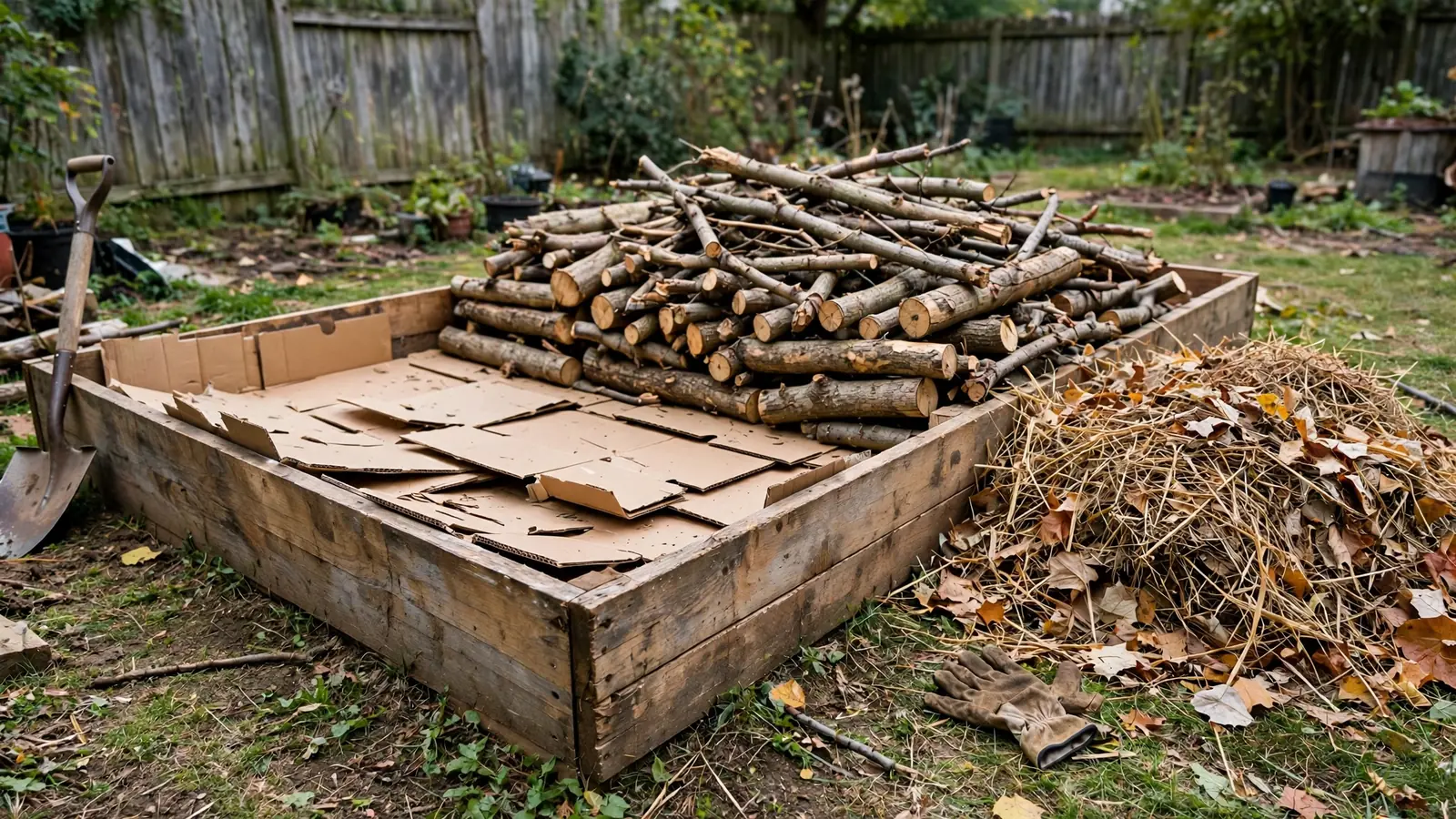
It's one of the most argued-about questions in raised bed gardening, and you'll find confident answers in every direction: cardboard, logs, gravel, landscape fabric, nothing at all. The reason for the disagreement is simple — the right answer depends on your bed.
New to raised beds? Start with our Raised Bed Gardening Hub — every soil guide in one place.
This guide compares the common options honestly, explains when each one makes sense, and flags the situations where the standard advice falls apart.
First Question: How Deep Is Your Bed?
This decides almost everything. Most vegetable roots do their serious work in the top 8–12 inches of soil. In a bed that's only 10–12 inches deep, the bottom layer is right in the root zone — whatever you put there matters a lot. In a 24-inch-deep bed, the bottom 8 inches barely see roots at all, so you can be much more economical down there.
Rule of thumb: reserve your best soil mix for the top 8–12 inches. What goes below that can be cheaper, coarser, or even nothing — depending on what's underneath the bed.
What's Under the Bed Matters Too
- Decent native soil or lawn: You're in the best position. Roots can push through an open bottom into the ground below, and worms will come up on their own. You need the least fuss here.
- Compacted clay or rubble: Drainage is your worry. Water needs a path out, and roots will mostly stay in the bed.
- Concrete, pavers, or a rooftop: The bed is fully on its own — a closed system. Drainage holes or gaps are non-negotiable, and the bottom layer has to support drainage without waterlogging.
The Options, Compared
Nothing (Open Bottom on Soil)
The simplest choice, and often the best one. If your bed sits directly on soil or lawn, you can put the frame down and fill the whole thing with your mix. Grass underneath usually dies off from lack of light. Roots and worms move freely between the bed and the ground.
Best for: beds on native soil or lawn, any depth. Watch out for: aggressive perennial weeds (bindweed, Bermuda grass) can push up through. If those are a problem in your yard, a barrier layer is worth it.
Cardboard (Sheet Mulching Layer)
A layer of plain corrugated cardboard (tape removed) laid on the ground before filling. It smothers grass and weeds, then breaks down within a season, letting roots and worms through. It's free, easy, and widely recommended.
Best for: beds built on top of lawn or weedy ground, where you want a weed barrier that disappears on its own. Watch out for: use plain cardboard, not glossy or heavily printed boxes. Overlap the sheets generously — weeds find gaps. In a very shallow bed on weedy ground, consider two layers.
Coarse Organic Material (Logs, Branches, Wood Chips)
This is the hugelkultur-inspired approach: logs, thick branches, and wood chips in the bottom, finer material on top, good soil mix at the surface. As the wood breaks down over years, it holds moisture like a sponge and feeds the soil.
Best for: deep beds (18+ inches), where the bottom zone is below most roots and you want to save money on soil. Watch out for: fresh wood ties up nitrogen as it decomposes, so keep it well below the root zone — at least 8–10 inches of good mix on top. It also settles noticeably as wood breaks down, so plan on topping up. Don't use black walnut, which contains a compound that inhibits many plants, or treated/painted lumber.
Leaves and Straw
A lighter version of the wood approach. Fall leaves and straw break down faster (a season or two), add organic matter, and cost nothing if you have them.
Best for: a middle layer in deep beds, or bulking up the bottom of a medium-depth bed. Watch out for: straw can carry weed seeds — and occasionally persistent herbicide residue from sprayed fields. If you're unsure of the source, compost it first or skip it. Leaves are generally safer; shred them so they don't mat into a soggy layer.
Gravel or Drainage Rock
Often recommended, rarely the right call in a garden bed. A gravel layer doesn't improve drainage in the way people expect — water actually hesitates to move from fine soil into coarse gravel (it's called a perched water table), so the soil just above the gravel stays wetter.
Best for: almost never in a raised bed. The one exception is a bed on solid concrete with no soil contact, where a thin coarse layer plus drainage holes keeps the bottom from sealing against the concrete. Watch out for: it eats up growing depth permanently, it's heavy, and you'll curse it if you ever dismantle the bed.
Landscape Fabric
Marketed as a weed barrier, but in the bottom of a raised bed it causes more problems than it solves. It blocks worms and roots from moving between the bed and the soil below, and soil washing down can clog it into an impermeable mat.
Best for: under paths around the bed — not inside it. Watch out for: "weed-proof" claims. Determined weeds grow through it, and then you can't pull them without tearing the fabric.
Putting It Together: Three Common Scenarios
Scenario 1: 12-inch bed on lawn, growing vegetables. Lay cardboard, fill the whole bed with your soil mix. Simple, cheap, effective. Estimate your soil volume with the Raised Bed Soil Calculator before ordering.
Scenario 2: 24-inch-deep bed on clay, tight budget. Bottom 8 inches: logs, branches, and coarse material. Middle: leaves and rough compost. Top 10–12 inches: your best soil mix. You've just cut your soil bill roughly in half — with little downside, as long as the wood stays well below the root zone.
Scenario 3: 12-inch bed on a concrete patio. No soil contact, so drainage is everything. Make sure the bed has drainage gaps or holes, skip the gravel, and fill with a free-draining mix. A shallow layer of coarse bark at the very bottom is fine, but the mix itself should drain well on its own. Our guide to raised bed soil mix covers what to look for.
What About the "Lasagna" Method?
You'll see layering methods with many thin alternating layers of greens and browns, newspaper, compost, and soil. It works — it's essentially composting in place. The tradeoff is time: a freshly built lasagna bed needs weeks to months to settle and start breaking down before it grows well. If you're planting this weekend, fill with finished mix instead and save the lasagna method for a bed you're building ahead of next season.
Frequently Asked Questions
Should I put plastic at the bottom of a raised bed?
No. Solid plastic traps water and creates anaerobic conditions — exactly what you don’t want around roots. The only liner worth considering is on the inside walls of a bed built with treated lumber, to reduce soil contact with the wood, and even that’s debated.
Will cardboard attract termites?
In most regions this isn’t a practical concern for a garden bed — cardboard breaks down within a season, and termites are after structural wood, not a thin decomposing layer. If termites are a serious local problem and the bed sits against your house, keep beds a foot or two from the foundation.
How long does the wood layer last?
Thick logs can take 3–5 years to break down substantially; branches and chips faster. Expect the bed to settle as it does — top up with compost each season and it’s a feature, not a bug.
Can I put the bed directly on grass without cardboard?
Yes — 8+ inches of soil mix will smother most lawn grass. Cardboard is cheap insurance, though, and it’s worth it if you have persistent weeds.
Don’t guess — calculate it. Enter your bed’s length, width, and depth in our free Raised Bed Soil Calculator for exact cubic feet, bag counts, and bulk cubic yards — with a settling buffer built in.