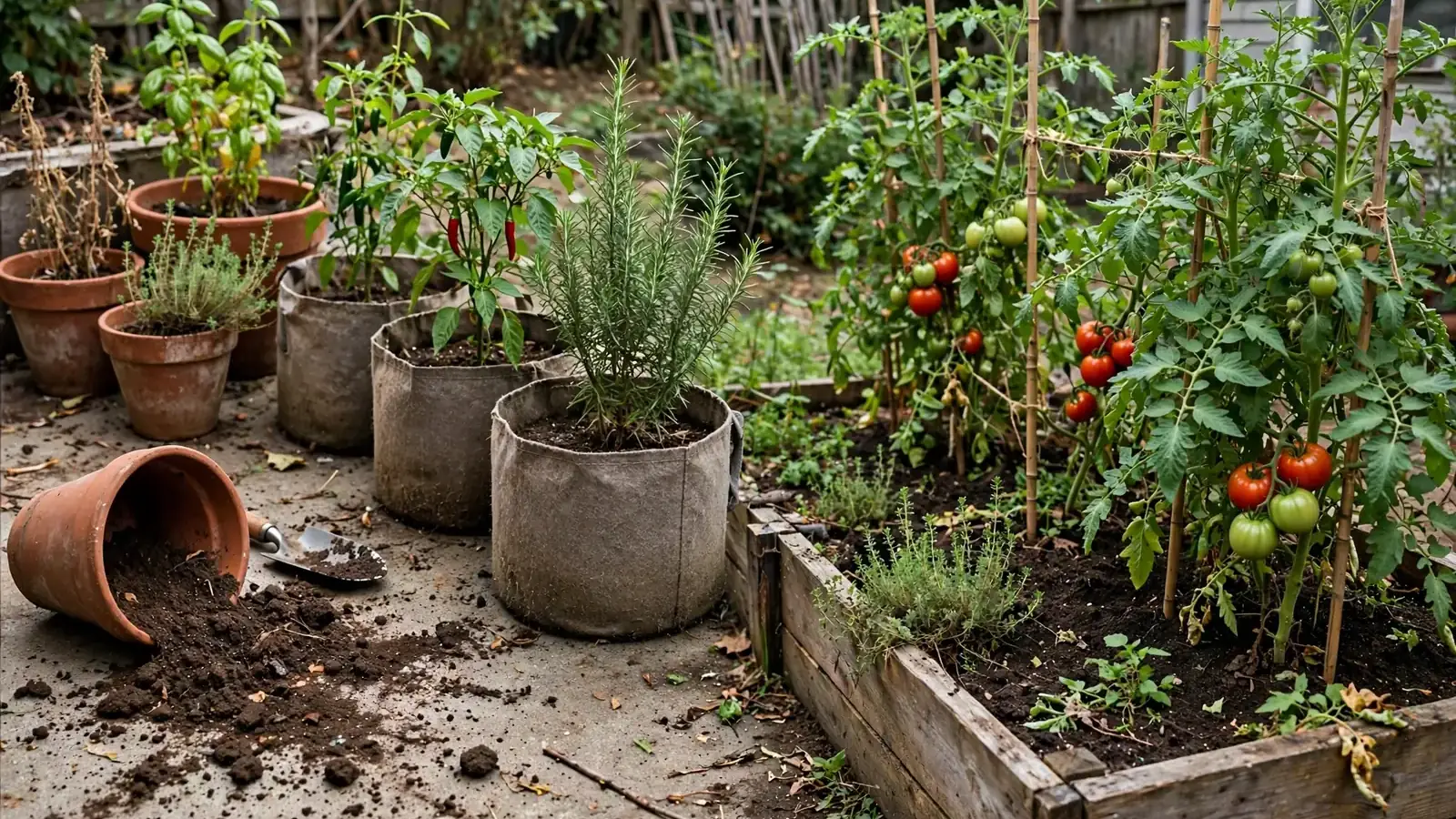
If you're deciding between growing in containers or building raised beds, you've probably noticed that most advice picks a side and argues it hard. Here's a different approach: neither is better in general. They're better for different situations — and the right choice depends on your space, your budget, your back, and what you actually want to grow.
New to raised beds? Start with our Raised Bed Gardening Hub — every soil guide in one place.
This is a decision guide, not a debate. By the end, you should know which one fits your situation — or whether the honest answer is "a bit of both."
The Quick Comparison
| Containers | Raised Beds | |
|---|---|---|
| Upfront cost | Low to start (a few pots), climbs with each pot | Higher upfront (lumber + lots of soil), cheaper per square foot at scale |
| Soil volume | Small per unit; dries out fast | Large; holds moisture and temperature steadier |
| Mobility | Move them anytime — chase the sun, dodge frost | Permanent once built and filled |
| Best spaces | Balconies, patios, rentals, tiny yards | Backyards, community plots, owned homes |
| Best crops | Herbs, salads, peppers, dwarf tomatoes | Root crops, sprawling squash, serious vegetable volume |
| Commitment | Start this afternoon with one pot | A weekend project with planning |
Cost: The Real Math
Containers win on entry cost. A decent 5-gallon pot and a bag of potting mix might run you $15–25 total, and you're growing something today. But costs scale linearly — twenty pots is twenty pots' worth of soil, and good potting mix isn't cheap.
Raised beds sting upfront. A 4×8 bed needs lumber or a kit plus around 32 cubic feet of soil at 12 inches deep — easily $150–300+ depending on materials. But the per-plant cost drops fast as the bed fills up, and the frame lasts years.
The crossover point: if you want more than about 20–30 square feet of growing space, raised beds are usually cheaper per square foot. Below that, containers win on simplicity and cost.
Soil and Watering: Where Size Matters
This is the biggest practical difference, and it comes down to physics. A small pot has a huge surface-area-to-volume ratio — it heats up fast, cools fast, and dries out fast. In midsummer, a container on a sunny patio can need water twice a day.
A raised bed's larger soil mass buffers everything: moisture lasts longer, temperature swings are gentler, and roots have room to chase water deeper. That forgiveness is why beginners often do better with beds — the soil covers for inconsistent watering.
The tradeoff: when a raised bed does dry out, rewetting 32 cubic feet takes real effort. And filling one is a genuine logistics project — calculate your raised-bed soil volume before you commit, because the soil bill surprises a lot of first-time builders.
Containers have one soil advantage: total control. Each pot gets the mix its plant wants — acidic mix for blueberries, gritty mix for herbs — without compromising for neighbors. In a shared bed, everything gets the same soil.
Mobility and Flexibility
Life changes, and containers change with it. Renters can take their garden to the next apartment. You can drag pots into the garage when a late frost threatens, or rearrange them as you learn which corner gets the best sun. If a plant is struggling, you move the plant, not the garden.
Raised beds are a commitment to a spot. Moving one means dismantling it. That's fine if you own your home and you've watched the sun for a season — it's a problem if you're renting, or if that "full sun" spot turns out to be shaded by July.
The renter's rule: if you might move within 2–3 years, lean containers. The garden you can take with you beats the one you leave behind.
What You Want to Grow
Some crops have a clear preference:
Containers do well with: herbs (basil, thyme, mint — mint especially, since it wants containment), salad greens, peppers, eggplant, dwarf and determinate tomatoes, strawberries.
Raised beds do well with: carrots and root crops (depth without stones), sprawling squash and cucumbers, corn (needs a block for pollination), potatoes, and anything where you want real volume — a season's worth of tomatoes, not a conversation piece.
Either works for: most things, honestly. People grow impressive tomatoes in 10-gallon pots and herbs in bed corners. Technique matters more than the vessel.
One thing to size correctly: container volume per plant matters enormously. A tomato crammed in a 2-gallon pot will never thrive no matter how good the soil. If you go the container route, check what size each plant actually needs with a container size picker before you buy pots.
Effort and Maintenance
Containers ask for attention in small, frequent doses — daily watering in summer, regular feeding since nutrients wash out of pots fast. It's fifteen minutes a day, not a weekend project.
Raised beds ask for effort in bigger, rarer chunks — building, filling, and a yearly compost top-up — then mostly run themselves between waterings. Mulching the surface cuts watering dramatically; a mulch calculator helps you figure out how much you'd need.
Neither is "less work" overall. They just distribute the work differently. Pick the rhythm that fits your life: daily small rituals, or occasional big pushes.
Your Back and Your Body
Worth saying plainly: gardening should fit your body. Containers on a table or railing put everything at standing height — genuinely accessible. Raised beds at 18–24 inches tall are far kinder than ground-level gardening, but still involve some bending. If mobility is a concern, tall containers or waist-high raised beds beat either standard option.
The Honest Answer: Many Gardeners Use Both
Here's what the debate usually misses — it's not either/or. A very common and effective setup is one or two raised beds for the main vegetable production, plus containers for the stuff that wants special treatment: mint that would take over, blueberries that want acidic soil, herbs by the kitchen door, a tomato on the sunny patio.
Start with whichever solves your immediate situation, and let the garden evolve. Gardens are never finished anyway.
Making Your Decision
Choose containers if: you rent, your space is a balcony or patio, you want to start today for under $50, you move plants around a lot, or you mainly grow herbs and salads.
Choose raised beds if: you own your space, you want serious vegetable volume, you're tired of daily watering, your native soil is terrible, or you want the lowest-maintenance daily routine.
Choose both if: you have the room and want the best of each — beds for production, pots for flexibility.
Next Steps
- Going with raised beds? Estimate how much soil your bed needs and read our guide to raised bed soil mix before you buy anything.
- Going with containers? Check the container size picker so every plant gets a pot it can actually thrive in.
- Still planning the layout? A garden bed planner helps you sketch it out before spending money.
Frequently Asked Questions
Can I put containers inside a raised bed?
You can, and some gardeners do — for example, sinking pots of mint into a bed to contain the roots while keeping the look unified. Just make sure the pots have drainage and you account for the lost growing space.
Do raised beds need to be replaced?
The frame eventually wears out (untreated wood lasts roughly 5–10 years depending on climate; cedar and composite last longer), but the soil just keeps improving. Rebuilding a frame around existing good soil is a weekend job, not a restart.
Are fabric grow bags better than plastic pots?
They air-prune roots, which prevents circling, and they drain well — but they also dry out faster than plastic. In hot climates, that can mean even more watering. They’re a good option, not a magic one.
Which is better for a complete beginner?
Whichever one you’ll actually tend. A single tomato in a 5-gallon pot on a sunny step teaches you more than an ambitious bed you built and abandoned. Start small, pay attention, expand next season.
Don’t guess — calculate it. Enter your bed’s length, width, and depth in our free Raised Bed Soil Calculator for exact cubic feet, bag counts, and bulk cubic yards — with a settling buffer built in.