

This post may contain affiliate links. If you buy through links on this page, we may earn a commission at no extra cost to you.
As an Amazon Associate I earn from qualifying purchases.
A tomato stem tied too tight will strangle itself by August. A cucumber vine left loose will slide off its trellis in the first wind. Both problems come from the same small choice: what holds the plant to its support. Plant clips and garden twine both do the job, but they do it in different ways, and the better pick depends on the plant, the season, and how much time you want to spend tying.
Plant clips are small plastic or metal clasps that snap around a stem and a support. They open and close with a pinch, they come off in seconds, and most of them can be used again next year. Garden twine is a length of jute, cotton, or synthetic string wrapped around the stem and the support and knotted. It costs very little per tie, it fits any gap size, and the natural-fiber kinds break down in the compost pile when the season ends.
Neither one is the right answer for every plant. Clips save time on plants that need many ties and regular adjustment. Twine fits better where stems are thick, supports are irregular, or the tie needs to sit in a spot no clip can reach. This article compares the two side by side, works through a real trellis run tied both ways, and ends with a plain verdict for each common use.
Plant clips vs garden twine at a glance
| Plant clips | Garden twine | |
|---|---|---|
| How it fastens | Snaps shut around stem and support | Wraps around stem and support, tied in a knot |
| Time per tie | About 5 seconds | About 20 to 30 seconds |
| Cost per tie | Higher up front, drops with reuse | A few cents per tie |
| Reuse | Yes, for several seasons if stored dry | No, cut off at season end |
| Fit | Fixed sizes, needs the right clip for the stem | Fits any stem and any support |
| Stem safety | Can pinch a fast-growing stem if left too long | Can cut into a stem if tied tight |
| End of season | Unclip, wash, store | Cut off, natural fiber goes in the compost |
| Best for | Tomatoes, peppers, cucumbers on straight trellises | Thick stems, odd supports, one-off ties |
The table shows the real trade. Clips trade money for speed and reuse. Twine trades time for flexibility and a low price. A gardener with six tomato plants and a straight trellis will feel the time saving from clips. A gardener tying a sprawling squash vine to a fence post will feel the flexibility of twine.
A worked example: one 10-foot trellis run, tied both ways
Take a single trellis run 10 feet long with six tomato plants spaced about 20 inches apart, a common setup in a raised bed. Each plant needs three ties over the season as it grows: one low tie at about 12 inches, one mid tie at about 30 inches, and one high tie at about 48 inches. That is 18 ties for the run.
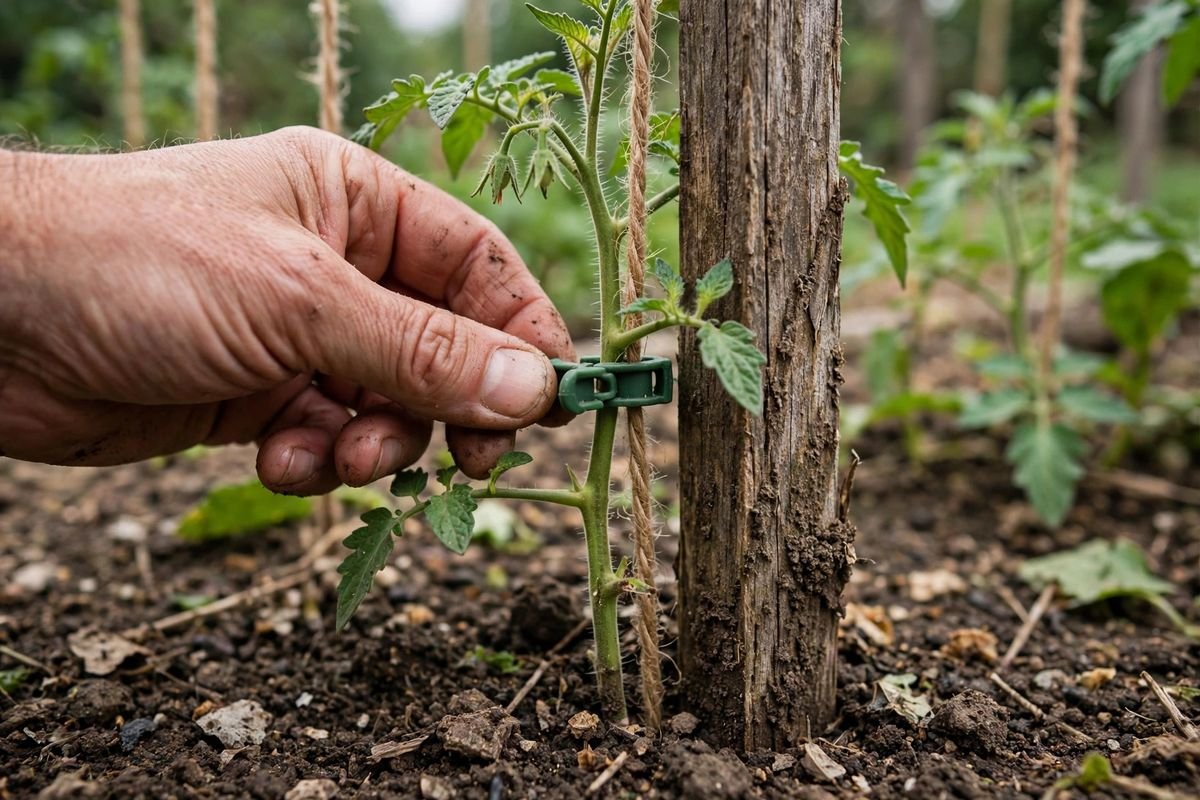
With clips, each tie takes about 5 seconds to snap on. Eighteen ties take about 90 seconds of tying time across the whole season, plus a few minutes at the start of the season to sort clips by size. A pack of 50 clips covers the run with spares left over, and the same clips can be used again next year if they are collected and stored dry.
With twine, each tie takes about 25 seconds: cut a length, wrap it in a figure eight around the stem and the support, and knot it with slack. Eighteen ties take about 7 to 8 minutes across the season. Twine use runs about 10 inches per tie, so the run needs about 15 feet of twine in total, a small share of one roll. The twine ties are cut off and discarded at the end of the season.
Cost per tie shows the same split. Using a $6 roll of jute twine with about 200 feet on it as the example price, 15 feet costs about 45 cents for the whole run, or about 3 cents per tie. Using a pack of clips bought for about $8 for 50 as the example price, 18 clips cost about $2.90 for the run, or about 16 cents per tie in the first year. If those clips last three seasons, the cost falls to about 5 cents per tie per season. The clips cost more in year one and less over time. The twine costs almost nothing and never comes back.
Time is where clips earn their price on a run like this. Saving six minutes on one trellis run is a small gain. Saving six minutes on each of ten runs across a garden is an hour. For a gardener with a few plants, the time saving is too small to matter, and twine is the cheaper pick. For a gardener with many plants, clips pay for themselves in saved evenings.
Pros and cons of plant clips
Clips are fast. A gardener can walk a trellis row and clip a dozen stems in a minute, which matters when tomato plants grow several inches in a week and need tying every few days in midsummer. Clips are also easy to move. When a stem outgrows its tie, the clip opens with a pinch and snaps on again a few inches higher, with no cutting and no waste.
Clips hold their shape in rain. A plastic clip does not stretch when wet, so the hold stays the same through a storm. Many clips are sized for common stems, and the larger sizes fit tomato and pepper stems through most of the season. Clips also keep the stem a fixed distance from the support, which leaves air moving around the stem and lowers the chance of a damp spot where disease can start.
The downsides are real. A clip that fits in June can pinch a stem that thickens by August, so clips need a check every week or two through the fast-growth months. Clips come in fixed sizes, and a stem that falls between two sizes may sit loose in the larger clip or squeeze in the smaller one. Clips also cost more up front, and a pack that gets left out over winter can turn brittle and crack the next spring.

Clips do not suit every support. A clip needs a support thin enough to fit inside its jaws, so a thick fence post or a wide wooden stake is a poor match. Clips also slip on smooth metal poles unless the clip grips well, and a clip that slides down a pole after rain leaves the stem unsupported.
Pros and cons of garden twine
Twine fits anything. A length of twine wraps around a thick squash stem, a thin bean shoot, a wooden stake, a wire fence, or a branch used as a stake, and the knot holds on all of them. Twine can be tied with slack built in, so a stem has room to thicken without being cut. A figure-eight wrap, with the cross of the eight sitting between the stem and the support, keeps the stem from rubbing on the support in wind.
Twine is cheap and easy to keep on hand. One roll covers a whole garden for a season, and a pair of scissors is the only tool needed. Natural jute and cotton twine break down in the compost pile, so end-of-season cleanup is a matter of cutting the ties and tossing them in with the spent plants. That matters in fall, when cleanup has to move fast.
The downsides are time and tension. Tying takes several times longer than clipping, and a gardener with many plants will feel that difference by midsummer. A knot pulled too tight cuts into a stem as it grows, and a knot tied too loose slips down the support. Jute twine weakens when it stays wet, so a tie that holds in June can snap in a wet September. Synthetic twine holds its strength in rain, but it does not break down, so every piece has to be cut off and thrown away rather than composted.
Twine also needs a little skill. A first tie often ends up too tight or too loose, and the fix is to cut it off and tie again. Clips skip that learning curve, since the clip either snaps shut or it does not.
How to tie so the stem stays safe
The rule is the same with either method: leave room for the stem to grow. A tie should hold the stem close to its support without squeezing it. With clips, pick the size that closes around the stem with a little daylight left inside the jaws, and move the clip up or swap it for a larger size when the stem fills the clip. With twine, wrap the twine in a figure eight and knot it with a finger-width of slack between the stem and the support.
Tie low first. A young plant tied at 12 inches grows straight from the start, and later ties follow the same line. A plant tied first at 30 inches often leans before the low tie goes on, and the lean stays in the stem. Check ties every week during fast growth, and every two weeks once growth slows. A tie that has gone tight needs to come off the same day it is found, since a stem can be damaged in a few more days of growth.
For heavy fruit, tie below the fruit cluster rather than above it. A tomato truss hangs from the stem, and a tie just below the truss carries the load without pulling on the fruit. For cucumbers, tie the main stem at each leaf joint and let the tendrils do the rest, since the tendrils grip the trellis on their own once the stem is held close. Our guide to how to grow cucumbers covers trellis spacing and training in more detail, and our guide to how to grow tomatoes covers staking and pruning for tall plants.
Removing ties at the end of the season
Ties come off when the plants come out. Leaving clips on dead stems over winter wastes the clips and leaves plastic in the bed. Leaving twine on dead stems is less of a problem for jute, which breaks down, but synthetic twine left in a bed will still be there in spring, tangled in the soil. Cut every tie, collect the clips in a bucket, and sort them by size before storing them dry indoors.
Fall cleanup is also the time to check what held up. Clips that cracked or lost their spring go in the trash, since a cracked clip can snap under a load next year. Twine that rotted early points to a wet spot in the bed or a tie that sat in a puddle. Use your local frost dates and regional planting guidance, not your USDA hardiness zone alone, to choose planting dates.

Store clips out of the sun. A shed shelf or a garage bin works, and a mesh bag keeps sizes sorted. Twine stores best indoors too, since a roll left in a damp shed can rot before spring. A dry roll kept in a sealed tub will still be sound next year.
Verdict: which tie for which job
Choose plant clips if you grow many tomatoes, peppers, or cucumbers on straight trellises and want tying to take minutes instead of a long stretch. Choose plant clips if you like to move ties as plants grow, since a clip opens and closes without waste. Choose plant clips if you want to buy once and reuse for several seasons.
Choose garden twine if you tie a small number of plants and want the lowest cost per tie. Choose garden twine if your supports are thick, rough, or irregular, since twine wraps around anything a clip cannot grip. Choose garden twine if you tie sprawling vines such as squash or melons, where each tie sits at a different angle and a fixed-size clip would not fit. Choose garden twine if you want the tie to go in the compost with the spent plant at the end of the season.
Most gardens end up using both. Clips carry the tomato and pepper rows where speed matters, and twine handles the odd jobs: a heavy branch that needs a sling, a vine that wandered off its trellis, a stem that outgrew its clip mid-season. Keep a pack of clips and a roll of jute twine in the shed, and pick the tie that fits the plant in front of you. For more on keeping container plants upright and watered, see our guide to how to keep container soil from drying out too fast.
Sources & Further Reading
University of California Agriculture and Natural Resources
Cornell Cooperative Extension
University of Minnesota Extension