
This post may contain affiliate links. If you buy through links on this page, we may earn a commission at no extra cost to you.
As an Amazon Associate I earn from qualifying purchases.
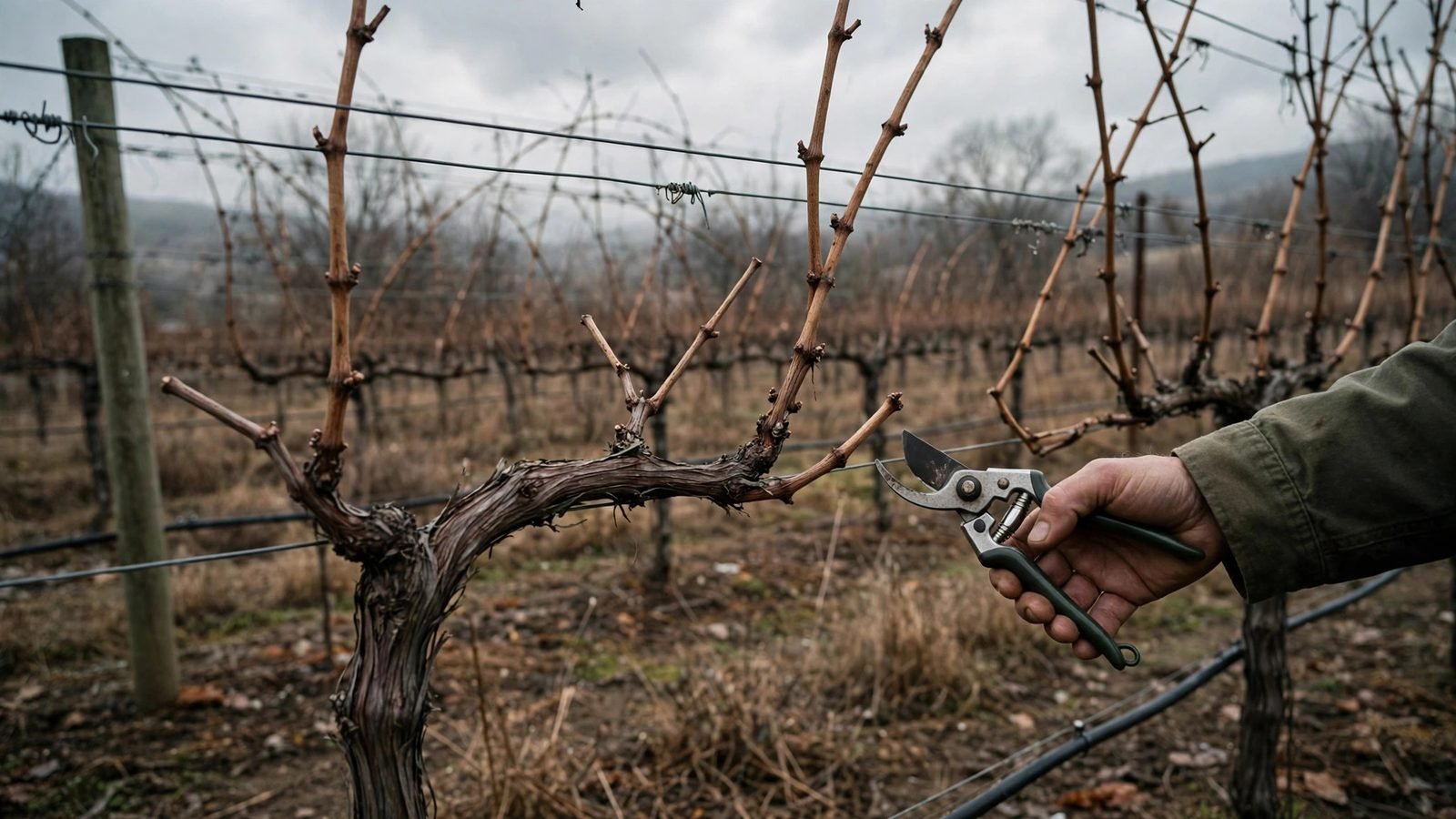
A grapevine in winter looks bare and a little stark. The leaves have gone, the tendrils have dried, and the tangled canes show the full shape of the plant for the first time since spring.
That bare stage is the right time to prune. With no leaves in the way, you can see which canes grew last year, which wood is old, and where the new fruiting wood should sit.
Winter pruning sets the crop for the coming year. Each bud you leave becomes a shoot, and each shoot can carry fruit. Leave too many buds and the vine spreads its strength thin, with small clusters and weak growth.
This guide covers dormant pruning for a home vine: when to cut, which system your vine uses, how to cut, and how many buds to leave.
When to prune grapevines in winter
Prune while the vine is fully dormant, after leaf fall and before the buds swell in spring. In many regions that window runs from late fall through late winter. The aim is to finish before budbreak, because cuts made after buds swell can damage soft new growth.
The Royal Horticultural Society names early winter as the main pruning time and advises finishing by midwinter, since later cuts can bleed sap. The flow looks messy, but extension sources describe it as a sign of a healthy vine at the end of dormancy, and it stops on its own once growth starts.
Use your local frost dates and regional planting guidance — not your USDA hardiness zone alone — to choose planting dates. In sites prone to spring frost, delaying the main cuts until late winter can push budburst a little later, which gives tender shoots a better chance of missing a late frost. Make any large cuts into old wood earlier, while the vine is still fully dormant.
Pick a dry day above freezing if you can. Frozen wood can split under the shears, so wait for a milder day if a cold snap is due.
Tools you need
Most of the work takes one good pair of bypass shears. Bypass blades pass each other like scissors and leave a clean cut, while anvil pruners crush the stem against a flat plate. For grape canes, which are woody and need a clean face to heal, bypass shears are the better pick. Look for bypass pruning shears with blades that open wide enough for pencil-thick wood and a shape that fits your hand.
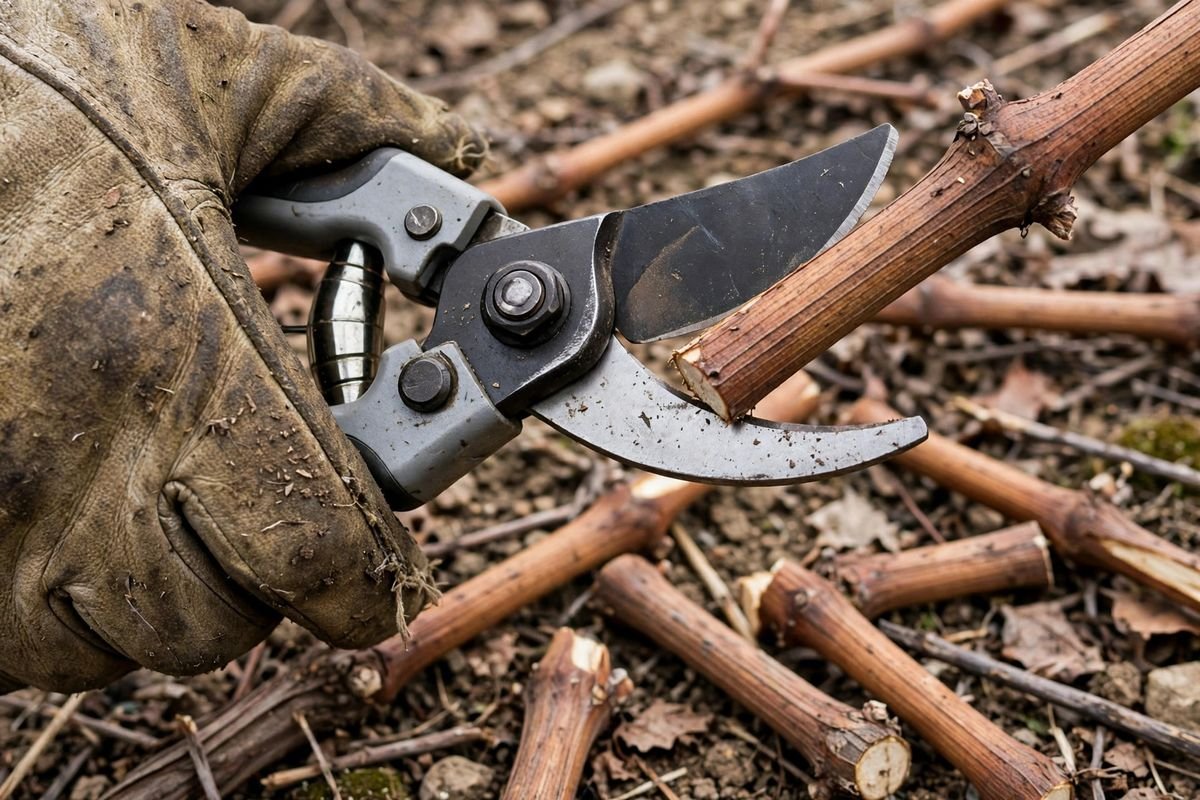
Add long-handled loppers for canes thicker than your thumb, and a folding saw for old wood at the trunk or cordon. Look for pruning loppers with bypass blades, and a folding pruning saw that locks open while you cut. Gloves protect your hands from rough bark, and soft twine ties the canes you keep to the wire.
Keep the blades sharp and clean. A dull blade tears bark and leaves a ragged face that heals slowly. Wipe the blades with rubbing alcohol between vines if you suspect disease, and sharpen them before the season starts. Our guide to how to sharpen pruning shears covers the basic steps, and bypass pruners vs anvil pruners explains why the blade style matters for woody stems.
How to read a dormant vine
Five words cover most of the vine. The trunk is the upright stem from the ground. A cordon is a permanent horizontal arm, usually tied to a wire. A cane is a shoot from last summer that has turned brown and woody. A spur is a cane cut short to one or a few buds. Buds sit at swollen nodes along each cane, and each bud holds a compressed shoot that will grow in spring.
Good canes to keep are 3 to 5 feet long, about one-third to three-eighths of an inch thick, close to the diameter of a pencil, and brown or cinnamon in color from a summer in the sun. Penn State Extension gives those same size and color marks for desirable canes. Canes that are thin, pale, dried out, hollow, or dead go on the discard pile.
Count buds from the base of a cane outward. The first few buds near the base matter most for spur pruning, since they sit close to the cordon and produce shoots in the fruiting zone. On some varieties the basal buds bear little fruit, which is why those varieties are cane pruned instead, with fruit taken from buds farther out along the cane.
Spur pruning or cane pruning: which system is yours?
Look at the permanent wood before you cut anything. A vine with long horizontal arms and short stubs spaced along them is a spur-pruned vine. A vine with a short trunk and one or two long canes tied along the wire, replaced each year, is a cane-pruned vine. The table below sums up the difference.
| Feature | Spur pruning | Cane pruning |
|---|---|---|
| Permanent wood | Long cordons with spurs spaced along them | Short trunk or head, with canes replaced yearly |
| Winter cut | Last summer side shoots cut back to 1 to 3 buds | Old fruiting canes removed, new canes kept long |
| Buds left per vine | About 20 to 60, by variety | About 20 to 30 for wine grapes, 50 to 80 for table grapes |
| Suits | Varieties with fruitful basal buds, wine grapes, muscadines | Table grapes and varieties with unfruitful basal buds |
Spur pruning is the simpler system to learn, and it suits vines trained as cordons along a wire or against a wall. Cane pruning takes more judgment at selection time, but it gives the best yields for many table grapes, since their fruit sits farther out on the cane. If you do not know the variety, keep the system the vine already has rather than switching it in one winter.
Spur pruning step by step
Start by clearing the vine of everything you do not plan to keep: dead wood, thin canes, crossing canes, and any growth below the cordon or on the trunk. Step back often; a vine that has been thinned well shows open space between the arms.
Work along one cordon at a time. For each spur position, pick the strongest one-year-old cane growing from that spot and cut it back to two buds. The Royal Horticultural Society advises one strong plump bud, or two if the first bud looks weak. Oregon State University Extension gives two to three buds per spur for home vines. Leave the cut about a quarter inch above the top bud you keep, angled so water runs off the cut face.
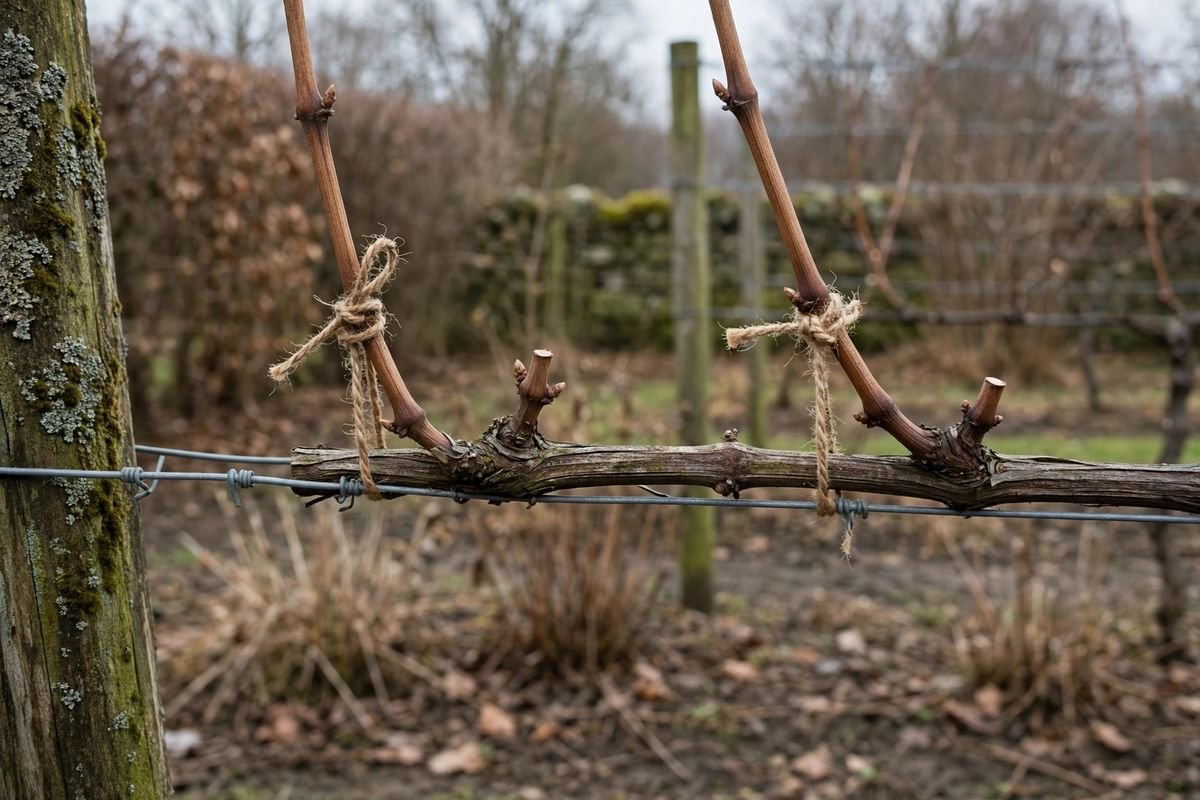
Space the spurs about 6 inches apart along the cordon. If two canes sprout from one spur position, keep the stronger one and remove the other at its base. Cut out any cane that grew from the top of an old spur and left a tall stack of stubs, since stacked spurs push the fruiting zone farther from the cordon.
Finish by clearing the trunk of suckers and watersprouts, which are shoots from the base or from latent buds on old wood. Tie any loose cordon sections to the wire with soft twine, firm enough to hold the arm in place and loose enough to let it thicken in spring.
Cane pruning step by step
Cane pruning keeps a few long canes and removes the rest. Select two to four new fruiting canes per vine, choosing canes that grew last summer, sit close to the head of the vine, and run in the direction of the wire. Cut each one to leave about 15 buds.
Near each fruiting cane, leave a short renewal spur cut to one or two buds. That spur grows the replacement cane for next winter, so the system renews itself each year. Remove all other one-year-old wood at its base, including the canes that fruited last year.
Tie each fruiting cane along the wire, wrapping it one and a half to two times around the wire and tying it near the end so it stays flat and does not whip in the wind. Canes tied flat give even budbreak in spring, while canes left arching upward push growth from the highest buds and leave the lower buds weak.
For a mature table-grape vine, aim for 50 to 80 buds per plant, and 20 to 30 buds for wine grapes, following Oregon State University Extension. If your vine is young or low in vigor, stay near the low end of the range.
A worked bud-count example for one vine
Here is a worked example with the assumptions stated plainly. Take a mature spur-pruned vine with a bilateral cordon, meaning two horizontal arms that add up to 6 feet of cordon in total, 3 feet on each side of the trunk. Assume one spur position every 6 inches along the cordon, two buds left on each spur, no missing or damaged buds, and a normal spring with no late frost.
First, find the spur positions. Six feet of cordon is 72 inches. Divide 72 by the 6-inch spacing and you get 12 spur positions along the vine. Next, find the buds. Twelve spurs with two buds each gives 24 buds left on the vine after pruning.
That is 4 buds per foot of cordon, from two spurs per foot at two buds each. For a wine variety, 24 buds sits inside the 20 to 30 bud range Oregon State University Extension gives for wine grapes, so the load fits. For a vigorous table grape, 24 buds would be light, and a cane-pruned vine of the same size might carry 50 to 80 buds instead.
Now turn buds into shoots. Not every bud breaks in spring. Assume about 80 percent break, which is a planning figure, not a measured result. Eighty percent of 24 buds is about 19 shoots. If each shoot carries one or two clusters, the vine would set roughly 19 to 38 clusters before any thinning.
Use the same arithmetic on your own vine: measure the cordon, pick a spacing, count the spurs, and multiply by the buds per spur. Check the total against the range for your grape type, and adjust the buds per spur or the spacing if it lands far outside it.
What to do after pruning
Clear the cuttings from under the vine. A season of pruned canes makes a large pile. Bundle the canes with twine for the green bin or the compost heap, but keep wood that shows cankers, mildew, or other disease out of the compost and put it in the trash instead.
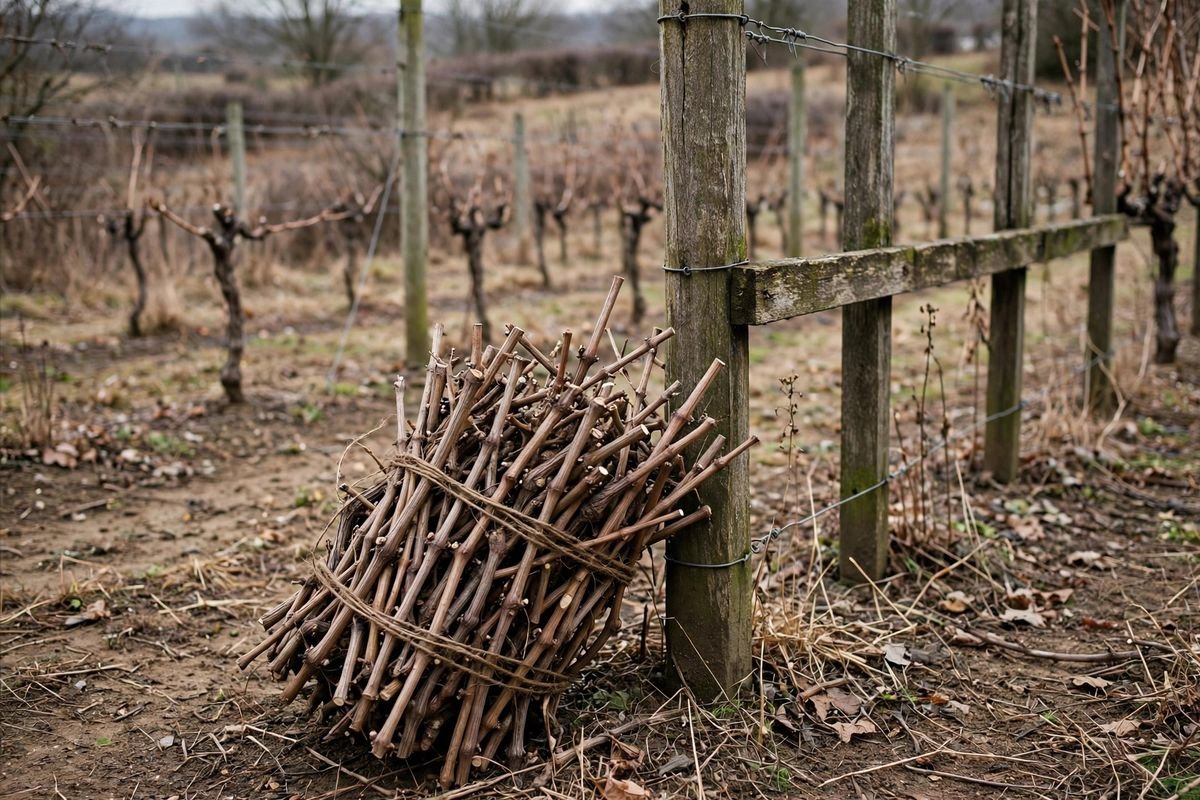
Check the trellis while the vine is bare. Tighten sagging wires, replace rotted posts, and fix loose ties before the weight of spring growth pulls on them.
Do not paint or seal the pruning cuts. The vine heals the cut face on its own, and sealants can trap moisture against the wound. Leave the cuts open to the air and let the vine close them as growth resumes.
Common mistakes to avoid
The most common mistake is pruning too little. Dormant pruning removes 80 to 90 percent of the current season growth, according to New Mexico State University Extension, and new growers often leave far more wood than the vine can carry. If the vine still looks like a tangle when you finish, count the buds you left and thin again.
Cutting above a weak or damaged bud is another frequent slip. The top bud you keep sets the direction of the new shoot, so pick a plump bud that points where you want growth to go. A flat or shriveled bud may never break, and the cane above it dies back.
Leaving long stubs invites dieback into the spur, and cutting flush against the cordon can damage the wood below. Aim for a short stub, about a quarter inch above the bud, with a clean angled face. Dull shears crush the cane instead of slicing it, so sharpen before you start.
Pruning after budbreak is the last mistake to avoid. Once buds swell, a bump from a sleeve or a shear can knock off the shoot for the year. If spring arrives early, finish the remaining cuts with care and leave the vines that have already broken for next winter.
Frequently asked questions
When is it too late to prune grapevines?
It is too late once buds have swollen and started to open. Prune while the vine is fully dormant and finish before budbreak. If you missed the window, do the lightest tidy-up you can without breaking buds, and do the full prune next winter.
Will sap bleeding from pruning cuts harm the vine?
No. Sap bleeding looks alarming, with water dripping from the cut faces, but New Mexico State University Extension states that bleeding does not harm vines and indicates a healthy vine at the end of dormancy. The flow stops on its own once growth starts.
How much wood should I remove each winter?
Far more than most new growers expect. Dormant pruning removes 80 to 90 percent of the current season growth, and the vine replaces it in one summer. Count the buds you leave and check the total against the range for your grape type, 20 to 30 buds for wine grapes and 50 to 80 for table grapes.
Can I fix a neglected vine in one winter?
Not in one pass. A vine left unpruned for years has a tangle of old wood, dead canes, and spurs stacked high above the cordon. In the first winter, remove dead and diseased wood and pick the best trunk and cordon lines. Rebuild the spur or cane system over the next two winters, one section at a time.
Do I need to seal pruning cuts?
No. Leave the cuts open. The vine seals the wound itself as growth resumes, and paint or tar can trap moisture against the cut.
Sources and further reading
- Oregon State University Extension, Pruning and training grapes in Oregon
- Royal Horticultural Society, Grapes: rod and spur pruning
- Royal Horticultural Society, Grapes: pruning and training
- Penn State Extension, Dormant Cane and Spur Pruning in Bunch Grape Vineyards
Related reading: best pruning shears for home gardeners, how to sharpen pruning shears, bypass pruners vs anvil pruners, and fall garden cleanup.
By the Pot and Plot Team