

This post may contain affiliate links. If you buy through links on this page, we may earn a commission at no extra cost to you.
As an Amazon Associate I earn from qualifying purchases.
Seed starting supplies scatter fast. Trays end up in one closet, seed packets in a drawer, and the plant labels in a third spot. By sowing time, you spend the first hour hunting for parts instead of sowing. A bin system fixes that by keeping every part in one labeled place, sorted by the job it does.
We have not tested the products linked here, and we give no current store prices. The links below go to search pages for seed starting supplies, so you can compare current options at the time you shop.
One bin system, sorted by job
Use three bins, each with a job name on the outside: trays, mixes and seeds, and lights and small parts. When you start a sowing session, pull out only the bins you need. When you finish, each item goes back to its own bin before the next job starts. The system works because the bin name tells you where an item belongs, even months later.
Pick bins with lids that latch. Seed packets slide out of open boxes, and loose potting mix drifts over everything in a shared bin. Clear bins help, since you can see at a glance if a bin is low on mix or labels. If you use opaque bins, tape a short contents list to the lid and update it when you restock.
Trays, domes, and inserts in one bin
Stack trays of the same size together, with inserts nested inside them and domes stacked on top. Mixing tray sizes in one stack wastes space, since a wide tray will not nest inside a narrow one. If you own two tray sizes, give each size its own stack, and put a label between the stacks.

Wash and dry trays before they go back in the bin. Damp trays grow mold in a closed bin, and old mix stuck in cells can carry damping-off fungi to the next sowing. Cleaning steps are in how to clean seed starting trays. Store the bin where trays cannot warp. A hot attic can bend thin plastic, so a shelf in a garage or a spare room suits most trays better.
Mixes, seeds, and labels in a second bin
Keep seed packets upright in a small box inside the bin, sorted by sowing group or by plant family. A box with dividers beats a loose pile, since packets at the bottom of a pile get crushed and their seed counts rub off. Put a marker pen and a stack of blank labels in the same box, so labeling happens at sowing time, not later from memory.
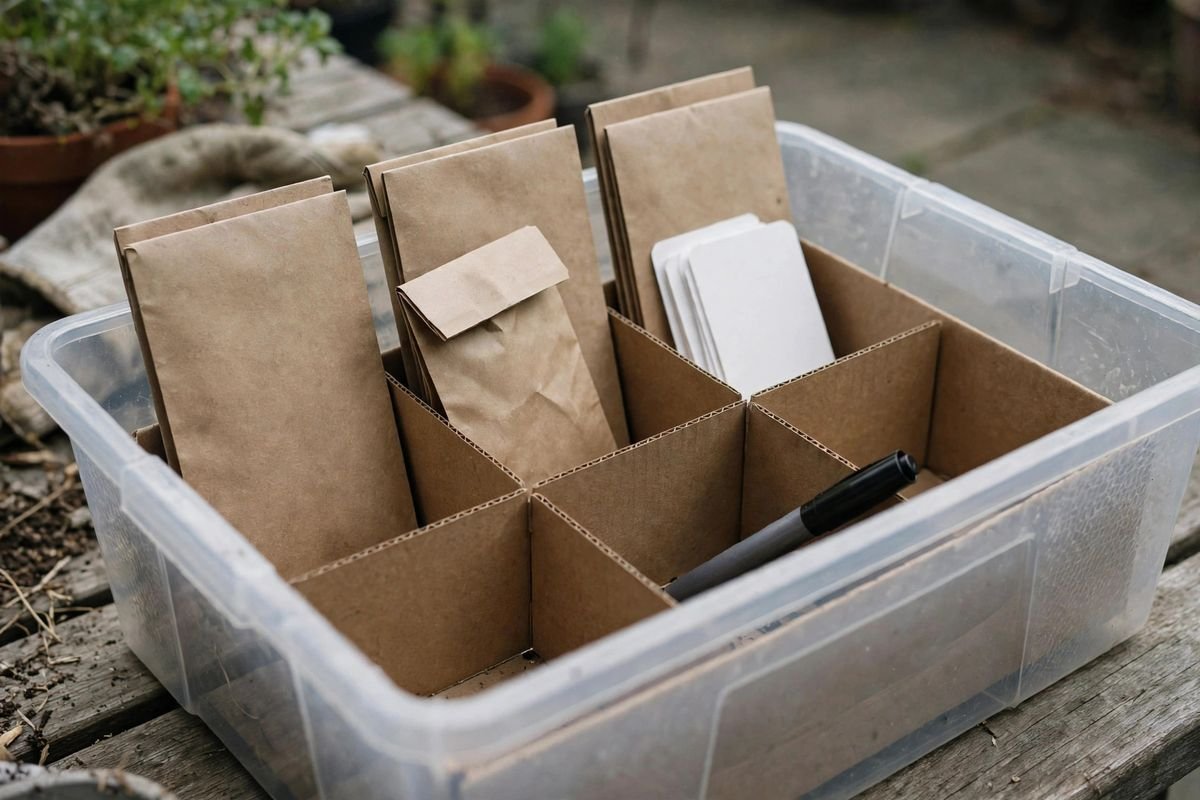
Store potting mix in its bag, sealed with a clip, inside the bin. An open bag spills mix over seed packets, and damp mix clumps in the bag. If you buy mix in bulk, scoop what you need into a smaller sealed container for the bin, and keep the bulk bag elsewhere. Check seed packets each year and pull out packets past their sowing window, so old seed does not crowd out fresh stock. For tray and kit choices, see best seed starting trays and best seed starting kits.
Lights, timers, and small parts in a third bin
Lights, cords, timers, and heat-mat controllers tangle if they share a bin with trays. Coil each cord and tie it with a twist tie before it goes in the bin. Put small parts, like spare bulbs, clips, and chain links, in a zip bag inside the bin, so a single clip does not vanish to the bottom.
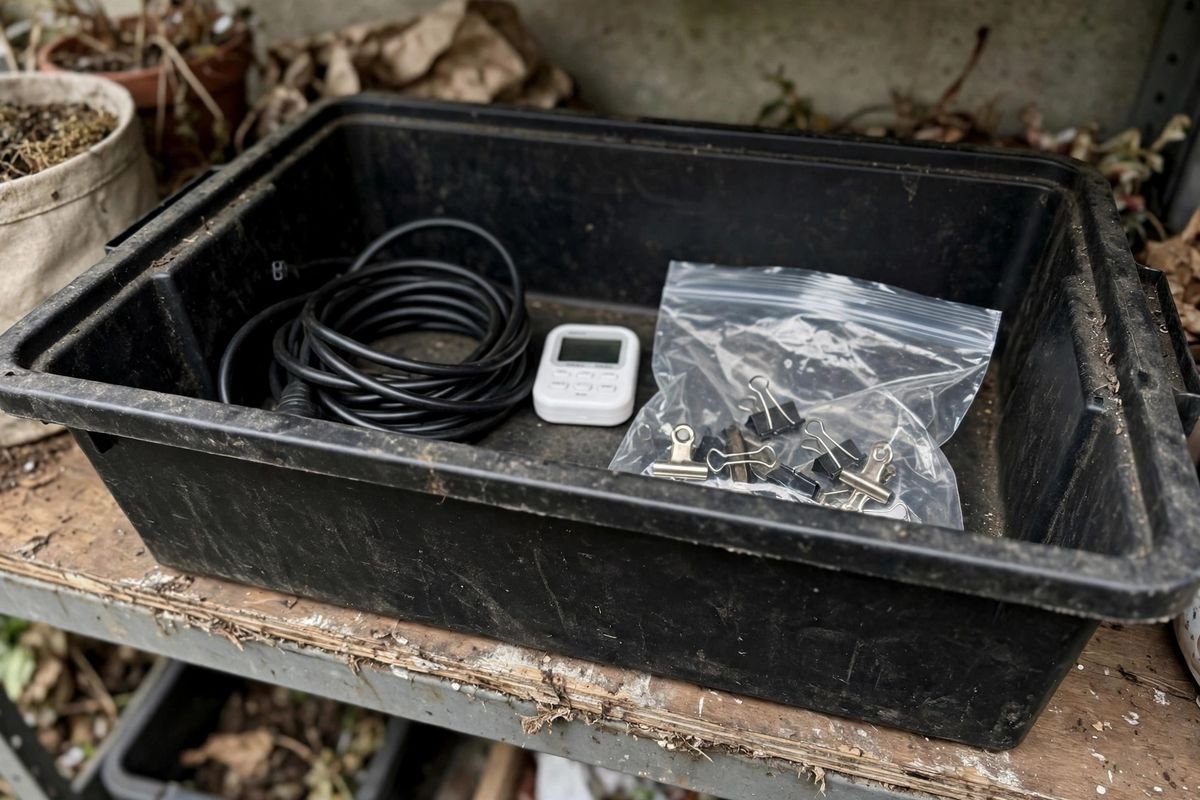
Label the bin with the shelf or stand the parts belong to. A timer that fits one stand may not fit another, and a note on the bin saves a trial-and-error session at setup time. Setup steps are in how to set up a seed starting station.
A worked example: a kit for four trays
Take a plan for four standard 10-by-20-inch trays. Assume each tray needs about 4 quarts of seed starting mix, each tray has one dome, and each tray holds 72 cells. Four trays times 4 quarts gives 16 quarts of mix, or 4 gallons. Four trays times 72 cells gives 288 cells, so a pack of 300 labels covers the batch with a few spares.
Now count the bins. One large bin about 16 inches tall holds the stack: four trays at about 2.5 inches deep each give 10 inches, plus four domes stacked at about 1 inch each gives 4 inches, for a total stack height of about 14 inches. That fits the 16-inch bin with 2 inches to spare. A second, medium bin holds the 4 gallons of mix, the seed box, labels, and a marker. A third, small bin holds two light fixtures, one timer, and a zip bag of clips. Three bins in total cover a four-tray kit, and each bin carries a job name you can read at a glance.
Label and restock at the end of each sowing round
At the end of a sowing round, spend ten minutes on restocking. Count labels, check the mix level, and note what ran short. Write the shortfall on the bin lid list before you forget it. That note becomes the shopping list for the next round, and it stops the mid-sowing trip to the store for one missing item.
Keep a simple sowing log in the seed box: tray number, variety, sowing date, and germination result. The log tells you which varieties earned a repeat and which trays need a different mix next time. It also stops duplicate sowing, since you can check the log before starting a tray you already sowed.
Sources & Further Reading
- Clemson Cooperative Extension, Home and Garden Information Center seed starting guides
- University of Minnesota Extension, Yard and Garden seed starting guides
- Iowa State University Extension and Outreach, horticulture seed starting publications
Search current options: seed starting trays with domes, clear storage bins with lids, and plant labels and marker pens.