
This post may contain affiliate links. If you buy through links on this page, we may earn a commission at no extra cost to you.
As an Amazon Associate I earn from qualifying purchases.
Seed catalogs start arriving in December, and the seed rack at the garden center fills up not long after. The short answer: order seeds for next spring in January, before the popular varieties sell out, and work back from your last frost date to decide what goes in the ground first. A January order gives you first pick of varieties, time to fix a mistake, and seeds in hand when the sowing window opens.
Ordering early is not about rushing. It is about avoiding the two failures that hit late orders every year: the variety you wanted is gone, and the packet arrives after the sowing date on its own label has passed. Both are easy to prevent with a list made before the catalogs open and an order placed while the stock is full.
This guide walks through reading a catalog, picking varieties that fit your garden, working out how many packets you need, and timing the order so the seeds arrive when you need them. If you are new to starting from seed, our seed starting checklist covers the gear and supplies to have ready before the first packet opens.
Start with your last frost date, not the catalog
Every timing decision in this guide hangs on one date: the average last spring frost for your area. Catalogs list sowing dates as weeks before or after last frost, and the packet tells you days to maturity from transplant or from sowing. Without your frost date, those numbers have nothing to anchor to.
Look up your local last frost date from your state extension service or a nearby weather station, and write it down before you open a catalog. Use your local frost dates and regional planting guidance — not your USDA hardiness zone alone — to choose planting dates. A zone tells you how cold your winters get. It says nothing about when your last spring frost falls, and two gardens in the same zone can have last frost dates a month apart.
Once you have the date, sort your wish list into three groups: crops to start indoors, crops to sow straight into the bed, and crops that can go either way. That split decides what you order first. Our guide to how to start a vegetable garden has a fuller version of this split.
How seed catalogs work
A print catalog and an online seed shop sell the same seed, but they read differently. A print catalog gives you the full variety description on one page: days to maturity, plant size, disease resistance codes, and a short note on flavor or use. An online shop adds search filters, customer reviews, and stock levels, but it also buries the same facts across tabs.
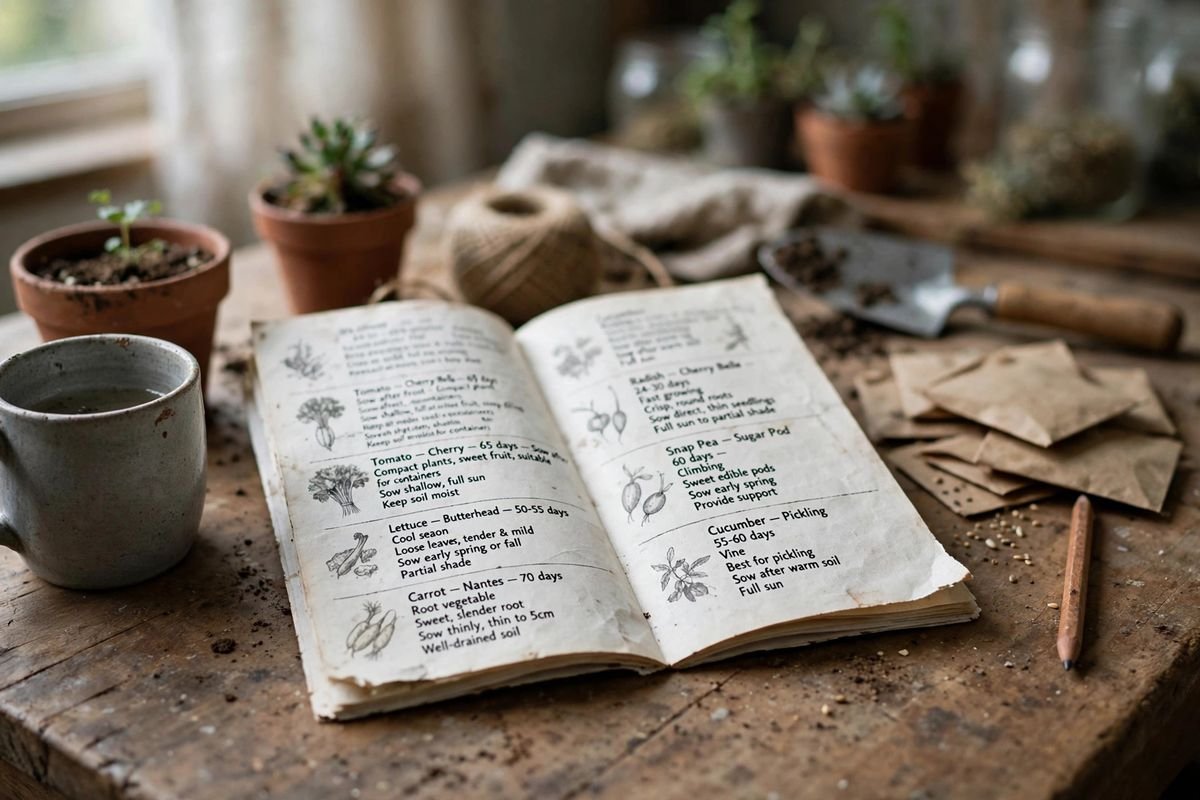
Read the variety description all the way through before you add anything to the cart. Three lines matter most. Days to maturity tells you how long from sowing or transplant to harvest, and it is the number that decides whether a variety fits your season. Disease resistance codes, usually a string of letters after the variety name, tell you which common diseases the variety resists. Plant size tells you how much bed space each plant needs, which decides how many packets you need in the first place.
Ignore the adjectives and read the numbers: 65 days beats 80 days when your season is short, and a variety that resists fusarium wilt beats one that does not when your soil has a history of it.
Pick varieties that fit your garden
Start with what you actually eat. A variety you will not cook with is wasted bed space, even if it wins awards. Make the list from your kitchen first, then match varieties to the space and season you have.
For each crop, check three things against your garden. First, days to maturity against your frost-free season: a tomato that needs 80 days from transplant will not ripen where the frost-free season runs 90 days. Second, plant size against your bed space: an indeterminate tomato needs a tall support and several square feet, while a bush type fits a container. Third, disease resistance against your garden’s history: if blight hit your tomatoes last year, a resistant variety is worth more than a new flavor.
Hybrid and open-pollinated seed both grow fine gardens, and the choice comes down to what you want from the plant. Hybrids usually give more uniform plants and built-in disease resistance, and their seed does not breed true if you save it. Open-pollinated varieties let you save seed that grows like the parent, and many older varieties have flavors that hybrids were not bred for. Grow hybrids where reliability matters most, and open-pollinated varieties where flavor or seed saving matters more. If you plan to save seed, buy open-pollinated only, and check the packet before you order.
New varieties deserve a small trial, not a full bed. Order one packet of the new tomato and grow it beside a variety you already trust. One season tells you more than any catalog description, and a failed trial costs one packet instead of a whole row.
How many packets do you actually need
Most gardeners order too much seed. A packet of lettuce holds hundreds of seeds, and a packet of beans holds enough for several rows. The fix is simple arithmetic: work out how many plants you want, divide by the germination rate on the packet, and buy only what that number calls for.
The table below uses typical packet counts and a household of two to four people. Packet counts vary by seller, so check the number printed on the packet you are buying, not the number in this table.
| Crop | Seeds per packet (typical) | Plants a household needs | Packets to order |
|---|---|---|---|
| Tomatoes | 25 to 30 | 4 to 6 plants | 1 |
| Peppers | 25 to 30 | 4 to 6 plants | 1 |
| Lettuce | 200 to 500 | 20 to 30 plants per sowing | 1 |
| Beans | 50 to 75 | 20 to 30 plants per sowing | 1 |
| Carrots | 300 to 500 | 60 to 100 roots per sowing | 1 |
| Zucchini | 15 to 25 | 2 to 3 plants | 1 |
One packet per crop covers most home gardens for a full season, and often for two, since succession crops like lettuce and beans use only a fraction of the packet per sowing.
A worked example: cost per packet, worked out
The numbers below are our own workings from stated assumptions, not prices from a catalog, so treat them as a planning guide and check the real prices on the site you order from. Suppose your order is 12 packets at an average of $3.50 each, which comes to $42.00 for seed. Add shipping of $6.95, a common flat rate for a small seed order, and the order total is $48.95.
Divide the total by the number of packets: $48.95 divided by 12 gives about $4.08 per packet delivered. That is the number to compare when you weigh one seller against another. A seller with cheaper packets and expensive shipping can cost more per packet delivered than a seller with dearer packets and free shipping over a threshold.
Now spread the cost over the plants. If those 12 packets grow about 120 plants across the season, counting succession sowings of lettuce, beans, and carrots, the seed cost comes to $48.95 divided by 120, or about $0.41 per plant. A packet of lettuce seed that costs $4.08 delivered and grows 60 heads across three sowings costs about $0.07 per head. A packet of tomato seed that costs $4.08 delivered and grows 6 plants costs about $0.68 per plant.
Keep the math honest: germination rates sit below 100 percent, so sow a few extra seeds per cell, and an unopened packet keeps for two to three years in a cool, dry place, so it carries into next spring at no extra cost.
When to order: the timeline
Seed sellers restock in late autumn and the full range is on sale by January. The popular varieties sell out first, usually by late February, and the restock, if there is one, often comes too late for spring sowing. Order in January and you choose from the full list. Order in March and you choose from what is left.
Work the order date back from your sowing dates. Indoor sowing for tomatoes and peppers starts 6 to 8 weeks before last frost, so the seed needs to be in your hands at least a week before that. If your last frost falls on April 15, tomato seed should be on your shelf by early March, and the order should go in during January to allow for shipping and a possible replacement if a packet arrives damaged.
Direct-sown crops give you more room. Peas, beans, and carrots go into the bed at or after last frost, so seed ordered in February still arrives in time. Even so, order them with the January batch. One order means one shipping charge, and the packets keep fine on the shelf until sowing day.
If a variety you want is sold out, check again in two weeks: small sellers restock in waves through January and February. If it stays sold out, pick a variety with the same days to maturity and the same growth habit.
What to check before you pay
Read the shipping terms before you check out. Some sellers charge a flat rate, some charge by weight, and some offer free shipping over a set order total. A $35 free-shipping threshold changes the math if your order sits at $30: adding one packet you will use anyway beats paying $6.95 to ship the rest.
Check the germination rate printed on the packet or the listing. Reputable sellers test each seed lot and print the rate. A rate below 70 percent for a common vegetable is a warning sign, and a seller that prints no rate at all is one to skip.
Check the return policy for damaged or wrong seed. Most sellers replace a crushed packet or a wrong variety without a fuss, but only if you report it within a few weeks of delivery. Open every packet when the order arrives, check the variety name against your list, and count the packets. A missing packet found in March is a problem; the same packet found in January is a quick email.
For a first order, a vegetable seed starter kit on Amazon can cover the basics in one box, though a catalog order usually gives a wider choice of varieties. Keep the order list and the receipts together for next year.
Storing seeds until sowing day
Seed keeps best cool, dry, and dark. A sealed jar or a zip bag with a silica packet, kept in a cupboard away from the stove, holds most vegetable seed for two to three years. The fridge works too, as long as the container is sealed, since moisture in the fridge air is what damages seed, not the cold.
Label every packet with the year you bought it. Germination falls a little each year, so last year’s lettuce seed still sows fine, while four-year-old onion seed may not. A quick germination test settles the question: fold ten seeds in a damp paper towel, keep it warm for a week, and count how many sprout. Seven or more out of ten means the packet is still good for sowing, with a few extra seeds per cell to cover the misses.
Frequently asked questions
When is the best month to order seeds for spring?
January, for most gardens. The full range is in stock, the popular varieties have not sold out yet, and the seed arrives weeks before indoor sowing starts. February still works for direct-sown crops, but the choice narrows fast after that.
How long does vegetable seed keep?
Most vegetable seed keeps two to three years in a cool, dry, dark place. Beans, peas, and tomatoes often last longer, while onions, parsnips, and corn lose germination faster. Test old seed with the damp paper towel method before you count on it.
Should I buy hybrid or open-pollinated seed?
Buy hybrids where reliability and disease resistance matter most, and open-pollinated varieties where flavor or seed saving matters more. The two types grow side by side without any trouble, and many gardens use both in the same season.
What if the variety I want is sold out?
Check back in two weeks, since sellers restock in waves through January and February. If it stays sold out, pick a variety with the same days to maturity and the same growth habit. A tomato with the same maturity date and the same bush or vine habit will behave much like the one you missed.
Sources and further reading
- University of Minnesota Extension, “Starting Seeds Indoors”: indoor sowing timing, germination, and seedling care.
- Cornell Home Gardening: vegetable variety and growing guidance from Cornell Cooperative Extension.
Related reading: Seed starting checklist: everything you need before sowing, How to start a vegetable garden, Seed starting mix vs potting soil.
By the Pot and Plot Team