
This post may contain affiliate links. If you buy through links on this page, we may earn a commission at no extra cost to you.
As an Amazon Associate I earn from qualifying purchases.
A seed starting calendar is a list of dates, one per crop, telling you when to sow indoors so the seedling is the right size on transplant day. The short answer: pick your last frost date, count back the weeks each crop needs indoors, and write the sowing date on a calendar you will actually look at. A tomato sown 8 weeks before last frost and a pepper sown 10 weeks before last frost do not share a sowing day, and the calendar is what keeps them apart.
Without a calendar, two things go wrong. Seeds sown too early grow into leggy, root-bound plants that sit on a windowsill waiting for spring, and seeds sown too late go out small and spend the first month catching up. Both come from the same cause: sowing by feel instead of by date.
This guide shows how to build the calendar from your own frost date, what numbers each crop needs, and a full worked example for three crops. If you have not gathered your supplies yet, our seed starting checklist covers the trays, mix, and light to have ready before the first sowing date arrives.
Start from your last frost date
Every date in a seed starting calendar is counted back from the average last spring frost. That date is the anchor, and everything else is arithmetic. Find it from your state extension service or a nearby weather station, and use the date for your town, not for your state as a whole, since frost dates shift with elevation and distance from water.
Use your local frost dates and regional planting guidance — not your USDA hardiness zone alone — to choose planting dates. A zone tells you how cold your winters get. It says nothing about when spring frost ends, and gardens in the same zone can sit a month apart on last frost. The calendar only works if the anchor date is right, so spend the five minutes to look up the local number.
Write the date at the top of the calendar in pen: every sowing date below is that date minus a number of weeks, so a wrong anchor shifts the whole calendar. If your area has a late frost one year in three, plan from the average date and keep row cover on hand, rather than shifting every sowing date later and losing a month of growth.
The three numbers every crop needs
Each crop needs three numbers before it gets a sowing date. First, weeks indoors: how long the seedling grows inside before transplant. Second, days to sprout: how long the seed takes to break the soil. Third, transplant timing: whether the seedling goes out at last frost, a week or two after, or once the soil has warmed well past frost.
Weeks indoors is the number that does most of the work. Tomatoes need 6 to 8 weeks. Peppers need 8 to 10, since they grow slower. Lettuce needs 4 to 5, and it can also go straight into the bed. Squash needs only 3 to 4, and sowing it earlier gives you a root-bound plant with nowhere to go. The seed packet prints this number as “start indoors X weeks before last frost,” and that line is the most useful sentence on the packet.
Days to sprout matters because the calendar date is the sowing date, not the sprouting date. A pepper that takes 14 days to sprout and 8 weeks indoors needs to be sown 10 weeks before transplant, not 8. Add the sprouting time to the indoor weeks when you count back, or the seedling will be two weeks behind on transplant day. A seed starting heat mat speeds sprouting for peppers and tomatoes, and the packet dates assume warm soil.
Transplant timing is the third number, and it is where most calendars slip. Tender crops like tomatoes, peppers, and squash go out after last frost, once nights stay above 50 degrees. Hardy crops like lettuce, kale, and broccoli go out 2 to 4 weeks before last frost.
Weeks before frost, by crop
The table below gives the usual indoor start for common crops, counted back from the transplant date. Hardy crops transplant before last frost, so their sowing dates land earlier than the weeks suggest.
| Crop | Weeks indoors | Transplant timing | Sow before last frost |
|---|---|---|---|
| Tomatoes | 6 to 8 weeks | At or just after last frost | 6 to 8 weeks |
| Peppers | 8 to 10 weeks | 1 to 2 weeks after last frost | 9 to 12 weeks |
| Eggplant | 8 to 10 weeks | 2 weeks after last frost | 10 to 12 weeks |
| Lettuce | 4 to 5 weeks | 3 to 4 weeks before last frost | 7 to 9 weeks |
| Kale | 4 to 6 weeks | 3 to 4 weeks before last frost | 7 to 10 weeks |
| Broccoli | 4 to 6 weeks | 2 to 4 weeks before last frost | 6 to 10 weeks |
| Squash and zucchini | 3 to 4 weeks | At or just after last frost | 3 to 4 weeks |
| Cucumbers | 3 to 4 weeks | 1 week after last frost | 4 to 5 weeks |
Read the last column as the date to write on the calendar. A pepper sown 9 to 12 weeks before last frost is the earliest sowing in most spring calendars, which is why peppers are the crop that catches gardeners out: they need to be sown while it still feels like deep winter outside.
Build the calendar step by step
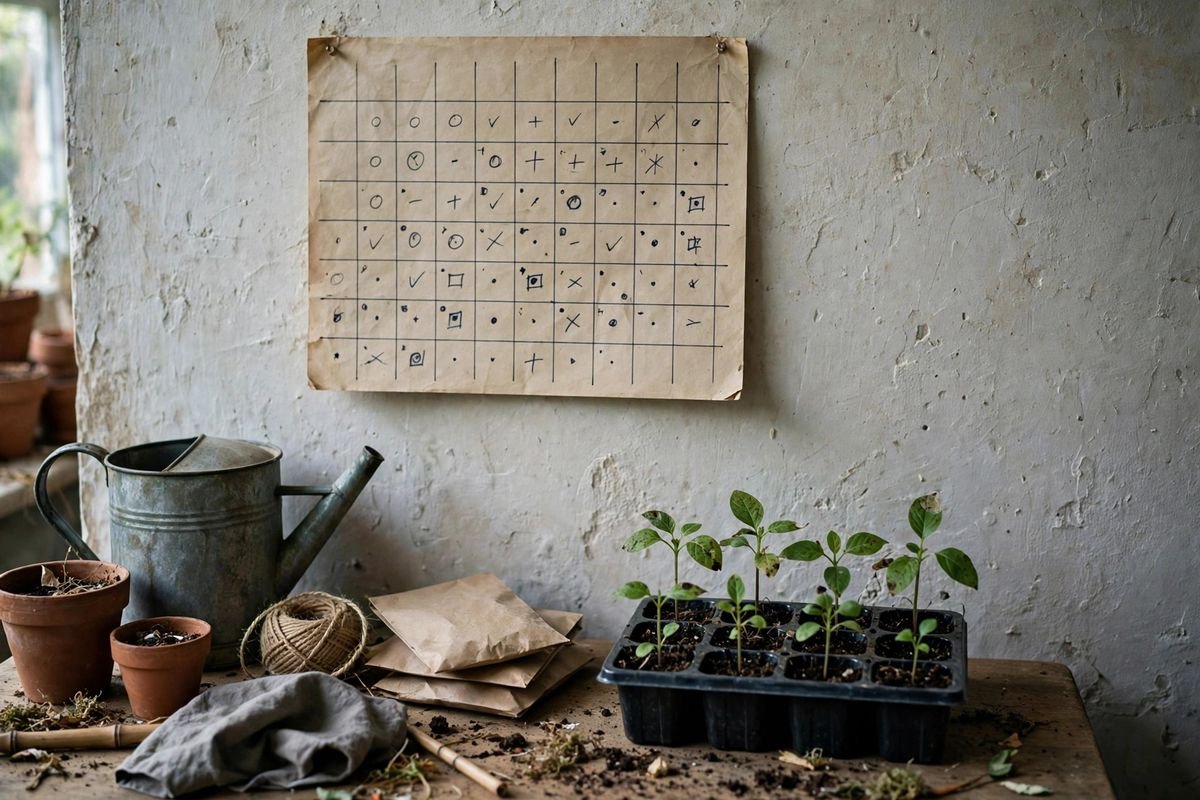
Step one is the list. Write down every crop you plan to start indoors, one per line, with the variety name beside it, since a variety with a long indoor period changes the date. Ten crops make a manageable list; twenty make a calendar that needs a spreadsheet, as long as the dates get written down somewhere you will see them.
Step two is the arithmetic. For each crop, take its transplant date, count back its weeks indoors, then add its sprouting time. Write the sowing date beside the crop, and do this for every crop in one sitting, since a calendar built in pieces tends to drift by a week here and there.
Step three is the grouping. Crops that share a sowing week go on the same day, which turns ten separate sowing days into three or four sowing sessions. Peppers and eggplant usually share a week. Tomatoes, broccoli, and kale often share another. Grouping saves an afternoon of repeated setup, and it means the trays go under the light in batches instead of one at a time.
Step four is the supply check. Count the cells you need for each sowing week and compare it with the trays you own. A week with 40 cells of peppers and 40 cells of eggplant needs two full trays, not one, and finding that out on sowing day is too late. Our comparison of soil blocks vs plastic cells helps if you are still choosing between the two.
Step five is the weekly check-in: once sowing starts, look at the calendar every Sunday and ask what needs sowing, watering, potting up, or hardening off that week. A calendar consulted only on sowing day is a list, not a plan.
A worked example: three crops, one frost date
The numbers below are our own workings from stated assumptions, so you can redo them with your own frost date. The assumption is a last spring frost of April 15, and all three crops are common varieties with the usual indoor periods.
Tomatoes: sow February 18
Tomatoes transplant at last frost, April 15, and need 6 to 8 weeks indoors. Take the middle, 7 weeks, and count back from April 15: 7 weeks is February 18. Add 7 to 10 days for sprouting, and the seed should be in the mix by February 18 at the latest. A tomato sown on February 18 is about 7 weeks old on April 15, which is the size that transplants best: stocky, with a thick stem and no flowers yet.
Peppers: sow February 4
Peppers transplant 1 to 2 weeks after last frost, so take April 25 as the transplant date. They need 8 to 10 weeks indoors, so take 9 weeks and count back from April 25: 9 weeks is February 22. Then add 14 days for sprouting, since peppers are slow to break the soil, and the sowing date moves to February 4. A pepper sown on February 4 sprouts around February 18 and is 9 weeks old on April 25. Sown on the tomato date instead, it would be two weeks behind.
Lettuce: sow February 25
Lettuce transplants 3 to 4 weeks before last frost, so take March 25 as the transplant date. It needs 4 to 5 weeks indoors, so take 4 weeks and count back from March 25: 4 weeks is February 25. Sprouting takes 7 days, so the seed goes in by February 25 and sprouts by March 4. The lettuce is ready to go out on March 25, a full three weeks before the tomato, and it will be cut before the tomato even leaves the house.
What the example shows
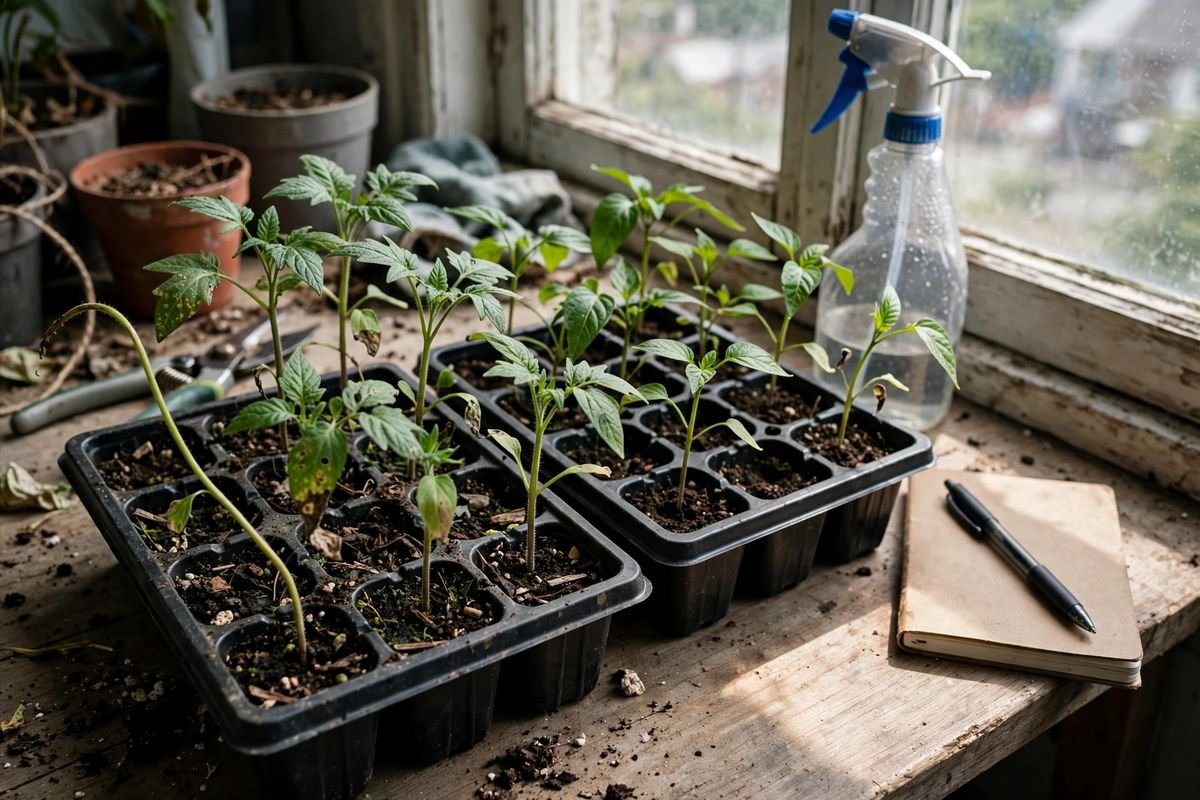
Three crops, three sowing dates spread across three weeks: peppers on February 4, tomatoes on February 18, lettuce on February 25. The order on the calendar runs opposite to the order in the garden: peppers are sown first and transplanted last, lettuce is sown last and transplanted first. If you sow all three on the same day, the lettuce is root-bound before its transplant date arrives and the pepper is still a seedling when its date comes.
Month by month: January through May
January is planning month: look up the frost date, make the crop list, order the seed, and check the trays and lights. Nothing gets sown in January in most areas, except peppers in the coldest zones. A January spent planning beats a February spent fixing a calendar built in a hurry.
February is the first sowing month. Peppers and eggplant go in during the first two weeks, tomatoes follow in the second half, and hardy crops like lettuce, kale, and broccoli go in during the last week, for transplant in late March. February is also the month to start the lettuce you grow indoors through winter, since the same trays and light serve both jobs.
March is the busy month: the February sowings need potting up into larger cells, squash and cucumbers go in during the last two weeks, and hardy seedlings start hardening off, a few hours outside each day.
April is transplant month: hardy crops go out in the first half, tomatoes at last frost, and peppers and eggplant a week or two after. Direct sowing starts too. Our comparison of direct sowing vs winter sowing covers the hardy seeds that never needed a tray at all.
What to do when the calendar slips
A calendar slips in two directions, and each needs a different fix. Sowing a week late is the easier slip: the seedling goes out a week younger, and most crops catch up within a fortnight, especially if the soil is warm and the watering is steady. Do not try to catch up by feeding heavily or by putting a small seedling out early.
Sowing a week early is the harder slip, since the seedling outgrows its cell before transplant day. Pot it up into a larger container and give it more light. If the plant is already flowering indoors, pinch the first flowers off: a tomato that sets fruit on a windowsill puts its energy into that fruit instead of into roots, and it will sulk for weeks after transplant.
A late frost after transplant is the slip nobody plans for, and row cover is the answer. Keep a length of floating row cover and a few hoops on hand through May. A floating row cover draped over the bed on a frost night holds a few degrees of warmth, which is often the difference between a live seedling and a dead one. Check the forecast every evening in the two weeks after transplant.
Frequently asked questions
What if I sow everything on the same day?
The fast crops will be root-bound before transplant day and the slow crops will go out small. Group crops by sowing week instead, and sow each group on its own date. Three sowing sessions across February beat one big session for almost every garden.
Do I need a grow light, or is a windowsill enough?
A windowsill grows seedlings, but they stretch toward the glass and go leggy without enough light. A simple shop light or LED grow light hung a few inches above the trays keeps stems short and stocky. If you only start a few trays, one light over one shelf is enough.
Can I reuse last year’s calendar?
Yes, if your crop list and varieties stay the same. Copy the dates, then mark the real transplant dates beside the planned ones and adjust next year where the gap was biggest.
Sources and further reading
- University of Minnesota Extension, “Starting Seeds Indoors”: indoor sowing timing, light, and transplant guidance.
- Cornell Home Gardening: vegetable growing guidance from Cornell Cooperative Extension.
Related reading: Seed starting checklist: everything you need before sowing, Soil blocks vs plastic cells for seed starting, Direct sowing vs winter sowing for hardy seeds.
By the Pot and Plot Team