

This post may contain affiliate links. If you buy through links on this page, we may earn a commission at no extra cost to you.
As an Amazon Associate I earn from qualifying purchases.
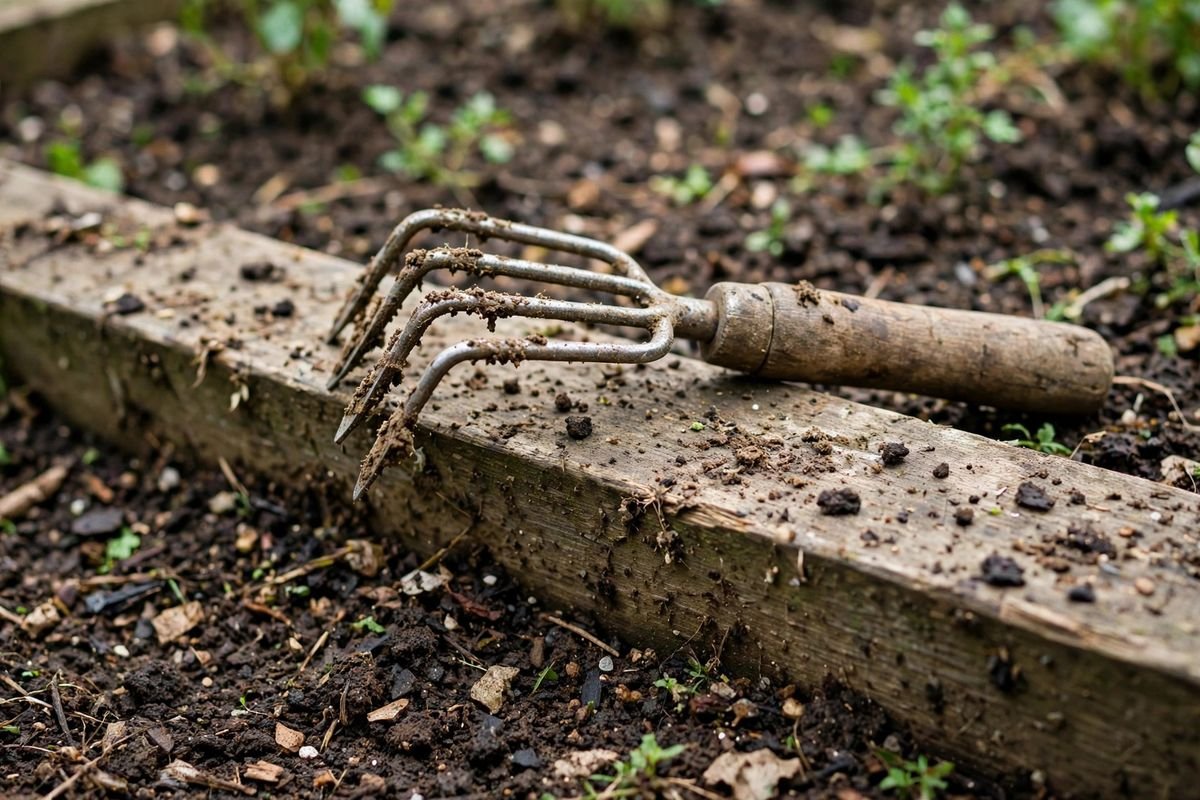
A hand cultivator is a short-handled tool with bent tines that breaks up the top inch or two of soil. It loosens crust after watering, mixes in a thin layer of compost, and pulls small weeds without turning the whole bed over. In a raised bed, where deep digging does more harm than good, a hand cultivator is often the only soil tool you need between plantings.
We have not tested the products linked here, and we give no current store prices. The links below go to search pages for hand cultivators, so you can compare current options, tine counts, and prices at the time you shop.
Three tines, five tines, or a hoe head
A three-tine cultivator has a narrow head, often about 4 inches wide, that fits between close rows and around young plants. A five-tine head runs about 7 inches wide and covers open ground faster, but it cannot fit between plants spaced 6 inches apart. A cultivator-hoe combination puts a small hoe blade on one side and tines on the other, which suits gardeners who want one tool for both jobs.
Tine shape changes how the tool behaves. Straight, stiff tines break crust and drag out shallow weeds. Curved tines dig a little deeper and lift soil as they move. Flat, wide tines act more like a tiny rake and are gentler around seedlings. If your soil forms a hard crust after watering, stiffer tines help. If your soil stays loose, a lighter head is easier on the wrist.

Handle length is a raised-bed question. A short handle keeps your hand close to the work and gives fine control near plants. A longer handle lets you work from the path, but it also levers the head sideways when you push hard. Most raised-bed gardeners do better with a short handle, since the bed is only 4 feet wide and the middle is within reach. For spacing plans that leave room for a cultivator, see how to plan plant spacing in a raised bed.
A worked example: cultivating one 4 by 8 foot bed
Take a 4 by 8 foot bed, 32 square feet, worked across its 4-foot width in passes along the 8-foot length. With a 4-inch-wide three-tine head, the 48-inch width needs 12 passes. Each pass is 8 feet, so the tool travels about 96 feet across the bed.
With a 7-inch-wide five-tine head, the same width needs about 7 passes, or about 56 feet of travel. That is roughly 40 feet less walking and pushing per session. The saving only holds where the bed is open. Between rows spaced 6 inches apart, the 7-inch head does not fit, so the narrow head is the only one that works at all. Count your row spacing before you count the saving.

Time follows the same pattern. At a slow, careful pace of about 1 foot per second, 96 feet of travel takes about 96 seconds of pushing, plus turns and weed stops. A full session with stops runs about 5 to 8 minutes for one bed. Done weekly, that is under half an hour a month to keep the surface loose and weed-free. Done only at planting time, the crust takes longer to break and the weeds have already set seed.
What to look for when you shop
Check how the head joins the handle. A head that runs through the handle and is pinned or riveted in place lasts longer than a head glued into a socket. In stony soil, a forged head holds its tine shape better than a stamped head, which bends when it hits a stone. If your beds are stony, weight is a fair trade for a head that stays true.
Grip size matters for longer sessions. A grip that fills your palm without forcing your fingers open reduces hand tiredness. Cushioned grips help in cold weather, but they also hold water, so dry them before storage. A hanging hole in the handle end keeps the tool on a hook instead of in a damp pile, which is where rust starts. Rust repair steps are in how to remove rust from garden tools.
For the rest of a beginner kit, see what garden tools a beginner actually needs. Cleaning steps after each use are in how to clean and disinfect garden tools.
Using one without harming roots
Work shallow. The top 1 to 2 inches is where crust forms and where small weed seeds sprout. Going deeper cuts crop roots, dries the soil, and brings buried weed seeds to the surface. Keep the tines flat and pull toward you in short strokes instead of chopping down.
Stay out of the bed when the soil is wet enough to stick to your shoes. Wet soil compacts underfoot and smears into a hard layer when it dries. Wait until the surface crumbles when you squeeze it. After rain, give a raised bed a day before cultivating, and skip the job entirely if water still stands in the paths.
Questions
Can a hand cultivator replace a hoe in a raised bed? For most raised beds, yes. A hoe covers open ground faster, but a raised bed is small enough that a hand cultivator keeps up, and it fits between plants where a hoe cannot.
How deep should you cultivate? About 1 to 2 inches for routine crust breaking and weeding. Deeper work belongs to planting time, when you mix compost into the root zone before plants go in.
Does cultivating dry the soil out? Shallow cultivating breaks the crust that wicks water up and out, so a loose surface can slow drying. Deep, frequent churning has the opposite effect, since it exposes moist soil to air.
Sources & Further Reading
- University of California Agriculture and Natural Resources, UC Master Gardener Program soil management guidance
- Iowa State University Extension and Outreach, horticulture soil preparation publications
- Clemson Cooperative Extension, Home and Garden Information Center raised bed guides
Search current options: hand cultivators for raised beds and three-tine hand cultivators.