
This post may contain affiliate links. If you buy through links on this page, we may earn a commission at no extra cost to you.
As an Amazon Associate I earn from qualifying purchases.
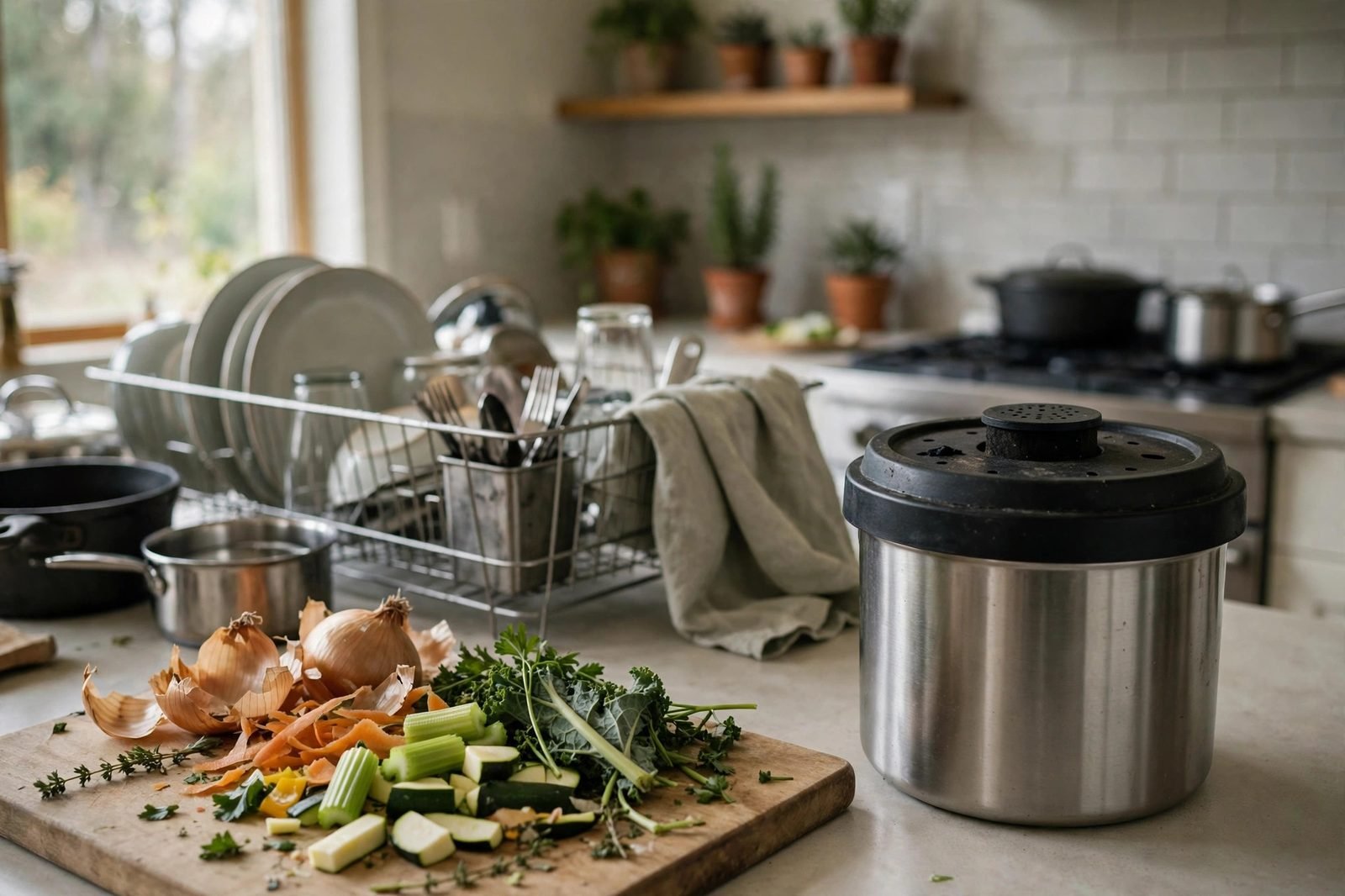
Winter is the hardest season to keep composting. The outdoor pile goes quiet, the trip to the back of the yard gets colder, and kitchen scraps still arrive every single day. The short answer: for most households, a small countertop caddy with a charcoal filter lid is the best indoor compost bin for winter. It sits beside the sink, holds about a week of scraps, and keeps smells in check if you empty it on schedule.
That said, the right bin depends on how much you cook and what you plan to do with the scraps. A stainless steel pail lasts longer and cleans up easier. A floor-standing pedal bin holds more and suits a busy family kitchen. A bokashi bucket takes foods other bins cannot, and an electric composter dries scraps overnight. This guide compares all five, with honest tradeoffs for each.
We have not tested every bin on a bench, so what follows is research-based: how each type works, what it handles well, and where it falls short. If you want the full picture of what happens after the scraps leave the kitchen, our guide to how to make compost at home walks through the outdoor side of the process.
Five indoor compost bins at a glance
Capacities are typical ranges for each category, not figures for one single product, since sizes vary from maker to maker.
| Type | Capacity | Odor control | Best for | Watch out for |
|---|---|---|---|---|
| Countertop caddy with charcoal filter | About 1 to 1.3 gallons | Good; charcoal filter in the lid traps smells | Small households and daily cooks | Filters need replacing every few months |
| Stainless steel pail | About 1 to 1.3 gallons | Good; tight lid and non-porous steel | People who want a bin that lasts for years | Heavier than plastic; some lids fit loosely |
| Floor-standing pedal bin | About 2 to 3 gallons | Fair to good; hands-free lid limits open time | Families and heavy cooks | Takes floor space; the pedal hinge wears out first |
| Bokashi bucket | About 4 to 5 gallons | Good when sealed; fermentation smell if opened often | Households that want to compost meat, dairy, and cooked food | Needs bran refills; contents must be buried after fermenting |
| Electric kitchen composter | Small batches, a few liters per cycle | Good; heat and a filter dry the scraps | People who want scraps gone fast with no trips outside | Uses power; the output is dried scraps, not finished compost |
Countertop caddy with charcoal filter
A countertop caddy is a small lidded container, usually plastic or ceramic, that lives beside the sink or cutting board. You scrape peels and coffee grounds straight into it while you cook, then carry it to the outdoor bin or the freezer when it fills up. A charcoal filter sits inside the lid and catches smells before they reach the room. It is the most common indoor bin for a reason: it is cheap and takes up almost no space.
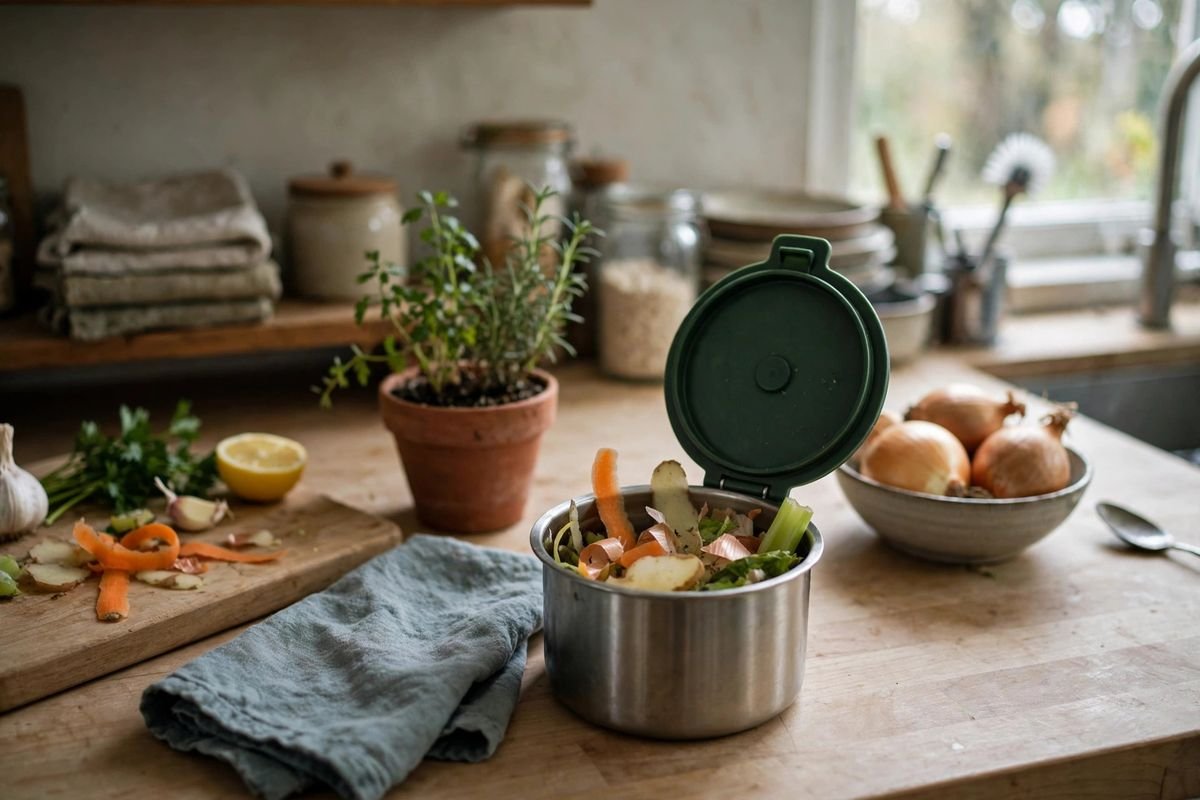
The tradeoff is size. At about 1 to 1.3 gallons, a caddy fills fast in a household that cooks most nights, so expect a trip outside every week or so, even in cold weather. Filters wear out after a few months, and a tired filter is the most common reason a caddy starts to smell. Pick this one if you cook for one or two people and want the lowest-effort way to start. If you would rather browse current options, this search for indoor compost bins on Amazon shows the range of caddies, pails, and pedal bins in one place.
Stainless steel pail
A stainless steel pail works the same way as a countertop caddy, with one big difference: the body is steel instead of plastic. Steel does not absorb smells the way plastic can, it wipes clean in seconds, and it will not crack if dropped.
The tradeoff is weight and price. A steel pail costs more than a plastic caddy of the same size, and a full one feels heavier in the hand. Some cheaper steel pails have lids that sit loosely, so check the lid fit before you commit. Pick this one if you plan to compost for years and would rather buy one bin once than replace a plastic caddy every year or two.
Floor-standing pedal bin
A floor-standing pedal bin is the big brother of the countertop caddy. It stands on the kitchen floor next to the trash can and opens with a foot pedal, so your hands stay free while you scrape a plate. At about 2 to 3 gallons, it holds roughly twice what a countertop caddy holds, which means fewer trips outside.
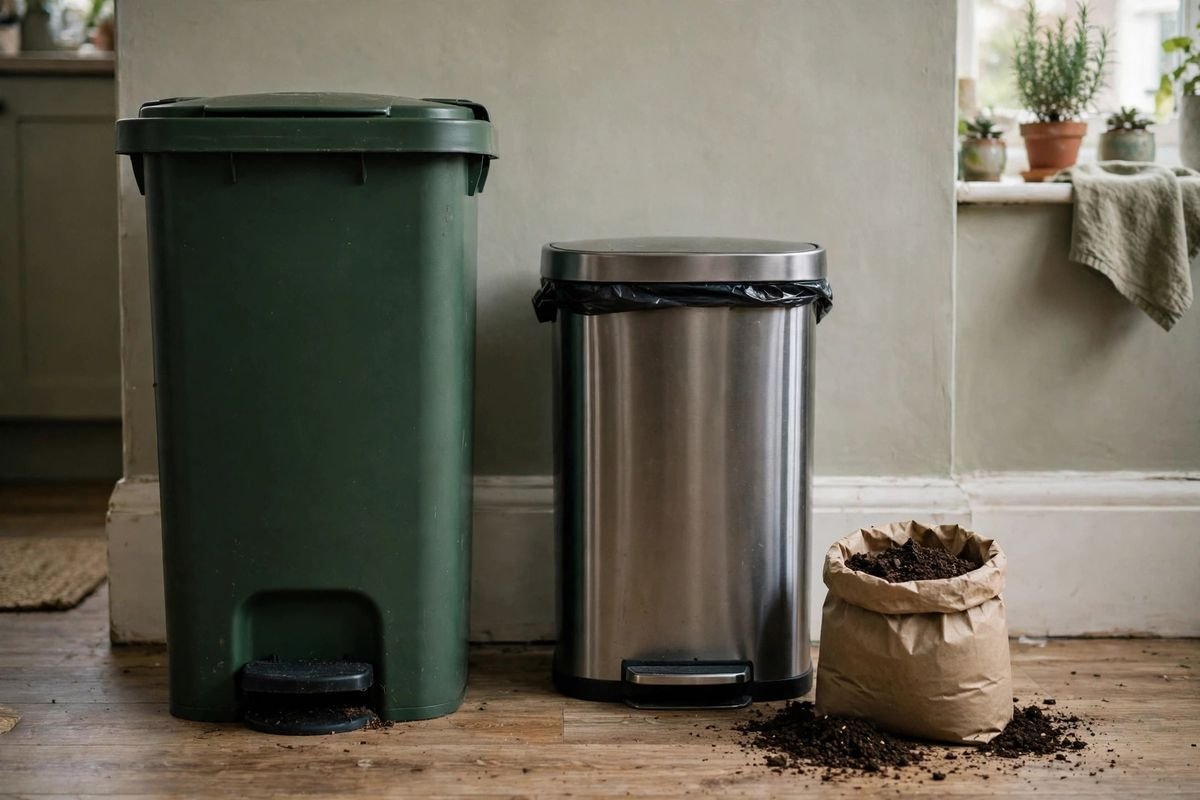
The tradeoff is floor space and moving parts. A pedal bin needs a patch of floor near the trash, and in a small kitchen that patch may not exist. The pedal hinge wears out first, and a lid that does not close is a lid that lets smells out. Pick this one if you cook for a family and would rather empty a bin twice a month than twice a week.
Bokashi bucket
A bokashi bucket works by a different method from the rest. Instead of letting scraps rot in air, you press them into an airtight bucket with a sprinkle of bokashi bran, which is grain inoculated with microbes that ferment the food. After about two weeks the contents can be buried in soil or added to an outdoor pile. The big draw is what it accepts: meat, fish, dairy, bread, and cooked food, all the things a normal caddy cannot take.
The tradeoff is process. A bokashi bucket needs a steady supply of bran, and you must keep the lid sealed and drain off the liquid that collects at the bottom every few days. Open the lid too often and the sharp, vinegary fermenting smell escapes. What comes out is fermented food, not compost, and it still needs soil or a pile to finish. Pick this one if you hate throwing food away and your household produces a lot of cooked leftovers, meat scraps, or dairy.
Electric kitchen composter
An electric kitchen composter is a countertop appliance that grinds and heats scraps until they dry into a small pile of crumbs. A cycle takes a few hours, and the output is a fraction of the volume you put in.
The tradeoff is honesty about what comes out. The EPA notes that these appliances reduce the volume and weight of food scraps by grinding and dehydrating them, but they do not produce compost. The dried output still needs a composting system, a garden bed, or a collection program. The machine also uses power, hums while it runs, needs filter changes, and takes up a real patch of counter space. Pick this one if you live in a flat or a home with no outdoor space and you are willing to pay for convenience. If you would rather compare current models, this search for electric kitchen composters on Amazon shows the range of sizes and cycles on offer.
How often will you empty it? A worked example
Emptying frequency is the question that decides which size to buy. The figures below are our own workings from stated assumptions, not lab measurements, so treat them as a planning guide.
Start with a two-person household. Suppose the two of you cook at home most nights and produce about 3 to 4 lb of kitchen scraps a week: peels, coffee grounds, eggshells, and stale bread. Take the middle of that range, 3.5 lb a week. A standard 1.3-gallon countertop caddy holds roughly 5 to 6 lb of loose, wet scraps; take the middle, 5.5 lb.
Divide capacity by weekly output: 5.5 lb divided by 3.5 lb a week gives about 1.6 weeks per fill, which is about every 10 to 11 days. At 3 lb a week it lasts about 13 days; at 4 lb a week, about 10 days. So a two-person household with a 1.3-gallon caddy should plan on emptying it roughly every 10 to 13 days.
The same math scales up. A four-person household produces roughly double, about 6 to 8 lb a week, so the same caddy fills in about 5 to 6 days. That household is better off with a 2 to 3 gallon pedal bin, which holds roughly 10 to 12 lb.
Two caveats keep the math honest. First, weight depends on what you throw in: wet scraps like melon rinds and coffee grounds are heavy for their size, while dry bread and eggshells are light. Second, bulky scraps like corn husks fill a caddy by volume before weight does. If your caddy always looks full after five days even though the math says ten, trust your eyes and empty it sooner.
Keeping smells down in winter
Cold weather helps, since cool air slows the microbes that make a scrap bin stink, but a warm kitchen undoes that advantage. The caddy sits at room temperature all day, so keep the lid shut, empty on schedule, and never let scraps sit in a warm bin for weeks.
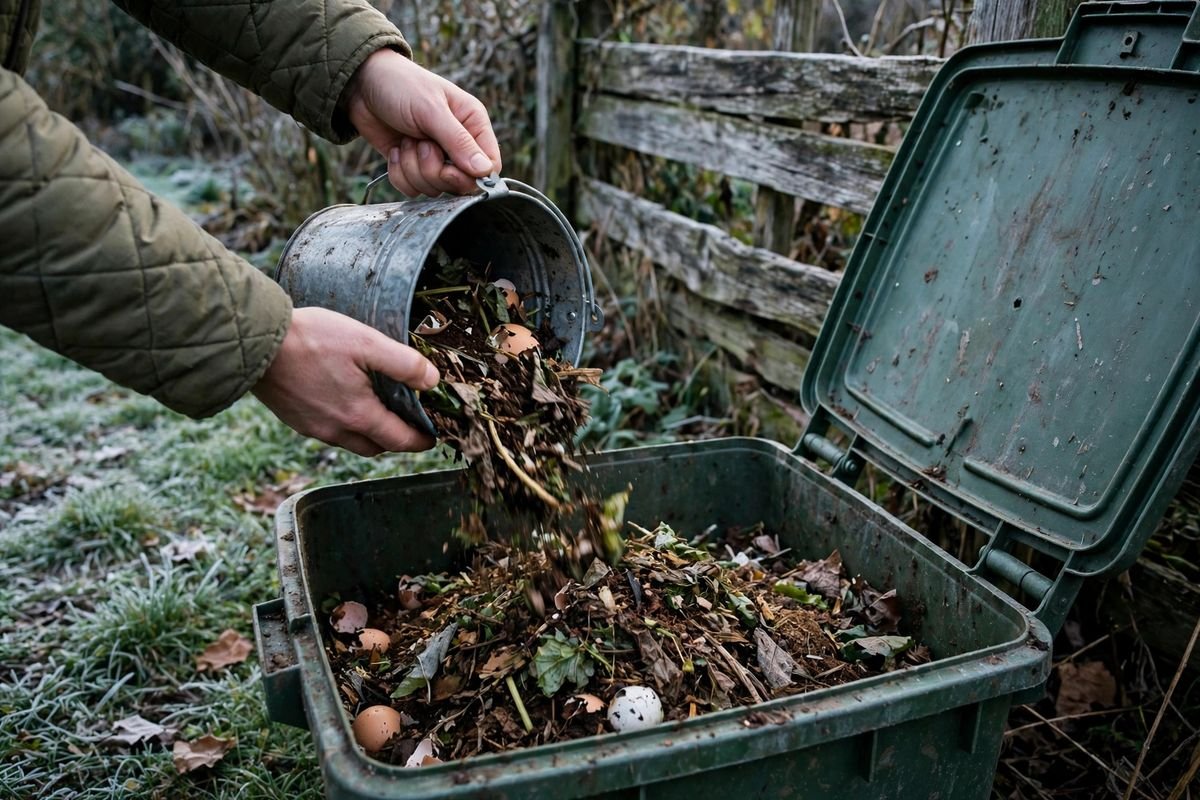
Three habits do most of the work. First, line the caddy with a sheet of newspaper or a compostable bag, which soaks up liquid and keeps the bin itself clean. Second, add a handful of dry material, like shredded newspaper or dry leaves, on top of wet scraps. Third, change the charcoal filter on schedule, since a filter that has been in the lid since spring is doing nothing by winter.
The freezer is the best winter trick of all. Keep a bag in the freezer and toss scraps in as you go. Frozen scraps do not smell at all, and you can empty the bag into the outdoor bin whenever the weather allows. When you do head outside, if that bin is frozen shut, our guide to what to do with a frozen compost bin covers how to deal with it. If you move scraps outdoors, check your local frost dates first.
Frequently asked questions
Can I put meat and dairy in an indoor compost bin?
In a normal caddy or pail, no. Meat, dairy, and greasy food break down slowly, smell badly, and can draw pests, which is why the EPA lists them among the materials to keep out of a home compost pile. A bokashi bucket is the exception, since fermentation handles those foods.
Do charcoal filters really stop smells?
They help, but they are not magic. A fresh charcoal filter traps a good share of the smell from a closed caddy, which is why most caddies ship with one. The catch is that filters wear out after a few months of steady use, and a worn filter traps almost nothing.
What if my outdoor compost bin is frozen solid?
Leave it alone until a thaw. A frozen pile is not broken, it is just paused, and the microbes inside will wake up when temperatures rise. In the meantime, keep scraps in a countertop caddy and empty it into the freezer.
Is an electric composter the same as composting?
No, and the difference matters. An electric composter dries and shrinks scraps, but the output is not finished compost. It still needs to go into soil, a compost pile, or a collection program to break down fully. Think of it as a scrap dryer, not a replacement for composting.
Sources and further reading
- EPA: Composting at Home: what to add, what to keep out, and how the EPA describes electric pre-processing appliances.
- Cornell Composting: composting science and fact sheets from the Cornell Waste Management Institute.
Related reading: How to make compost at home, What to do with a frozen compost bin, How to start a worm bin indoors for winter.
By the Pot and Plot Team