

This post may contain affiliate links. If you buy through links on this page, we may earn a commission at no extra cost to you.
As an Amazon Associate I earn from qualifying purchases.
A small garage can hold a full set of garden tools without blocking the car or the walk to the door. The trick is to put each tool in a fixed spot on a wall, overhead, or on a cart, and to leave the floor as open as possible. Tools piled in a corner fall over, hide the tool you need, and turn a quick job into a search.
We have not tested the products linked here, and we give no current store prices. The links below go to search pages for garage storage, so you can compare current options at the time you shop.
Start with the walkway, not the wall
Walk the route you use most, from the garage door to the house door and out to the yard. Mark that path with tape on the floor if it helps. Keep that strip clear of bins, bags of soil, and leaning tools. A walkway about 3 feet wide lets one person pass with a watering can or a tray of seedlings without turning sideways.
Once the walkway is set, the walls beside it become storage. Tools hung on a wall take up only a few inches of depth, while the same tools leaning in a corner can eat a foot or more of floor. Keep heavy tools at waist height or lower, and put light, long tools higher, where a falling handle cannot hit anyone.
Wall rails for long-handled tools
A pair of horizontal rails with hooks holds most long-handled tools: shovels, spades, rakes, hoes, and a garden fork. Hang each tool by its handle hole or by a hook under the head, with the head pointing down or up in a consistent way. Heads pointing down keep sharp edges low and away from hands, but heads pointing up keep mud off the wall. Pick one direction and keep it, so you can grab a tool without looking twice.
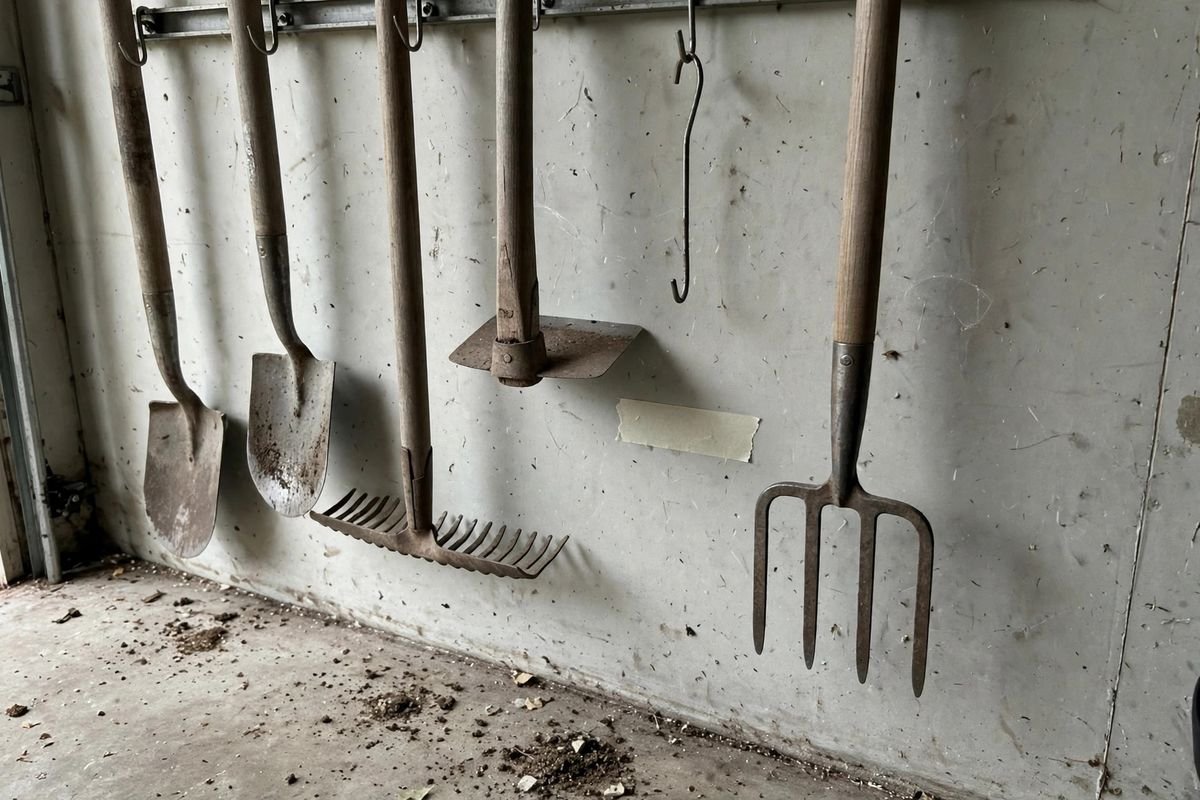
Hand tools need a different rail. Trowels, hand forks, and cultivators are short, and they slide off wide hooks. A rail with small hooks, a pegboard strip, or a row of spring clips keeps them in place. Hang them by the handle end, with the working end down, and leave a finger-width gap between tools so you can lift one out without pulling its neighbors off the rail.
Put labels on the rail if more than one person uses the garage. A short strip of tape with a tool name under each hook stops the slow drift where tools end up on the nearest empty hook. A label maker is not needed. Masking tape and a marker work, and you can rewrite a label when a tool is replaced.
Ceiling storage for bulky seasonal items
Ceiling racks suit items you use a few times a year: a spare hose reel, a folding trellis, cold-frame panels, and empty pots stacked in a mesh bag. A rack mounted to ceiling joists keeps those items off the floor and out of the walkway. Check the rack height before you buy one. You need enough clearance to walk under it and to open the car doors, and the rack must sit below any garage-door track.

Do not store heavy soil bags or full watering cans overhead. A bag that slips from a high rack can hurt someone and split open on the floor. Keep overhead loads light and flat, and strap loose items so they cannot slide off when the garage door shakes the frame.
A rolling cart for daily tools
A small rolling cart holds the tools you reach for every week: a trowel, hand pruners, twine, gloves, and a hand fork. Roll it to the yard door when you work, and roll it back to its marked spot when you finish. A cart with a flat top also gives you a place to set a tray while you pot up seedlings.

The cart works only if it has a home. Mark its parking spot on the floor with tape, and keep that spot out of the walkway. A cart left wherever you stopped using it becomes one more obstacle, and the tools on it end up scattered again.
A worked example: one 10-foot wall in a one-car garage
Take a one-car garage with one free wall 10 feet wide, or 120 inches. Assume you own 6 long-handled tools and 8 hand tools, and you want a clear walkway beside the wall. Leave 12 inches of spare wall at one end for a door frame or a light switch. That leaves 108 inches of usable rail.
Give each long-handled tool 10 inches of rail width. That figure covers handle width and room for your hand. Six tools times 10 inches gives 60 inches of upper rail. Give each hand tool 6 inches of rail width. Eight tools times 6 inches gives 48 inches of lower rail. The two rails together need 108 inches, which matches the usable wall exactly. If your count is larger, add a second wall section or move bulky seasonal items to a ceiling rack instead of crowding the rail.
Check the depth too. Tools hung flat on a wall stick out about 6 inches. A walkway 3 feet wide beside that wall still leaves 30 inches of clear passage after the tools, which is enough for one person carrying a tray. If the walkway narrows below 2 feet, move the rail to the opposite wall or shift bulky items overhead.
Keep tools dry and easy to grab
Garage damp is the main enemy of stored tools. Wipe mud off blades before hanging them, and let wet tools dry near the door before they go back on the rail. A light wipe of oil on carbon steel heads slows rust in a damp garage. Full cleaning steps are in how to clean and disinfect garden tools, and rust repair steps are in how to remove rust from garden tools.
Review the layout once a season. Tools you have not used in a year can move to the ceiling rack or out of the garage, and the rail space they free up goes to tools you reach for weekly. A short seasonal check keeps the system honest, and it stops the wall from filling up again. For a full care routine, see garden tool maintenance checklist and what garden tools a beginner actually needs.
Sources & Further Reading
- Clemson Cooperative Extension, Home and Garden Information Center tool care guides
- University of Minnesota Extension, Yard and Garden tool maintenance guides
- Iowa State University Extension and Outreach, horticulture tool care publications
Search current options: wall-mounted garden tool racks, garage ceiling storage racks, and rolling garden tool carts.