
This post may contain affiliate links. If you buy through links on this page, we may earn a commission at no extra cost to you.
As an Amazon Associate I earn from qualifying purchases.
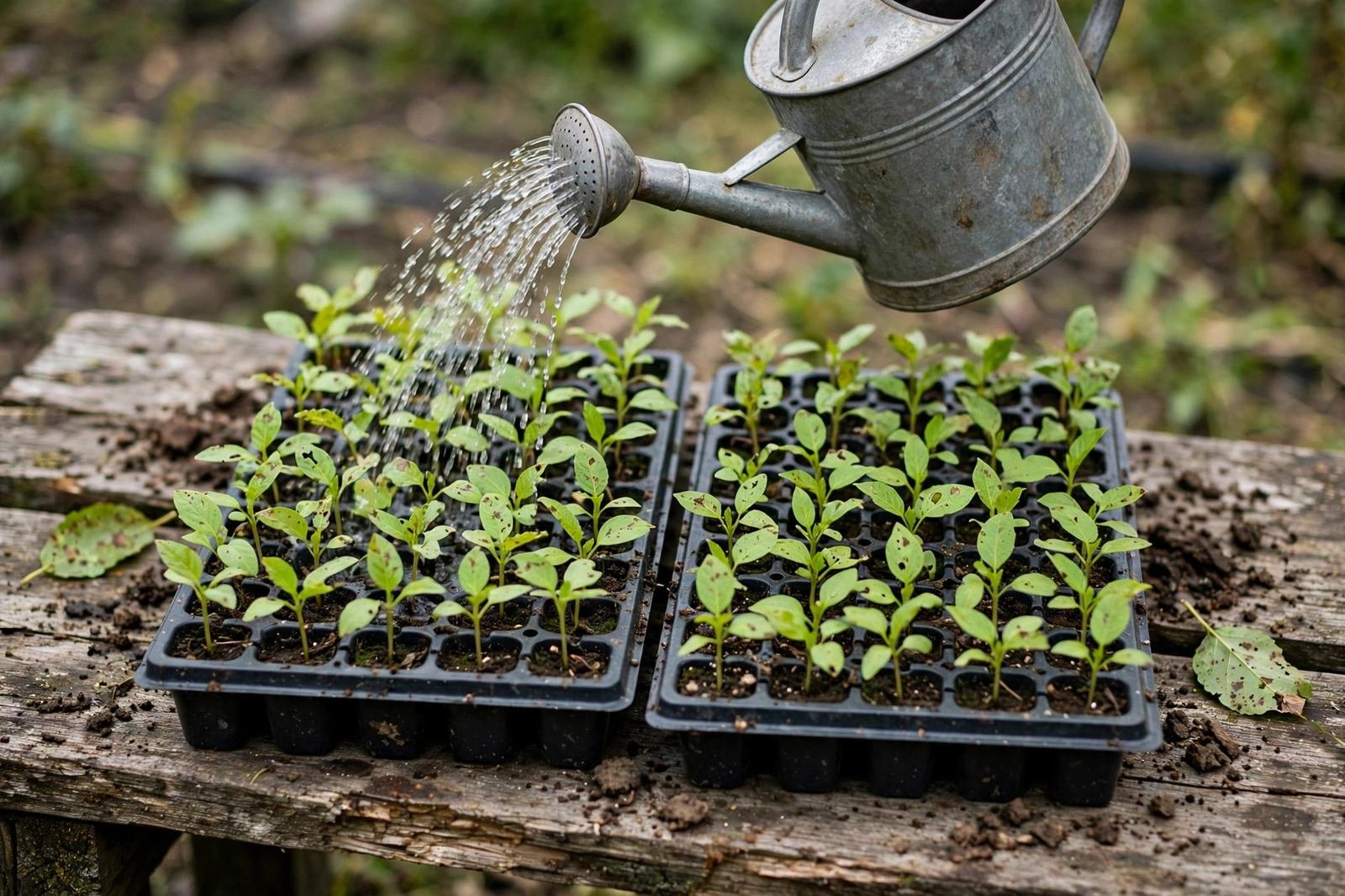
Seedlings fail more often from rough watering than from too little water. A hard stream from a hose or a large can knocks tiny plants flat, moves seeds out of place, and washes fine soil mix out of the cells. A can made for seedlings gives a soft rain instead, so water soaks in without disturbing the roots that are just forming.
We have not tested the products linked here, and we give no current store prices. The links below go to search pages for can types, so you can compare current options, sizes, and prices at the time you shop.
Why seedlings need a gentle pour
A seedling cell holds only a small amount of mix, and that mix dries fast under lights or near a sunny window. The roots in that cell are thin and shallow. A strong pour compacts the mix, closes the air spaces roots need, and leaves a crust on the surface. A fine rose breaks the stream into many small drops, so the surface stays loose and water moves down evenly instead of running off to one side.
Control matters as much as gentleness. With a small can, you can stop after one pass, look at the surface, and add a second light pass only where the mix still looks dry. That habit prevents the two common errors with seedlings: a daily flood that keeps roots wet, and a light sprinkle that wets only the top and leaves the lower mix dry. For a gentler method that skips top watering altogether, see how to bottom water seedlings, and for timing, see how often to water seedlings.

A worked example: four trays of seedlings
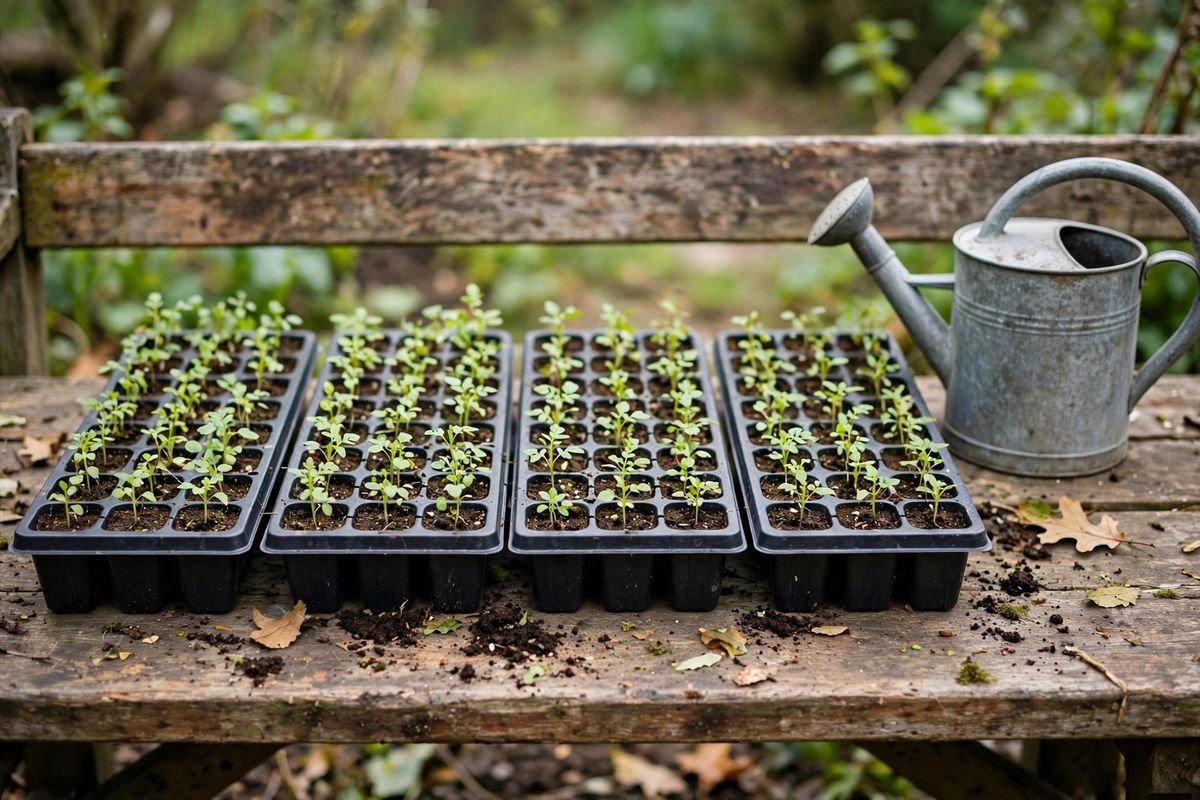
Take four trays with 24 cells each. That is 4 times 24, or 96 cells in total. Suppose each cell needs about 1 fluid ounce of water per round, roughly 30 millilitres, to wet the mix through without water pooling in the tray. This is an assumption for the example, not a rule for every mix: a coarse mix drains faster and may need a second pass, while a peat-heavy mix holds water longer and may need less.
The arithmetic for one round is simple. 96 cells times 1 fluid ounce per cell gives 96 fluid ounces, which is 3 quarts, or 0.75 gallon. A 2-gallon can holds 256 fluid ounces. Two rounds need 192 fluid ounces, so one full 2-gallon can covers two rounds with 64 fluid ounces left over. A third round needs 96 fluid ounces, so it needs a refill of at least 32 fluid ounces on top of what is left. In plain terms, a 2-gallon can handles two full rounds for four trays, then needs topping up before the third.
The example also shows why can size is a trade-off. A 2-gallon can is heavy when full, about 17 pounds with water alone, and that weight is hard to pour with care over small cells. Many growers keep a large can for filling and a small 1-quart or half-gallon can for the actual pour over trays. The small can needs refilling more often, but each pour stays gentle and easy to aim.
What to look for in a seedling can
Start with the rose. A fine rose has many small holes and gives a soft shower. A coarse rose, the kind sold for beds and borders, drops larger streams that can flatten seedlings. Some cans come with two roses, fine and coarse, that swap on the spout. That pair is handy if one can must serve both trays and larger pots.
Next, check the spout and the balance. A long spout reaches across a tray without tipping the can, and a spout that sits low on the body pours with less tilt. Hold the can, if you can, with water in it: the handle should let your wrist stay straight, and the can should not tip forward when the rose is on. A can that feels awkward empty will feel worse when full.
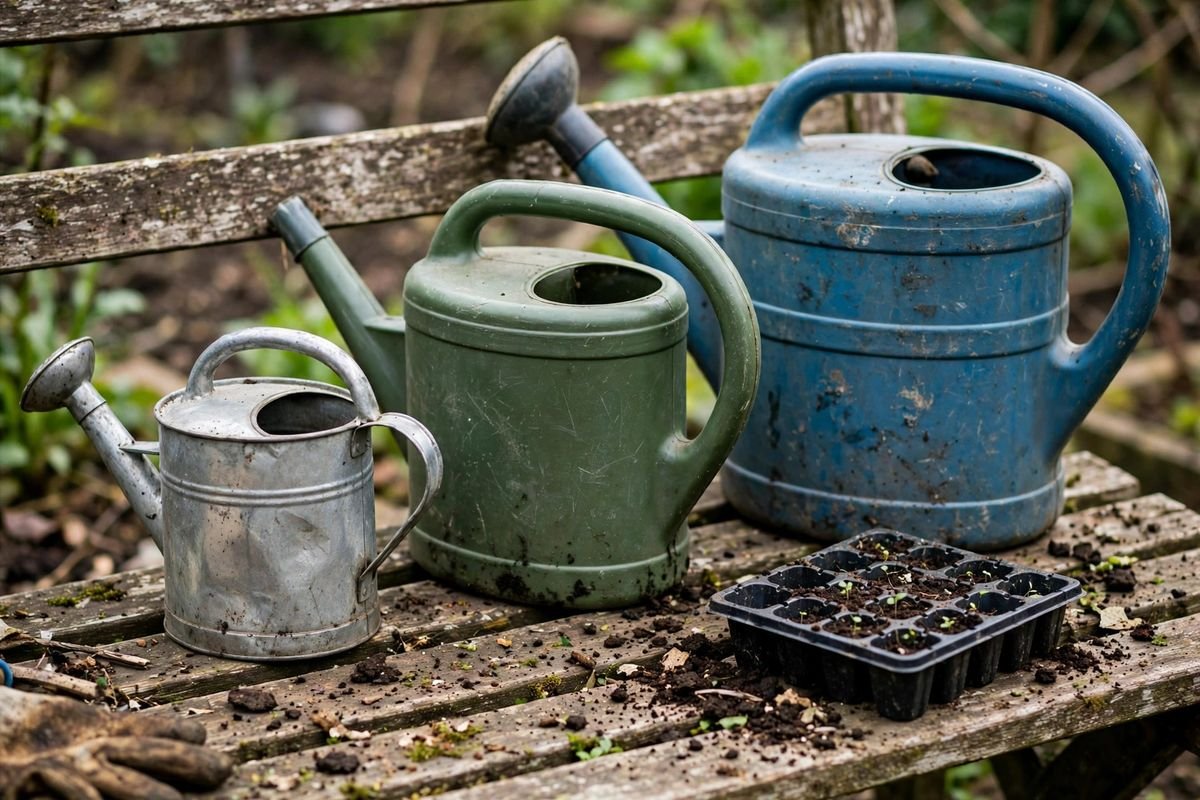
Capacity and material come after that. For indoor trays, a half-gallon to 1-gallon can is often the sweet spot: large enough to water several trays, small enough to pour with care. Plastic cans are light and cheap, and they do not rust. Metal cans last longer and hold their shape, but they cost more and feel heavier. Either material works for seedlings, as long as the rose is fine and the pour stays soft.
Watering cans compared with watering wands
A watering wand is a different tool, not a larger can. It fits on the end of a hose, stretches your reach into beds and hanging baskets, and gives a rain-like spray for plants that are already established. It is a poor fit for seedling trays, because a hose keeps feeding water while you move, and the flow is harder to stop cell by cell. A can, by contrast, holds a fixed amount, so you can see how much you have used and stop at any point.
That difference also sets the place for each tool. Use a wand for beds, borders, and baskets that need a lot of water fast. Use a can for trays, small pots, and new transplants that need a measured, gentle pour. Many growers own both, and that split is sensible: the wand does the heavy work outside, while the can does the careful work inside. To compare wands on their own terms, see best watering wands for gardeners, and for a direct wand-versus-nozzle comparison from this batch, see watering wand vs hose nozzle.
To compare current options, search for watering cans for seedlings with a fine rose and small indoor watering cans with a long spout. Check the rose first, then capacity, then whether the spout and handle feel balanced when the can is full.

Care, storage, and a few habits that help
Empty the can after each use, especially a metal can, so stale water does not sit in the rose and clog the small holes. A quick rinse and a shake clear most soil crumbs. Store the can with the rose off, if it comes off, so air moves through the spout and the rose dries out.
Two small habits make tray watering easier. First, water in the morning, so leaves dry during the day and the mix is not wet all night. Second, water from the bottom sometimes, as described in how to bottom water seedlings, and use best bottom watering trays for seedlings to pick a tray that suits that method. Alternating top and bottom watering keeps the surface from crusting while the lower mix still gets wet.
Questions
Can you use a regular watering can for seedlings? You can, if it has a fine rose and you pour slowly. A large can with a coarse rose is the problem, not the can itself. Swap the rose for a fine one, or pour into a small can for the trays.
How do you know a tray has had enough water? Water until a small amount drains from the cell holes or the tray feels heavier, then stop and empty any standing water from the outer tray after 15 minutes. Seedlings left standing in water rot faster than seedlings that dry a little between waterings.
Is a spray bottle a good substitute for a can? A spray bottle wets only the surface, so it suits seeds that have not yet sprouted. Once roots form, the mix below the surface needs water too, and a fine-rose can does that job with far fewer passes.
Sources & Further Reading
- University of Minnesota Extension, starting seeds indoors guides
- Cornell Cooperative Extension, seed starting and transplant guides
- Penn State Extension, seed starting guides