
This post may contain affiliate links. If you buy through links on this page, we may earn a commission at no extra cost to you.
As an Amazon Associate I earn from qualifying purchases.
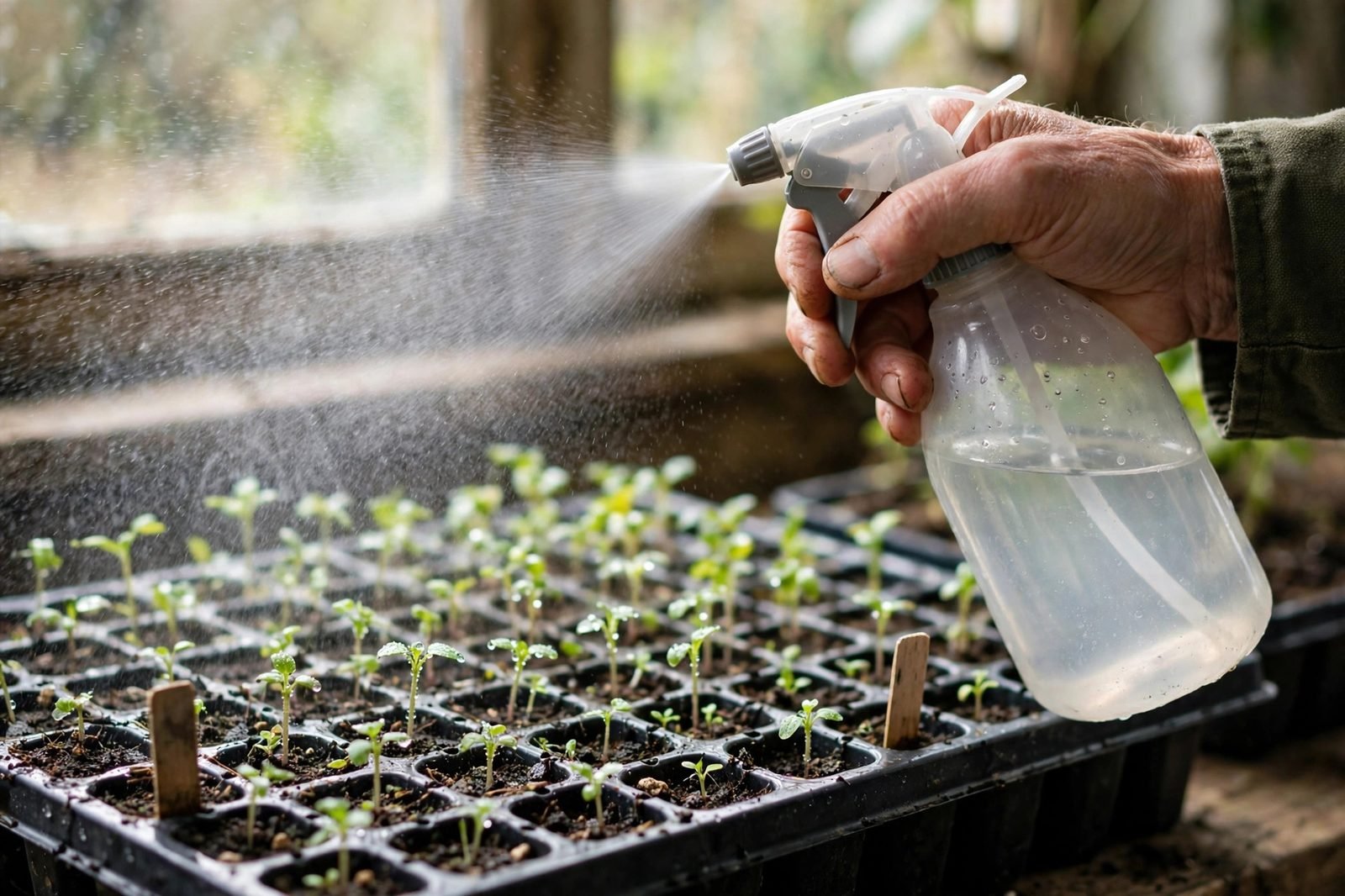
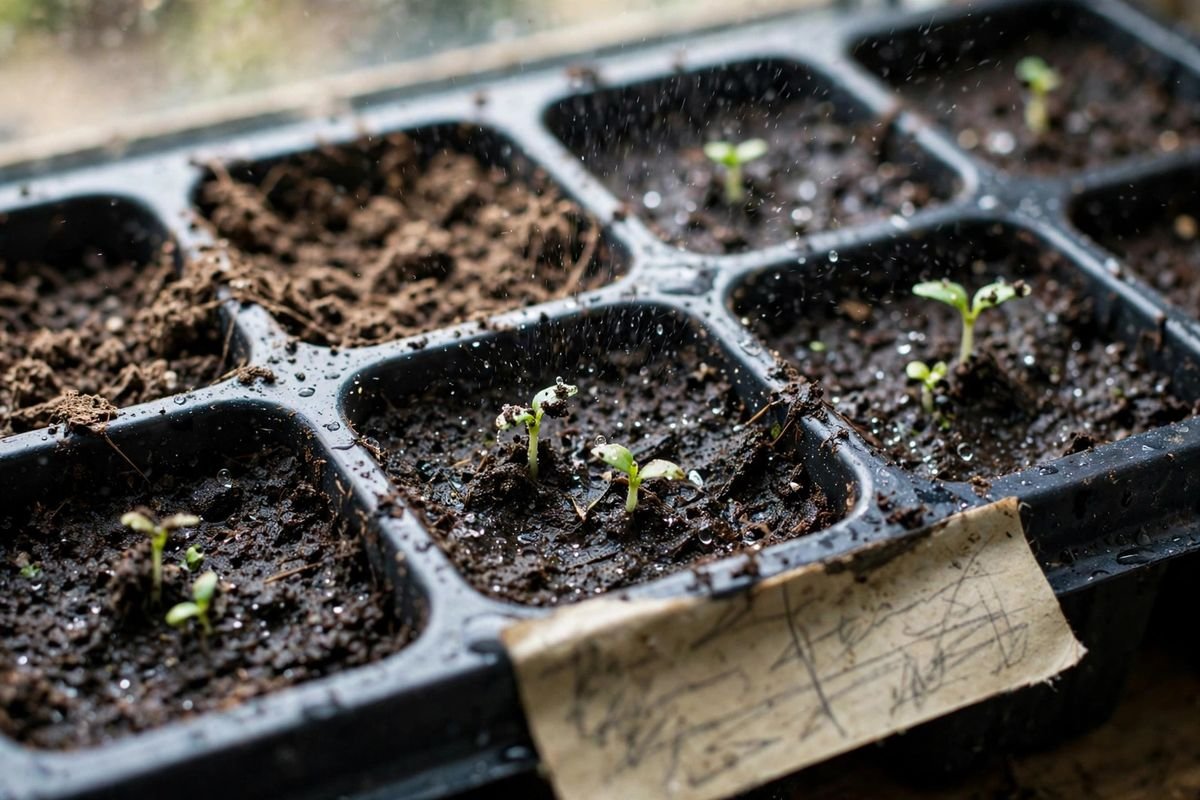
Seedlings are easy to kill with kindness. A watering can pours a stream heavy enough to flatten a just-sprouted stem and wash tiny seeds out of their cells. Misting gives you a gentler tool: fine droplets that dampen the mix surface without moving seeds around. The University of Minnesota Extension lists a spray bottle on its seed-starter supply list and calls gentle moisture “best applied with a spray bottle.”
This is a research-based buying guide. We compared listed specs, capacity, spray adjustability, and materials, across the bottle types sold for seed starting. We did not run side-by-side product tests, so we make no claims about which brand survives a season on our bench. What follows is how the specs line up for real seed-starting work, plus the refill math we did ourselves so you can buy the right size the first time.
Spray bottles for seedlings at a glance
| Pick | Capacity | Spray pattern | Material | Best for |
|---|---|---|---|---|
| Continuous-mist bottle | 300-360 mL | Fine mist on a sustained pull | PET plastic | One or two trays of delicate seedlings |
| Pump trigger bottle | 500 mL-1 L | Adjustable, mist to stream | HDPE plastic | Budget all-rounder |
| Pressure sprayer | 1.5-2 L | Adjustable nozzle, mist to stream | HDPE plastic | Three or more trays |
| Battery mister | About 1 L | Continuous fine mist | Plastic | Gardeners who mist daily |
| Tiny glass atomizer | About 100 mL | Fine mist | Glass | Skip for seed starting |
What seedlings need from a spray
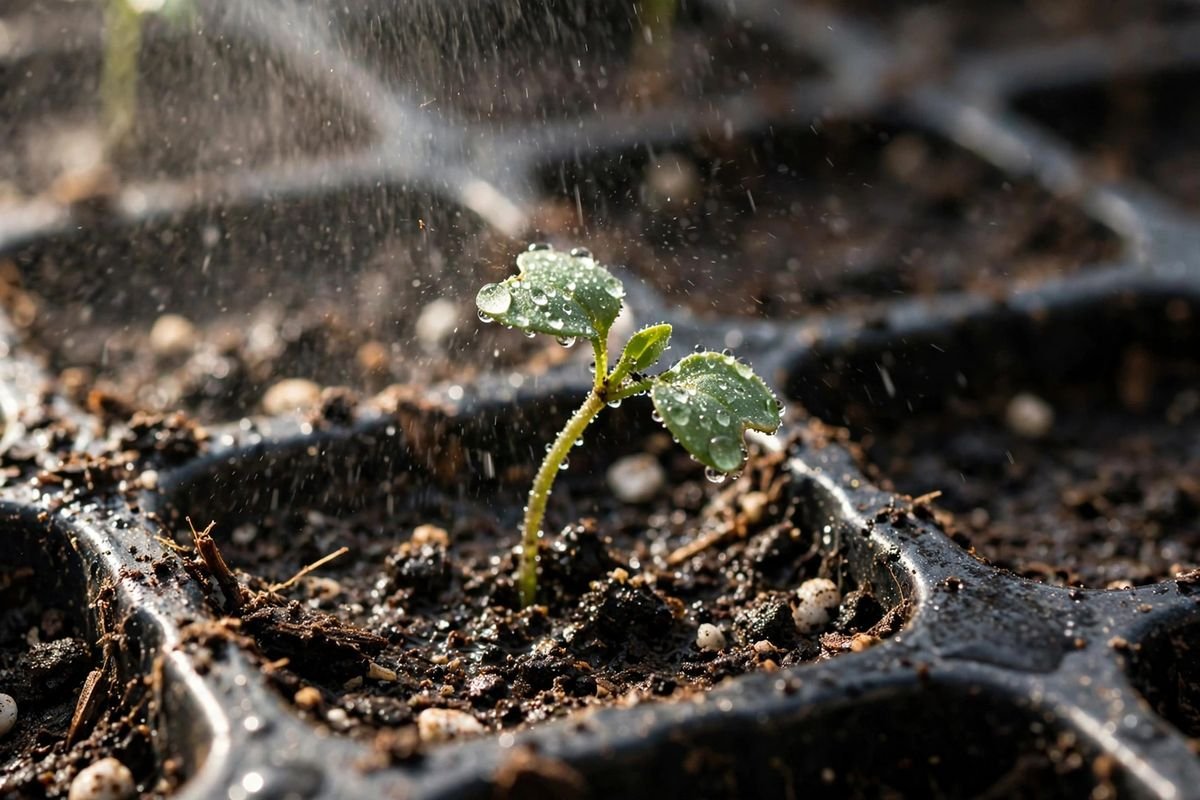
Three things matter: droplets fine enough not to disturb seeds, a pattern you can adjust, and capacity matched to your tray count. Droplet size matters most in the first week after sowing, when seeds sit on or just under the surface. Adjustability matters because you want mist for fresh sowings and a slightly stronger spray for established seedlings with true leaves. Capacity matters because a 100 mL atomizer means constant refills once you run more than a tray or two.
The picks
Best all-around: a continuous-mist bottle
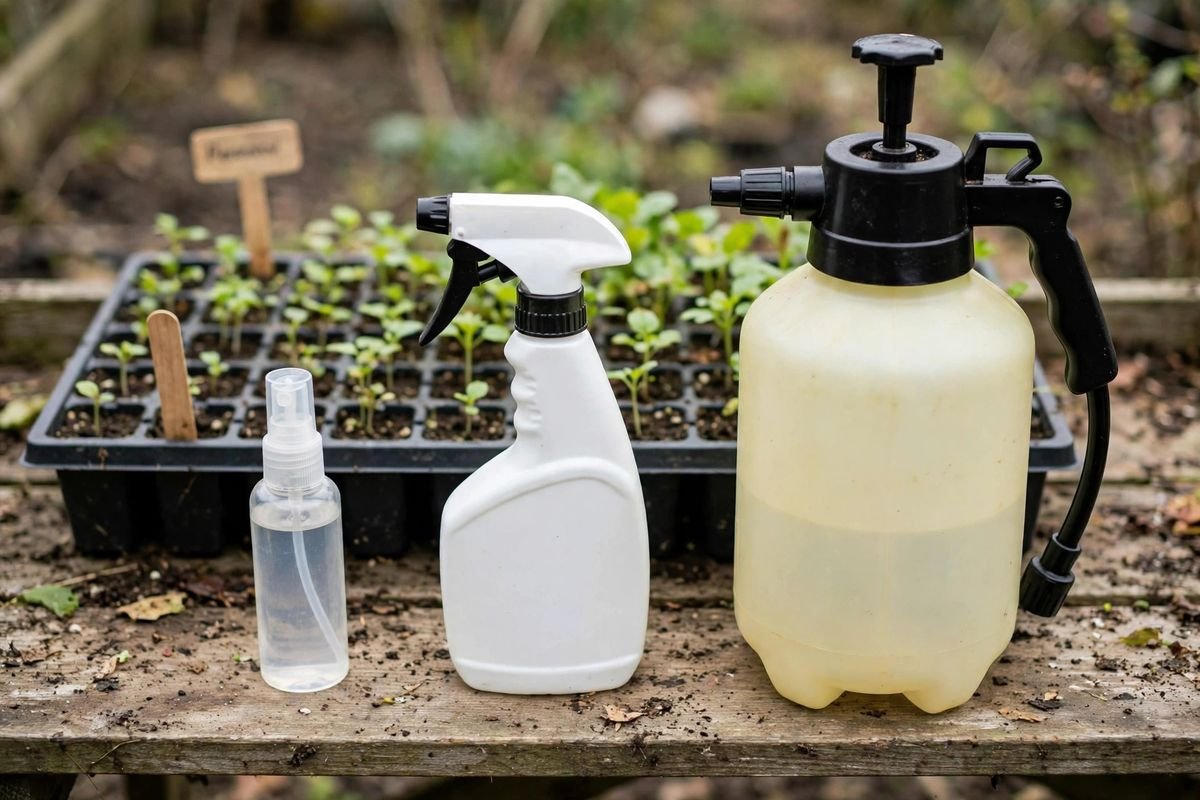
These bottles put out a steady fine mist as long as you hold the trigger, with no repeated squeezing. Listed capacities run 300-360 mL in PET plastic. For one or two trays, that is the sweet spot: gentle, even coverage and a bottle light enough to hold at arm’s length. The tradeoff is capacity. Once you run four or more trays, you will refill mid-session. Search Amazon for continuous mist spray bottles.
Best budget: a basic pump trigger bottle
A standard 500 mL to 1 L pump bottle with an adjustable nozzle costs little and does most of the job. The tradeoff is your hand: dozens of trigger pulls per session, and droplet size varies more between pulls than with a continuous mister. Most of us end up owning several of these anyway, because they stay useful for houseplants long after seed-starting season. Search Amazon for adjustable pump spray bottles.
Best for many trays: a 1.5-liter pressure sprayer
Pump the handle to pressurize the tank, then hold the trigger for a continuous spray; the nozzle twists from mist to stream. For three or more trays, one tank covers a whole session with no refills. The tradeoff is bulk: it is overkill for a single tray on a windowsill. Search Amazon for 1.5-liter pressure sprayers.
Best convenience: a battery-powered mister
Rechargeable or battery-powered misters run on a button press with no pumping at all. The tradeoff is cost and charging: you are buying a gadget to replace a hand motion, and it needs a charged battery when you need it. Worth it if you mist several trays every day through the season. Search Amazon for battery-powered plant misters.
What we would skip
Single-stream-only trigger bottles defeat the purpose. A stream is what you were trying to avoid. Tiny glass atomizers hold about 100 mL, which covers roughly one tray surface before a refill. They suit a bathroom shelf better than a seed-starting shelf.
The math: how much water a tray actually needs
Assumptions. A continuous-mist bottle releases about 1.2 mL per one-second trigger pull; a standard pump trigger releases about 1 mL per pull. Dampening the surface of a 72-cell tray takes about 120 mL, in our estimate. These are planning numbers for sizing your bottle, not lab measurements.
Per cell, that is 120 / 72 = about 1.7 mL per cell per session. With the continuous mister, one tray takes 120 / 1.2 = 100 one-second pulls, or roughly two minutes of steady misting. A 360 mL bottle therefore covers 360 / 120 = 3 tray-sessions per fill. Mist two trays twice a day and you use 4 x 120 = 480 mL a day: about one and a third fills of the 360 mL bottle, or a single fill of a 500 mL pump bottle. A 1.5-liter pressure sprayer holds 1,500 / 480 = just over three days of that same routine.
Misting is not watering
Misting keeps the surface damp between waterings and right after sowing; it does not replace a real drink. Once seedlings have true leaves, bottom watering does the heavy lifting. Our guide to how to bottom water seedlings walks through the method. Keep the air moving with a small fan, because constantly wet, still air invites damping-off, the seedling disease Clemson Extension notes sterile soilless mix helps prevent.
Misting soaks paper labels into mush, so pair your bottle with seedling labels that do not fade. And if you run a heat mat, mist more often: mats dry the mix faster, as our guide on whether seedlings need a heat mat explains.
Common questions
Can I just use a watering can with a rose head?
For sturdy seedlings with true leaves, yes. For fresh sowings and new sprouts, a rose head still drops more water per second than a mister, and the weight can shift tiny seeds. Use the mister until the first true leaves show, then switch.
How often should I mist?
When the surface looks dry. Small cells dry out faster than large ones, and a heat mat speeds that up. Misting is a top-up between bottom waterings, not a schedule of its own.
Sources & further reading
- Clemson University Cooperative Extension, “Starting Seeds Indoors” (hgic.clemson.edu/factsheet/starting-seeds-indoors), covers sterile soilless mix, damping-off, and the bottom watering method.
- University of Minnesota Extension, “A warm-weather jump on seed starting” (extension.umn.edu), lists the spray bottle on the seed-starter supply list and calls gentle moisture “best applied with a spray bottle.”
Match the bottle to your tray count, fill it with room-temperature water, and keep the mix surface evenly damp until the first true leaves appear. That is the whole job; the bottle just makes it easier.