
This post may contain affiliate links. If you buy through links on this page, we may earn a commission at no extra cost to you.
As an Amazon Associate I earn from qualifying purchases.
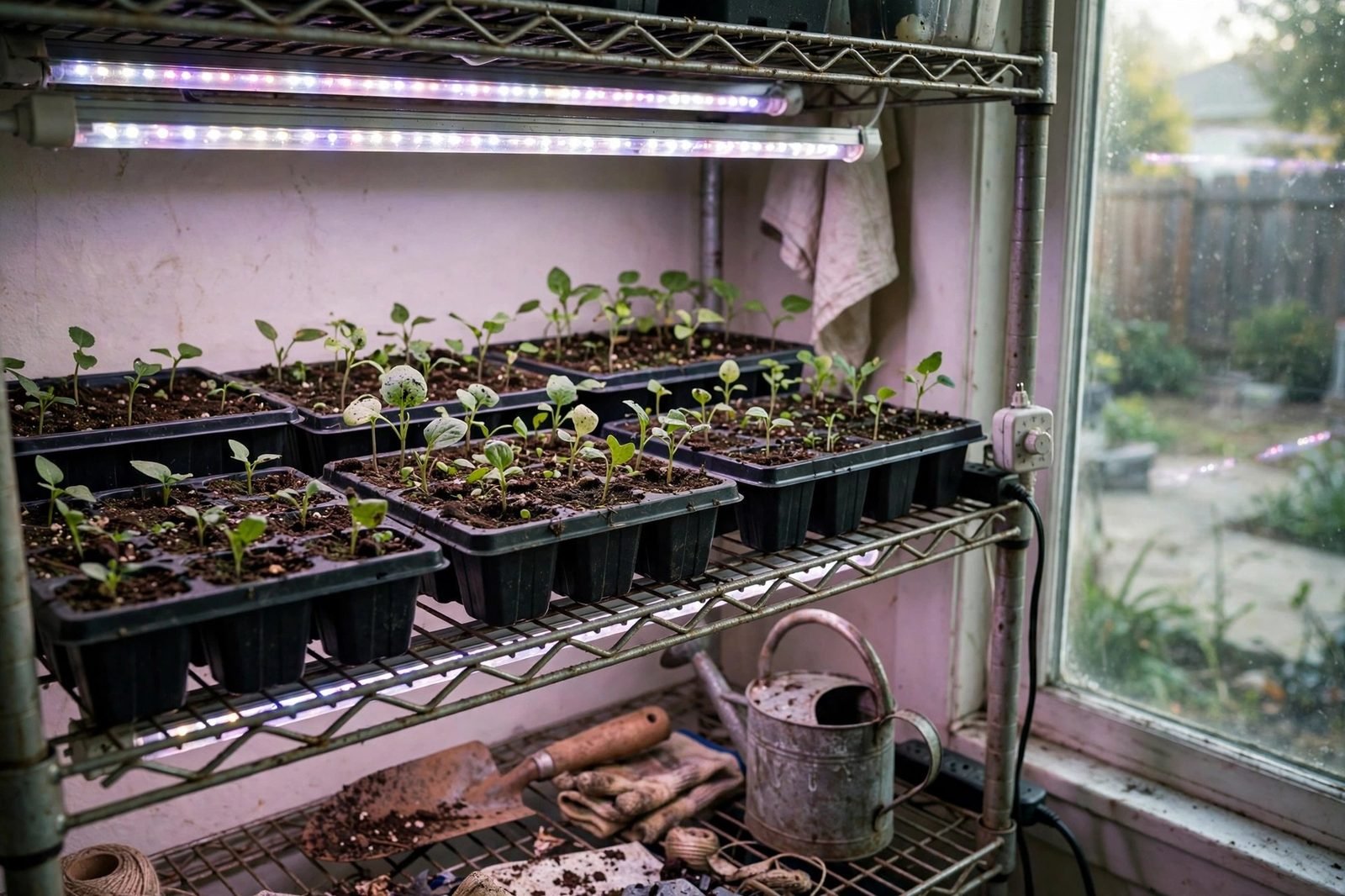
For most seedlings, the short answer is a long day with a real night: 14 to 16 hours of light, followed by 8 to 10 hours of darkness. That range covers the crops most of us start indoors, from tomatoes and peppers to lettuce and herbs. Extension guides from several universities land on the same idea: seedlings grow stocky and green under a generous photoperiod, and they still need a dark stretch each day to rest and process what the light gave them.
Leaving lights on around the clock feels generous, but it rarely pays. In this guide we walk through why 24-hour light backfires, a starting-hours table by growth stage, plain-light math for trading hours against fixture distance, a timer schedule we can copy, and what the extra two hours actually cost over a season.
| Stage or Crop | Starting Hours On | Notes |
|---|---|---|
| Just germinated (first leaves out) | 16 hours | The fragile stage; dim distance matters as much as hours |
| Stocky transplants (tomatoes, peppers, eggplant) | 14 to 16 hours | Warm-season crops kept compact for transplant |
| Leafy greens and herbs | 14 hours | A mid-range day keeps leaves tender |
| Cool-season brassicas (broccoli, cabbage) | 14 hours | Steady, moderate days before a cool transplant |
| Hardening off (last week indoors) | 12 to 14 hours, tapering | Match the outdoor day so the move is not a shock |
| Any seedling, any crop | Never 24 hours | Every seedling needs a real dark period |
Why Seedlings Need Darkness Too
Light drives photosynthesis, but a plant finishes much of its daily housekeeping in the dark. During dark hours, seedlings move sugars from leaves to roots, repair tissue, and run the hormone cycles that tell a stem whether to stretch or thicken. University extension guidance on indoor seed starting comes back to this balance again and again: generous light, then a genuine night.
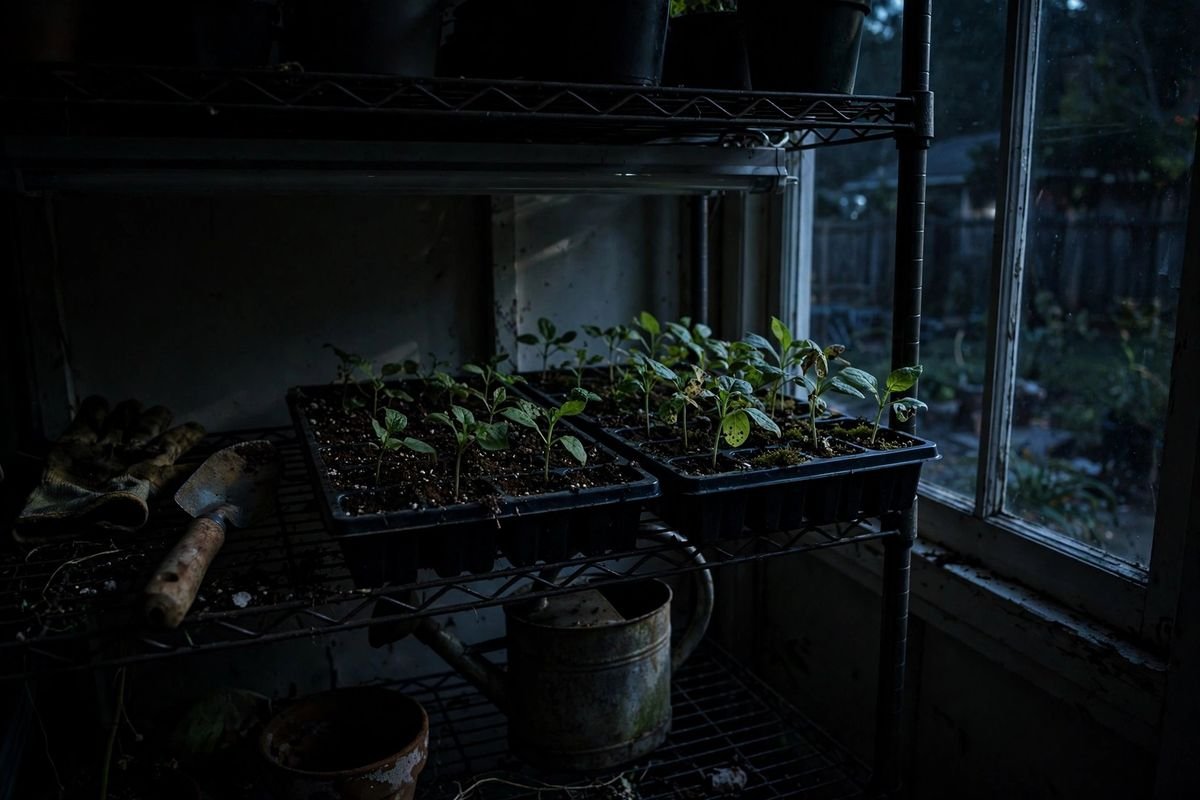
That is also why 24-hour light backfires. With no dark period, some seedlings slow down instead of speeding up. Leaves can pale or develop bleached patches, stems stop putting energy into roots, and a few crops with day-length sensitivity get confused about whether to grow leaves or start flowering. Add a warm room and a light that never rests, and we also cook up algae on the soil surface while the electric meter spins all night. Our guide on why seedlings go leggy under grow lights covers the stretch side of this problem; hours are the other half of the same story.
How Many Hours, by Stage and Crop
The Quick Reference table above gives our starting points, and we treat them as starting points rather than rules carved in stone. A seedling that just popped out of the mix gets our longest day, 16 hours, because its first true leaves are tiny solar panels with little area to work with. As transplants put on true leaves and thicken, 14 to 16 hours keeps tomatoes, peppers, and eggplant compact without rushing them.
Leafy greens and herbs sit comfortably at 14 hours; they grow fast, and a moderate day keeps leaves tender instead of tough. Cool-season brassicas like broccoli and cabbage also do well at 14 hours before they head out to a cold frame. In the last week indoors, we taper toward the outdoor day length, 12 to 14 hours, so hardening off feels like a continuation rather than a shock. Warmth pairs with these schedules: our notes on whether seedlings need a heat mat explain when bottom heat helps germination and when we pull the mat once sprouts appear.
The Daily-Light Math: Hours Versus Distance, in Plain Terms
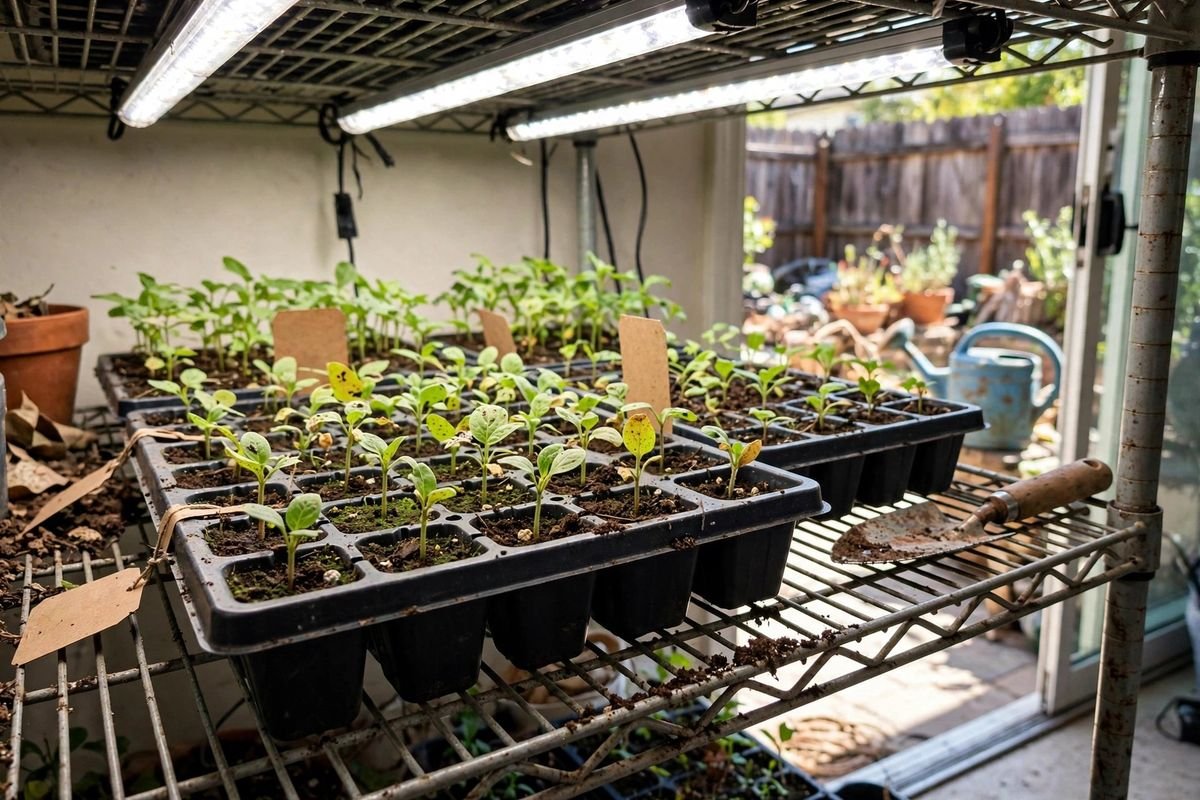
Hours are only half the equation. A seedling cares about the total light it collects across the day, which in plain terms is hours of light multiplied by how strong that light is at leaf height. Distance controls the strength: pull a fixture away and the light reaching the leaves drops fast. Here is a worked comparison with every assumption stated.
Assumptions: we use relative units instead of instrument readings, so no light meter is required. Call the light at our reference distance, about 2 to 4 inches below the fixture for many LED bars, a strength of 1.0. Raising the same fixture a few inches, to roughly 6 to 8 inches above the leaves, delivers noticeably weaker light; we estimate that at about 0.7 of the reference strength, a conservative planning figure consistent with how quickly light falls off with distance.
Option A, closer and shorter: 14 hours at strength 1.0 gives a daily light total of 14 × 1.0 = 14.0 units.
Option B, farther and longer: 16 hours at strength 0.7 gives 16 × 0.7 = 11.2 units. Two extra hours do not make up for the weaker light. To match Option A at that distance we would need 14 ÷ 0.7 = 20 hours a day, which wipes out the dark period entirely, the exact mistake we want to avoid. The practical lesson: set the distance first, then choose hours inside the 14-to-16 window. Our guide on how high grow lights should hang above seedlings walks through the distance side in detail.
A Timer Schedule We Can Copy
We run our seed shelves on a simple plug-in timer so the schedule never depends on memory. A rhythm that works for most of us: lights on at 5:30 a.m., off at 9:30 p.m. That is 16 hours on and 8 hours off, and it lines up the brightest part of the seedling day with a normal household day. A 14-hour version is just as easy: on at 6:00 a.m., off at 8:00 p.m.
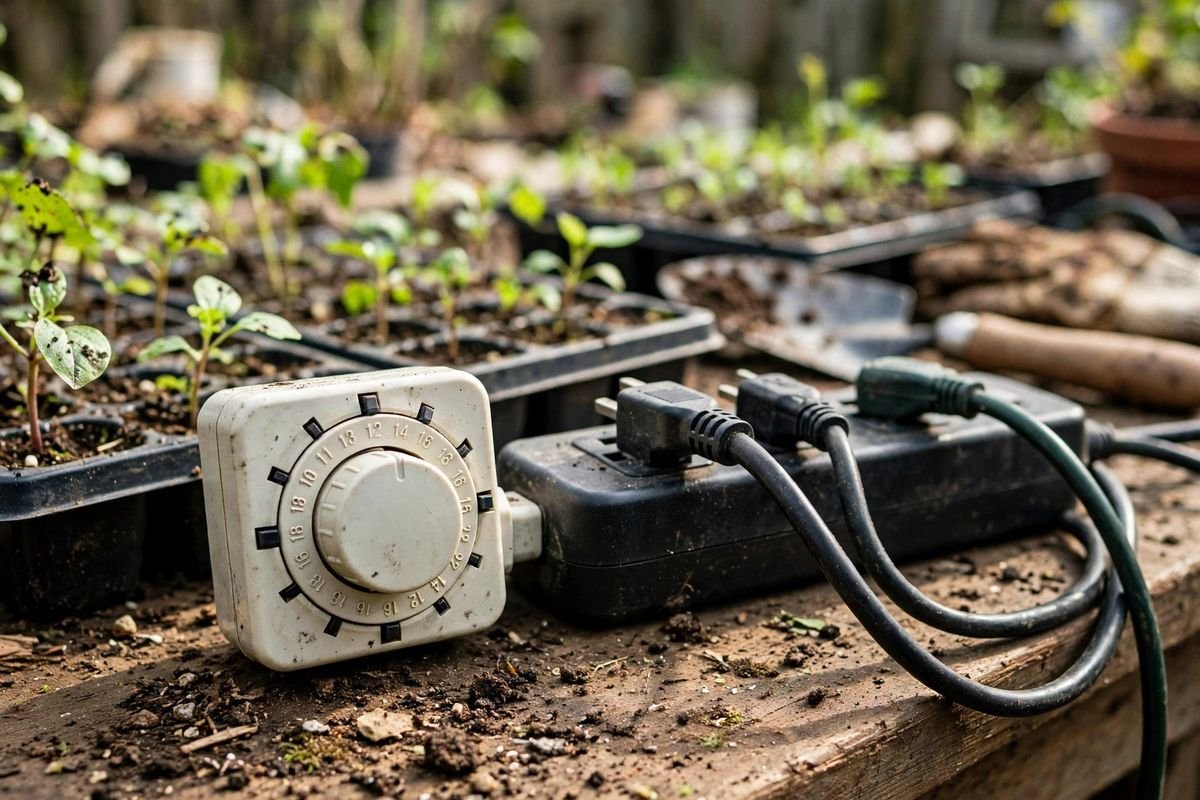
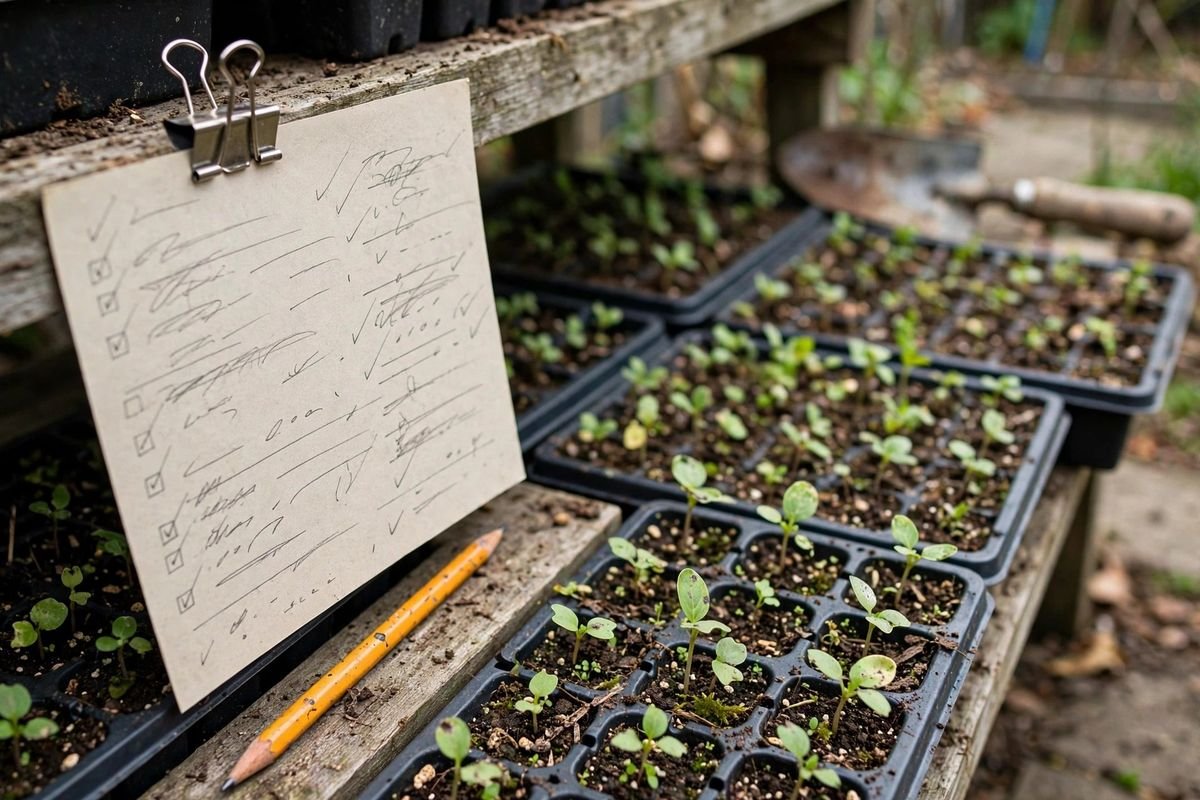
Browsing outlet timers for grow lights on Amazon shows the common mechanical and digital styles; either works as long as it carries the fixture load and keeps its settings through a brief outage. A handwritten card clipped to the shelf keeps the plan visible during the busy transplant weeks.
What Two Extra Hours Cost Over a Season
Here is the running-cost math for stretching a 14-hour day to 16 hours, with assumptions stated so anyone can rerun it with local numbers. Assumptions: one LED fixture drawing 40 watts (0.04 kilowatts), an electricity rate of 17 cents per kilowatt-hour, and an 8-week indoor season of 56 days.
Extra-light cost: 2 extra hours a day × 56 days = 112 hours. At 0.04 kW that is 112 × 0.04 = 4.48 kWh, which costs 4.48 × $0.17 = about $0.76 for the whole season. The full 16-hour schedule costs 16 × 56 × 0.04 = 35.84 kWh, about $6.09, so the extra two hours are a small slice of a modest bill. Electricity is rarely the reason to shorten the day; plant rest is. Fixture size still matters, and our roundup of the best grow lights for seedlings compares shelf-friendly options when we are ready to upgrade.
Signs Our Schedule Needs a Tweak
Stretching stems with wide gaps between leaves usually mean too little total light: move the fixture closer before adding hours. Pale or bleached leaf spots under a never-off light point to a missing dark period; restore a full night first. Slow, stalled growth with short days under 12 hours suggests extending toward 16 hours. Purpling or cupped leaves can signal a room that is too cool at night rather than a light problem, so we check temperature before touching the timer. Small changes, one at a time, tell us which lever actually worked.
FAQ
Can we leave grow lights on 24 hours to speed seedlings up?
We do not recommend it. Extension guidance consistently pairs a long day with a real dark period, and around-the-clock light can slow growth, bleach leaves, and waste power. If seedlings need more total light, we move the fixture closer within safe limits and keep the day at 14 to 16 hours.
Do seedlings need light before they sprout?
Most vegetable seeds germinate in darkness under the soil surface and need light the moment the first leaves emerge. A few small-seeded flowers benefit from light at the surface; the seed packet notes that when it applies. Either way, our timer schedule starts the day sprouts appear.
Should hours change as seedlings grow?
A gentle taper works well: 16 hours for brand-new sprouts, 14 to 16 hours for stocky transplants, then 12 to 14 hours in the final week indoors so seedlings meet the outdoor day without a jolt. We change one variable at a time and watch stem thickness over several days.
What if a timer fails and lights stay on all weekend?
One long weekend rarely ruins a batch. We restore the normal schedule, check for pale leaf patches, and let the dark period resume. Seedlings are tougher than we expect, and steady days afterward matter more than one odd stretch.
Sources & Further Reading
- University of Georgia Extension — starting seeds indoors, light duration and seedling care (extension.uga.edu).
- Michigan State University Extension — indoor lighting for seedlings and photoperiod basics (canr.msu.edu).
- Penn State Extension — seed starting schedules, light, and temperature guidance (extension.psu.edu).
- University of Vermont Extension — indoor seed starting and lighting for transplants (uvm.edu/extension).
- North Carolina State Extension — home seed starting, light management for transplants (content.ces.ncsu.edu).
Keep Growing With These Guides
Hours, distance, and a real night work as a team: set the fixture height, pick a day length between 14 and 16 hours, and let a timer keep the promise. Which shelf in our space runs the longest day right now, and do its seedlings get their full eight hours of dark?