This post may contain affiliate links. If you buy through links on this page, we may earn a commission at no extra cost to you.
As an Amazon Associate I earn from qualifying purchases.
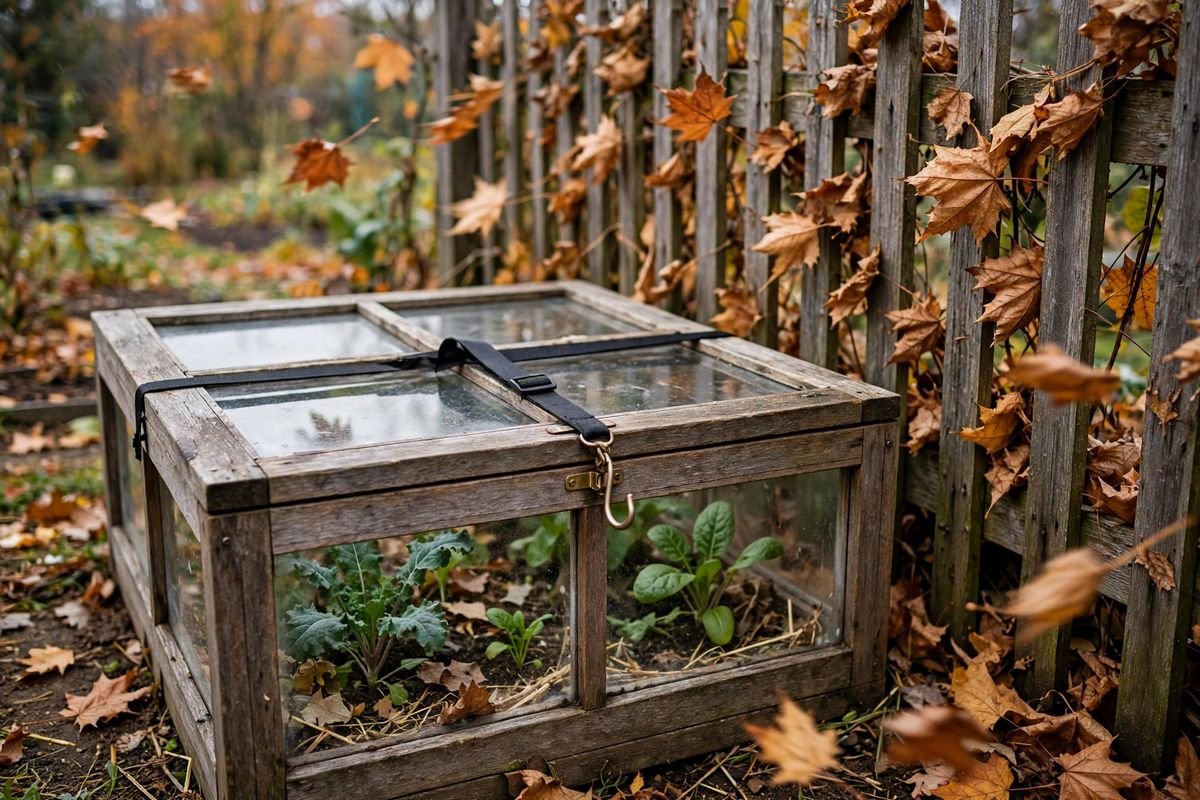
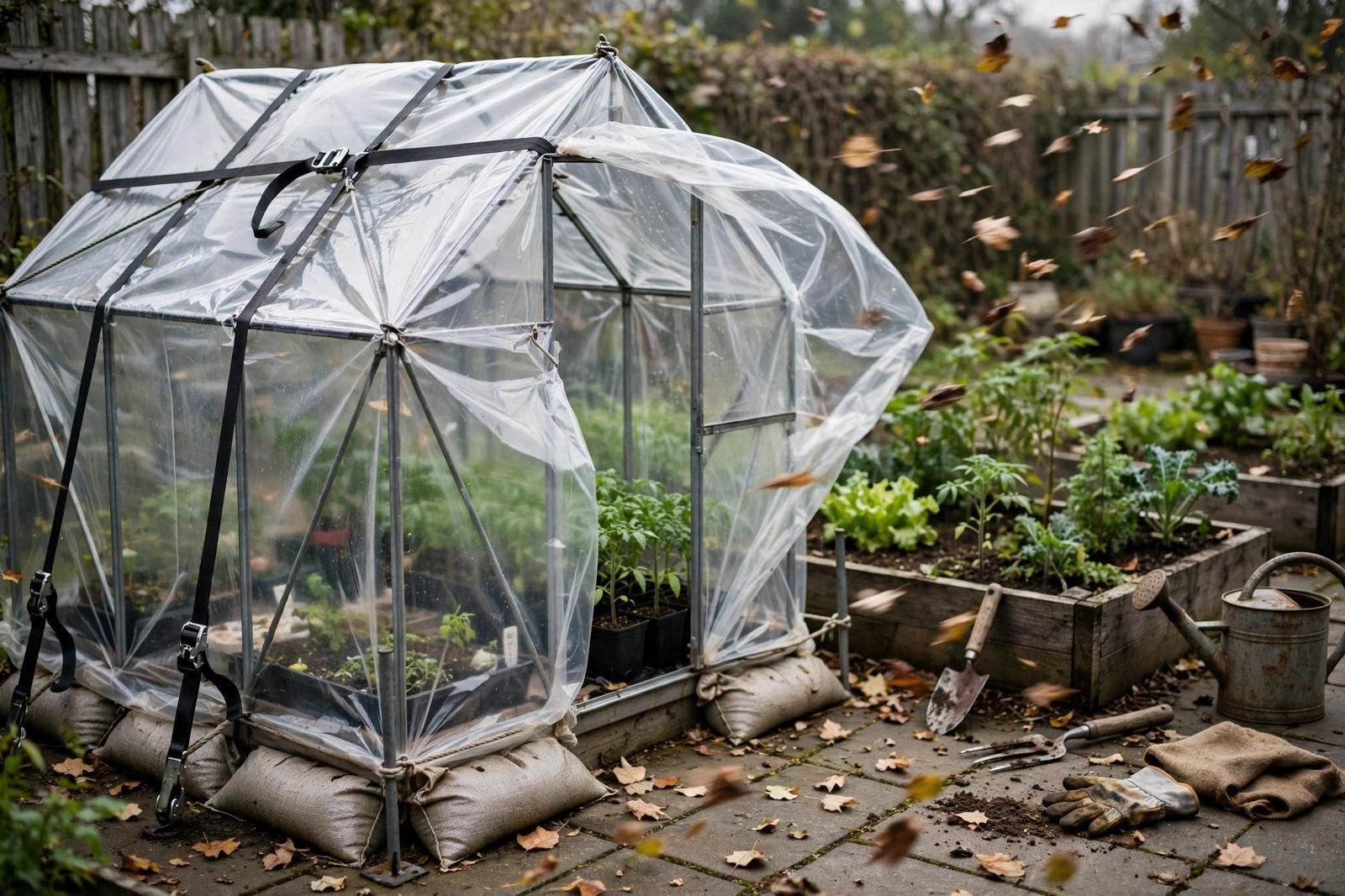
A mini greenhouse that walks across the patio in the first fall storm is a familiar sight, and so is a cold frame lid lifted by a gust or a hoop cover billowing like a sail. Lightweight structures do not need extreme wind to move; they need a flat side to push against and a loose corner for wind to get under.
Anchoring fixes both problems. We add weight low, tie the frame to something that will not move, and close the gaps where wind sneaks in. This guide explains the reasoning in plain terms, works through a sizing example for an exposed patio, and covers common backyard structures.
| Structure | Anchor Approach |
|---|---|
| Mini greenhouse on a patio | Ballast or ground anchors at all four corners, plus a frame strap |
| Cold frame | Hinged, latched lid; stakes or pavers on the base frame |
| Hoop house or low tunnel | Stakes every 2 to 3 feet; cover clamped or edges buried |
| Trellis or obelisk | Legs 10 to 12 inches deep, or tied to a raised bed frame |
| Shelf unit | Ballast on the lowest shelf; back tied to a railing where allowed |
| Before a storm | Close and latch everything, add temporary ballast, check ties |
Why Wind Moves Garden Structures
Wind push grows fast as speed climbs. In plain terms, pressure rises with the square of wind speed, so a 40 mph gust pushes about four times as hard as a 20 mph breeze. That is why a structure can sit calmly all summer and slide on the first blustery night. Three effects matter for us. Push slides or tips a structure sideways. Lift gets under a lid, roof panel, or cover edge and peels it upward. Rattle works clips and fasteners loose over hours of vibration, so one loose corner today becomes a missing panel next week.
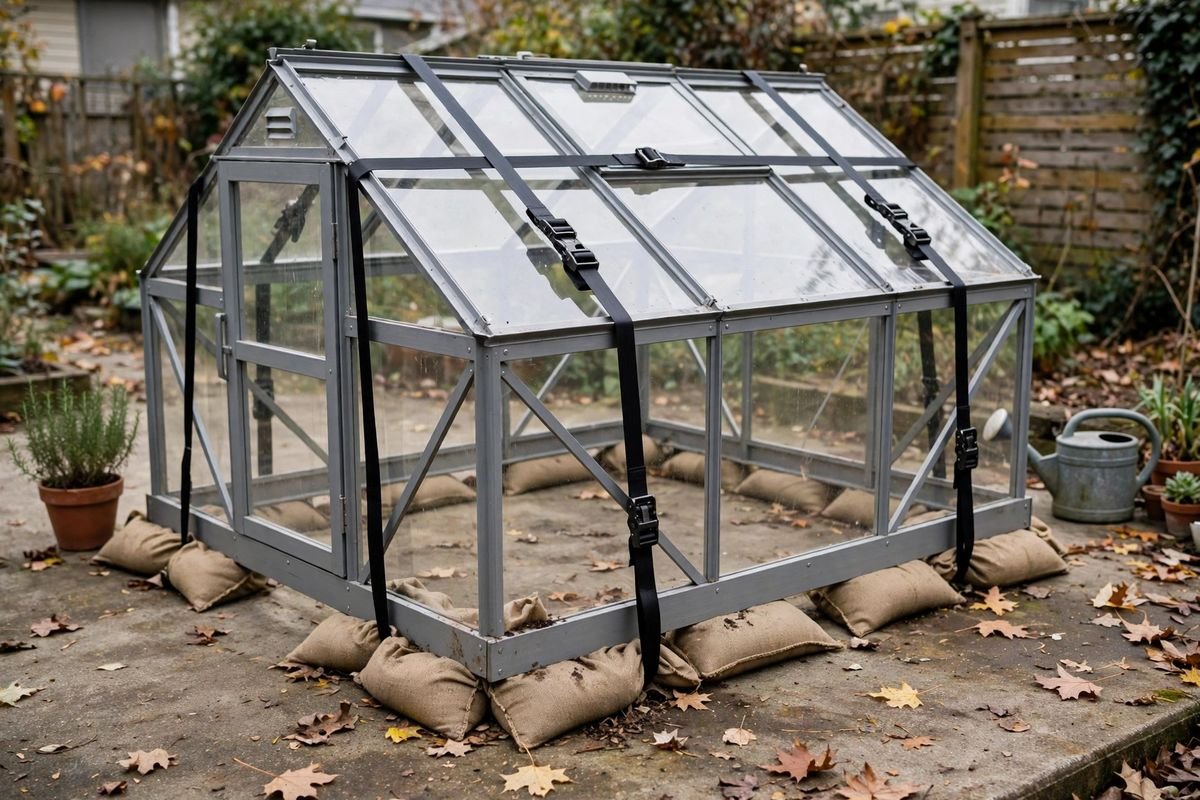
Shape matters as much as weight. A mini greenhouse presents a broad flat side to the wind with little mass down low, while a cold frame rarely slides but offers its lid as a perfect lift surface. Hoop covers fail at the edges first, where a small gap lets wind inflate the cover and pull staples one by one. Our guide on how to protect balcony plants from strong wind covers the plant side of this problem; here we secure the structures themselves.
Plain-Language Wind Load: A Worked Example
We are not certifying any structure here, and any manufacturer wind rating always comes first. The numbers below are a planning aid so we can size anchors sensibly, with every assumption stated.
Inputs and assumptions: a patio mini greenhouse 6 feet long, 4 feet wide, and 6 feet tall at the ridge; the wind-facing side profile is about 30 square feet; the empty frame with polycarbonate panels weighs about 45 pounds; it stands on smooth concrete; we plan for a 45 mph gust, a common fall storm gust in many regions.
Estimated push: a rough rule of thumb puts wind pressure near 5 pounds per square foot at 45 mph on a flat surface. That is an approximation, not a code value. Over 30 square feet, total sideways push is roughly 150 pounds acting near mid-height.
Resistance check: friction on smooth concrete holds only a fraction of a 45-pound structure’s weight. Even a generous 20 pounds of friction leaves a wide gap against roughly 150 pounds of push. Legs and friction alone will not hold this structure in that gust; we need positive anchors or real ballast.
Sizing the fix: four sandbags at about 35 pounds each add 140 pounds low at the corners, raising both friction and tip resistance. Anchoring works from the other side: one ground anchor per corner, strapped to the frame, transfers mid-height push down into the soil. Our spacing rule: anchor every corner, and add a mid-span anchor on any side longer than 6 feet. A 6-foot side needs only its corners, while hoop runs get stakes every 2 to 3 feet along the base. For siting that reduces exposure, our guide on how to start a balcony garden covers placement in tight spaces.
Lift check: the same gust tries to raise roof panels and any unlatched door. We close and latch vents and doors, strap over the ridge of hoop structures, and clamp or bury cover edges rather than draping them. Push and lift arrive in the same gust, so we solve both before the storm. Gardeners comparing structures rated for exposed patios will find our roundup of the best mini greenhouses for patios useful alongside this math.
Anchor Options and When Each Fits
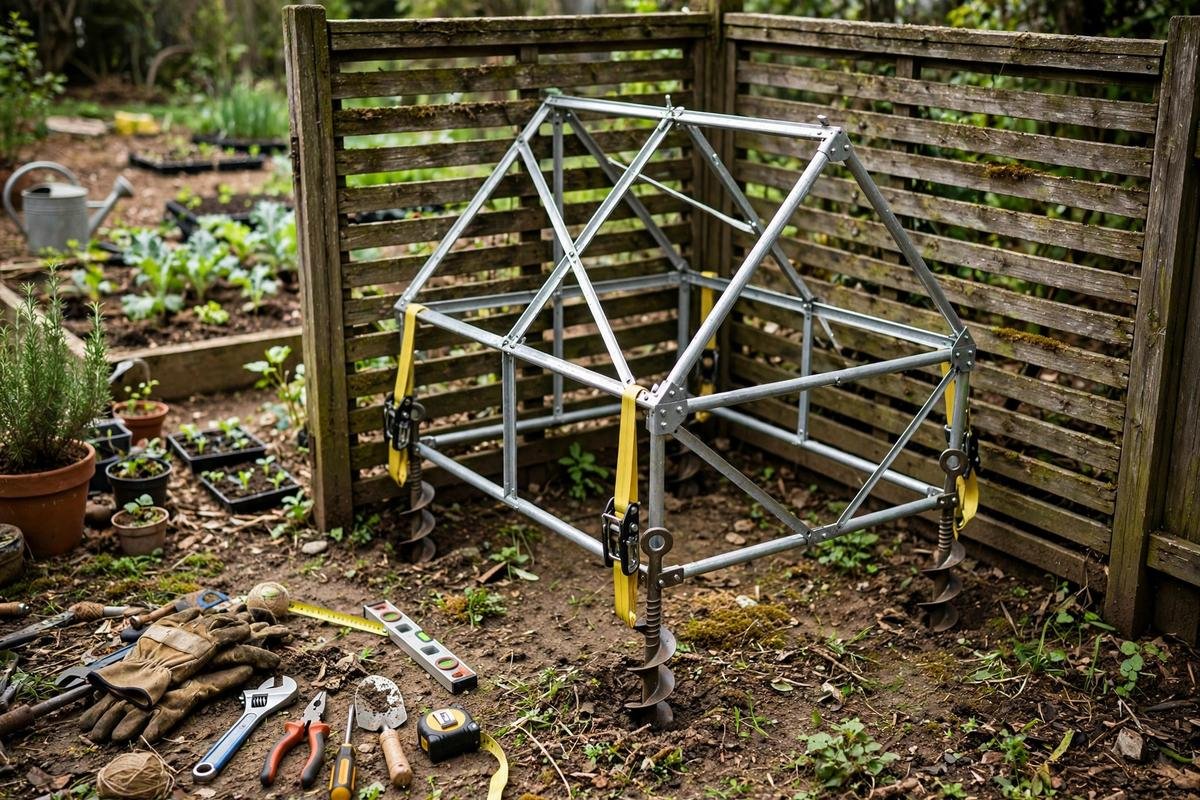
Spiral ground anchors and earth staples suit frames, hoops, and greenhouses set on soil or gravel. Spirals hold well in firm soil and struggle in loose sand. Browsing spiral ground anchors on Amazon shows common lengths; longer anchors hold better in soft ground. Sandbags and water weights suit patios and decks where drilling is not allowed, draped over a low base rail or set on the bottom shelf, never stacked on a roof. Straps connect a frame to ground anchors, a railing, or a raised bed frame; we use UV-stable webbing and replace faded, stiff straps. Pavers add quick ballast when they sit on the frame itself rather than beside it. Where HOA or rental rules limit ground anchors, ballast plus railing ties are our fallback.
How to Anchor a Mini Greenhouse or Cold Frame, Step by Step
- Pick the most sheltered spot available. A few feet closer to a wall or fence can cut gusts noticeably, though corners between two walls sometimes funnel wind. Where light debris collects on windy days marks the swirl spots we avoid.
- Level and square the base. A rocking corner vibrates loose faster and gives wind a pry point. We shim or paver under feet until all sit firm, then check squareness by measuring the diagonals.
- Secure the covering first. Panels get all their clips, covers get clamped or buried edges, and lids get hinges plus a latch. A structure that sheds wind smoothly needs less anchor than one with a loose panel acting as a sail.
- Install corner anchors. On soil, set one anchor at each corner angled slightly away from the structure and strap the frame down to each. On concrete, place ballast on the base rail at each corner and strap across the frame where the design allows. No corner should be free to lift or slide on its own.
- Add mid-span anchors on long sides. Sides over about 6 feet get one anchor at mid-span, per the spacing rule above. Hoop runs get stakes every 2 to 3 feet, closer on the windward side.
- Ballast low, never high. Extra weight belongs on the lowest shelf or base rail. Weight placed high raises the center of gravity and makes tipping easier. Browsing sandbags for canopy weights on Amazon shows sizes that drape neatly over base rails.
- Latch everything before a storm. We close vents and doors, latch cold frame lids, add a temporary strap over hoop covers, and move loose pots off shelves. Two minutes of closing beats an hour of cleanup.
- Inspect after the first strong wind. Anything that shifted shows us where the next anchor or bag belongs. A fall recheck joins the seasonal routine alongside bed care in how to winterize a raised garden bed.
Anchoring Hoops, Trellises, and Shelves
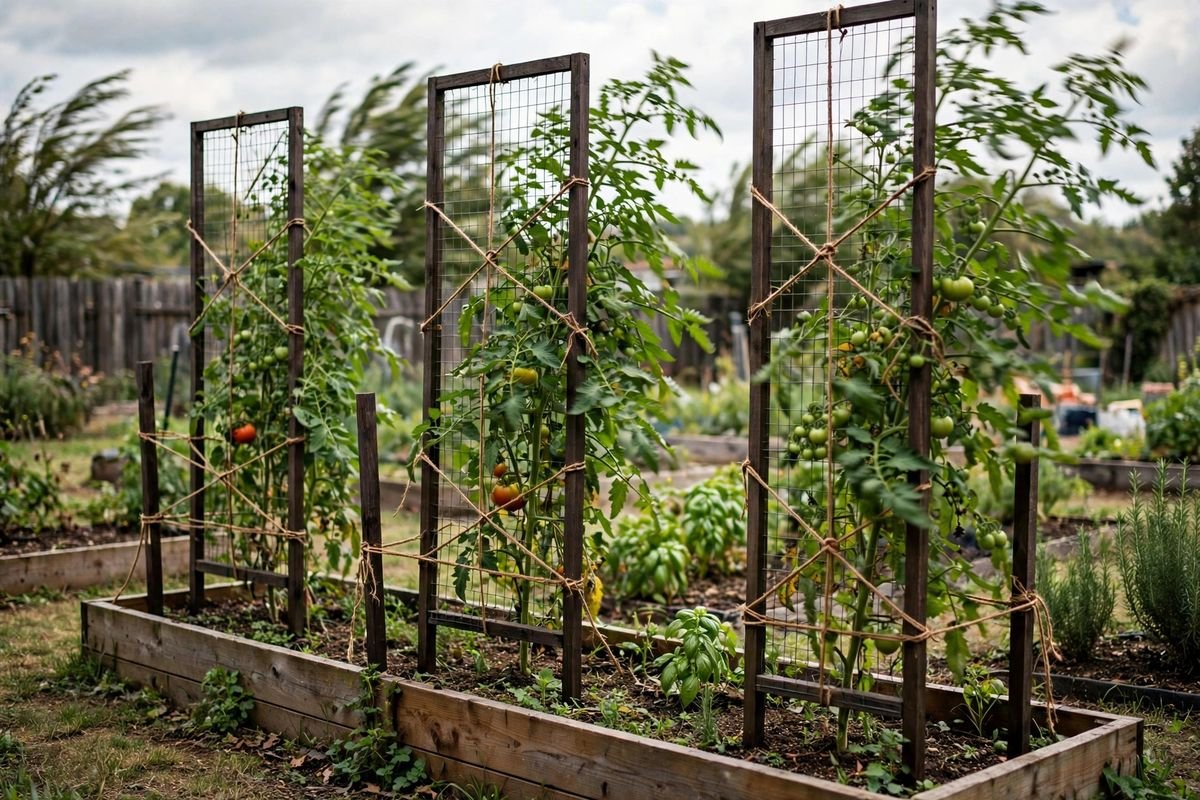
Hoop houses and low tunnels fail at the edges. We bury the cover edge 4 to 6 inches in a shallow trench or clamp it to a base board, set stakes every 2 to 3 feet, and run a rope over the top at each hoop tied to the same stakes to stop billowing. Trellises and obelisks need depth or a tie: legs pushed 10 to 12 inches into firm soil hold most climbers, and in raised beds we tie the trellis to the bed frame so the whole bed mass resists the pull. Freestanding shelves tip when top-heavy, so we keep heavy pots low, ballast the bottom shelf, and tie back uprights to a railing where allowed.
Common Mistakes We Avoid
Relying on friction alone: smooth patios offer little grip, especially wet. Anchoring only two corners: wind pries from the free corners first. Loose covers and open vents: one open vent can pressurize a small greenhouse from inside and push panels outward. Sun-rotted straps: faded, stiff webbing may snap in the first real gust, so we replace suspect straps in fall. Skipping the post-storm check: most failures are progressive, from a loose clip to a lost panel, and catching the clip is the cheap fix.
FAQ
Can sandbags alone hold a mini greenhouse on a patio?
For small structures in moderate exposure, corner ballast with latched panels often suffices, as the worked example shows. On very exposed patios we combine ballast with a strap to a fixed point where allowed, and we move valuable plants indoors ahead of named storms.
How deep should ground anchors go?
We follow the maker guidance. As a planning habit, 12 to 18 inch anchors suit soft or sandy soil, while 8 to 10 inches can hold in firm ground. An anchor should sit snug with no wobble; if it spins loosely, we move to firmer soil or switch to ballast.
Should we take structures down for winter?
Lightweight greenhouses and hoop covers last longer stored under shelter, and snow load damages more small structures than wind does. Cold frames with latched lids and anchored corners usually winter in place well, with a midwinter strap check.
What is the quickest fix before an unexpected storm?
Close and latch everything, add ballast low at the corners, throw a strap over hoop covers, and move loose items off shelves. Those steps take minutes and prevent the most common damage.
Sources & Further Reading
- University of Florida IFAS Extension — wind effects on small greenhouse structures and storm preparation (edis.ifas.ufl.edu).
- North Carolina State Extension — high tunnel anchoring, cover attachment, and wind management (content.ces.ncsu.edu).
- University of Minnesota Extension — cold frame construction, latching, and seasonal use (extension.umn.edu).
- Iowa State University Extension and Outreach — securing lightweight garden structures (extension.iastate.edu).
- NOAA National Weather Service — plain-language wind pressure and gust background (weather.gov).
Keep Growing With These Guides
A structure that stays put protects everything inside it, from patio seedlings to greens under hoops beside a winterized bed. Which structure in our space moves first when the wind picks up — the greenhouse, the cold frame lid, or the hoop cover — and which corner will we anchor first?