
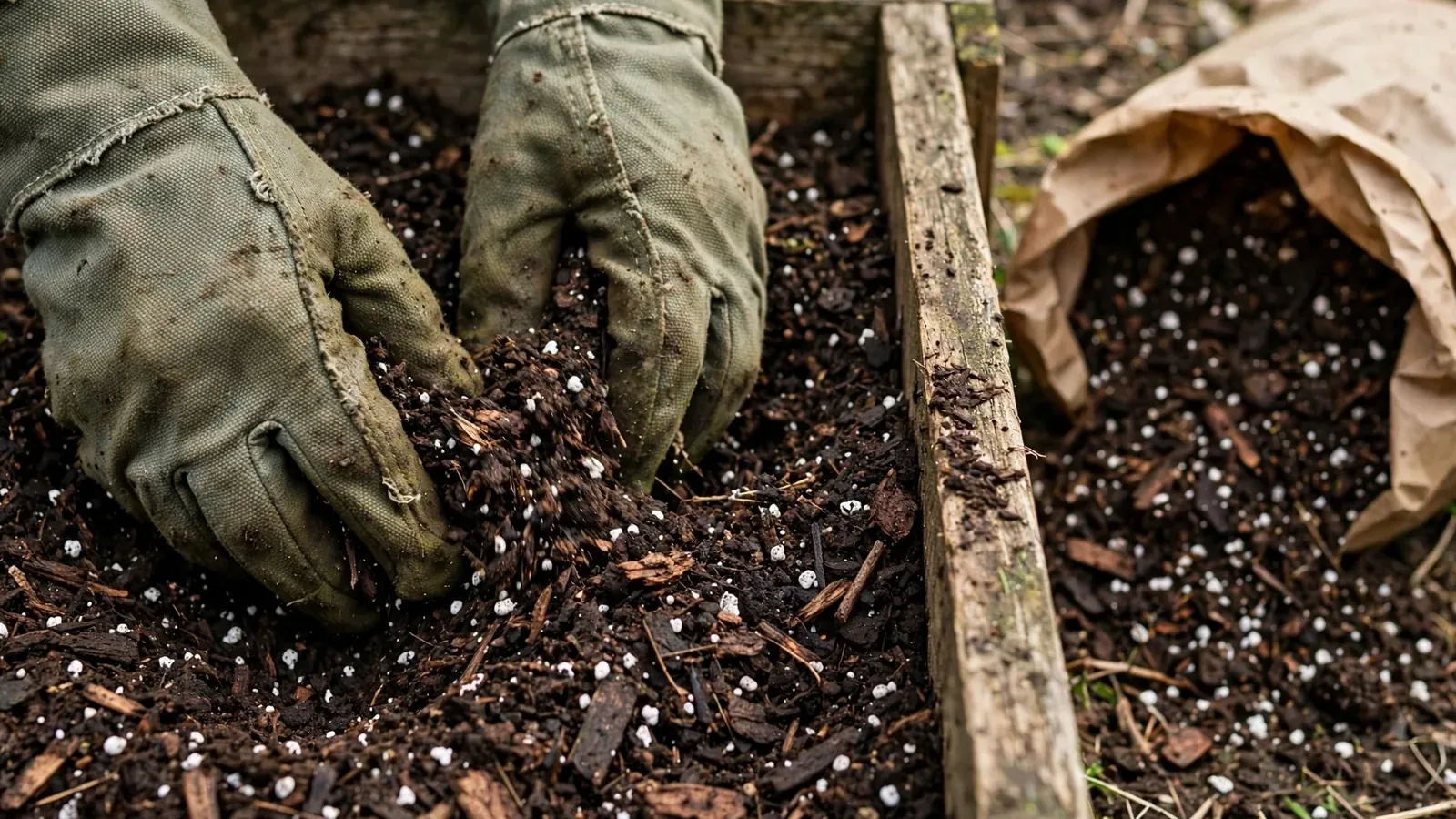
Fill a raised bed with the wrong stuff and you'll know it by midsummer. Water pools on top or vanishes straight through, seedlings stall out, and you end up wondering whether the bed was worth building at all. Get the mix right, though, and a raised bed is one of the most forgiving ways to garden.
New to raised beds? Start with our Raised Bed Gardening Hub — every soil guide in one place.
Here's the truth up front: there is no single perfect raised bed soil recipe. What works depends on how deep your bed is, what's underneath it, what you're growing, and what you can actually buy nearby without spending a fortune.
Why There's No Universal "Perfect" Mix
Search long enough and you'll find people swearing by exact ratios. The problem: a mix that thrives in a 24-inch-deep bed on sandy soil won't behave the same in a 10-inch bed on clay.
A few things change the answer:
- Bed depth. Shallow beds (under 12 inches) need a mix that holds together well, because roots can't go find better soil below. Deep beds give you more room to layer cheaper materials underneath.
- What's under the bed. A bed sitting on decent native soil can borrow from it; roots will push through an open bottom. A bed on concrete or compacted clay is on its own.
- What you're growing. Leafy greens are happy in lighter, compost-rich mixes. Carrots and parsnips want loose, stone-free depth. Tomatoes are heavy feeders that appreciate richer soil.
- Your budget. Bagged "raised bed mix" is convenient and pricey. Bulk topsoil plus compost from a landscape yard is usually far cheaper for big beds — but quality varies, so ask what's in it.
Keep those in mind and the rest of this guide gets a lot more useful.
The Three Main Ingredients
Almost every good raised bed mix combines three things: a mineral base, organic matter, and something for drainage and air space.
1. Topsoil or Raised Bed Soil (the Base)
This is the backbone — the mineral part that gives the mix body and weight. Bagged products labeled "raised bed soil" or "garden soil" are usually topsoil blended with some compost and bark. They're fine for a first bed, but check the bag: some are mostly ground-up wood products, which tie up nitrogen as they break down.
If you're filling a big bed, bulk topsoil from a landscape supply yard is the budget move — but quality varies, so ask whether it's screened. Good topsoil is dark, crumbly, and smells earthy.
2. Compost (the Nutrition)
Compost does the heavy lifting for fertility and soil life. It feeds plants slowly, improves structure, and helps sandy mixes hold water and clay-heavy mixes drain.
But compost has limits. Used at 100%, it keeps breaking down and settling — a bed filled with pure compost can sink several inches in a season. It's also the most expensive ingredient if you're buying bagged. Think of compost as a generous portion of the mix, not the whole thing — around a quarter to a third of the total volume is a commonly cited starting point.
If you make your own, even better — just make sure it's finished (dark, crumbly, no recognizable scraps) before it goes in the bed. Unfinished compost can rob nitrogen from your plants while it keeps decomposing.
3. Aeration Amendments (the Breathing Room)
Roots need air as much as water, and this is the ingredient beginners skip:
- Perlite or vermiculite — lightweight, consistent, sold everywhere. Perlite drains a bit more; vermiculite holds a bit more water.
- Coarse bark fines — cheap in bulk, break down slowly, improve structure over time.
- Rice hulls — a good renewable option where available; they lighten the mix and decompose gradually.
One thing to skip: fine play sand. Mixed into a heavy soil it can make drainage worse, not better — the classic "clay plus sand equals brick" problem.
Drainage: The Thing That Decides Everything
Whatever ratio you land on, the mix has to drain. Not instantly — you don't want water racing through — but a bed that stays soggy will rot roots and breed disease faster than almost any other mistake.
A simple check: fill a pot with your mix and water it well. Water should soak in rather than pool, and the pot should feel noticeably lighter within a day. If water sits on the surface, add more aeration material. If it pours straight through and dries out in hours, add more compost or topsoil.
Raised beds naturally drain better than in-ground soil because gravity gets a head start, which is one reason they're forgiving. But a bed sitting on plastic sheeting or solid concrete with no drainage holes is just a bathtub — make sure water has somewhere to go.
A Few Starting Points (Not Prescriptions)
These are widely used blends gardeners report good results with — starting points with different cost and effort profiles, not prescriptions:
- The simple bulk blend: roughly 60% topsoil, 30% compost, 10% aeration amendment. Cheap for large beds, easy to remember.
- The bagged route: straight bagged "raised bed mix," possibly with a bag or two of compost mixed in for a boost. Most expensive per cubic foot, but zero guesswork.
- Mel's Mix (from square foot gardening): one-third compost, one-third peat moss or coco coir, one-third coarse vermiculite. A published, well-tested approach for intensive small-space beds.
Notice none of these is "the answer." They're starting points with different cost and effort profiles. Once you know your bed's dimensions, you can estimate how much of each ingredient you'll actually need with our Raised Bed Soil Calculator — handy when you're deciding between bulk and bagged.
Common Mistakes to Avoid
- 100% bagged topsoil. It compacts over time, especially the cheap stuff. Mix in compost and something for aeration.
- 100% compost. It'll grow great plants for a few months, then settle dramatically. Plus it's expensive at scale.
- Shoveling in native clay soil straight. A little native soil mixed in is fine and adds biology, but clay-heavy soil alone turns a raised bed into a brick.
- Forgetting that beds settle. Most new beds settle an inch or two in the first season. Fill to the top, and plan on adding a compost top-up each spring — a compost calculator helps you figure out how much top-up material a bed needs.
- Burying weed seeds or herbicide-treated material. If you're getting bulk compost or manure, ask about the source. Persistent herbicides in contaminated compost or manure can damage garden plants — a miserable problem to discover after planting.
What Changes the Answer
A couple of situations deserve special mention:
Deep beds (18+ inches): You don't need premium mix all the way down. Fill the bottom half with cheaper bulk topsoil or coarse organic material and save the good stuff for the top 8–12 inches where most roots live. (More on layering in our guide to what goes in the bottom of a raised bed.)
Root crops: Carrots, parsnips, and daikon want the top 10–12 inches loose and stone-free. If your mix is chunky, grow shorter varieties.
Tight budget: The cheapest good bed is usually bulk topsoil plus as much compost as you can afford, with bark fines for aeration. It won't be perfect in year one, but soil improves — every season of compost top-ups makes it better.
Frequently Asked Questions
Can I just use garden soil from my yard?
You can mix some in, but pure native soil — especially clay — compacts in a contained bed and drains poorly. Blend it with compost and aeration material rather than using it straight.
How often should I add compost to a raised bed?
A yearly top-up of an inch or two of compost, typically in spring or fall, is the standard rhythm. It replaces what broke down and settled, and feeds the soil for the next season.
Is peat moss okay to use?
It works well for water retention, but harvesting it damages peat bogs, so many gardeners now use coco coir instead. Either way, it’s an amendment — not a complete mix on its own.
Do I need to replace raised bed soil every year?
No. Good soil gets better with age as organic matter builds up. Top up what’s settled, keep adding compost, and a bed can produce well for many years.
Don’t guess — calculate it. Enter your bed’s length, width, and depth in our free Raised Bed Soil Calculator for exact cubic feet, bag counts, and bulk cubic yards — with a settling buffer built in.