
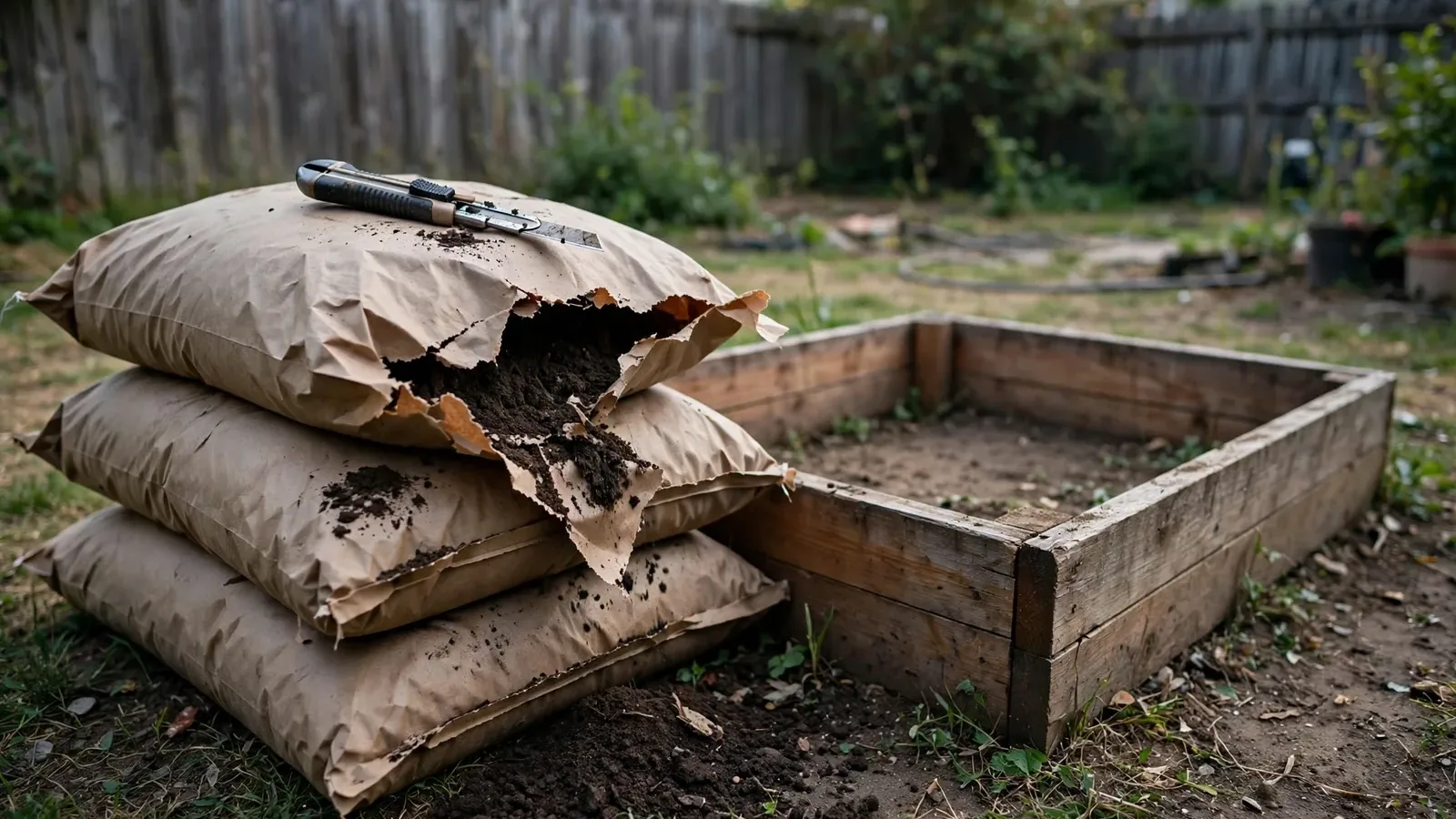
You’ve measured the bed, picked a depth, and done the volume math. Now comes the garden center aisle, where soil comes in 1, 1.5, and 2 cubic foot bags and nothing quite divides evenly. Here’s how to turn cubic feet into a shopping list — and why the number on your list and the number you actually need can differ by a bag or two.
New to raised beds? Start with our Raised Bed Gardening Hub — every soil guide in one place.
The One Formula You Need
Total cubic feet ÷ bag size = number of bags (round up)
That’s it. If your bed needs 32 cubic feet and you’re buying 2 cu ft bags: 32 ÷ 2 = 16 bags. If you’re buying 1.5 cu ft bags: 32 ÷ 1.5 = 21.3, which rounds up to 22.
The rounding-up part matters more than it looks. A bed filled to 97% looks like a mistake, and soil never goes to waste — the leftover half-bag tops up a container, fills a low spot in the lawn, or refreshes last year’s bed. Rounding up is always the right call.
If you haven’t computed your cubic feet yet, it’s length × width × depth in feet (depth in inches ÷ 12). Or skip the arithmetic: our Raised Bed Soil Calculator gives you the bag count for 0.75, 1, 1.5, and 2 cu ft bags in one go.
Common Bag Sizes
Walk into any garden center and you’ll mostly see three sizes:
- 1 cu ft bags — the small, manageable option. Easy to carry, easy to pour exactly where you want. You’ll need a lot of them for a big bed.
- 1.5 cu ft bags — the most common size at big-box stores. The default choice for most raised bed projects.
- 2 cu ft bags — the best value per cubic foot on the shelf, and the heaviest. A 2 cu ft bag of moist mix is the heaviest bag on the shelf. Plan your back accordingly — if lifting is a concern, the 1 and 1.5 cu ft bags are easier to handle.
Smaller bags (0.75 cu ft and under) exist too, mostly for specialty mixes and amendments rather than bulk filling. They’re handy for topping up, not for filling a 4×8 from scratch.
Bigger isn’t automatically cheaper per cubic foot, but it usually is — compare the shelf price divided by the bag volume before assuming. And factor in the hauling: sixteen 2-cu-ft bags is two car trips; thirty-two 1-cu-ft bags is four.
The Magic Number: 27
One conversion unlocks every bulk-vs-bag comparison you’ll ever do:
1 cubic yard = 27 cubic feet
So a cubic yard of soil equals:
- 27 bags of 1 cu ft
- 18 bags of 1.5 cu ft
- 14 bags of 2 cu ft (13.5, rounded up)
Memorize 27 and you can sanity-check anything. Bulk supplier quotes $X per yard? Divide by 27 for the per-cubic-foot price and compare it directly to the bag shelf price. A friend says their truck holds “about a yard”? That’s 18 standard bags’ worth — now you know whether one trip will do it.
This also helps you translate advice. When a guide says “order a yard of compost,” that means 27 cubic feet — enough to put a 1-inch top-dress on about 324 square feet of bed, or to fill a 4×8 bed about 10 inches deep.
Why Your Real Bag Count Might Differ
The formula gives you the theoretical number. Real beds have opinions. Here’s what moves the count:
Settling. Fresh fill usually settles noticeably in the first season as organic matter breaks down and everything compacts. A 5–10% buffer — one or two extra bags on a typical bed — covers it. This is the single most common reason for a “second trip.”
Freeboard. Most gardeners don’t fill to the very rim — an inch or two of headroom keeps soil from washing out when you water. If you plan 2 inches of freeboard on a 12-inch bed, you’re really buying 10 inches of soil. That’s 17% less than the full-depth number.
Compaction in the bag. Bagged soil is compressed. A 2 cu ft bag fluffs up to noticeably more than 2 cubic feet once you break it apart and spread it. The flip side: it then settles back down after watering. These roughly cancel out, but it’s why two gardeners can fill identical beds and use slightly different bag counts.
Partial fills and bottom layers. Logs, straw, leaves, or existing soil in the bottom of the bed all displace purchased mix. If the bottom third of your bed is branches, subtract a third from your bag count.
Bag size variance. Not every “1.5 cu ft” bag is exactly 1.5 cubic feet — manufacturing tolerances and settling in the bag mean real volumes wander a bit. Yet another reason to round up rather than down.
A Worked Example Start to Finish
Let’s do a complete run for the classic 4×8 bed at 12 inches deep:
1. Volume: 4 × 8 × 1 = 32 cubic feet
2. Settling buffer (10%): 32 × 1.1 = 35.2 cubic feet
3. Bag counts:
- 2 cu ft bags: 35.2 ÷ 2 = 17.6 → 18 bags
- 1.5 cu ft bags: 35.2 ÷ 1.5 = 23.5 → 24 bags
- 1 cu ft bags: 35.2 ÷ 1 = 35.2 → 36 bags
4. Sanity check: 35.2 cubic feet is about 1.3 cubic yards — plausible for a bed this size.
Without the buffer it’d be 16 / 22 / 32 bags. The buffer costs you two extra bags and saves you a return trip. Worth it.
Bags vs. Bulk, Briefly
Once your project passes about a cubic yard (27 cubic feet — roughly one deep 4×8 bed), price out bulk delivery. Bulk soil is almost always cheaper per cubic foot than bags, and one delivery beats a week of car trips. Below a yard, delivery fees usually erase the savings and bags win on convenience.
If you go bulk, the bag math still helps: knowing your project is “about 35 cubic feet” tells the supplier you need roughly a yard and a third, and it tells you whether their minimum order makes sense.
Frequently Asked Questions
How many bags of soil equal one cubic yard?
27 one-cu-ft bags, 18 of the 1.5-cu-ft bags, or 14 of the 2-cu-ft bags (rounded up).
Should I buy extra bags beyond the calculation?
Yes — 5–10% extra for settling. Leftover soil always gets used somewhere in a garden.
Do different brands’ bags hold the same amount?
Nominally, yes — a cubic foot is a cubic foot. In practice, fill levels vary a little between brands and even between bags. Buy the buffer and don’t stress about it.
Can I mix bag sizes?
Of course. Buy the big 2-cu-ft bags for the bulk of the fill and a couple of small bags for precise topping up. The formula works per bag size — just split your total cubic feet across them.
Don’t guess — calculate it. Enter your bed’s length, width, and depth in our free Raised Bed Soil Calculator for exact cubic feet, bag counts, and bulk cubic yards — with a settling buffer built in.